1001.10
Spherical Reference: Operationally speaking, the word omnidirectional involves a speaker who is observing from some viewing point. He says, “People and things are going every which way around me.” It seems chaotic to him at first, but on further consideration he finds the opposite to be true, that only inherent order is being manifest. First, we observe that we do not and cannot live and experience in either a one- dimensional linear world nor in a two-dimensional infinitely extended planar world.
1001.11
Omnidirectional means that a center of a movable sphere of observation has been established a priori by Universe for each individual life’s inescapably mobile viewpoint; like shadows, these move everywhere silently with people. These physical- existence-environment surrounds of life events spontaneously resolve into two classes:
- those events that are to pass tangentially by the observer; and
- those event entities other than self that are moving radially either toward or away from the observer.
1001.12
The tangentially passing energy events are always and only moving in lines that are at nearest moment perpendicular to the radii of the observer, which means that the multiplicity of his real events does not produce chaos: it produces discretely apprehendable experience increments, all of which can be chartingly identified by angle and frequency data therewith to permit predictable reinterpositioning events and environmental transformations .
1001.13
The observer’s unfamiliarity with the phenomena he is observing, the multiplicity of items of interaction and their velocity of transformations, and their omniengulfing occurrences tend to dismay the observer’s hope of immediate or reasonable comprehension. Therefore, observers are often induced to discontinue their attempts at technical comprehension of their experience, in a surrender of the drive to comprehend. This fills the potential comprehension void of the observer with a sense of chaos, which sensation he then subconsciously converts into a false rationale by explaining to himself that the environment is inherently chaotic, ergo, inherently incomprehensible. Thus he satisfies himself that he is being super-reasonably “realistic” and that Universe is just annoyingly disorderly—ergo, frequently dismissible—which seemingly warrants his invention of whatever kind of make-believe Universe seems momentarily most satisfying to him.
1001.14
The more humanity probes and verifies experimentally by reducing its theories to demonstrable practice in order to learn whether or not the theories are valid, the more clearly does Universe reveal itself as being generated and regenerated only upon a complex of entirely orderly relationships. The inherent spherical center viewpoint with which each individual is endowed generates its own orderly radii of observation in a closed finite system of event observations that are subject to orderly angular subdividing, recording, and interrelating in spherical trigonometric computational relationship to the observer’s inherently orderly sphere of reference.
1001.15
The expression “frame” of reference is not only “square” as imputed by the two-dimensional language of youth, but also by its exclusive three-dimensional axes of reference. Such XYZ coordinates impose inept, exclusively rectilinear definings, which are uncharacteristic of the omniwavilinear orbiting Universe reality. Science has not found any continuous surfaces, solids, straight lines, or infinitely extensible, nonclosed-system planes. The only infinity humanity has discovered experimentally is that of the whole-fraction subdivisibility of wholes into parts, as for instance by the progressive halvings that divide the finitely closed circle into ever smaller, central-angle-expressed, arc increments. The spherical dimensions of tangent and angle frequencied intervals can always be searchlighted “right on” all actual event tracery.
1001.16
Because spherical trigonometry sounded so formidable, it was omitted from primary education. Humans preferred to rationalize their observed experience exclusively in terms of nonexistent straight lines and planes, and thus they evolved illogical linear and square models of Universe such as the four corners of the wide, wide world with its nonexistent fixed up and down coordinates. Employment of the “square” XYZ coordinate frame of mensural reference in all present scientific exploration is similar to going to Washington from Boston only via Chicago because that pattern conformed to the scientists’ only right-angled-expressibility of relationships. Of course, if you know calculus, you could evolve a curve plotted on the XYZ gridding which may shorten your course; but if you don’t know calculus, you have to go via Chicago.
1001.20 Field of Geodesic Event Relationships
1001.21
Since the myriads of eccentricities of cyclic periodicities of omni- everywhere-and-everywhen complex intermotions of intertransforming Universe inherently defy any “fixed” overall frame of cosmic motion referencing; and since the omnicosmic presence of mass-attractive and tensionally operative gravity means that no so-called straight line can be generated by any one body, as all bodies are affected by other bodies in varying degrees; and since all bodies are in motion either independently or in company with other bodies and are axially rotating on precessionally skewed axes as they elliptically orbit their dominant bodies (or dominant collection of bodies); wherefore, any point on any body progressively describes only an overall pattern in Universe of a cyclic, curlicue, wavilinear, elliptically-orbiting-within-elliptically-orbiting of larger systems.
1001.22
Within the total cosmic complexity the directions taken by each and all of the moving bodies are always the paths of least resistance. Because the paths are those of least resistance, all events of all transforming and traveling entities require the least energy to accomplish their complex action programmed passages—ergo, their accomplished curvilinear courses are always the most economical lines of travel. These most economical routes of travel are known as geodesic lines. Geodesics are not only nature’s most economical lines of interrelationship travel, but ipso facto they are also nature’s shortest- time-of-travel lines.
1001.23
When using string to secure the cover on a cubical box whose edges are two feet long, people spontaneously surround the box in a direction perpendicular to the cube’s edges and, having run the string completely around the cubical box in one direction, they do so again in a plane at right angle to the first wind-around. This takes 16 feet of string and a pair of mid-top and mid-bottoms knots to securely bind-in all six faces of the cube. However, all six faces can be surrounded and the cover held secure almost twice as economically by using only one string eight-and-one-half-feet long and following the geodesic line that winds around the corners of the cube from midedge to adjacent mid- edge to produce an equiedged hexagon whose length of line-of-string-reach-around is the shortest distance around all six faces of a cube, wherefore the string cannot slide off the cube. To make this most economical path dynamically evident, hold a cube between the index fingers of your left and right hands with the left index finger pressed against one top corner of the cube and your right index finger pressed against the corner of the bottom of the cube most diagonally opposite the first corner pressed. Now, holding the box firmly between the two index fingers and stretching your arms in front of you with your fingers at the same level above the floor, ask someone to spin the box around the axis between your two fingers; as they do so, you will see the top and bottom profile of the spinning box and its six free corners rotating in two pairs of three each to produce two hills in the top and bottom profiles of the revolving box with a valley between them running around the box’s equator of spinning. Along the bottom-most valley runs the hexagonally wound eight-and-one-half-feet-long string in its geodesic valley of least distance around all six faces.
1001.24
When a man shoots a bird in flight, he aims at a point where he thinks the bird will be by the time the bullet can travel that far; he must also allow for gravitational pull Earthward and cross-wind deflection of the bullet’s always-consequently-corkscrew line of travel. The corkscrew line of successful travel between gun and bird is the most energy-economical trajectory. It is a geodesic line. If the man chooses the seemingly straight, “shortest” line between himself and the bird at the time he is aiming—which is the way he was taught by geometry in school—he will miss the bird.
1001.25
The misconception of a “straight” line and its popular adoption into humanity’s education system as constituting the “shortest distance between two points” takes no consideration of what the invisible, dynamic, atomically structured system may be which provides the only superficially flat paper-and-lead-pencil-pattern of interrelationship graphing of the line running between the two points considered. Nor does the straight-line shortest-distance assumption consider what a “point” is and where it begins and ends— ergo, it cannot determine where and when its dimensionless points have been reached, and it cannot determine what the exact length of that shortest distance between “points” may be.
1001.26
Such self-deceiving misinterpretations of experiences have been introduced by education into human sensing and traditional reasoning only because of humanity’s microstature and microlongevity in respect to the terrestrial environment and geological time. Individual humans have also been overwhelmed by the momentum of tradition, the persuasions of “common sense,” and a general fear of questioning long-established and ultimately power-backed authority and tradition. Thus has innocent humanity been misinformed or underinformed by the spoken-word-relayed inventory of only popularly explained, naked-eye impressions of local environment experiences as they have occurred throughout millions of years prior to humanity’s discovery and development of instrumentally accommodated, macroscoped and microscoped exploration of our comprehensive environment. The experientially obtained, macro-micro, instrumentally measured data found no evidence of the existence of dimensionless “points,” “lines,” and “planes,” nor of dimensioned “solids,” nor of any “thing,” nor of any noun-designatable, thing-substantiated, static entities. The experiments of human scientists have disclosed only verb-describable events—four-dimensionally coordinate behaviors of complexedly and ceaselessly intertransforming events, wavilinear event trajectories, interferences, and resonant event fields.
1002.10 Omnidirectional Nucleus
1002.11
Omnidirectional invokes a nucleus. Omnidirectional consideration as generalized conceptual pattern integrity requires an inherently regenerative nucleus of conceptual observation reference. Because of omni-closest-packing of 12 spheres triangularly surrounding one, inwardly-outwardly precessed pulsations cannot distribute energy further inwardly than the nuclear sphere’s prime volume, ergo nucleus-free, and only geometrically approximatable center of volume; whereafter it can only be distributed outwardly.
1002.12
With 12 omnidirectional, equally-most-economical, alternative-move options accommodating each event, each multiplied in optional diversity by myriads of alternate frequencies-of-occurrence rates, it is inherent to the “game” of Universe that complex redistribution of event identities swiftly ensues, as with a vast omnidirectionally observed kaleidoscope in ever-accelerating acceleration of pulsatively intertransformed pattern continuities.
1002.13
Because there are spaces between closest-packed spheres, energy can be imported syntropically all the way inward to the prime nuclear domain, which thereafter can only be articulated outwardly—ergo, as entropy. The omnidirectional grid of the isotropic vector matrix, whose vertexes always coincide with the sphere centers of all closest-sphere packings, always provides the new spherical reference system that spontaneously accommodates the observer’s omnirational accounting of all Universe relations by providing an omnidirectionally observing observer’s nuclear-sphere viewpoint; and all the other relevantly-to-be-identified nuclear (star) sphere centers all inherently interpositioned in omnispherical, uniradius, isotropic matrix array with omnivectorially accommodated, omnidirectionally permitted intertransformability, apprehendibility, and discrete vectorially quantated and angularly identified comprehensibility of all intertransformative transactions.
1003.10 Isotropic-Vector-Matrix Reference
1003.11
Isotropic means everywhere the same, which also means omnidirectionally the same. The isotropic vector matrix provides the actual and only systematic scheme of reference that agrees with all the experimentally disclosed behaviors of nature, while also disclosing only whole-number increments of nature’s and individual’s special-case objectifications of the often only subjectively apprehended information regarding the generalized principles being employed by nature. All the isotropic-vector-matrix identifications of experience are expressible in terms of angle and frequency. The angles are independent of size and absolutely generalized. The frequencies are all special-case, time-space-limited specifics and identify relative sizes and magnitudes of eternally conceptual generalizations.
1004.10 An Omnisynergetic Coordinate System
1004.11
The omnirational, omnidirectional, comprehensive coordinate system of Universe is omnisynergetic. The name synergetic refers specifically to the cosmically rational, most omnieconomic coordinate system with which nature interaccommodates the whole family of eternal generalized principles that are forever omni-interaccommodatively operative. This coordinate system is ever regenerative in respect to the nuclear centers, all of which are rationally accounted for by synergetics.
1005.10 Inventory of Omnidirectional Intersystem Precessional Effects
1005.11
Precession has been thought of only as an angularly reoriented, single-plane resultant of orbiting forces, as expounded, for instance, in the author’s 1940 article on the gyroscope (see footnote at Sec. 1009.60 ). Sun’s planets are precessed to orbit in a plane generated at 90 degrees to the axis of its poles. In synergetics, we discover omnidirectional precession as in tensegrity geodesic spheres. When we push inwardly on any two diametrically opposite points of a tensegrity geodesic sphere, the whole sphere contracts symmetrically; when we pull outwardly from one another on any two diametrically opposite and islanded compression members of a geodesic tensegrity sphere, the whole sphere is precessionally and symmetrically expanded. Precession is not an exclusively single-plane, 90-degree reorientation, for it also operates omnidirectionally, as do all electromagnetic wave phenomena, which can, however, be reflectively concentrated and unidirectionally beamed. The fact that waves can be reflectively and refractively focused does not alter the fact that they are inherently omnidirectional.
1005.12
While all great circles of a sphere always cross each other twice, any two such orbits precess one another into 90-degree-polar crossings, while three-way great- circling interprecesses to equiangularly intertriangulate and thus interstabilize each other.
1005.13
Today, society is preoccupied with exclusively linear information inputs.
1005.14
Pushing on one individual pole of a tensegrity geodesic sphere is the same as pushing on two poles, because you only have to push at one point for the inertia of the system to react against your pushing. This point produces a spherical wave set that if uninterfered with, will travel encirclingly around the sphere from any one starting point to its 180-degree antipodes. It is like dropping a pebble into the water: the crest is the expanded phase of Universe, and the trough is the contracted phase of Universe. Looking at the ripples, we see that they are the locally initiated expanding-contracting of whole Universe as a consequence of local energy-event inputs. This is why tensegrity and pneumatic balls bounce. Contracting as they contact, their equally violent expansion impels them away from the—relative to them—inert body of contact.
1005.15
Fig. 1005.15 Omnidirectional Intersystem Precessional Effects - Volume and Area Progressions
Omnidirectional Intersystem Precessional Effects: Volume and Area Progressions:
Link to original
A. Progression of concentric circles with area difference equal to area of central circle.
B. Progression of concentric spheres with volume difference equal to volume of central sphere.
C. Doubling areas of progressive concentric circles.
D. Doubling volumes of progressive concentric spheres.
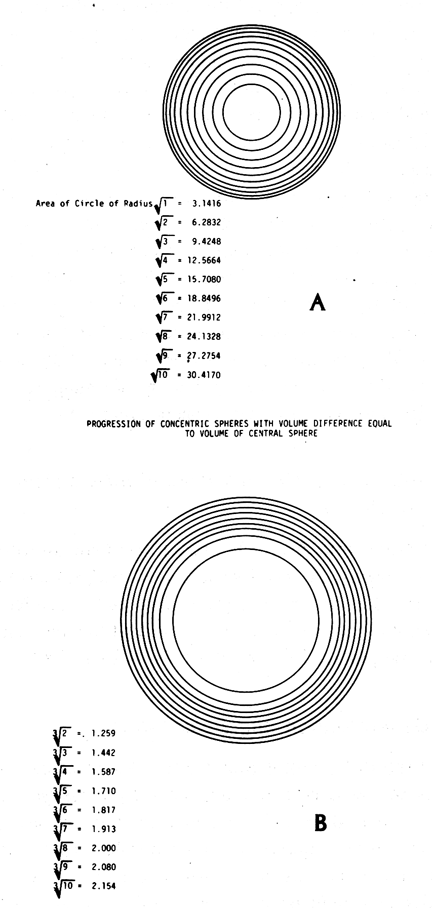
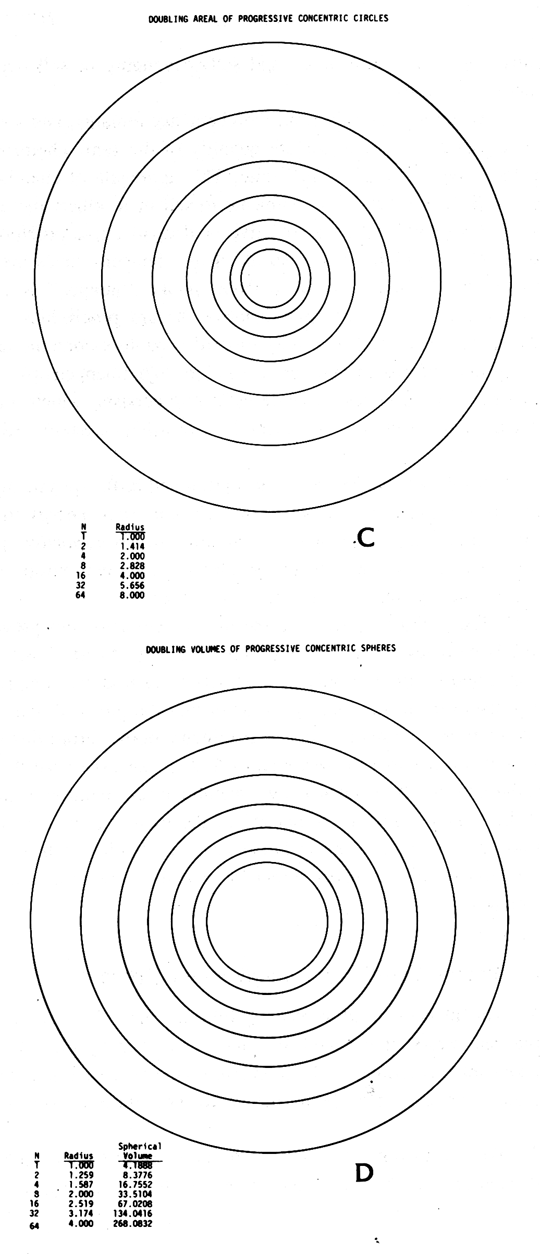
Volume and Area Progressions: Omnidirectional precession involves both volumetric progressions and areal progressions that are interaccommodative as radial (volumetric) precessions and circumferential (surface) precessions resulting per given unit of energy input into the system. The ratios of these concentric progressions are illustrated at Figs. 1005.15A-D.
1005.20
Biospherical Patterns: Here we see the interplay of all the biological systems wherein all the “life”-accommodating organisms of Earth’s biosphere are exclusively regenerated by energy sent to Earth by radio from the energy-broadcasting stars, but most importantly from the star Sun, by which design-science system the terrestrial vegetation and algae are the only energy radio-receiving sets.
1005.21
You and I and all the other mammals cannot by sunbathing convert Sun’s energy to direct life support. In the initial energy impoundment of the powerful Sun- energy radiation’s exposure of its leaves and photosynthesis, the vegetation would be swiftly dehydrated were it not watercooled. This is accomplished by the vegetation putting its roots into the ground and drawing the water by osmosis from the ground and throughout its whole system, finally to atomize it and send it into the atmosphere again to rain down upon the land and become available once more at the roots.
1005.22
Because the rooted vegetation cannot get from one place to another to procreate, all the insects, birds, and other creatures are given drives to cross-circulate amongst the vegetation; for instance, as the bee goes after honey, it inadvertently cross- pollinates and interfertilizes the vegetation. And all the mammals take on all the gases given off by the vegetation and convert them back to the gases essential for the vegetation. All this complex recirculatory system combined with, and utterly dependent upon, all the waters, rocks, soils, air, winds, Sun’s radiation, and Earth’s gravitational pull are what we have come to call ecology.
1005.23
As specialists, we have thought of all these design programmings only separately as “species” and as independent linear drives, some pleasing and to be cultivated, and some displeasing and to be disposed of by humans. But the results are multiorbitally regenerative and embrace the whole planet, as the wind blows the seeds and insects completely around Earth.
1005.24
Seen in their sky-returning functioning as recirculators of water, the ecological patterning of the trees is very much like a slow-motion tornado: an evoluting- involuting pattern fountaining into the sky, while the roots reverse-fountain reaching outwardly, downwardly, and inwardly into the Earth again once more to recirculate and once more again—like the pattern of atomic bombs or electromagnetic lines of force. The magnetic fields relate to this polarization as visually witnessed in the Aurora Borealis. (Illus. 505.41)
1005.30
Poisson Effect: Pulling on a rope makes it precess by taut contracting at 90 degrees to the line of pulling, thus going into transverse compression. That’s all the Poisson Effect is—a 90-degree resultant rather than a 180-degree resultant; and it’s all precession, whether operative hydraulically, pneumatically, crystallographically, or electromagnetically.
1005.31
The intereffect of Sun and planets is precessional. The intereffect of the atom and the electrons is precessional. They can both be complex and elliptical because of the variability in the masses of the satellites or within the nuclear mass. Planar ellipses have two foci, but “to comprehend what goes on in general” we have to amplify the twofold planar elliptical restraints’ behavior of precession into the more generalized four- dimensional functions of radiation and gravitation.
1005.32
All observability is inherently nuclear because the observer is a nucleus. From nucleus to circle to sphere, they all have radii and become omniintertriangulated polyhedrally arrayed, interprecessing event “stars.”
1005.40
Genetic Intercomplexity: DNA-RNA genetics programming is precessionally helical with only a net axial linear resultant. The atoms and molecules are all always polarized, and their total interprecessional effects often produce overall linear resultants such as the stem of a plant. All the genetic drives of all the creatures on our Earth all interact through chemistry, which, as with DNA-RNA, is linearly programmable as a code, all of which is characterized by sequence and intervals that altogether are realized at various morphologically symmetrical and closely intercomplementary levels of close proximity intercomplexity. On the scale of complexity of ecology, for instance, we observe spherically orbiting relay systems of local discontinuities as one takes the pattern of regenerativity from the other to produce an omniembracing, symmetrically interfunctioning, synergetic order. The basic nuclear symmetries and intertransformabilities of synergetics omniaccommodates the omnidirectional, omnifrequencied, precessional integrity.
1005.50
Truth and Love: Linear and Embracing: Metaphysically speaking, systems are conceptually independent of size. Their special-case realizations are expressible mathematically in linear equations, although they are only realizable physically as functions of comprehensive-integrity, interprecessionally complex systems. And the tetrahedron remains as the minimum spheric-experience system.
1005.51
The very word comprehending is omni-interprecessionally synergetic.
1005.52
The eternal is omniembracing and permeative; and the temporal is linear. This opens up a very high order of generalizations of generalizations. The truth could not be more omni-important, although it is often manifestly operative only as a linear identification of a special-case experience on a specialized subject. Verities are semi- special-case. The metaphor is linear. (See Secs. 217.03 and 529.07.)
1005.53
And all the categories of creatures act individually as special-case and may be linearly analyzed; retrospectively, it is discoverable that inadvertently they are all interaffecting one another synergetically as a spherical, interprecessionally regenerative, tensegrity spherical integrity. Geodesic spheres demonstrate the compressionally discontinuous—tensionally continuous integrity. Ecology is tensegrity geodesic spherical programming.
1005.54
Truth is cosmically total: synergetic. Verities are generalized principles stated in semimetaphorical terms. Verities are differentiable. But love is omniembracing, omnicoherent, and omni-inclusive, with no exceptions. Love, like synergetics, is nondifferentiable, i.e., is integral. Differential means locally-discontinuously linear. Integration means omnispherical. And the intereffects are precessional.
1005.55
The dictionary-label, special cases seem to go racing by because we are now having in a brief lifetime experiences that took aeons to be differentially recognized in the past.
1005.56
The highest of generalizations is the synergetic integration of truth and love.
1005.60
Generalization and Polarization: In cosmic structuring, the general case is tensegrity: three-way great-circling of islands of compression. Polarized precession is special-case. Omnidirectional precession is generalized.
1005.61
It is notable that the hard sciences and mathematics have discovered ever- experimentally-reverifiable generalizations. But the social scientists and the behaviorists have not yet discovered any anywhere-and-everywhere, experimentally-reverifiable generalizations. Only economics can be regarded as other than special-case: that of the utterly uninhibited viewpoint of the individual. Nature’s own simplest instructional trick in its economic programming is to give us something we call “hunger” so that we will eat, take in regenerative energy. Arbitrarily contrived “scarcity” is the only kind of behavioral valving that the economists understand. There is no other way the economists know how to cope. Selfishness is a drive so that we’ll be sure to regenerate. It has nothing to do with morals. These are organic chemical compounds at work. Stones do not have hunger.
1005.611
Metabolic Generalizations: Within economics we may be able to demonstrate the existence of a metabolic process generalization which is akin to, if not indeed implicitly inherent in, a composite of Boltzman’s, Einstein’s, and others’ concept of a cosmically regenerative omniintercomplementation of a diversity of energetic export- import centers whose local cosmic episodes nonsimultaneously ebb and flow to accommodate the entropically and syntropically, omnidiversally, omniregenerative intertransformings of the nonsimultaneous intercomplementations of nonunitarily conceptual but finite Scenario Universe. How can economics demonstrate a generalization from the utterly uninhibited viewpoint of the individual human? It is said that stones do not have hunger. But stones are hygroscopic and do successively import and export both water and energy as heat or radiation. New stones progressively aggregate and disintegrate. We may say stones have both syntropically importing “appetites” and self- scavenging or self-purging entropic export proclivities.
1005.612
When a person dies, all the chemistry remains, and we see that the human organism’s same aggregate quantity of the same chemistries persists from the “live” to the “dead” state. This aggregate of chemistries has no metaphysical interpreter to communicate to self or to others the aggregate of chemical rates of interacting associative or disassociative proclivities, the integrated effects of which humans speak of as “hunger” or as the need to “go to the toilet.” Though the associative intake “hunger” is unspoken metaphysically after death, the disassociative discard proclivities speak for themselves as these chemical-proclivity discard behaviors continue and reach self-balancing rates of progressive disassociation. What happens physically at death is that the importing ceases while exporting persists, which produces a locally unbalanced—thereafter exclusively exporting—system. (See Sec. 1052.59.)
1005.613
It follows that between conception and birth—physically speaking—“life” is a progression of predominantly importive energy-importing-and-exporting transactions, gradually switching to an exportive predominance—ergo, life is a synthesis of the absolutely exportive entropy of radiation and the absolutely importive syntropy of gravity.
1005.614
The political, religious, and judicial controversies prevailing in the late 1970s with regard to abortion and “the right to life” will all ultimately be resolved by the multiplying elucidation for popular comprehension of science’s discovery at the virological level that the physical and chemical organism of humans consists entirely of inanimate atoms. From this virological discovery it follows that the individual life does not exist until the umbilical cord is cut and the child starts its own metabolic regeneration; prior to that the life in the womb is merely composed of the mother organism, as is the case with any one individual egg in her ovary. Life begins with individually self-startered and sustained energy importing and dies when that independent importing ceases.
1005.62
Because man is so tiny and Earth is so great, we only can see gravity operating in the perpendicular. We think of ourselves as individuals with gravity pulling us Earthward individually in perpendiculars parallel to one another. But we know that in actuality, radii converge. We do not realize that you and I are convergently interattracted because gravity is so big. The interattraction is there, but it seems so minor we dismiss it as something we call “aesthetics” or a “love affair.” Gravity seems so vertical.
1005.63
Initial comprehension is holistic. The second stage is detailing differentiation. In the next stage the edges of the tetrahedron converge like petals through the vector- equilibrium stage. The transition stage of the icosahedron alone permits individuality in progression to the omni-intertriangulated spherical phase.
1006.10 Omnitopology Defined
1006.11
Omnitopology is accessory to the conceptual aspects of Euler’s superficial topology in that it extends its concerns to the angular relationships as well as to the topological domains of nonnuclear, closest-packed spherical arrays and to the domains of the nonnuclear-containing polyhedra thus formed. Omnitopology is concerned, for instance, with the individually unself-identifying concave octahedra and concave vector- equilibria volumetric space domains betweeningly defined within the closest-packed sphere complexes, as well as with the individually self-identifying convex octahedra and convex vector equilibria, which latter are spontaneously singled out by the observer’s optical comprehensibility as the finite integrities and entities of the locally and individual- spherically closed systems that divide all Universe into all the macrocosmic outsideness and all the microcosmic insideness of the observably closed, finite, local systems—in contradistinction to the indefinability of the omnidirectional space nothingness frequently confronting the observer.
1006.12
The closest-packed symmetry of uniradius spheres is the mathematical limit case that inadvertently “captures” all the previously unidentifiable otherness of Universe whose inscrutability we call “space.” The closest-packed symmetry of uniradius spheres permits the symmetrically discrete differentiation into the individually isolated domains as sensorially comprehensible concave octahedra and concave vector equilibria, which exactly and complementingly intersperse eternally the convex “individualizable phase” of comprehensibility as closest-packed spheres and their exact, individually proportioned, concave-in-betweenness domains as both closest packed around a nuclear uniradius sphere or as closest packed around a nucleus-free prime volume domain. (See illustrations 1032.30 and 1032.31.)
1006.13
Systems are individually conceptual polyhedral integrities. Human awareness’s concession of “space” acknowledges a nonconceptually defined experience. The omniorderly integrity of omnidirectionally and infinitely extensible, fundamentally coordinating, closest packing of uniradius spheres and their ever coordinately uniform radial expandibility accommodates seemingly remote spherical nucleations that expand radially into omniintertangency. Omni-intertangency evidences closest sphere packing and its inherent isotropic vector matrix, which clearly and finitely defines the omnirational volumetric ratios of the only concave octahedra and concave vector equilibria discretely domaining all the in-betweenness of closest-packed-sphere interspace. The closest-packed- sphere interspace had been inscrutable a priori to the limit phase of omni-intertangencies; this limit phase is, was, and always will be omnipotential of experimental verification of the orderly integrity of omni-intercomplementarity of the space-time, special-case, local conceptualizing and the momentarily unconsidered, seeming nothingness of all otherness.
1006.14
Human awareness is conceptually initiated by special-case otherness observability. Humans conceptualize, i.e., image-ize or image-in, i.e., bring-in, i.e., capture conceptually, i.e., in-dividualize, i.e., systemize by differentiating local integrities from out of the total, nonunitarily conceptualizable integrity of generalized Universe.
1006.20
Omnitopological Domains: In omnitopology, spheres represent the omnidirectional domains of points, whereas Eulerian topology differentiates and is concerned exclusively with the numerical equatability of only optically apprehended inventories of superficial vertexes, faces, and lines of whole polyhedra or of their local superficial subfacetings: (V + F = L + 2) when comprehensive; (V + F = L + 1) when local.
1006.21
In omnitopology, the domains of volumes are the volumes topologically described. In omnitopology, the domain of an external face is the volume defined by that external face and the center of volume of the system.
1006.22
All surface areas may be subdivided into triangles. All domains of external facets of omnitopological systems may be reduced to tetrahedra. The respective domains of each of the external triangles of a system are those tetrahedra formed by the most economical lines interconnecting their external apexes with the center of volume of the system.
1006.23
In omnitopology, each of the lines and vertexes of polyhedrally defined conceptual systems have their respective unique areal domains and volumetric domains. (See Sec. 536.)
1006.24
The respective volumetric domains of a system’s vertexes are embracingly defined by the facets of the unique polyhedra totally subdividing the system as formed by the set of planes interconnecting the center of volume of the system and each of the centers, respectively, of all those surface areas of the system immediately surrounding the vertex considered.
1006.25
The exclusively surface domains of a system’s vertexes are uniquely defined by the closed perimeter of surface lines occurring as the intersection of the internal planes of the system which define the volumetric domains of the system’s respective vertexes with the system’s surface.
1006.26
The respective areal domains of external polyhedral lines are defined as all the area on either surface side of the lines lying within perimeters formed by most economically interconnecting the centers of area of the polyhedron’s facets and the ends of all the lines dividing those facets from one another. Surface domains of external lines of polyhedra are inherently four-sided.
1006.27
The respective volumetric domains of all the lines—internal or external of all polyhedra are defined by the most economical interconnectings of all adjacent centers of volume and centers of area with both ends of all their respectively adjacent lines.
1006.30 Vector Equilibrium Involvement Domain
1006.31
The unfrequenced vector equilibrium has 12 external vertexes and one internal vertex of the nuclear sphere embraced by the 12 uniradius closest-packed spheres around it; the omniinterconnecting vectors between the 12-around-one spheric centers define the vector equilibrium involvement domain.
1006.32
Fig. 1006.32 Duo-Tet Star Polyhedron Defines Vector Equilibrium Involvement Domain
Duo-Tet Star Polyhedron Defines Vector Equilibrium Involvement Domain: The Duo-Tet star polyhedron that first appears in Fig. 987.242A is shown here within a vector equilibrium net. The complex also illustrates the eight Eighth-Octa that must be added to the eight triangular faces of the vector equilibrium to form the nucleated cube__the total complex of which functions as the vector equilibrium nuclear involvement domain. A closest-sphere-packing evolution of this same transformation (adding eight Eighth-Octa to the VE’s six triangular faces) appears at Fig. 415.17
Link to original
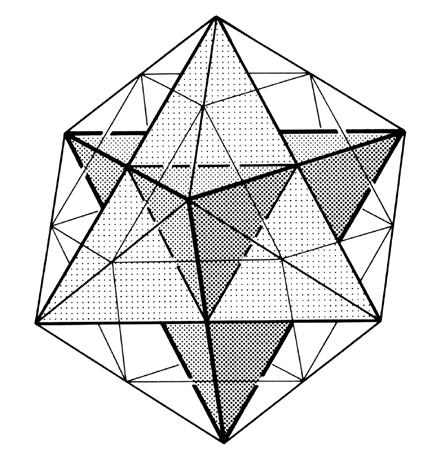
We learn from the complex jitterbugging of the VE and octahedra that as each sphere of closest-packed spheres becomes a space and each space becomes a sphere, each intertransformative component requires a tetravolume-12 “cubical” space, while both require 24 tetravolumes. The total internal-external closest-packed-spheres-and-their- interstitial-spaces involvement domains of the unfrequenced 20-tetravolume VE is tetravolume-24. This equals either eight of the nuclear cube’s (unstable) tetravolume-3 or two of the rhombic dodecahedron’s (stable) tetravolume-6. The two tetravolume-12 cubes or four tetravolume-6 dodecahedra are intertransformable aspects of the nuclear VE’s local-involvement domain. (See Fig. 1006.32.)
1006.33
The vector equilibrium at initial frequency, which is frequency², manifests the fifth-powering of nature’s energy behaviors. Frequency begins at two. The vector equilibrium of frequency² has a prefrequency inherent tetravolume of 160 (5 × 2⁵ = 160) and a quanta-module volume of 120 × 24 = 1 × 3 × 5 × 2⁸ nuclear-centered system as the integrated product of the first four prime numbers: 1, 2, 3, 5. Whereas a cube at the same frequency accommodates only eight cubes around a nonnucleated center. (Compare Sec. 1033.632)
1006.34
For the first moment in history synergetics is providing operational comprehensibility of the fourth-and-fifth-dimensional-coordinated, most economical behaviors of physical Universe as well as of their intellectual, metaphysical conceptuality. We have arrived at a new phase of comprehension in discovering that all of the physical cases experimentally demonstrable are only special cases of the generalized principles of the subfrequency, subtime, and subsize patterning integrity of the nucleus-containing, closest-packed isotropic vector matrix system.
1006.35 With reference to our operational definition of a sphere (Sec. 224.07), we find that in an aggregation of closest-packed uniradius spheres:
Tetravolume 1 = minimum F⁰ F⁰ tetrasphere
Tetravolume 5 = maximum Fʰ Fʰ sphere (h = high frequency geodesic icosasphere, Sec. 985.01)
Tetravolume 6 = maximum Fʰ Fʰ sphere (high-frequency icosa plus the intersphere volumetric involvement domain of each closest- packed uniradius sphere = rhombic dodecahedron)
1006.36
In respect to each uniradius, omni-closest-packed spherical domain of 6:
| Maximum Icosa Sphere Fʰ | = 5 plus tetra quanta inside = 1 minus tetra quantum outside | integrating as +4 |
| Tetra Sphere F⁰ | = 1 plus tetra quanta inside = 5 minus tetra quantum outside | integrating as −4 |
1006.37
For other manifestations of the vector equilibrium involvement domain, review Sections 415.17 (Nucleated Cube) and 1033 (Intertransformability Models and Limits), passim.
1006.40 Cosmic System Eight-dimensionality
1006.41
We have a cosmically closed system of eight-dimensionality: four dimensions of convergent, syntropic conservation → + 4, and four dimensions of divergent, entropic radiation → - 4 intertransformabilities, with the non-inside-outable, symmetric octahedron of tetravolume 4 and the polarized semiasymmetric Coupler of tetravolume 4 always conserved between the interpulsative 1 and the rhombic dodecahedron’s maximum- involvement 6, (i.e., 1 + 4 + 1); ergo, the always double-valued—22 — symmetrically perfect octahedron of tetravolume 4 and the polarized asymmetric Coupler of tetravolume 4 reside between the convergently and divergently pulsative extremes of both maximally aberrated and symmetrically perfect (equilibrious) phases of the generalized cosmic system’s always partially-tuned-in-and-tuned-out eight-dimensionality.
1007.10 Omnitopology Compared with Euler’s Topology
1007.11
While Euler discovered and developed topology and went on to develop the structural analysis now employed by engineers, he did not integrate in full potential his structural concepts with his topological concepts. This is not surprising as his contributions were as multitudinous as they were magnificent, and each human’s work must terminate. As we find more of Euler’s fields staked out but as yet unworked, we are ever increasingly inspired by his genius.
1007.12
In the topological past, we have been considering domains only as surface areas and not as uniquely contained volumes. Speaking in strict concern for always omnidirectionally conformed experience, however, we come upon the primacy of topological domains of systems. Apparently, this significance was not considered by Euler. Euler treated with the surface aspects of forms rather than with their structural integrities, which would have required his triangular subdividing of all polygonal facets other than triangles in order to qualify the polyhedra for generalized consideration as structurally eternal. Euler would have eventually discovered this had he brought to bear upon topology the same structural prescience with which he apprehended and isolated the generalized principles governing structural analysis of all symmetric and asymmetric structural components.
1007.13
Euler did not treat with the inherent and noninherent nuclear system concept, nor did he treat with total-system angle inventory equating, either on the surfaces or internally, which latter have provided powerful insights for further scientific exploration by synergetical analysis. These are some of the differences between synergetics and Euler’s generalizations.
1007.14
Euler did formulate the precepts of structural analysis for engineering and the concept of neutral axes and their relation to axial rotation. He failed, however, to identify the structural axes of his engineering formulations with the “excess twoness” of his generalized identification of the inventory of visual aspects of all experience as the polyhedral vertex, face, and line equating: V + F = L + 2. Synergetics identifies the twoness of the poles of the axis of rotation of all systems and differentiates between polar and nonpolar vertexes. Euler’s work, however, provided many of the clues to synergetics’ exploration and discovery.
1007.15
In contradistinction to, and in complementation of, Eulerian topology, omnitopology deals with the generalized equatabilities of a priori generalized omnidirectional domains of vectorially articulated linear interrelationships, their vertexial interference loci, and consequent uniquely differentiated areal and volumetric domains, angles, frequencies, symmetries, asymmetries, polarizations, structural-pattern integrities, associative interbondabilities, intertransformabilities, and transformative-system limits, simplexes, complexes, nucleations, exportabilities, and omni-interaccommodations. (See Sec. 905.16.)
1007.16
While the counting logic of topology has provided mathematicians with great historical expansion, it has altogether failed to elucidate the findings of physics in a conceptual manner. Many mathematicians were content to let topology descend to the level of a fascinating game—dealing with such Moebius-strip nonsense as pretending that strips of paper have no edges. The constancy of topological interrelationships—the formula of relative interabundance of vertexes, edges, and faces—was reliable and had a great potential for a conceptual mathematical strategy, but it was not identified operationally with the intertransformabilities and gaseous, liquid, and solid interbondings of chemistry and physics as described in Gibbs’ phase rule. Now, with the advent of vectorial geometry, the congruence of synergetic accounting and vectorial accounting may be brought into elegant agreement.
1007.20 Invalidity of Plane Geometry
1007.21
We are dealing with the Universe and the difference between conceptual thought (see Sec. 501.101) and nonunitarily conceptual Universe (see Scenario Universe, Sec. 320). We cannot make a model of the latter, but we can show it as a scenario of meaningfully overlapping conceptual frames.
1007.22
About 150 years ago Leonhard Euler opened up the great new field of mathematics that is topology. He discovered that all visual experiences could be treated as conceptual. (But he did not explain it in these words.) In topology, Euler says in effect, all visual experiences can be resolved into three unique and irreducible aspects:
- vertexes, faces, and edges (Secs. 223.04 and 1006.20) or, as unique dimensional abundances:
- points, areas, and lines (Sec. 527.11) or, as structural identifications:
- joints, windows, and struts (Sec. 986.053) or, as we say in synergetics topology:
- crossings, openings, and trajectories (Sec. 524.30) or the more generalized: events, nonevents, and traceries or more refined as:
- fixes, discontinuities, and continuities or in most refined synergetics: events, novents, and even interrelatabilities (Sec. 269.05).
1007.23
In topology, then, we have a unique aspect that we call a line, not a straight line but an event tracery. When two traceries cross one another, we get a fix, which is not to be confused in any way with a noncrossing. Fixes give geographical locations in respect to the system upon which the topological aspects appear. When we have a tracery or a plurality of traceries crossing back upon one another to close a circuit, we surroundingly frame a limited view of the omnidirectional novents. Traceries coming back upon themselves produce windowed views or areas of novents. The areas, the traces, and the fixes of crossings are never to be confused with one another: all visual experiences are resolved into these three conceptual aspects.
1007.24
Look at any picture, point your finger at any part of the picture, and ask yourself: Which aspect is that, and that, and that? That’s an area; or it’s a line; or it’s a crossing (a fix, a point). Crossings are loci. You may say, “That is too big to be a point”; if so, you make it into an area by truncating the corner that the point had represented. You will now have two more vertexes but one more area and three more lines than before. Euler’s equation will remain unviolated.
1007.25
A circle is a loop in the same line with no crossing and no additional vertexes, areas, or lines.
1007.26
Operationally speaking, a plane exists only as a facet of a polyhedral system. Because I am experiential I must say that a line is a consequence of energy: an event, a tracery upon what system? A polyhedron is an event system separated out of Universe. Systems have an inside and an outside. A picture in a frame has also the sides and the back of the frame, which is in the form of an asymmetrical polyhedron.
1007.27
In polyhedra the number of V’s (crossings) plus the number of F’s, areas (novents-faces) is always equal to the number of L’s lines (continuities) plus the number 2. If you put a hole through the system—as one cores an apple making a doughnut-shaped polyhedron—you find that V + F = L. Euler apparently did not realize that in putting the hole through it, he had removed the axis and its two poles. Having removed two axial terminal (or polar) points from the inventory of “fixes” (loci-vertexes) of the system, the V + F = L + 2 equation now reads V + F = L, because two V’s have been deducted from the inventory on the left side of the equation.
1007.28
Another very powerful mathematician was Brouwer. His theorem demonstrates that if a number of points on a plane are stirred around, it will be found after all the stirring that one of the points did not move relative to all the others. One point is always the center of the total movement of all the points. But the mathematicians oversimplified the planar concept. In synergetics the plane has to be the surface of a system that not only has insideness and outsideness but also has an obverse and re- exterior. Therefore, in view of Brouwer, there must also always be another point on the opposite side of the system stirring that also does not move. Every fluidly bestirred system has two opposed polar points that do not move. These two polar points identify the system’s neutral axis. (See Sec. 703.12.)
1007.29
Every system has a neutral axis with two polar points (vertexes-fixes). In synergetics topology these two polar points of every system become constants of topological inventorying. Every system has two polar vertexes that function as the spin axis of the system. In synergetics the two polar vertexes terminating the axis identify conceptually the abstract—supposedly nonconceptual—function of nuclear physics’ “spin” in quantum theory. The neutral axis of the equatorially rotating jitterbug VE proves Brouwer’s theorem polyhedrally.
1007.30
Fig. 1007.30 View of Tetrahedron from Above
There are four triangles: three surround the top vertex; the fourth is implicit in the base.
Link to original
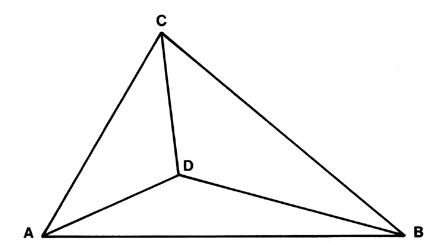
When you look at a tetrahedron from above, one of its vertexes looks like this: (See Fig. 1007.30)
You see only three triangles, but there is a fourth underneath that is implicit as the base of the tetrahedron, with the Central vertex D being the apex of the tetrahedron. The crossing point (vertex-fix) in the middle only superficially appears to be in the same plane as ABC. The outer edges of the three triangles you see, ACD, CDB, ADB, are congruent with the hidden base triangle, ABC. Euler assumed the three triangles ACD, CDB, ADB to be absolutely congruent with triangle ABC. Looking at it from the bird’s-eye view, unoperationally, Euler misassumed that there could be a nonexperienceable, no-thickness plane, though no such phenomenon can be experientially demonstrated. Putting three points on a piece of paper, interconnecting them, and saying that this “proves” that a no- thickness, nonexperiential planar triangle exists is operationally false. The paper has thickness; the points have thickness; the lines are atoms of lead strewn in linear piles upon the paper.
1007.31
You cannot have a something-nothingness, or a plane with no thickness. Any experimental event must have an insideness and an outsideness. Euler did not count on the fourth triangle: he thought he was dealing with a plane, and this is why he said that on a plane we have V + F = L + 1 . When Euler deals with polyhedra, he says “plus 2.” In dealing with the false plane he says “plus 1.” He left out “1” from the right-hand side of the polyhedral equation because he could only see three faces. Three points define a minimum polyhedral facet. The point where the triangles meet in the center is a polyhedral vertex; no matter how minimal the altitude of its apex may be, it can never be in the base plane. Planes as nondemonstrably defined by academic mathematicians have no insideness in which to get: ABCD is inherently a tetrahedron. Operationally the fourth point, D, is identified or fixed subsequent to the fixing of A, B, and C. The “laterness” of D involves a time lag within which the constant motion of all Universe will have so disturbed the atoms of paper on which A, B, and C had been fixed that no exquisite degree of measuring technique could demonstrate that A, B, C, and D are all in an exact, so-called flat-plane alignment demonstrating ABCD to be a zero-altitude, no-thickness-edged tetrahedron.
1008.10 Geodesic Spheres in Closest Packing
this and the following heading:
done
done
italicsNedits
1008.11
What we call spheres are always geodesics. While they may superficially appear to be spherical, they are always high-frequency geodesic embracements.
1008.12
In the closest packing of omnitriangulated geodesic spheres, the closest the spheres can come to each other is as triangular face-bonding, which is of course triple- bonded, or trivalent. In such cohering tangency, the closest-packed geodesic “spherical” polyhedra would constitute crystalline arrangements and would take up the least amount of space, because the midfaces are radially closer to the center of the sphere than are the midedges (midchords) of the omnifaceted “spheric” polyhedra, while the vertexes are at greatest radius.
1008.13
Taking up a little more room would be closest packing of geodesic spheres by edge-bonding, which is double-bonded, or bivalent. Bivalently tangential spherical polyhedra, being hinged edge-to-edge, may have characteristics similar to liquid or gelatinous aggregates.
1008.14
Single-bonded geodesic spherical polyhedra closest packed point-to-point are univalent. This point-to-point arrangement takes up the most space of all closest- packed spherical tangency agglomerates and may illustrate the behavior of gases.
1008.15
These nuances in closest-packing differentiations may explain many different unexpected and hitherto unexplained behaviors of Universe.
1009.00 Critical Proximity
1009.10
Interference: You Really Can’t Get There from Here: Omnitopology recognizes the experimentally demonstrable fact that two energy-event traceries (lines) cannot pass through the same point at the same time. It follows that no event vectors of Universe ever pass through any of the same points at the same time. Wherefore, it is also operationally evidenced that the conceptual-system geometries of omnitopology are defined only by the system withinness and withoutness differentiating a plurality of loci occurring approximately midway between the most intimate proximity moments of the respectively convergent-divergent wavilinear vectors, orbits, and spin equators of the system. (See Sec. 517, “Interference.“) The best you can do is to get almost there; this is evidenced by physical discontinuity. Zeno’s paradox thus loses its paradoxical aspects.
1009.11
In omnitopology, a vertex (point) is the only-approximate, amorphous, omnidirectional region occurring mid-spatially between the most intimate proximity of two almost-but-never-quite, yet critically intertransformatively, interfering vectors. (See Sec. 518.)
1009.20
Magnitude of Independent Orbiting: Most impressively illustrative of what this means is evidenced by the mass-attractively occasioned falling in toward Earth of all relatively small objects traveling around Sun at the same rate as Earth, Earth itself being only an aggregate of all the atoms that are cotravelers around Sun at the same velocity, while each atom’s nucleus is only one-ten-thousandth the diameter of its outer electron shell. There is as much space between the atom’s nucleus and its electron-orbit- produced shell as proportionately exists between Sun and its planet Pluto.
1009.21
The tendency to fall in to Earth or any other celestial body will be reduced as a cotraveling object increases its distance away from Earth or any other relatively large body as a consequence of its being given acceleration into orbital speed greater than Earth’s Sun-orbiting speed. In 99.9999999999 percent of Universe no body tends to fall in to any other; 99.999999 × 1030 of all known Universe bodies are independently orbiting.
1009.30
Symmetrical Conformation of Flying-Star Teams: We have terms such as “boundary layer” that have to be recognized in hard technology where we find that despite the accurate machining to fine tolerance of such things as steel bearings, there is always a dimensional aberration that is unaccounted for in man’s eyes but, when measured instrumentally in nuclear-diameter magnitudes, is as relatively great as that between the stars of the Milky Way. Men think superficially only of lubricants and mechanically-fitting- bearings tolerances whereas—focused at the proper magnitude of conceptuality—what goes on in the affairs of lubricants and bearings discloses discrete geometrical relationships where no event ever makes absolute contact with another. There are simply orbital interferences, where the mass attractions will always be just a little more powerful than the fundamental disintegrative tendencies.
1009.31
The relative frequency timing of orbits is such that as one complex energy event (a body) approaches critical proximity between any two other equal mass bodies to that of the intruder, the group mass interattraction fourfolds. We get to a condition where the approaching body is suspended between two others like landing on an invisible trampoline. Similarly, in manmade machinery as the teeth of gears enter into the matching gears’ valleys, the mass-attraction forces finally provide an invisible suspension field whereby none of the atoms ever touches another. (See Sec. 1052.21.)
1009.32
When metallic alloys are produced, we have such conditions, for instance, as four symmetrically orbiting stars producing a tetrahedral flying formation, each trying to orbit away from the other but inter-mass-attractively cohered. When this flying team of four stars in tetrahedral conformation joins together with a second team of four stars in tetrahedral conformation, they take position symmetrically with each member star of the two sets of four becoming congruent with the eight corners of a cube.
1009.33
Now each of the stars in the flying teams has nearer neighbors than it had before, and this mass interattractiveness is multiplied as the second power of relative proximity. Their initial acceleration of 186,000 miles per second keeps their orbits always intact. Each of the flying formations is made up of other flying teams of atoms with a central commander nucleus and a fleet of electrons buzzing around it at 186,000 miles per second; being interfrequenced, the four nucleated team members synchronously interact as the orbits of their electrons in closest proximity are intervally geared in second-power accelerations of intertenuousness, producing an omnicoordinate condition akin to the mid- gear-tooth trampoline (an invisible muscular field).
1009.34
Next, a six-member flying team (octahedron) heaves into critical proximity with the original two teams now flying a group formation in the form of the eight comer positions of the cube. The acceleration stability of each of the flying teams is such that they join with the new six-star team taking symmetrical positions in the middle of the six square faces of the eight-star-team cube. The mass interattraction of the 14 now becomes vastly greater, and the electron-orbit-gear-trampolines of each of the 14 nuclear-flow spherical ships are now in very much greater second-power increase of interattractiveness.
1009.35
This cubical flying team of 14 ships now sights another flying team of 12 ships, and the team of 14 and the team of 12 are flown into group formation with the 12 ships taking station at the midpoints of the 12 edges of the 14-star-team cube. Thus the mass attraction is ever more vastly increased, yet the integrity of their interpositioning and their non-falling-into-one-anotherness is guaranteed by the centrifugal forces of the orbiting superbly balanced by the second-power increase of the gravitational buildup already noted.
1009.36
Thus are planets cohered, and thus are metallic alloys on planets even more powerfully cohered—all within the rules of never-quite-touching; all within the rules of interval; all within the rules of no actual particulate “solids.” They may fly wavilinear patterns, but the atoms are found to be as discontinuous as the wavilinear sky trails of the jet airplane. While physics is as yet formally puzzling over the paradox of the wave and the particle, the apparent contradiction is occasioned only by the superficial misconception of a particle where none exists. We deal only with events in pure principle. The sense of physical, textural reality, of awareness itself, which uniquely identifies life and time (in contradistinction to eternal, weightless metaphysics), is inherent to the plurality of frequencies and degrees of freedom that in pure principle theoretically provide different interpositionings within given amounts of time. The plurality of principles, which themselves are interaccommodative, inherently generates awareness differentiability. The exquisite perfection of the total interaccommodation and the limited local set of the tunabilities of the terrestrial living organisms, such as the human instrument vehicle, are all permitted in the general complexity and permit local-focus, limited awareness as individual-seeming perceptivity. (See Sec. 973.30.)
1009.37
What I am saying is that we have only eternity and integrity. Unity is plural in pure principle. The awareness we speak of as life is inherently immortal and equieternal.
1009.40
Models and Divinity: Because of indeterminism, the exclusive tenuous nature of integrity—discontinuity—means that no exact hard particulate models may ever be fashioned by man. The conscientious and competent modelmaker undertaking to make a beautiful tetrahedron suddenly becomes aware that it is impossible to make a perfect corner at a point. There is always both a terminal and a radius and an askew convergence- divergence at noncontacting critical proximity. When he magnifies the edges which look sharp to the naked eye, he sees they are never sharp. The more powerful the magnification he brings to bear on his work, the more he becomes aware of the lumpy radii of the micropatterning of the stuff with which he works. Finally, the electron microscope tells him that the point of a needle is a pile of oranges and that the blade of the razor is a randomly dumped breakwater of spherical rubble. When further meticulously studied and magnified, this superficial seeming randomness proves to be our flying squadrons, earlier described, enjoying a vast number of intricately orderly team maneuvers but with never a pilot in sight. The whole is flown by remote control with fantastic feedback and local automation, all governed by an eternally complex integrity of complementary, interaccommodative principles.
1009.41
Little man on little planet Earth evoking words to describe his experiences, intuiting ever and anon the greater integrity, struggles to form a word to manifest his awareness of the greater integrity. His lips can express, his throat and lungs can produce, in the limited atmosphere of planet Earth, he may make a sound like g o d … which is obviously inadequate to identify his inherent attunement to eternal complex integrity. The little humans on little Earth, overwhelmed these millions of years with the power of the bigger over the lesser (muscles), have spontaneously identified the cosmic integrity with the local terrestrial experience. The conditioned-reflex feedbacks have introduced enormous confusion of approximate identification, fusing the local physical muscular authority with the eternal complex integrity, whose absolute generalizability can never be locked into or described as a special case.
1009.50
Acceleration: Physics does not speak of motion; it speaks of acceleration. And physics has identified only two kinds of acceleration, linear and angular. We are informed experientially that this is a misinterpretation of the data.
1009.51
There are indeed two kinds of acceleration, but they are both angular. All accelerations are angular and cyclically complete. There are no open endings in Universe. Physics has discovered only waves, no straight lines.
1009.52
The angular accelerations, however, manifest a vast variety of radii. The differentiation of physics into linear and angular occurred when the humans involved failed to realize that the diameter of the little circle is always a small arc of a vastly greater circle passing through it. The greater the radius, the slower the total cyclic realization. There are no straight lines or “linear infinities.” Realization of this is what Einstein spoke of as “curved space.” (See Sec. 522.21.)
1009.53
Einstein was up against trying to communicate with the mathematicians in terms of their adopted mathematical models, all of which were— and still are—straight- line, XYZ models on a linear frame and with linear coordinates going outward from the model to infinity. So “field” was always a little set of local perpendicular crossings of straight lines each outward bound to an infinity of infinities.
1009.54
All the experimentally harvested information says that the “field” must now be recognized as a complex of never-straight lines that, at their simplest, always will be very short arcs of very great circular orbits. And the orbits are all elliptical due to the fact that unity is plural and at minimum two. There will always be at least one other critical proximity-imposing aberration restraint focus.
1009.55
A single ellipse is a wave system with two diametric peak phases—a gear with only two teeth—at 180 degrees from one another. All other gears are multitoothed, high-frequency waves. All is wavilinear.
1009.56
Critical proximity crimping-in is realized by local wave-coil-spring contractions of the little system’s diameter by the big system, but local radius is always a wavilinear, short-section arc of a greater system passing through it in pure generalized eternal principle. (See Sec. 541.04.)
1009.57
Fig 1009.57A Critical Proximity Crimping-in of Local Wave Coil-spring
Fig 1009.57A Critical Proximity Crimping-in of Local Wave Coil-spring: Consideration of the little system by the big system. Local radius is always a wavilinear short section arc of a great system in pure principle.
Link to original
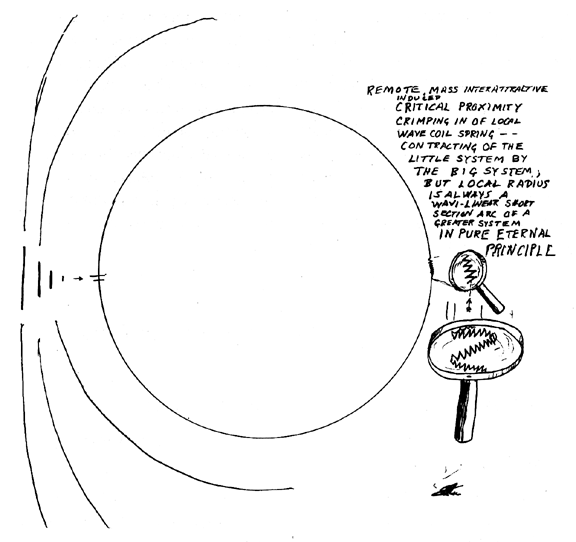
Fig. 1009.57B Big Orbit Passing through Little Orbit
Fig. 1009.57B Big Orbit Passing through Little Orbit: What was called linear acceleration is an unrecognized arc of a bigger system.
Link to original
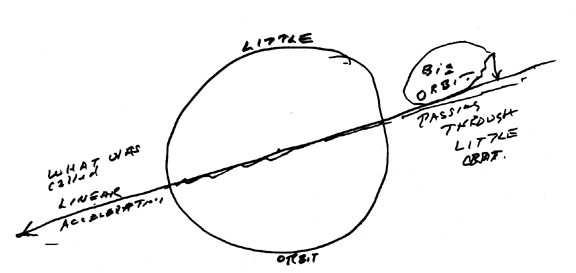
An apparent straight line is not only locally wavilinear but a short-section arc of a greater system passing through a lesser system. (See Figs. 1009.57A-B.) Universe lines return upon themselves.
1009.60
Hammer-Thrower: The effect of bodies in acceleration upon other bodies in acceleration is always precessional, and the resultant is always at an angle other than 180 degrees. Even today, the physicists consider precession to be only mathematically treatable by quantum mechanics because they have failed to realize that the complex intereffects are conceptually comprehendible.1
(Footnote 1: The author established this fact with the authority of the great specialists in applied precession (i.e., gyroscoping), the chief engineer and vice president for research of the Sperry Gyroscope Company. See the author’s article on the gyroscope in Fortune, Vol. XXI, No. 5, May 1940.)
1009.61
The model of the man fastening a weight to a string and swinging it around his head is the familiar one of the hammer-thrower. With each accelerating cycle the object swung around his head accumulates in its velocity the progressive energy imports metabolically exported through the action of the human’s muscles. (See Sec. 826.03 for description of the metabolic energy accumulation of the hammer-thrower. ) Men have not accurately interpreted their instinctively articulated performance of slinging, hammer- throwing, baseball pitching, and other angularly accelerated hurlings. When a human picks up a stone and throws it, he thinks of it as a different kind of a sport from the hammer- thrower’s activity. But the only difference is that with throwing the stone, his arm is the rod of the hammer and instead of accumulating velocity by many cycles of acceleration, he operates through only one-third of a circle in which he can accumulate a certain amount of metabolic muscle energy to transform into acceleration. Substituting the athlete’s “hammer” for the stone or baseball, the hammer-thrower is able to build much more of his metabolically generated energy into muscular acceleration, which accumulates to produce very great force. The baseball-throw and the hammer-throw utilize the same principle, except that the rate of accumulation is one-third cycle for the former while it is a plurality of cycles for the latter, thus permitting the introduction of larger amounts of time-of-effort application.
1009.62
A man with a weight on a string swings it above his head and lets go of it, but the man is in such close proximity to Earth that the attraction of Earth takes over and pulls the weight in toward Earth. This tends to misinform the observer, who may lose sight of the fact that the man and Earth and the weight on the string are all going together around Sun at 60,000 mph.
1009.63
Despite the overwhelming power of the attraction of Earth, we must continue to keep in mind the critical-proximity concept. For instance, let us consider two steel magnets lying on a table and apparently not attracting one another simply because Earth-pull against the table and the friction of the table prevent them from indicating their pull for one another. But as they are given a series of pushes toward one another there comes a point when Earth’s gravity-induced friction is overcome by the local magnetic interattraction which increases as the second power of the relative interdistance increase; and there comes a moment when friction is overcome and the two magnets start moving toward one another and accelerate to a fast, final-snap closure. It is when such other forces are overcome that the two magnets articulate their interattraction independent of all other forces: this is the point we call critical proximity. (See Sec. 518.)
1009.64
Earth and Moon were, still are, and always will be pulling on the two magnets to some extent—as are all the other galaxies of Universe. The critical-proximity moment is when all the other pulls are overcome by the pull between the two magnets and “falling-in” occurs; and the falling-in is always of the lesser toward the greater.
1009.65
The astronaut can go out space-walking because he and his space vehicle are in the same Universe orbit at the same rate, as would be any other object the space-walker had in his hand. Here is an opportunity for the mutual mass attractions to articulate themselves, except that in this situation, the prime force is the acceleration itself. What the physicists have failed to elucidate to society, and possibly to themselves, as well, is that linear acceleration is also orbital but constitutes release from co-orbiting (or critical- proximity orbiting) into the generalized orbiting of all Universe.
1009.66
All the creatures on board planet Earth are in such critical proximity that the falling-in effect of the apple hitting the grass, the rain dropping on the sidewalk, the hammer falling to the floor, or the child bottoming to the deck of the crib are all typical of the critical-proximity programmability of a design integrity, which programmability is employable by humans in design science. All of the creatures of planet Earth are in a “fall- in” programmed by a critical-proximity guarantee.
1009.67
The bee goes after his honey and, inadvertently, at 90 degrees to his honey- seeking plunge, his tail takes on pollen and knocks off pollen to produce a large, slowly orbiting interfertilization of the vegetation’s prime-energy impoundment of photosynthesis from the stars—particularly the Sun star—of all the radio-transmitted energies to Earth. Photosynthesis impounds energy, and by orderly molecular formation and crystal building, the synergetic intertransformabilities and the associabilities and disassociabilities of the isotropic-vector-matrix field accommodation occur. What is spoken of as ecology is slowly orbiting local interaction of mutual intersupport within unpremeditatedly accomplished tuning of the prime drive programming of the spontaneous fall-in-ability of the creatures within the critical-proximity conditions: the sugar on the table, the naked girl on the bed.
1009.68
All special-case events are generated in critical proximity. Critical proximity is inherent to all intertransformability and interaccounting of eternally regenerative Universe—as, for instance, in the myriad varieties of frequencies ranging from eons to split-seconds. When Earth’s orbit passes through a comet’s stardust plume, we witness some of the comet’s stardust falling in to Earth captivity, some of it igniting as it enters the atmospheric gases, some falling into Earth, and some with such acceleration as only to pass through the atmosphere leaving meager entropic dust to fall to Earth.
1009.69
Comet: A comet is a celestial itinerant, a cosmic skyways vacuum cleaner trying to accommodate an aggregation of stardust as it travels successively through the orbital neighborhoods of planets, stars, and other comets. The radiation pressures from the nearest stars, however, tend to blow the vacuum cleaner’s stardust gleanings out into a bagless “dustbag,” causing what we erroneously speak of as the comet’s tail. These “tail” displays should be spoken of as Sun-radiation blowout trajectories. As comets come into critical proximity of syntropically importing planets, the stardust aggregates of their inverted “tails” are gravitationally depleted by the planets they pass, as much of that stardust is attracted into the planets or moons to become part of those import centers’ syntropic buildup in a multibillions-of-years syntropic preparation of their stored-energy aggregates to be converted into the state of an entropically exporting star.
1009.70
Orbital Escape from Earth’s Critical-Proximity Programmability: Human mind, while discovering generalized principles, eternally persisted in special-case experience sequences, but has gradually developed the capability to employ those principles to put vehicles and then self into such acceleration as to escape the fall-back-in proclivity and to escape the general ecological fall-in program of invisible interorbiting regeneration.
1009.71
As each human being discovers self and others and employs more principles more and more consciously to the advantage of others, the more effectively does the individual retain the integrity of his own unique orbiting in Universe, local though it may seem aboard our planet. His unique orbiting brings him into a vast variety of critical- proximity fall-ins. Man has progressively acquired enough knowledge to raise his vision from the horizontal to the vertical, to stay first atop the watery ocean and next atop the airocean heights, and most recently to orbit beyond the biosphere with ever greater independence, with ever greater competence, and with ever greater familiarity with the reliability of the generalized principles.
1009.72
Little individuals in orbit around little berry patches, fruit trees, nut piles, and fishing holes are instinctively programmed to pick up rocks and pile up walls around the patches, orchards, and gathering places. Some men floating on the waters and blown by the wind were challenged to respond to the accelerating frequence of stress and high- energy impacts, and they went into vastly longer orbital voyages. Others went into lesser and slower orbits on camels and horses, or even slower orbits on their own legs. The effect of human beings on other human beings is always precessional. All of us orbit around one another in ever greater acceleration, finally going into greater orbits. The local critical-proximity fall-in and its 99.9999 percent designed-in programming becomes no longer in critical-proximity evidence, while all the time the apprehending and comprehending of the generalized principles elucidates their eternal integrity in contrast to the complex inscrutability of the local critical-proximity aberrations permitted and effected in pure principle whenever the frictional effect on the two stones lying before us overcomes their tendency to fall in to one another—with naught else in Universe but two stones—which statement in itself discloses our proclivity for forgetting all the billions of atoms involved in the two stones, and their great electron orbits around their nuclei, guaranteeing the omniacceleration, yet synergetically and totally cohered by the mass- interattractiveness, which is always more effective (because of its finite closures) than any of the centrifugal disintegrative effects of the acceleration. All the interaberrations imposed on all the orbits bring about all the wave-frequency phenomena of our Universe. The unique wave frequencies of the unique 92 chemical elements are unique to the local critical-proximity event frequency of the elemental event patternings locally and precessionally regenerated. Finally, we must recall that what man has been calling “linear” is simply big orbit arc seemingly attained by escaping at 90 degrees from local orbit. There are only two kinds of acceleration, greater and lesser, with the lesser being like the radius of the nucleus of an atom in respect to the diameter of its electron shell.
1009.73
Humanity at this present moment is breaking the critical-proximity barrier that has programmed him to operate almost entirely as a part of the ecological organisms growing within the planet Earth’s biosphere. His visit to Moon is only symptomatic of his total, local, social breakout from a land-possessing, fearful barnacle into a world-around- swimming salmon. Some have reached deep-water fish state, some have become world- around-migrating birds, and some have gone out beyond the biosphere. Long ago, man’s mind went into orbit to understand a little about the stars. And little man on little Earth has now accumulated in the light emanating from all the stars a cosmic inventory of the relative abundance of each of the 92 regenerative chemical elements present in our thus- far-discovered billion galaxies of approximately a hundred billion stars each, omnidirectionally observed around us at a radius of 11 billion light years. Man can always go into infinitely great, eternal orbit. Mind always has and always will.
1009.80
Pea-Shooter, Sling-Thrower, and Gyroscope: Gravity and Mass- Attraction: Highly specializing, formula-preoccupied, conventional academic science of the late twentieth century seems to have lost epistemological sight of the operationally derived mathematics identifying Galileo’s accelerating-acceleration of free-falling bodies as being simply R2, where R is the relative proximity of any two bodies whose mutual interattraction is isolatingly considered. R2 says that every time the proximity is halved, the mass-interattraction of the two bodies will be increased as 22, i.e., fourfolded.
1009.81
Isaac Newton did comprehend this. Newton was inspired by the early Greeks and by Copernicus, Kepler, and Galileo. Newton compounded Kepler’s discovery of the mathematical regularities manifest by the differently sized solar system’s interattractions with Galileo’s discoveries—which information Newton’s own intuition then further integrated with ancient experience of the sling-throwers, which showed that the more the sling-thrower converted his muscle power into increasing the speed of the sling orbiting around his head before freeing one end of it to release his stone pellet, the faster and farther would the impelled stone travel horizontally before another more powerful force pulled it inwardly toward Earth’s center.
1009.82
The gravitational constant is expressed as a second power. Second-powering means that the number is multiplied by itself. Thus the forces of the accelerating- acceleration of gravity can be calculated, provided the masses of the two interapproaching bodies are multiplied and their relative proximity is expressed in the terms of the relative radii magnitudes of the bodies.
1009.83
When we see the pea-shooter blowing peas out in a trajectory, we see that if it is blown harder, the impelled peas may attain a longer trajectory before they curve down and toward Earth as they yield to gravity. Assuming no wind, the gradual curvature from approximately horizontal to vertical of the peas’ trajectory all occurs in the same single vertical plane. When you insert your finger into the blown pea’s trajectory, you interfere with the pea and deflect it angularly. This means deflecting the plane with which the pea’s horizontal course is translated toward the vertical from below, or sideways, or from any direction. This trajectory altering is a phenomenon described by the physicists as angular deflection.
1009.84
In the same way, you can also deflect the plane of travel of water coming out of a garden hose—to aim the stream of water in any direction you want before gravity overcomes the initial force impelling the water. We cannot see the individual molecules of water we are deflecting one by one when our finger angularly modifies the stream of water at the hose nozzle, but we can see the individual shooter-blown peas that we can deflect individually, thus aiming them to hit various targets. The vertical plane of the pea is deflected sideways by you, and its falling within the plane is directed by gravity. There is a vertical integrity of the trajectory plane. The finger only deflects the horizontal orientation plane. The pea does not have a memory and after initial deflection by your finger does not try to resume the vertical plane of its previous travel.
1009.85
Two forces have operated to determine the pea’s trajectory:
- gravity, which continues to operate, deflecting it progressively; and
- the finger, which momentarily deflected it but is no longer doing so.
When we come back to the spinning Olympic hammer-thrower this time rotating vertically between head-and-foot-clamped ball-bearing turntables which in turn are mounted in gimbaled rings, to whose belt is hooked a complete, 360-degree, ball-to-ball, “grass-skirt- like” ring of horizontally revolving steel balls on the outer ends of steel rods, on the inner ends of which are pairs of triangular steel handles now hooked to the hammer-thrower’s belt after his successive angular acceleration of each hammer into the horizontal spinning ring of his “grass skirt.” His separately accelerated and horizontally traveling balls are each similar to each of the peas as first blown horizontally out of the pea-shooter tube. Both the peas and the steel balls are being affected by two forces: the peas by gravity pulling upon them and by the force with which they were originally propelled in horizontal trajectory; the spinning steel balls have their original horizontal acceleration, which was so great as to overcome gravity’s Earthward-pulling effect, plus their second restraint, that of the steel rods successfully restraining and countering the centrifugal force that seeks to release the balls into tangential, not radial trajectory.
1009.86
Because centrifuges separate “heaviers” from “lighters” by expelling the heavy from the light—such as milk centrifuges out of cream— people have mistakenly thought of the expelling as radial rather than tangential. Make yourself a diagram of your own spinning of a weight around your head—you tend to think of it as being released in a horizontal plane at a point on the spun circle directly in the line running between your eyes and the target direction in which you wish the hammer to travel, that is leading perpendicularly outward from the circle in the direction in which the released pellet travels. The fact is that if it were released at that point, it would travel at a direction 90 degrees, or sidewise from your desired trajectory, from that actually realized. Studying the action of an Olympic hammer-thrower, you will find that the spherical hammer and its rod are released at a point facing away 90 degrees from the direction in which the released hammer travels: i.e., the hammer always goes off tangentially from the circle of acceleration. This contradicts the popular conception of a centrifugal force as being radial rather than tangential.
1009.87
Returning to our Olympic hammer-thrower’s steel-ball, flying skirt, if you touch evenly their successively passing tops, thus downwardly deflecting each ball of the full circle of ball hammers spinning around, each is discretely deflected, say 30-degrees downwardly, which changes the plane of its individual orbital spinning. Each “peels off,” like an airplane flying formation and obeying a command to break company and go into a descending path followed exactly by each successive ball coming into touch-contact with your deflecting finger held rigidly at the same point.
1009.88
If your rigidly held finger is lowered further to another discrete point in the line of travel of the successively revolving balls, and if it is held rigidly at this new point, each of the circle of revolving spherical hammers will again be discretely deflected into an additionally tilted plane (with the hammer-thrower himself as axis of rotation always maintaining perpendicularity to the plane of the hammers’ revolution, his axial tilting being accommodated by the three-dimensionally oriented axles of the two gimbal rings within and to which his ball-bearing foot-and-head clamps are firmly attached).
1009.89
We had learned earlier about fixed or progressive-horizontal reangling of the plane of the peas’ coincidentally yielding to gravity (Sec. 1009.83), as we tried discrete deflecting of the successive peas shot from the pea-shooter. By experimenting, moving our finger progressively deeper, in deliberately distanced stages, into the peas’ profile- described “tubular” space-path of travel, we found that the nearer our finger came to the center line of travel within that “tubular” space-path, the wider the resulting angle of deflection of the peas’ trajectory. When finally our finger crossed the tube’s center line, the angular deflection ceased and direct 180-degree opposition to the line of pea travel occurred, whereat all the horizontal force originally imparted to the peas by the pea- shooter’s pneumatic pressure-blowing is almost absorbed by impact with the finger. The pea bounces back horizontally for a usually imperceptibly meager distance before yielding entirely to gravity and traveling Earthward at 90 degrees to its original horizontal trajectory.
1009.90
What we also learned observationally before and after deflecting the peas experimentally was that gravity went to work on the peas as soon as they left the tube, and that as the peas were decelerated by air resistance below the rate of acceleration that rendered them approximately immune to the pull of gravity, that latter force became ever more effective as the air resistance took its toll of energy from the peas, and the peas were deflected progressively Earthward. We also observed that no wind was blowing, and when we did not deflect the peas with our finger, they all followed a progressively descending path in exactly the same plane until they hit the ground. Next we learned that if we intruded our finger horizontally a discrete distance into the tubular space-path of the peas, they were deflected at some discrete angle (less than 90 degrees, diametrically away from the point of entry of our finger into the peas’ tubular space-path), and that if we did not move our finger further into the tubular space-path, each traveling pea thus interfered with deflected the same angular amount horizontally away from our intruding finger and held that newly angled direction, yielding further only to air resistance and gravity, with the result that each successive pea thus discretely deflected proceeded in a progressively curved trajectory, but always within the same vertical plane. In other words, successively separate and discretely distanced progressive intrusions of our finger into the tubular space-path of travel deflected the vertical plane of the trajectory of the peas into a new but again sustained vertical plane of travel, that new vertical plane occurring each time at a more abrupt angle from the original nonintruded vertical plane of the stream of traveling peas. Thus we learned that we could deliberately aim the peas to hit targets within the range of such traveling. (We have all succeeded in deflecting the trajectory of a pressured stream of water in just such a manner, but we cannot see the individual molecules of water thus deflected and think of it as a continuous stream.) The discretely modified behavior of our pea-shooter’s individual peas and the individual steel-ball “hammers” of the Olympic hammer-thrower altogether permit our comprehension of the parts played by individual, but invisible-to-human-eyes energy quanta in bringing about only superficially witnessed motion phenomena that most often appear deceivingly as motionless solids or as swiftly rotating solid flywheels such as those of gyroscopes.
1009.91 Thus we now can understand that our touching the rim of a flywheel of an XYZ-axialed and gimbaled gyroscope causes each of the successively and discretely top- touched quanta to be deflected downward into a new plane of travel, accompanied always by the coincident tilting of the axle of the flywheel, which always maintains its perpendicularity to the plane of spin of the flywheel. The tilting of the plane of spin of the flywheel, caused by our finger touching the rim of the spinning wheel, tilts that wheel around an axis of tilt, which axis is the line diametrically crossing the circular plane of spin from the rim point that you touched. This diametric line is the tilting-hinge line. It runs directly away from you across the wheel. This means that as the wheel’s extended axle perpendicular to the flywheel plane tilts with the wheel, as permitted by the three-axial degrees of freedom of the gimbaled gyroscope, then the axle tilts in a plane at right angles to the tilting-hinge line in the flywheel. Because the steel wheel and its axle are integral, it would be in exactly the same plane of force in which you applied your touch to the flywheel’s rim, if, instead, you took hold of the top bearing housing the flywheel’s top axle extremity and pulled that gimbal-freed bearing toward the rim point at which your finger had applied its initial touch, the bearing housing and the axle of the flywheel will rotate exactly sidewise from the direction in which you are pulling on it because that force makes the flywheel tilt hingingly around the line running diametrically across the wheel from your rim-touching point.
1009.92
Thus we learn that pulling the axle bearing atop the gyroscope toward the rim-touching point, which is also incidentally pulling the top axle bearing in the gimbaled system toward yourself, results in the wheel plane tilting around the described hinging line, and the axle and its bearing are thus forced to move coincidentally in a plane perpendicular to that hinge line and in the direction which is tangential to the wheel spinning at the initial touching point. This means that pulling on top of the gyroscope does not result in its yielding toward you, as you might have expected from its three-axial degrees of gimbaled freedom, as it would have done had the wheel not been spinning. Instead, it seemingly travels rotatingly in a plane at 90 degrees to your effort and continues to do so so long as you apply the force, and does so ever more speedily if you increase the force. This yielding at a plane angled at 90 degrees to your (or anyone’s) applied effort is precession, which is the effect of a body in motion on any other body in motion; the resulting angles of precession are never in a plane congruent with the precessionally actuating force.
1009.93
Since all Universe is in motion, all the intereffects of its energy concentrations as “matter” are always intereffecting one another precessionally. The pull of Sun on Earth results in Earth orbiting around Sun at 90 degrees to the line of Sun’s mass attraction of Earth. Bodies “fall” toward Earth only when their relatively small size and the critical proximity of their respectively mutual orbiting of Sun at 60,000 mph allows their progressive orbital convergence; the lesser body is only negligibly affected by the precessional forces of other astro bodies because of the second-power rate of diminution of intermass-attraction occurring as the intervening distances are increased.
1009.94
All the foregoing illustrates the integration of (1) Newton’s mass-attraction law, (2) precession, and (3) synergy. They are all coming together here: Kepler, Galileo, and Newton. The earliest sling-thrower revolving the sling around his head (angular acceleration, as it is called by the physicists) demonstrates the added energy of the sling- thrower extending the trajectory. The pea-shooter does the same thing in linear acceleration. It can extend its trajectories with greater energy, but its pellets, too, yield to the gravity of Earth. Earth is very powerful, but the pea-shooter or the sling-thrower discover that the harder they swing or blow—i.e., the more energy they put into accelerating their pellets—the farther the pellets go horizontally before gravity deflects them at 90 degrees.
1009.95
But there is an integration of the horizontal and vertical planes of applied forces, between the horizontal plane of your varying effort and the vertical plane of the constant Earth’s pull. Realization of this integration may be what inspired Newton. Galileo used the phrase “accelerating-acceleration,” which means that the velocity is continually increasing. But the sling-thrower’s force was discontinued, and the air resistance decelerated its missile until gravity’s force at 90 degrees became greater. If the sling- thrower propelled his missile outside the atmosphere of Earth and beyond the critical- proximity limits within which falling in occurs, his missile would keep on traveling ad infinitum in an astro-wandering orbit.
1009.96
The logic of sensorially satisfactory experience acquired in the foregoing elucidation of precession—and the discovery of our self-deceivingly-conditioned reflex in respect to assuming 180 degrees to be the normal angular direction of spin-off instead of reality’s 90-degreeness—not only renders precession comprehendible, but can make its 90-degree spin-off and other effects understandably normal and can explain much that has heretofore seemed inexplicable and abnormal. The two angular-acceleration planes become very important devices of comprehension. In our generalization of generalizations, we find that synergy, as “the behavior of whole systems unpredicted by any of the systems’ parts taken separately,” embraces both the generalized mass attraction and the precessional laws. Apparently, synergy embraces our definition of Universe and is therefore probably the most generalized definition of Universe.
1009.97
The generalizations are of the mind and are omniembracing and omnipermeative. Like the rays of Sun, radiations are radii and are focusable. Gravity cannot be focused; it is circumferentially embracing. Radiation has shadows; gravity has none. Radiation produces the phenomenon known to Einstein as the bending of space, the gravitational field.
1009.98
Gravitation is omniembracing. In the barrel hoops (see Sec. 705), gravity operates only in single and parallel, separate planes. Omnitriangulated geodesic spheres consisting exclusively of three-way interacting great circles are realizations of gravitational-field patterns. Events are forced to bounce in spherically contained circles because they seek the largest possible interior circumference patterns. All great circles cross each other twice. Three or more noncongruent great circles are automatically inter- self-triangulating in their repetitive searching for the “most comfortable” interactions, which always resolve their three-way-great-circle patterning into regular spherical icosahedra, octahedra, or tetrahedra. The gravitational field will ultimately be disclosed as ultra-high-frequency tensegrity geodesic spheres. Nothing else.