1010.01
A prime volume has unique domains but does not have a nucleus.
1010.02
A prime volume is different from a generalized regenerative system. Generalized regenerative systems have nuclei; generalized prime volumes do not.
1010.03
There are only three prime volumes: tetrahedron, octahedron, and icosahedron. Prime volumes are characterized exclusively by external structural stability.
1010.10
Domain and Quantum: The unique insideness domain of a prime system is, in turn, a prime volumetric domain, which is always conceptually defined by the system’s topological vertex-interconnecting lines and the areas finitely enclosed by those lines. (V + F = L + 2.) Prime volumetric domain provides space definition independent of size.
1010.11
Prime volumetric domain and prime areal domain together provide space conceptuality independent of size, just as the tetrahedron provides prime structural system conceptuality independent of size.
1010.12
Complex bubble aggregates are partitioned into prime volumetric domains by interiorly subdividing prime areal domains as flat drawn membranes.
1010.13
A prime volumetric domain has no volumetric nucleus. A prime areal domain has no planar nucleus. So we have prime system volumetric domains and prime system areal domains and linear interconnections of all vertexes—all with complete topological conceptual interpatterning integrity utterly independent of size.
1010.14
This frees conceptual-integrity comprehending and all the prime constituents of prime-pattern integrity, such as “volume,” “area,” and “line,” from any special-case quantation. All the prime conceptuality of omnitopology is manifest as being a priori and eternally generalized phenomena. Thus quantum as prime-structural-system volume is eternally generalized, ergo, transcends any particulate, special-case, physical-energy quantation. Generalized quanta are finitely independent because their prime volumetric- domain-defining lines do not intertouch.
1010.20
Nonnuclear Prime Structural Systems: The domain of the tetrahedron is the tetrahedron as defined by four spheres in a tetrahedral, omniembracing, closest-packed tangency network. The domain of an octahedron is vertexially defined by six spheres closest packed in omnitriangular symmetry. The domain of an icosahedron is vertexially defined by 12 spheres omnicircumferentially intertriangulated and only circumferentially symmetrically triangulated in closest packing without a nucleus (in contradistinction to the center sphere of the vector equilibrium, whose 12 outer sphere centers define the vector equilibrium’s 12 vertexes; all 13 of the vector equilibrium’s spheres are intersymmetrically closest packed both radially and circumferentially).
1010.21
All of the three foregoing non-nuclear-containing domains of the tetrahedron, octahedron, and icosahedron are defined by the four spheres, six spheres, and twelve spheres, respectively, which we have defined elsewhere (see Sec. 610.20, “Omnitriangular Symmetry: Three Prime Structural Systems”) as omnitriangulated systems or as prime structural systems and as prime volumetric domains. There are no other symmetrical, non-nuclear-containing domains of closest-packed, volume-embracing, unit-radius sphere agglomerations.
1010.22
While other total closest-packed-sphere embracements, or agglomerations, may be symmetrical or superficially asymmetrical in the form of crocodiles, alligators, pears, or billiard balls, they constitute complexedly bonded associations of prime structural systems. Only the tetrahedral, octahedral, and icosahedral domains are basic structural systems without nuclei. All the Platonic polyhedra and many other more complex, multidimensional symmetries of sphere groupings can occur. None other than the three- and-only prime structural systems, the tetrahedron, octahedron, and icosahedron, can be symmetrically produced by closest-packed spheres without any interioral, i.e., nuclear, sphere. (See Secs. 532.40, 610.20, 1010.20 and 1011.30.)
1011.00 Omnitopology of Prime Volumes
1011.10
Prime Enclosure: Omnitopology describes prime volumes. Prime volume domains are described by Euler’s minimum set of visually unique topological aspects of polyhedral systems. Systems divide Universe into all Universe occurring outside the system, all Universe occurring inside the system, and the remainder of Universe constituting the system itself. Any point or locus inherently lacks insideness. Two event points cannot provide enclosure. Two points have betweenness but not insideness. Three points cannot enclose. Three points describe a volumeless plane. Three points have betweenness but no insideness. A three-point array plus a fourth point that is not in the plane described by the first three points constitutes prime enclosure. It requires a minimum of four points to definitively differentiate cosmic insideness and outsideness, i.e., to differentiate macrocosm from microcosm, and to differentiate both of them from here and now.
1011.11
Systems are domains of volumes. One difference between a domain and a volume is that a domain cannot have an interior point, because if it did, it would be subject to more economical subdivision. For instance, the vector equilibrium is a system and has a volume, but it consists of 20 domains. A vector equilibrium is not a prime domain or a prime volume, because it has a nucleus and consists of a plurality of definitive volumetric domains. The vector equilibrium is inherently subdivisible as defined by most economical triangulation of all its 12 vertexes into eight tetrahedra and 12 quarter-octahedra, constituting 20 identically volumed, minimum prime domains.
1011.20
Hierarchy of Nuclear Aggregations: The prime nuclear aggregation of spheres around one sphere is the vector equilibrium. Vector equilibrium constitutes the prime nuclear group because it consists of the least number of spheres that can be closest packed omnitangentially around one nuclear sphere. The vector equilibrium provides the most volumetrically economical pattern of aggregation of 12 balls around a nuclear ball of the same diameter as the 12 surrounding balls; the 13th ball is the center. In other words, is the lowest possible number connected with a structurally stable triangulated nucleus, being omnitriangularly interconnected both radially and circumferentially.
1011.21
An octahedron is at minimum a prime system. Prime systems are generalized. To be realized experimentally in special-case time-space, the octahedron must consist of a high-frequency aggregate of octahedral and tetrahedral components. An octahedral system gains a nucleus with 19 balls, i.e., with 18 uniradius balls around one, as against the minimum nucleated (four-frequency) tetrahedral array of 35 balls, i.e., with 34 balls symmetrically around one. So the octahedron gains a nucleus at a lower frequency than does the tetrahedron.
1011.22
Whether at zero-frequency or multifrequency state, the icosahedron cannot have a tangentially contiguous, ergo statically structural, nuclear sphere of the same radius as those of its closest-packed, single, outer-layer array. It can only have a dynamically structured nucleus whose mass is great enough to impose critical-proximity central dominance over its orbitally icosahedrally arrayed, remotely co-orbiting constellation of concentrated energy events.
1011.23
The vector equilibrium has four hexagonally perimetered planes intersecting each other symmetrically at its center; while the octahedron has only three square- perimetered planes symmetrically intersecting one another at its center. The hexagon has room at its center for a uniradius circle tangent to each of the six circles tangent to one another around it; whereas the square does not have room for such a uniradius circle. Wherefore the minimal four-dimensional coordinate system of the vector equilibrium is the minimum inherently nucleated system. (This is why mathematical physics employing three- dimensional, XYZ coordination can only accommodate its experimental evidence of the atomic nucleus by amorphous mathematics.) Like the octahedron, the vector equilibrium also has eight triangular facets; while also explosively extroverting the octahedron’s three square central planes, in two ways, to each of its six square external facets, thus providing seven unique planes, i.e. seven-dimensionality. And while the octahedron develops a nucleus at a lower number than does the tetrahedron—or more economically than a tetrahedron—it is indicated that the nuclear arrays are symmetrical and play very great parts in compound chemistry. (The cube develops a nucleus only at a relatively high frequency.) In each one of these, there may be hierarchies that identify the difference between organic and inorganic chemistries. Due to the fact that there are nuclear aggregations in symmetry to which all of our chemistries relate, we may find an organic and inorganic identification of the tetrahedral and octahedral nucleations. The nonnuclear, exclusively volumetric, single-layer, closest-packed, icosahedral aggregate may be identified with the electron “shells” of the compounding atoms.
1011.30
Prime Tetra, Octa, and Icosa: Prime means the first possible realization. It does not have frequency. It is subfrequency. One or zero are subfrequency. Interval and differentiation are introduced with two. Frequency begins with three—with triangle, which is the minimum cyclic closed circuitry.
1011.31
Three linear events have two intervals, which is the minimum set to invoke the definition frequency. But it is an “open” circuit. The circuit is closed and operative when the triangle is closed and the same three events produce three equi-intervals, rather than two. Equi-interval = “tuned.” This is why wave-frequency relationships have a minimum limit and not an infinite series behavior.
1011.32
Frequency and size are the same phenomena. Subfrequency prime tetra, prime octa, and prime icosa are each constituted of only one edge module per triangular facet. While generalizably conceptual, the prime structural systems and their prime domains—linear, areal, and volumetric—are inherently subfrequency, ergo, independent of time and size.
1011.33
Special case always has frequency and size-time.
1011.34
Generalization is independent of size and time, but the generalization principle must be present in every special case of whatever magnitude of size or time.
1011.35
Prime tetrahedra and octahedra do not have nuclei. In contradistinction to prime tetrahedra and prime octahedra, some complex tetrahedra, complex octahedra, and complex cubes do have a nucleus. They do not develop structurally in strict conformity to closest packing to contain an internal or nuclear ball until additional closest-packed, uniradius sphere layers are added. For instance, the cubical array produced by nesting eight uniradius spheres in the center of the eight triangulated sphere arrays of the nuclear- balled vector equilibrium produces eight tetrahedra single-bondedly arrayed around a nuclear ball. Additional, and symmetrically partial, layers require identification as frequency of reoccurrence of concentric shell embracement. In contradistinction to the other two prime system domains, however, the icosahedron does not accommodate additional closest-packed sphere layers and never develops a static structural nucleus. The icosahedron’s closest-packing capability is that of circumferential propagation of only one omni-intertriangulated uniradius sphere and can increase its frequency only as one shell and not as a nucleus.
1011.36
If the icosahedron does develop a further outward shell, it will have to discard its internal shell because the central angles of the icosahedron will not allow room for unit-radius spheres of two or more closest-packed omnitriangulated concentric shells to be constructed. Only one closest-packed shell at a time is permitted. Considered internally, the icosahedron cannot accommodate e- en one uniradius, tangentially contiguous, interior or nuclear sphere of equal radius to those of its closest-packed, uniradius, outer shell.
1011.37
Speaking externally, either “prime” or complex “frequency” tetrahedra and octahedra may interagglomerate with one another close-packingly to fill allspace, while icosahedron may never do so. The icosahedra may be face-associated to constitute an ultimately large octahedral structure. Icosahedra may also symmetrically build independent, closest-packed, tetrahedral arrays outwardly on each of their multi- frequenced, 20 triangular facets. Thus it is seen that the icosahedral closest packing can only grow inside-outedly, as does the vector equilibrium grow internally, i.e. inside- inwardly.
1011.38
While the regular icosahedron’s radius is shorter in length than its external edge chords, the vector equilibrium has the same radius as each of its edge chords; which explains the vector equilibrium’s tolerance of a nucleus and the icosahedron’s intolerance of a nucleus.
1011.40
Congruence of Vectors: All vector equilibria of any frequency reveal vectorially that their radially disassociative forces always exactly and balancingly contain their circumferentially integrated—and therefore more embracing than internally disintegrating—forces as manifest by their vectorial edge chords. The vector equilibrium consists of four symmetrically interacting hexagonal planes. Each hexagon displays six radially disintegrative, independently operative, therefore uncompounded, central vectors and their equal-magnitude six, always cooperatively organized and compounded, circumferential chord vectors. Sum-totally, the four hexagons have 24 radial disintegrative vectors and 24 chordally integrative vectors, with the chordals occurring as four closed sets of six vectors each and the radials as four open sets of six vectors each. The planes of any two hexagons of the set of four intersect one another in such a manner that the radii of any two intersecting planes are congruent, while the chords are not. This paired congruency of the 24 radial-disintegrative vectors of the four hexagons reduces their visible number to 12. The 24 chordally integrative vectors remain separate and visible as 24 finitely closed in four embracing sets of six each.
1011.41
The phenomenon “congruence of vectors” occurs many times in nature’s coordinate structuring, destructuring, and other intertransformings, doubling again sometimes with four vectors congruent, and even doubling the latter once again to produce eight congruent vectors in limit-transformation cases, as when all eight tetrahedra of the vector equilibrium become congruent with one another. (See Sec. 461.08.) This phenomenon often misleads the uninformed observer.
1011.50
Instability of Vector Equilibrium: If we remove the 12 internal, congruently paired sets of 24 individual radii and leave only the 24 external chords, there will remain the eight corner-interlinked, externally embracing triangles, each of which (being a triangle) is a structure. Between the eight triangular external facets of the vector equilibrium, there also occur six squares, which are not structures. The six square untriangulated faces are the external facets of six nonstructurally stabilized half-octahedra, each of whose four central triangular faces had been previously defined by the now removed 24 radially paired vectors of the vector equilibrium. A half-octahedron, to be stable, has to be complementingly square-face-bonded with its other half. The prime vector equilibrium has only these six half-octahedra, wherefore the circumferential instability of its six square faces invites structural instability. Thus deprived of its internal triangular structuring by removal of all its radial vectors, the vector equilibrium becomes disequilibrious.
1011.51
The prime vector equilibrium has a nucleus surrounded, close-packingly and symmetrically, by 12 uniradius spheres. (See Illus. 222.01.) As we add unit radius sphere layers to the prime vector equilibrium, the 12 balls of the first, or prime, outer layer become symmetrically enclosed by a second closest-packed, unit radius layer of 42 balls circumferentially closest packed. This initiates a vector equilibrium with modular edge and radius intervals that introduce system frequency at its minimum of two.²
(Footnote 2: The number of balls in the outer shell of the vector equilibrium = 10 F² + 2. The number 42, i.e., F², i.e., 2² = 4, multiplied by 10 with the additive 2 = 42.)
1011.52
The edge frequency of two intervals between three balls of each of the vector equilibrium’s 24 outer edges identifies the edges of the eight outer facet triangles of the vector equilibrium’s eight edge-bonded (i.e., double-bonded) tetrahedra, whose common internal vertex is congruent with the vector equilibrium’s nuclear sphere. In each of the vector equilibrium’s square faces, you will see nine spheres in planar arrays, having one ball at the center of the eight (see Illus. 222.01), each of whose eight edge spheres belong equally to the adjacent tetrahedra’s outwardly displayed triangular faces. This single ball at the center of each of the six square faces provides the sixth sphere to stabilize each of the original six half-octahedra formed by the nuclear ball of the vector equilibrium common with the six half-octahedra’s common central vertex around the six four-ball square groups showing on the prime vector equilibrium’s surface. This second layer of 42 spheres thus provides the sixth and outermost ball to complete the six-ball group of a prime octahedron, thus introducing structural stability increasing at a fourth-power rate to the vector equilibrium.
1011.53
With the 42-ball layer added to the vector equilibrium, there is no ball showing at the center of any of the triangular faces of the vector equilibrium. The three- ball edges of the 42-ball vector equilibrium provide a frequency of two. Three spheres in a row have two spaces between them. These interconnecting spaces between the centers of area of the adjacent spheres constitute the vectorial interconnections that provide the energetic, or force, frequency of the described systems.
1011.54
Then we come to the next concentric sphere layer, which has 92 balls; its frequency is three, but there are four balls to any one edge. The edges are all common to the next facet, so we only have to credit the balls to one facet or another at any one time; however, we have to do it in total overall accounting, i.e., in terms of how many balls are sum-totally involved in each of the concentrically embracing layers.
1011.55
With the four-ball edge F³, for the first time, a ball appears in the center of each of the eight triangular facets. These central balls are potential nuclei. They will not become new vector-equilibrium nuclei until each potential nuclear sphere is itself surrounded by a minimum of two completely encompassing layers. These potential new nuclei (potentially additional to the as yet only one nucleated sphere at the center of the prime vector equilibrium) occur in the planar triangular facets of the vector equilibrium’s eight tetrahedra, which, being tetrahedra, are structural-system integrities (in contradistinction to its six half-octahedra, which—until fortified by their sixth outer-vertex balls of the two-frequency vector equilibrium—were structurally unstable).
1011.56
Though there is one ball in the center of each of the eight triangular facets of the F³ vector equilibrium, those balls are exposed on the outer surface of their respective tetrahedra and are not omnidirectionally and omnitangentially enclosed, as they would have to be to constitute a fully developed regenerative-system nucleus. Though outer- facetly centered (i.e., planarly central), those eight F³, triangularly centered balls are not nuclei. To become nuclei, they must await further symmetrically complete, concentric, closest-packed, vector-equilibrium shell embracements which bring about a condition wherein each of the eight new potential nuclei are embraced omnidirectionally and omnitangentially in closest-packed triangulation by a minimum of two shells exclusively unique to themselves, i.e., not shared by any neighboring nuclei. The F³ vector equilibrium’s triangular facets’ central surface-area balls are, however, the initial appearance in symmetrical, concentric, vector-equilibrium shell frequency growth of such potentially developing embryo nuclei. They are the first potential nuclei to appear in the progressive closest-packed, symmetrical, concentric layer enclosing of one prime regenerative system’s primally nucleated vector equilibrium.
1011.57
But at F³ we still have only one true nuclear ball situated symmetrically at the volumetric center of three layers: the first of 12, the next of 42, and the outer layer of 92 balls. There is only one ball in the symmetrical center of the system. This three-layer aggregate has a total of 146 balls; as noted elsewhere (see Sec. 419.05) this relates to the number of neutrons in Uranium Element #92.
1011.58
Any sphere is in itself a potential nucleus, but it has to have 12 spheres close- packingly and omni-intertangentially embracing it to become a prime nucleated, potentially regenerative system. To stabilize its six half-octahedra requires a second layer of 42 balls. The potentially regenerative prime nucleus can have the first F⁰ layer of 12-around-one nucleus, and the next (F²) layer of 42 around both the nucleus and the first layer, without any new potential nucleus occurring in either of those first two concentric layers. So the vector equilibrium is a nuclear uniqueness for the first layer of 12 and the next layer of 42, with no other potential nucleus as yet appearing in its system—in its exterior shell’s structural triangular facets—to challenge its nuclear pristinity.
1011.59
While there is a ball in the center of the square faces at the two-frequency, 42-ball level, those square cross sections of half-octahedra are not stable structures. Those square-centered balls are literally structurally superficial, ergo they are extra balls that show up but are not structurally stable in any way. They may be released to further re- form themselves into four-ball, prime, tetrahedral, structural systems, or they may be borrowed away from the nuclear system by another nuclear system—as does occur in chemical combines—without damaging the borrowed-from system’s structural integrity. The four balls that occur in the core of the square facets of the F³, 92-ball shell are also borrowable extra balls.
1011.60
In the 92-ball, F³ third shell, eight potential nuclei occur in the triangular facets. “Four” and “square” do not constitute a structural array. To be structural is to be triangulated. Four balls also occur in each of the square facets, whereas one ball had occurred in the center of each of the six square facets of the previous F², 42-ball layer. This means that at the F³, 92-ball layer, there are five balls in each of the six square-face centers. These five will be complemented by one or more, thus to form six new, detachable, nonnucleated, prime octahedra in the F⁴, 162-ball layer by a square group of nine balls in each of the six square facets of the vector equilibrium. The center ball of these nine will now join with the four balls of the F³ layer and the one ball of the F² layer to form altogether a prime, closest-packed octahedron having no nucleus of its own.
1011.61
At the F⁴, 162-ball layer, the eight potential nuclei occurring in the mid- triangle faces of the F³ layer are now omnisurrounded, but as we have seen, this means that each has as yet only the 12 balls around it of the F⁰ nuclear-development phase. Not until the F⁵, 252-ball layer occurs do the eight potential second-generation nuclei become structurally enclosed by the 42-ball layer, which has as yet no new potential nuclei showing on its surface—ergo, even at the F⁵ level, the original prime nucleus considered and enclosingly developed have not become full-fledged, independently qualified, regenerative nuclei. Not until F6 and the 362-ball layer has been concentrically completed do we now have eight operatively new, regenerative, nuclear systems operating in partnership with the original nucleus. That is, the first generation of omnisymmetrical, concentric, vector equilibrium shells has a total of nine in full, active, operational condition. These nine, 8 + 1, may have prime identification with the eight operationally intereffective integers of arithmetic and the ninth integer’s zero functioning in the prime behaviors of eternally self-regenerative Universe. We may also recall that the full family of Magic Numbers of the atomic isotopes modeled tetrahedrally occurs at the sixth frequency (see Sec. 995).
1011.62
The potential nucleated octahedra that were heralding their eventual development when the six prime (nonnucleated) octahedra occurred at the F⁴ level do not develop to full threefold, concentric, shell embracement as operational nuclei for several levels beyond that which had produced the second-generation eight vector-equilibrium nuclear integrities. We become also intrigued to speculate on the possible coincidence of the prime patternings developing here in respect to the 2, 8, 8, 18, 18, etc., sequences … of the Periodic Table of the Elements.
1012.00 Nucleus as Nine = None = Nothing
1012.01
Nucleus as nine; i.e., non (Latin); i.e., none (English); i.e., nein (German); i.e., neuf (French); i.e., nothing; i.e., interval integrity; i.e., the integrity of absolute generalized octaval cosmic discontinuity accommodating all special-case “space” of space- time reality. (See Secs. 415.43 and 445.10.)
1012.10
Positive-Negative Wave Pattern: Both the gravitational and the radiational effects operate exclusively in respect to and through the nucleus, whose unique domains multiply in eighths. Completion of the absolute initial uniqueness of pattern evolution of the nucleus itself brings in the nine as nothingness. How does this happen?
1012.11
Let us take three balls arranged in a triangle. We then take two other uniradius tangent balls lying in the same plane and address them symmetrically to any one corner-ball of the first three so that we have two rows of three balls crossing one another with one ball centrally common to both three-ball lines; so that we have two symmetrically arrayed triangles with one common corner. Obviously the center ball—like a railway switch—has to serve alternately either one three-ball track or the other, but never both at the same time, which would cause a smash-up. If we do the same thing four-dimensionally for the eight tetrahedra of the vector equilibrium, we find that the nuclear center ball is accommodating any one or any pair of the eight tetrahedra and is interconnecting them all. Externally, the eight tetrahedra’s 24 vertexes share 12 points; internally, their eight vertexes share one point. The common center ball, being two-in-one (unity two), can be used for a pulse or a space; for an integer or a zero. The one active nucleus is the key to the binary yes-no of the invisible transistor circuitry.
1012.12
As in the 92-ball, three-frequency vector equilibrium, there are four balls to an edge going point to point with a three-space, F³, in between them. An edge of the four ball could belong either to the adjacent square or to the adjacent triangle. It cannot belong to either exclusively, and it cannot belong to them both simultaneously; it can function for either on modulated-frequency scheduling. It is like our chemical bonding, bivalent, where we get edge-to-common-edgeness.
1012.13
As shown in Numerology (Sec. 1223), when we begin to follow through the sequences of wave patterning, we discover this frequency modulation capability permeating the “Indig’s” octave system of four positive, four negative, and zero nine. (See drawings section.)
1012.14
Fig. 1012.14A Indig Octave System of Four Positive, Four Negative and Zero-Nine Wave Pattern of Experiential Number
Fig 1012.14A Indig Octave System of Four Positive, Four Negative and Zero-Nine Wave Pattern of Experiential Number: This basic discontinuous wave disclosure is intimately related to inherent octavization through tension-chord halving discovered by the Pythagoreans, and the major-minor-mode “fifthing” obtained by tension-chord thirding of length. These inherent additive-subtractive, alternate pulsing effects of number produce positive waves, but not continuously as had been misassumed. Zero-or “No-tet, None, Nine” intrudes. Waves are discontinuous and confirm unit quantation, one tetrahedron inherently constituting the basic structural system of Universe. The star Sun’s combining of four hydrogen atoms into helium atoms generates quanta radiation.
Link to original
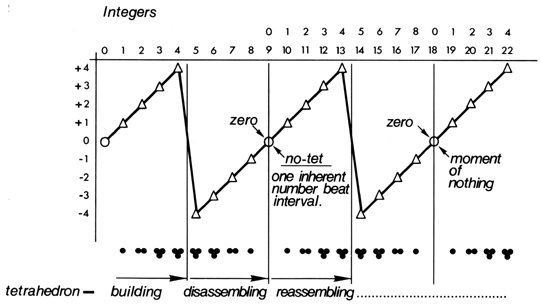
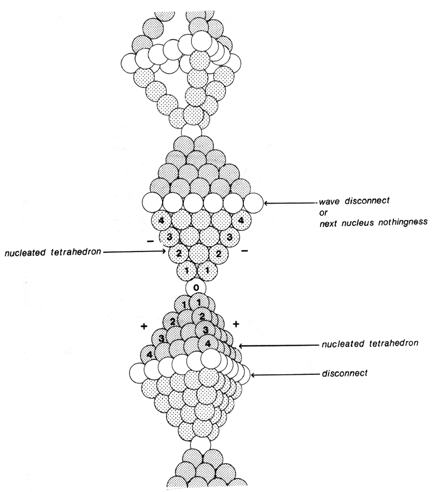
Fig. 1012.14B Wave, Quanta, Indigs, Unity-Is-Plural Bow Ties
Fig 1012.14B Wave, Quanta, Indigs, Unity-Is-Plural Bow Ties: This works for any pair of the ten pairs of tetrahedra in the vector equilibrium, of which only four pairs are active at any one time. The bow-tie waves illustrate the importance of zero. They come into phase with one another and with physics and chemistry. (Note the “Wave Disconnect” or next-nucleus nothingness.)
Link to original
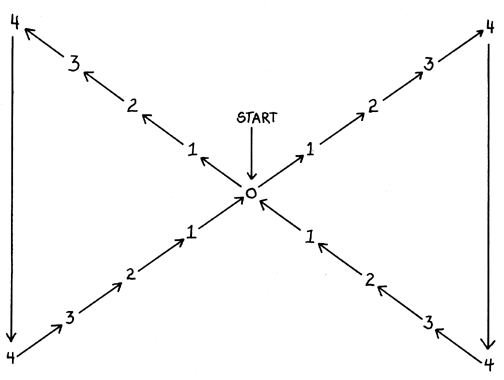
Applying the Indig-Numerology to the multiplication tables, this wave phenomenon reappears dramatically, with each integer having a unique operational effect on other integers. For instance, you look at the total multiplication patterns of the prime numbers three and five and find that they make a regular X. The foumess ( = + 4) and the fiveness ( = - 4) are at the positive-negative oscillation center; they decrease and then increase on the other side where the two triangles come together with a common center in bow-tie form. You find that the sequences of octaves are so arranged that the common ball can be either number eight or it could be zero or it could be one. That is, it makes it possible for waves to run through waves without having interference of waves. (See drawings section.)
1012.15
Each ball can always have a neutral function among these aggregates. It is a nuclear ball whether it is in a planar array or in an omnidirectional array. It has a function in each of the two adjacent systems which performs like bonding. This is the single energy- transformative effect on closest-packed spheres which, with the arhythmical sphere → space → space → sphere → space → space—suggests identity with the neutron-proton interchangeable functioning.
1012.16
The vector equilibrium as the prime convergence-divergence, i.e., gravity- radiation nucleus, provides the nuclear nothingness, the zero point where waves can go through waves without interfering with other waves. The waves are accommodated by the zeroness, by the octave of four positive and four negative phasings, and by a nuclear terminal inside-outing and a unique pattern-limit terminal outside-inning. But there are two kinds of positives and negatives: an inside-outing and an arounding. These are the additive twoness and the multiplicative twoness. The central ball then is an inside-outness and has its poles so it can accommodate either as a zeroness a wave that might go around it or go through it, without breaking up the fundamental resonance of the octaves.
1012.20
Pumping Model: The center ball of a vector equilibrium is zero. The frequency is zero, just as in the first layer the frequency is one. So zero times ten is zero; to the second power is zero; plus two is two. So the center ball has a value of two. The significance is that it has its concave and its convex. It has both insideness and outsideness congruently. It is as far as you can go. You turn yourself inside out and go in the other direction again. This is a terminal condition.
1012.21
We have then a tetrahedron that has an external and an internal: a terminal condition. Gravity converts to radiation. This is exactly why, in physics, Einstein’s supposition is correct regarding the conservation of Universe: it turns around at both the maximum of expansion and the minimum of contraction, because there is clearly provided a limit and its mathematical accommodation at which it turns itself inside out.
1012.22
You get to the outside and you turn yourself outside-in; you come to the center and turn yourself inside-out. This is why radiation does not go to higher velocity. Radiation gets to a maximum and then turns itself inwardly again—it becomes gravity. Then gravity goes to its maximum concentration and turns itself and goes outwardly, becomes radiation. The zero nineness-nucleus provides the means.
1012.30
Indestructibility of Tetrahedron: We have here a pumping model of the vector equilibrium. It consists only of the vector lines of the system formed by 12 uniradius spheres closest packed around one sphere of the same radius. The interconnecting lines between those 13 spheres produce the pumping vector equilibrium model’s skeleton frame. We have also removed the vector equilibrium’s 12 internal double radii to permit the vector equilibrium system to contract; thus we have for the moment removed its nuclear sphere. Every vector equilibrium has eight tetrahedra with 12 common edges, a common central vertex, and 12 common exterior vertexes. Each tetrahedron of the eight has four planes that are parallel to the corresponding four planes of the other seven. Each of the vector equilibrium’s eight tetrahedra has an external face perpendicular at its center to a radius developed outwardly from the nucleus. Each of the eight external triangular faces is interconnected flexibly at each of its three comers to one other of the eight triangles. It is found that the whole vector equilibrium external-vector framework can contract symmetrically, with the four pairs of the eight external triangles moving nontorquingly toward one another’s opposite triangle, which also means toward their common nucleus. As they do so, each of the four pairs of exterior triangles approaches its opposite. When the eight separate but synchronously contracting tetrahedra diminish in size to no size at all, then all eight planes of the eight triangles pass congruently through the same nuclear center at the same time to form the four planes of the vector equilibrium. (See Sec. 623.)
1012.31
Because each of the eight triangles had converged toward one another as four opposite pairs that became congruent in pairs, we seemingly see only four planes going through the center in the model. There are, however, really eight planes passing through the same vector-equilibrium nuclear point at the same time, i.e., through the empty, sizeless nucleus.
1012.32
As the eight tetrahedra diminished in size synchronously, their edges became uniformly smaller at a velocity of the first power; their areas became smaller at a velocity of the second power; and their volumes became smaller at a velocity of the third power— which are three very different velocities. Finally, they all reached zero velocity and size at the same time. As they became smaller, however, there was no change in their respective foumess of faces; sixness of edges; foumess of vertexes; nor equilateralness; nor equiangularity. These are changeless constants. So what you see in the model is eight sizeless tetrahedra that became one empty, sizeless, congruent set, with all their mathematically constant tetrahedral characteristics unaltered, ergo, conceptually manifest as eternity.
1012.33
What we speak of as a point is always eight tetrahedra converged to no size at all. The eight tetrahedra have been brought to zero size and are abstracted from time and special case. They are generalized. Though the empty vector-equilibrium model is now sizeless, we as yet have the planes converging to intercept centrally, indicating the locus of their vanishment. This locus of vanishment is the nearest to what we mean by a point. The point is the macro-micro switchabout between convergence and divergence.
1012.34
We also have learned that a plurality of lines cannot go through the same point at the same time. Therefore, the eight perpendiculars to the centers of area of the triangle faces and the 12 lines that led to their 12 common outer vertexes, like the tetrahedra’s volumes and areas, have come to common zero time-space size and can no longer interfere with one another. We find operationally, however, that there never was any paradoxical problem, such as Zeno’s “never completable approach” concept, for we have learned of the fundamental torque or twist always present in all experientially explored system realization, and we find that as each team of opposite triangles apprehended the other just upon their nearing the center, each is whirled 180 degrees, or is “half spun” about, with its three corners never completely converging. Whereafter they diverge.
1012.35
Take three round rods of the same diameter and nest them together in parallel triangulation. They are now closest-possibly-packed together. Now slip a triangular-shaped ring tightly around them and glide it to their midlength point. Now twist the ends of the three in opposite directions; the ends will open outwardly from one another as triangles. Stand the group on one three-point tripod end with wires between those opposite ends to limit their spreading. But they could also have twisted clockwise for the half-spin. They could half-spin alternatively to produce whole-cycle coverage. We find that three lines converge to critical proximity, then twist, and spin around one another. This happens also with all six of the diameters (or all 12 of the radii) of the vector equilibrium. (An articulating model of this can be made with four sets of three stiff brass wires each, laying the four sets in parallel, closest-packed bunches and soldering together the three wire ends at one end of each of the four bunches; it will be found that their total of 12 free ends may be lead through one another’s mid-girth in a symmetrically progressive manner, after which these led-through, four sets of ends may be respectively sprung together in sets of three and soldered together; which model then provides a number of very exciting intertransformabilities elucidating the vector equilibrium’s significance.) In the vector equilibrium, the “whole cycles” are accomplished in four planes corresponding symmetrically to one another as represented by the great-circle planes of the empty-state vector equilibrium or of its eight empty-state tetrahedra.
1012.36
Because the nuclear center of the vector equilibrium is also the generalized volumetric center of the spheres in the closest-packed condition, as well as of the spaces between the spheres, all of which correspond to all the vertexes (or all possible system convergences) of the isotropic vector matrix, we learn that all three vectorial lines of Universe can twist by one another producing half-spin, half-quantum, wave bulgings as they do without frustrating any form of intertransformative event development in Universe, and while also disclosing an absolute compatibility to, and elucidation of, wave- quanta behavior in generalized conceptuality.
1012.37
Reviewing the same phenomenon once again, we make further discovery of the utter interrelatedness of synergetic accommodation, as we find the half-spin “tepee” twist also turning the tetrahedron inside out. (See Sec. 621.20.) Here we find that the vector equilibrium, or the vector equilibrium’s eight tetrahedra’s external vertexes, all converged toward one another only to suddenly describe four half-great-circle spins as they each turned themselves inside out just before the convergence: thus accomplishing sizeless invisibility without ever coming into contact. Eternal interval is conserved. Thus the paradox of particle discontinuity and wave continuity is conceptually reconciled. (See Sec. 973.30.)
1013.00 Geometrical Function of Nine
[1013.00-1013.64 Geometry of Nine Scenario]
1013.10 Unity as Two: Triangle as One White Triangle and One Black Triangle
1013.11
Fish fan their tails sideways to produce forward motion. Snakes wriggle sideways to travel ahead. Iceboats attain speeds of 60 miles per hour in a direction at right angles to wind blowing at half that speed. These results are all precessional.
1013.12
The minialtitude tetrahedron seen as a flattened triangle has a synergetic surprise behavior akin to precession. We can flip one simple white triangle over and find that the other side is black. One triangle must thus be considered as two triangles: the obverse and reverse, always and only coexisting almost congruent polar end triangles of the almost zerolong prism.
1013.13
Polarity is inherent in congruence.
1013.14
Every sphere has a concave inside and a convex outside. Convex and concave are not the same: concave reflectors concentrate energy; radiation and convex mirrors diffuse the radiant energy.
1013.15
Unity is plural and at minimum two. Unity does not mean the number one. One does not and cannot exist by itself.
1013.16
In Universe life’s existence begins with awareness. No otherness: no awareness. The observed requires an observer. The subjective and objective always and only coexist and therewith demonstrate the inherent plurality of unity: inseparable union.
1013.20 Complementarity and Parity
1013.21
Physics tends to think of complementarity and parity as being the interrelationship characteristics of two separate phenomena. Complementarity was discovered half a century ago, while parity was first recognized only 20 years ago. In fact the non-mirror-imaged complementations are two aspects of the same phenomenon. The always-and-only-coexisting non-mirror-image complementations also coexist as inseparable plural unity.
1013.30 Eight Three-petaled Tetrahedral Flower Buds
1013.31
We can interconnect the three mid-edged points of an almost-zero-altitude tetrahedron, a thin-material triangle, thus subdividing a big triangle into four smaller similar triangles. We recall that the big triangle must be considered as two triangles; the obverse may be white and the reverse may be black. We can fold the three corner triangles around the three lines separating them from the central triangle, thereby producing two different tetrahedra. Folding the corner triangles under or over produces either a white tetrahedron with a black inside or a black tetrahedron with a white inside. Since the outside of the tetrahedron is convex and the inside is concave, there are two very real and separate tetrahedra in evidence. Eight faces (four black, four white) have been evolved from only four externally viewable triangles, and these four were in turn evolved from one (unity-is-plural) triangle—an almost-zero-altitude tetrahedral system or an almost-zero- altitude prismatic system.
1013.32
Both the positive and negative concave tetrahedra have four different black faces and four different white faces. We can differentiate these eight faces by placing a red, a green, a yellow, and a blue dot in the center of each of their respective four white inside faces, and an orange, a purple, a brown, and a gray dot in the center of each of their outside black triangles successively.
1013.33
Each of the two tetrahedra can turn themselves inside out as their three respective triangular corners rotate around the central (base) triangle’s three edge hinges—thus to open up like a three-petaled flower bud. Each tetrahedron can be opened in four such different flower-bud ways, with three triangular petals around each of their four respective triangular flower-receptacle base faces.
1013.34
The four separate cases of inside-outing transformability permit the production of four separate and unique positive and four separate and unique negative tetrahedra, all generated from the same unity and each of which can rank equally as nature’s simplest structural system.
1013.40 Nine Schematic Aspects of the Tetrahedron
1013.41
Every tetrahedron, every prime structural system in Universe, has nine separate and unique states of existence: four positive, four negative, plus one schematic unfolded nothingness, unfolded to an infinite, planar, neither-one-nor-the-other, equilibrious state. These manifest the same schematic “game” setups as that of physics’ quantum mechanics. Quantum mechanics provides for four positive and four negative quanta as we go from a central nothingness equilibrium to first one, then two, then three, then four high-frequency, regenerated, alternate, equiintegrity, tetrahedral quanta. Each of the eight tetrahedral quanta also has eight invisible counterparts. (See Figs. 1012.14A-B, and 1012.15.)
1013.42
When the four planes of each of the eight tetrahedra move toward their four opposite vertexes, the momentum carries them through zerovolume nothingness of the vector equilibrium phase. All their volumes decrease at a third-power rate of their linear rate of approach. As the four tetrahedral planes coincide, the four great-circle planes of the vector equilibrium all go through the same nothingness local at the same time. Thus we find the vector equilibrium to be the inherent zero-nineness of fundamental number behavior. (See color plate 31.)
1013.50 Visible and Invisible Tetrahedral Arrays
1013.51
Visibly Demonstrable: Physical
| Four white, three-petaled flowers |
|---|
| 1 red base |
| 1 green base |
| 1 yellow base |
| 1 blue base |
| Four black, three-petaled flowers |
|---|
| 1 orange base |
| 1 purple base |
| 1 brown base |
| 1 gray base |
1013.52
Invisible But Thinkable: Metaphysical
| Four white, three-petaled flowers |
|---|
| 1 orange base |
| 1 purple base |
| 1 brown base |
| 1 gray base |
| Four black, three-petaled flowers |
|---|
| 1 red base |
| 1 green base |
| 1 yellow base |
| 1 blue base |
1013.60 Quantum Jump Model
1013.61
All of the triangularly petaled tetrahedra may have their 60-degree corners partially open and pointing out from their bases like an opening tulip bud. We may take any two of the 60-degree petaled tetrahedra and hold them opposite one another while rotating one of them in a 60-degree turn, which precesses it axially at 60 degrees, thus pointing its triangular petals toward the other’s 60-degree openings. If we bring them together edge to edge, we will produce an octahedron. (Compare Sec. 1033.73.)
1013.62
The octahedron thus produced has a volume of four tetrahedra. Each of the separate tetrahedra had one energy quantum unit. We now see how one quantum and one quantum may be geometrically joined to produce four quanta. Another quantum jump is demonstrated.
1013.63
Each of the two tetrahedra combining to make the octahedron can consist of the eight unique combinations of the black and the white triangular faces and their four red, green, yellow, and blue center dots. This means that we have an octahedron of eight black triangles, one of eight white, and one of four white plus four black, and that the alternation of the four different color dots into all the possible combinations of eight produces four times 26 — which is the 104 possible combinations.
1013.64
Where N = 8 and there are four sets of 8, the formula for the number of combinations is:
This result has a startling proximity to the 92 unique regenerative chemical elements plus their additional non-self-regenerative posturanium atoms.