1030.10
Omniequilibrium of Vector Equilibrium: I seek a word to express most succinctly the complexedly pulsative, inside-outing, integrative-disintegrative, countervailing behaviors of the vector equilibrium. “Librium” represents the degrees of freedom. Universe is omnilibrious because it accommodates all the every-time-recurrent, alternatively-optional degrees of equieconomical freedoms. Omniequilibrious means all the foregoing.
1030.11
The sphere is a convex vector equilibrium, and the spaces between closest- packed uniradius spheres are the concave vector equilibria or, in their contractive form, the concave octahedra. In going contractively from vector equilibrium to equi-vector- edged tetrahedron (see Sec. 460), we go from a volumetric 20-ness to a volumetric oneness, a twentyfold contraction. In the vector-equilibrium jitterbug, the axis does not rotate, but the equator does. On the other hand, if you hold the equator and rotate the axis, the system contracts. Twisting one end of the axis to rotate it terminates the jitterbug’s 20-volume to 4-volume octahedral state contraction, whereafter the contraction momentum throws a torque in the system with a leverage force of 20 to 1. It contracts until it becomes a volume of one as a quadrivalent tetrahedron, that is, with the four edges of the tetrahedron congruent. Precessionally aided by other galaxies’ mass-attractive tensional forces acting upon them to accelerate their axial, twist-and-torque-imposed contractions, this torque momentum may account for the way stars contract into dwarfs and pulsars, or for the way that galaxies pulsate or contract into the incredibly vast and dense, paradoxically named “black holes.”
1030.20
Gravitational Zone System: There is no pointal center of gravity. There is a gravitational-zone-system, a zone of concentration with minimum-maximum zone system limits. Vertex is in convergence, and face is in divergence. Synergetics geometry precession explains radial-circumferential accelerational transformations.
1031.10 Dynamic Symmetry
1031.11
When we make the geodesic subdivisions of symmetrically omnitriangulated systems, the three corner angles increase to add up to more than 180 degrees because they are on a sphere. If we deproject them back to the icosahedron, they become symmetrical again, adding to exactly 180 degrees. They are asymmetrical only because they are projected out onto the sphere. We know that each corner of a two-frequency spherical icosahedron has an isosceles triangle with an equilateral triangle in the center. In a four- frequency spherical icosahedron there are also six scalenes: three positive and three negative sets of scalenes, so they balance each other. That is, they are dynamically symmetrical. By themselves, the scalenes are asymmetrical. This is synergy. This is the very essence of our Universe. Everything that you and I can observe or sense is an asymmetrical aspect of only sum-totally and nonunitarily-conceptual, omnisymmetrical Universe.
1031.12
Geodesic sphere triangulation is the high-frequency subdivision of the surface of a sphere beyond the icosahedron. You cannot have omnisymmetrical, equiangle and equiedged, triangular, system subdivisioning in greater degree than that of the icosahedron’s 20 similar triangles.
1031.13
As we have learned, there are only three prime structural systems of Universe: tetrahedron, octahedron, and icosahedron. When these are projected on to a sphere, they produce the spherical tetrahedron, the spherical octahedron, and the spherical icosahedron, all of whose corner angles are much larger than their chordal, flat-faceted, polyhedral counterpart corners. In all cases, the corners are isosceles triangles, and, in the even frequencies, the central triangles are equilateral, and are surrounded by further symmetrically balanced sets of positive and negative scalenes. The higher the frequency, the more the scalenes. But since the positive and negative scalenes always appear in equal abundance, they always cancel one another out as dynamically complementarily equilateral. This is all due to the fact that they are projections outwardly onto a sphere of the original tetrahedron, octahedron, or icosahedron, which as planar surfaces could be subdivided into high-frequency triangles without losing any of their fundamental similarity and symmetry.
1031.14
In other words, the planar symmetrical is projected outwardly on the sphere. The sphere is simply a palpitation of what was the symmetrical vector equilibrium, an oscillatory pulsation, inwardly and outwardly—an extension onto an asymmetrical surface of what is inherently symmetrical, with the symmetricals going into higher frequency. (See Illus. 1032.12, 1032.30, and 1032.31.)
1031.15
What we are talking about as apparent asymmetry is typical of all life. Nature refuses to stop at the vector-equilibrium phase and always is caught in one of its asymmetric aspects: the positive and negative, inward and outward, or circumferentially askew alterations.
1031.16
Asymmetry is a consequence of the phenomenon time and time a consequence of the phenomenon we call afterimage, or “double-take,” or reconsideration, with inherent lags of recallability rates in respect to various types of special-case experiences. Infrequently used names take longer to recall than do familiar actions. So the very consequence of only “dawning” and evolving (never instantaneous) awareness is to impose the phenomenon time upon an otherwise timeless, ergo eternal Universe. Awareness itself is in all these asymmetries, and the pulsations are all the consequences of just thought itself: the ability of Universe to consider itself, and to reconsider itself. (See Sec. 529.09.)
1032.00 Convex and Concave Sphere-Packing Intertransformings
1032.10
Convex and Concave Sphere-Packing Intertransformings as the Energy Patterning Between Spheres and Spaces of Omni-Closest-Packed Spheres and Their Isotropic-Vector-Matrix Field: When closest-packed uniradius spheres are interspersed with spaces, there are only two kinds of spaces interspersing the closest-packed spheres: the concave octahedron and the concave vector equilibrium. The spheres themselves are convex vector equilibria complementing the concave octahedra and the concave vector equilibria. (See Secs. 970.10 and 970.20.)
1032.11
The spheres and spaces are rationally one-quantum-jump, volumetrically coordinate, as shown by the rhombic dodecahedron’s sphere-and-space, and share sixness of volume in respect to the same nuclear sphere’s own exact fiveness of volume (see Secs. 985.07 and 985.08), the morphological dissimilarity of which render them one-quantumly disequilibrious, i.e., asymmetrical phases of the vector equilibrium’s complex of both alternate and coincident transformabilities. They are involutionally-evolutionally, inward- outward, twist-around, fold-up and unfold, multifrequencied pulsations of the vector equilibria. By virtue of these transformations and their accommodating volumetric involvement, the spheres and spaces are interchangeably intertransformative. For instance, each one can be either a convex or a concave asymmetry of the vector equilibrium, as the “jitterbug” has demonstrated (Sec. 460). The vector equilibrium contracts from its maximum isotropic-vector-matrix radius in order to become a sphere. That is how it can be accommodated within the total isotropic-vector-matrix field of reference.
1032.12
Fig. 1032.12 Convex and Concave Sphere Packing Voids
Fig. 1032.12 Convex and Concave Sphere Packing Voids:
Link to original
A. In a tetrahedron composed of four spheres, the central void is an octahedron with four concave spherical triangular faces and four planar triangular faces with concave sides. This can be described as a “concave octahedron.”
B. In an octahedron composed of six close-packed spheres, the central void is a vector equilibrium with six concave spherical square faces and eight triangular faces with concave sides: a “concave vector equilibrium.”
C. The vector equilibrium with edges arced to form a sphere: a convex vector equilibrium.
D. The vector equilibrium with arcs on the triangular faces defined by spheres tangent at vertexes: a concave vector equilibrium.
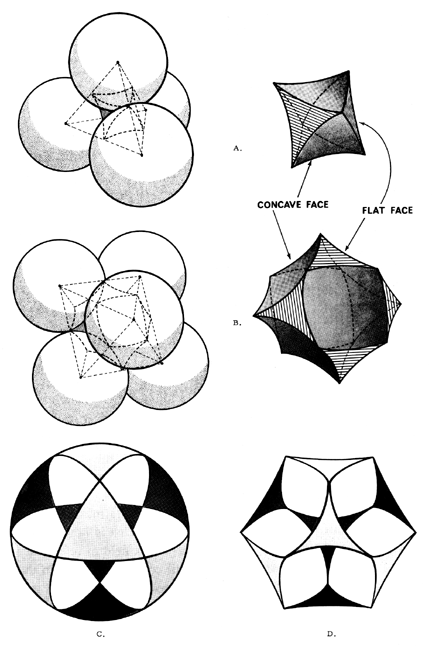
As the vector equilibrium’s radii contract linearly, in the exact manner of a coil spring contracting, the 24 edges of one-half of all the vector equilibria bend outwardly, becoming arcs of spheres. At the same time, the chords of the other half of all the vector equilibria curve inwardly to produce either concave-faced vector-equilibria spaces between the spheres or to form concave octahedra spaces between the spheres, as in the isotropic-vector-matrix field model (see Illus. 1032.12). Both the spheric aspect of the vector equilibrium and the “space” aspect are consequences of the coil-spring-like contraction and consequent chordal “outward” and “inward” arcing complementation of alternately, omnidirectionally adjacent vector equilibria of the isotropic-vector-matrix field.
1032.13
In a tetrahedron composed of four spheres, the central void is an octahedron with four concave spherical triangular faces and four planar triangular faces with concave edges. This can be described as a concave octahedron. In an octahedron composed of six closest-packed spheres, the central void is a vector equilibrium with six concave spherical square faces and eight triangular faces with concave edges: a concave vector equilibrium. The vector equilibrium, with edges arced to form a sphere, may be considered as a convex vector equilibrium. Illus. 1032.12D shows the vector equilibrium with arcs on the triangular faces defined by spheres tangent at vertexes: a concave vector equilibrium.
1032.20
Energy Wave Propagation: The shift between spheres and spaces is accomplished precessionally. You introduce just one energy action—push or pull—into the field, and its inertia provides the reaction to your push or pull; the resultant propagates the everywhere locally sphere-to-space, space-to-sphere omni-intertransformations whose comprehensive synergetic effect in turn propagates an omnidirectional wave. Dropping a stone in the water discloses a planar pattern of precessional wave regeneration. The local unit-energy force articulates an omnidirectional, spherically expanding, four-dimensional counterpart of the planar water waves’ circular expansion. The successive waves’ curves are seen generating and regenerating and are neither simultaneous nor instantaneous.
1032.21
The only instantaneity is eternity. All temporal (temporary) equilibrium life- time-space phenomena are sequential, complementary, and orderly disequilibrious intertransformations of space-nothingness to time-somethingness, and vice versa. Both space realizations and time realizations are always of orderly asymmetric degrees of discrete magnitudes. The hexagon is an instantaneous, eternal, simultaneous, planar section of equilibrium, wherein all the chords are vectors exactly equal to all the vector radii: six explosively disintegrative, compressively coiled, wavilinear vectors exactly and finitely contained by six chordal, tensively-coil-extended, wavilinear vectors of equal magnitude.
1032.22
Physics thought it had found only two kinds of acceleration: linear and angular. Accelerations are all angular, however, as we have already discovered (Sec. 1009.50). But physics has not been able to coordinate its mathematical models with the omnidirectional complexity of the angular acceleration, so it has used only the linear, three-dimensional, XYZ, tic-tac-toe grid in measuring and analyzing its experiments. Trying to analyze the angular accelerations exclusively with straight lines, 90-degree central angles, and no chords involves pi (π) and other irrational constants to correct its computations, deprived as they are of conceptual models.
1032.23
Critical-proximity crimping-in of local wave coil-spring contractions of the Little System by the Big System reveals the local radius as always a wavilinear short section of a greater system arc in pure, eternal, generalized principle.
1032.30
Fig. 1032.30 Space Filling of Octahedron and Vector Equilibrium
Fig. 1032.30 Space Filling of Octahedron and Vector Equilibrium: The packing of concave octahedra, concave vector equilibria, and spherical vector equilibria corresponds exactly to the space filling of planar octahedra and planar vector equilibria. Exactly half of the planar vector equilibria become convex; the other half and all of the planar octahedra become concave.
Link to original
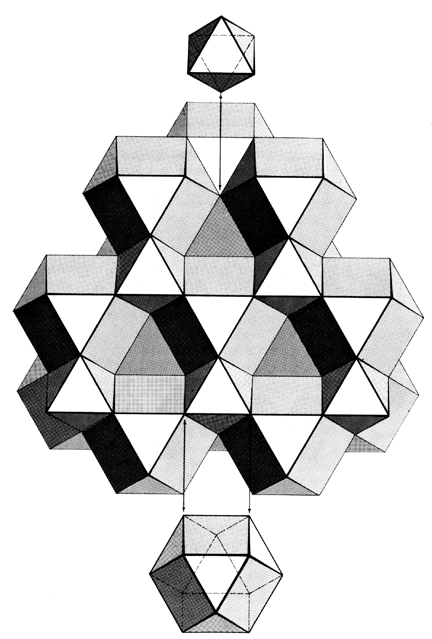
Complementary Allspace Filling of Octahedra and Vector Equilibria: The closest packing of concave octahedra, concave vector equilibria, and spherical vector equilibria corresponds exactly to the allspace filling of planar octahedra and planar vector equilibria (see Sec. 470). Approximately half of the planar vector equilibria become concave, and the other half become spherical. All of the planar octahedra become concave (see Illus. 1032.30).
1032.31
Fig. 1032.31
Fig. 1032.31 Concave Octahedra and Concave Vector Equilibria Define Spherical Voids and Energy Trajectories: “Concave octahedra” and “concave vector equilibria” pack together to define the voids of an array of close-packed spheres which in conjunction with the convex spherical vector equilibria fill allspace. This array suggests how energy trajectories may be distributed through great-circle geodesic arcs from one sphere to another always passing through the vertexes of the array, which are the vertexes of the vector equilibria and the points where the spheres touch each other.
Link to original
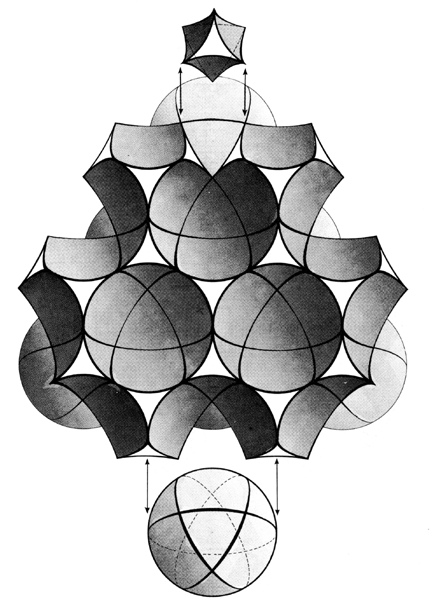
Concave octahedra and concave vector equilibria close-pack together to define the voids of an array of closest-packed spheres which, in conjunction with the spherical vector equilibria, fill allspace. This array suggests how energy trajectories may be routed over great-circle geodesic arcs from one sphere to another, always passing only through the vertexes of the array—which are the 12 external vertexes of the vector equilibria and the only points where the closest-packed, uniradius spheres touch each other (see Illus. 1032.31).
1033.00 Intertransformability Models and Limits
[1033.00-1033.92 Involvement Field Scenario]
1033.010 Generation of the Involvement Field in Which Synergetics Integrates Topology, Electromagnetics, Chemistry and Cosmology
1033.011
Commencing with the experimentally demonstrated proof that the tetrahedron is the minimum structural system of Universe (i.e., the vectorially and angularly self-stabilizing minimum polyhedron consisting of four minimum polygons in omnisymmetrical array), we then discover that each of the four vertices of the tetrahedron is subtended by four “faces,” or empty triangular windows. The four vertices have proven to be only whole-range tunable and point-to-able noise or “darkness” centers—which are primitive (i.e., as yet frequency-blurred), systemic somethings (see Secs. 505.65, 527.711, and 1012.33) having six unique angularly intersightable lines of interrelationship whose both-ends-interconnected six lines produce four triangular windows, out through which each of the four system-defining somethings gains four separate views of the same omninothingness of as-yet-untuned-in Universe. As subtunable systems, points are substances, somethings ergo, we have in the tetrahedron four somethings symmetrically arrayed against four nothingnesses. (Four INS versus four OUTS.)
1033.012
The four somethingnesses are mass-interattractively interrelated by six interrelationship tensors—each tensor having two other interconnected tensor restraints preventing one another and their four respective vertexial somethings from leaving the system. Like a three-rubber-banded slingshot, each of the four sets of three restraining, but in fact vertexially convergent, tensors not only restrains but also constrains their respective four somethings to plunge aimedly into-through-and-out their respectively subtended triangular windows, into the unresisting nothingness, and penetrating that nothingness until the stretchable limit of the three tensors is reached, whereat they will be strained into reversing the direction of impelment of their vertexial somethings. Thus we discovered the tetrahedron’s inherent proclivity to repeatedly turn itself inside out, and then outside-out, and reverse. Thus the tetrahedron has the means to convert its tuned-in-ness to its turned- out-and-tuned-outness, which inherently produces the frequencies of the particular discontinuities of electromagnetic Universe.
1033.013
Because there are four symmetrically arrayed sets of nothingnesses subtending four somethings, there are four ways in which every minimum structural system in Universe may be turned inside out. Ergo, every tetrahedron is inherently eight tetrahedra, four outside-out and four inside-out: the octave system.
1033.014
We deliberately avoid the terms positive and negative and—consistent with experience—may use the words active and passive respectively for outside-out and inside- out. Active means “now in use”; passive means “not in use now.”
1033.015
Since the somethings are the INS and the nothingness is OUT, outside-out and inside-out are experientially meaningful. There are inherently a plurality of different nothingness OUTS consisting of all the potential macro- and microranges of “presently untuned-in” systemic frequencies.
1033.016
Experientiality, which is always in time, begins with an observer and an observed—i.e., two somethings, two INdividuals—with the observed other individual only differentially perceivable against the omninothingness, the presently untuned-IN, ergo OUT. (The observer and the otherness may be integral, as in the complex individual—the child’s hand discovering the otherness of its own foot, or the tongue-sense discovering the taste of the tactile-sensing thumb, or the outside thumb discovering the insideness of the mouth.)
1033.017
We have elsewhere reviewed the progressive tangential agglomeration of other “spherical” somethings with the otherness observer’s spherical something (Secs. 411.01-08) and their four-dimensional symmetry’s systemic intermotion blocking and resultant system’s interlockage, which locking and blocking imposes total system integrity and permits whole-system-integrated rotation, orbiting, and interlinkage with other system integrities.
1033.018
Since we learned by experimental proof that our four-dimensional symmetry accommodates three axial freedoms of rotation motion (see the Triangular-cammed, In- out-and-around, Jitterbug Model, Sec. 465), while also permitting us to restrain³ one of the four axes of perpendicularity to the four planes, i.e., of the INS most economically— or perpendicularly—approaching the tensor relationship’s angularly planed and framed views through to the nothingness, we find that we may make a realistic model of the omniinvolvement field of all eight phases of the tetrahedron’s self-intertransformability.
(Footnote 3: “Restrain” does not mean motionless or “cosmically at rest.” Restrain does mean “with the axis locked into congruent motion of another system.” Compare a system holding in relative restraint one axis of a four-axis wheel model.)
1033.019
Fig. 1033.019 Circuit Pattern Tensegrity
Fig. 1033.019 Circuit Pattern Tensegrity: In Anthony Pugh’s model 12 struts form four interlocking but nontouching triangular circuits. The plane of each triangle of struts bisects the vector equilibrium which its vertexes define. Each triangle of struts is inscribed within a hexagonal circuit of tensors.
Link to original
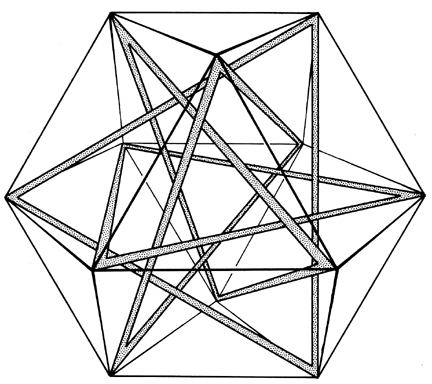
The involvement field also manifests the exclusively unique and inviolable fourfold symmetry of the tetrahedron (see Cheese Tetrahedron, Sec. 623), which permits us always to move symmetrically and convergently each—and inadvertently any or all—of the four triangular window frames perpendicularly toward their four subtending somethingness-converging-point-to-able IN foci, until all four planes pass through the same threshold between INness and OUTness, producing one congruent, zerovolume tetrahedron. The four inherent planes of the four tensegrity triangles of Anthony Pugh’s model⁴* demonstrate the nothingness of their four planes, permitting their timeless—i.e., untuned—nothingness congruence. (See Fig. 1033.019.) The tuned-in, somethingness lines of the mathematician, with their inherent self-interferences, would never permit a plurality of such lines to pass through the same somethingness points at the same time (see Sec. 517).
(Footnote 4: This is what Pugh calls his “circlit pattern tensegrity,” described on pages 19-22 of his An Introduction to Tensegrity (Berkeley: University of California Press, 1976.)
1033.020
Four-triangular-circuits Tensegrity: The four-triangular-circuits tensegrity relates to the four great circles of the vector equilibrium. The four great circles of the vector equilibrium are generated by the four axes of vector equilibrium’s eight triangular faces. Each of the four interlocking triangles is inscribed within a hexagonal circuit of vectors—of four intersecting hexagonal planes of the vector equilibrium. These tensegrity circuits relate to the empty tetrahedron at its center. (See Secs. 441.021, 938.12, and 1053.804.)
1033.021
Our omniinvolvement tetrahedral-intertransformability, isotropic-vector- matrix-field of any given relative frequency can accommodate both the tetrahedron’s most complexedly expansive-divergent domain and its most convergence-to-untuned- nothingness identification, while also maintaining the integrity of its inherent isolatability from both all otherness and all nothingness.
1033.022
The involvement field also identifies the unique cosmically inviolate environment domain of convergent-divergent symmetrical nuclear systems, i.e., the vector equilibrium’s unique domain provided by one “external” octahedron (see Sec. 415.17), which may be modeled most symmetrically by the 4-tetravolume octahedron’s symmetrical subdivision into its eight similar asymmetric tetrahedra consisting of three 90-degree angles, three 60-degree angles, and six 45-degree angles, whose 60-degree triangular faces have been addressed to each of the vector equilibrium’s eight outermost triangular windows of each of the eight tetrahedra of the 20-tetravolume vector equilibrium.
1033.023
Any one triangular plane formed by any three of the vertexial somethings’ interrelationship lines, of any one omnitriangulated tetrahedral system, of any isotropic vector matrix grid, can move in only four-degrees-of-freedom directions always to reach to-or-fro limits of vertexial convergences, which convergences are always zerovolume.
1033.030 Untenable Equilibrium Compulsion
1033.031
In the 20-tetravolume vector equilibrium we have four passive and four active tetrahedra vertexially interconnected. The eight tetrahedra have a total of 32 vertexes. In the 20-tetravolume vector equilibrium each tetrahedron has three of its vertexial somethings outwardly arrayed and one vertexial something inwardly arrayed. Their 24 externally arrayed vertexes are congruently paired to form the 12 vertexes of the vector equilibrium, and their eight interior vertexial somethings are nuclear congruent; ergo, four-forcedly-more-vector-interconstrained than any of their externally paired vertexial something sets: an untenable equilibrium compulsion (UEC). (Compare Secs. 1012.11 and 1224.13.)
1033.032
The untenable equilibrium compulsion (UEC) inherently impels the nucleus toward and through any of the nucleus’s eight externally subtended triangular windows, the three corners of each of which are two-tensor-restrained (six tensors per triangular window) by the gravitationally embracing, circumferentially closed tensors. This empowers the nuclear eightfold-congruent somethings to exit pulsatingly through the windows to a distance one-half that of the altitude of the regular tetrahedron, which is describable to the eight divergent points by mounting outwardly of the eight Eighth- Octahedra on each of the eight triangular window frames of the vector equilibrium, which thereby describe the cube of 24 tetravolumes (i.e., eight of the primitive, Duo-Tet- described cubes of three tetravolumes). These eight external pulsative points are inherently center-of-volume terminalled when nuclear systems are closest packed with one another. Thus we find the total nuclear domain of Universe to have a tetravolume of 24. When the vector equilibrium nucleus has no closest-packed-around-it, nucleated vector equilibrium systems, then the eightfold nuclear impelment works successively to expel its energies pulsatingly and radiantly through all eight of its windows.
1033.10 Octave System of Polyhedral Transformations
1033.101
The systematic outsideness is the macrountuned: the ultratunable. The systemic insideness is the micrountuned: the infratunable. The system is the discretely tuned-in conceptuality.
1033.102
The closest-packed spheres are simply the frequencies that are activated, that get into closest proximity as a continuum of the outsideness:
— the critical proximity spherical zone, which is fall-in-here or fall-in-there or independently in orbit for shorter or longer time spans;
— the boundary layer;
— the mass-interattractively tensioned (trampoline) field, which is as deeply near as any proximate systems can come to “tangency”;
— the threshold zone of tuned-in but non-frequency-differentialed; when a system is at the threshold, it is non-frequency-modulated, hence only a point-to-able noise or gray, nondescript color.
1033.103
If there were a geometric outsideness and insideness, we would have a static geometrical Universe. But since the insideness and outsideness are the as-yet-untuned-in or no-longer-tuned-in wavelengths and their frequencies, they require only Scenario Universe, its past and future. Only the NOW conceptualizing constitutes a geometry—the immediate conceptual, special-case, systemic episode in a scenario of nonunitarily conceptual, nonsimultaneous, and only partially overlapping, differently enduring, differently magnituded, special-case, systemic episodes, each in itself a constellation of constellations within constellations of infra- or ultratunably frequenced, special case frequenced systems (Compare Sec. 321.05.)
1033.104
The isotropic-vector-matrix-field has an infinite range of electromagnetic tunings that are always multiplying frequency by division of the a priori vector equilibrium and its contained cosmic hierarchy of timeless-sizeless primitive systems’ unfrequenced state. At maximum their primitive comprehensive domain is that of the six-tetravolume, 24-A-and-B-quanta-moduled, unfrequenced rhombic dodecahedron, the long axis of whose 12 diamond faces is also the prime vector length of the isotropic vector matrix. At primitive minimum the unfrequenced state is that of the six-A-and-B-quanta-moduled Syte. Both the maximum and minimum, primitive, greatest and least primitive common divisors of Universe may be replicatively employed or convergently composited to produce the isotropic vector matrix field of selectable frequency tunability, whose key wavelength is that of the relative length of the uniform vector of the isotropic vector matrix as initially selected in respect to the diameter of the nucleus of the atom.
1033.11
Fig. 1033.11 Electromagnetic Field of Closest-packed spheres
Fig. 1033.11 Electromagnetic Field of Closest-packed spheres: This figure represents one of the four planes of symmetry of the closest-packed unit-radius spheres, of the isotropic vector matrix. Between the untuned macro and the untuned micro is the transceivered frequency operation of the tuned-in and transmitted information.
Link to original
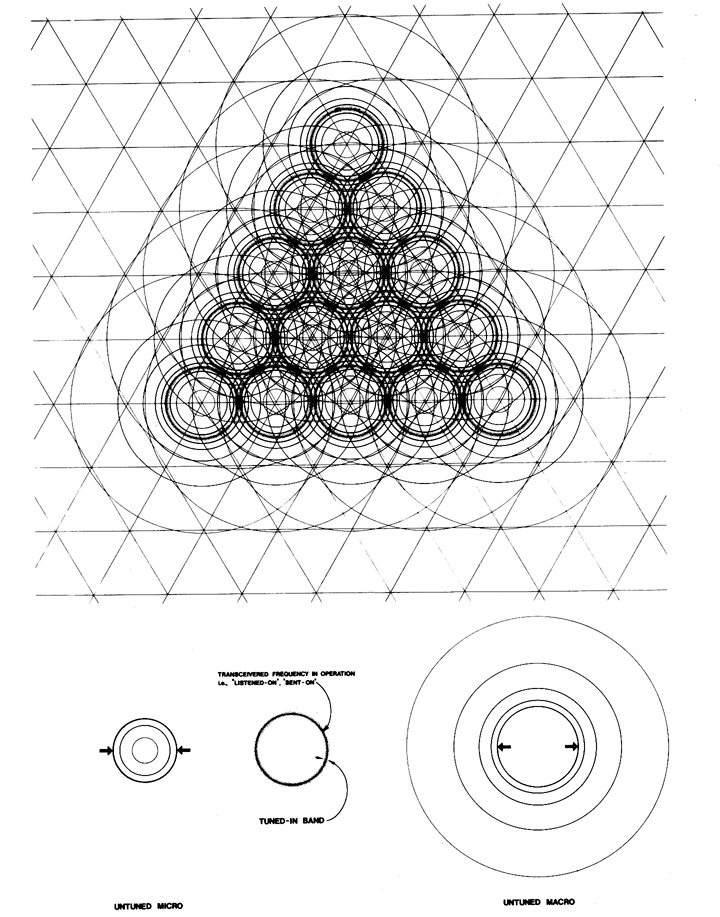
Every electromagnetic wave propagation generates its own cosmic field. This field is a four-dimensional isotropic vector matrix that can be readily conceptualized as an aggregation of multilayered, closest-packed, unit-radius spheres. (See Fig. 1033.111A.) Unit-radius spheres pack tangentially together most closely in 60-degree intertriangulations. Atoms close-pack in this manner. The continuum of inherent outsideness of all systems enters every external opening of all closest-packed, unit-radius sphere aggregates, permeating and omnisurrounding every closest-packed sphere within the total aggregate. Between the closest-packed, unit-radius spheres the intervening voids constitute a uniform series of unique, symmetrical, curvilinear, geometrical shapes, and the successive centers of volumes of those uniform phase voids are uniformly interspaced— the distance between them being always the same as the uniform distances between adjacent closest-packed spheres.
1033.111
Fig. 1033.111A
Fig. 1033.111A Photograph of Southeast Asian Reed Sphere Woven on Three-way Grid.
Link to original
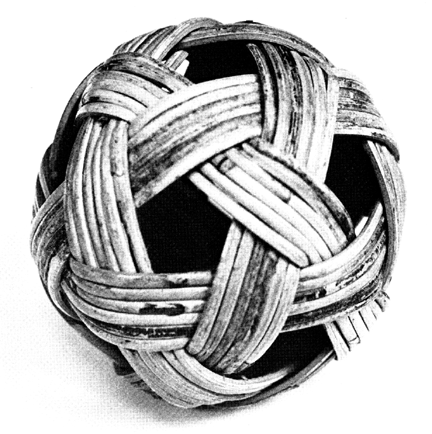
Fig. 1033.111 B-D
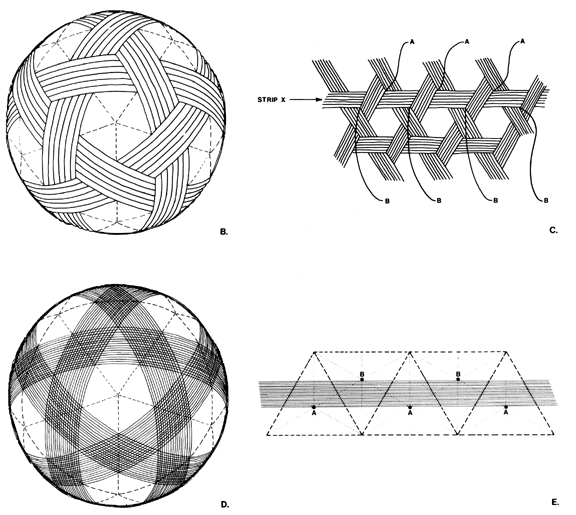
Fig. 1033.111 B-D:
Link to original
B. Diagram of three-way grid sphere.
C. Band widths of frequency tunability.
D. Six great circle band widths of spherical icosahedron.
E. Centers of volumes of tetrahedra are control matrix for electromagnetic band widths.
Each of the closest-packed, unit-radius spheres is itself a geodesic sphere, a spherical sieve with triangular openings: a tetra-, octa-, or icosasphere of some frequency of modular subdivision. (Compare the fallacy of the Greek sphere as described at Secs. |981.19, 1022.11-13, 1106.22, and 1107.21.) Wherefore, each of the closest-packed spheres is permeable by higher-frequency, shorter-wavelength, electromagnetic propagations; ergo, appropriately frequenced fields may pass through the isotropic vector matrix’s electromagnetic field of any given wavelengths without interference. Not only does each closest-packed sphere consist of a plurality of varifrequenced vertices interconnected by chords that define the triangular sieve, but also these vertexial somethings are mass-interattractively positioned and have their own boundary layer (trampoline) cushions; ergo, they are never in absolute tangency.
1033.112
The isotropic vector matrix grid illustrates that frequency multiplication may be accomplished only by division. The unit-radius spheres of the isotropic vector matrix electromagnetic fields close-pack in four planes of symmetry, permitting four-dimensional electromagnetic wavebands. The three-way, spherical, electromagnetic, basketry interweaving is illustrated at Fig. 1033.111B. There are six great-circle equators of the six axes formed by the 12 vertices of the spherical icosahedron. The centers of area of the spherical triangles thus formed describe the terminals of the electromagnetic waveband widths. The widths of the bands of frequency tunability are determined by the truncatability of the spherical icosahedron’s six bands as they run between the centers of area of the adjacent triangles.
1033.113
Note that the centers of area of the adjacent spherical triangles are alternately staggered so as to define a broad path within which the electromagnetic waveband is generated.
1033.120 Click-stop Subdivisioning
1033.121
In synergetic geometry we witness the transformation of all spheres into their local complementary inter-void domains as the local inter-void domains transform into closest-packed, unit-radius spheres. (See Fig. 1032.31.) The multifrequenced tetrahedral, octahedral, and icosahedral geodesic subdivisioning of spherical projections of the primitive polyhedral systems describes how the complex interbonding of substances occurs; it is further described by the varying radii of the closest-packed spheres and the complex of isotropic vector matrixes required to accommodate the varying radii as well as their ultra- and infrapermeating: this elucidates the resonance of substances as well as the unique electromagnetic frequencies of chemical elements. Here is the grand synergetic nexus integrating electromagnetics, chemistry, and topology.
1033.122
Synergetics arouses human awareness of the always-and-only-co-occurring, non-tuned-in cosmic complementations of our only-from-moment-to-moment systematically tuned-in conceptionings. Synergetics’ always symmetrical, complementarily expanding and contracting intertransformings disclose a succession of “local way stations.” Progressive arrival at these convergent-divergent “way station” states discloses a succession of immediately neighboring, larger-to-smaller, symmetrical polyhedra of diminishingly numbered topological characteristics, which all together constitute a cosmic hierarchy of symmetrical, rationally volumed, most primitive, pattern-stabilization states. Superficially the states are recognizable as the family of Platonic polyhedra.
1033.123
Throughout the convergent phase of the transformation continuum, all the vertices of these successive Platonic forms and their intertransformative phases are always diminishingly equidistant from the same volumetric center. The omnisymmetrical contraction is accommodated by the angular closing—scissor-hinge-wise—of immediately adjacent edges of the polyhedra. The vertices of each of these intertransforming symmetric states, as well as their intermediate transforms, are always positioned in a sphere that is progressively expanding or contracting—depending on whether we are reading the cosmic hierarchy as energetic volumes from 1 to 24 or from 24 to 1.
1033.124
As the originally omnisymmetrical, 20-tetravolume vector equilibrium of 12 vertices, 14 faces, and 24 vector edges shrinks its vertex-described spherical domain, it may receive one quantum of energy released entropically by some elsewhere-in-Universe entropic radiation, as most frequently occurring when octahedra of matter are precessed and the octahedron’s tetravolume 4 is reduced to tetravolume 3 (see Octahedron as Conservation and Annihilation Model, Sec. 935), the tetrahedron thus annihilated being one quantum lost entropically without any alteration of the Eulerean topological characteristics as an octahedron. Since each quantum consists of six vector edges that can now be entropically dispersed, they may be syntropically harvested by the 20-tetravolume vector equilibrium, and, constituting one quantum of energy, they will structurally stabilize the shrinking 20-tetravolume vector equilibrium → 4-tetravolume octahedron system in the intermediate symmetrical form of the icosahedron. As the icosahedron of 12 vertices, 20 faces, and 30 edges (24 + 6) shrinks its spherical domain, it can do so only by compressing the one energy quantum of six syntropically captured vector edges into the six vertical somethings of the octahedron, thereby allowing 12 faces to unite as six—all the while the icosahedron’s ever-shrinking spherical surface pattern alters uniformly, despite which its topological inventory of 12 vertices, 14 faces, and 24 edges remains constant until the simultaneous moment of vertex, face, and edge congruence occurs. Simultaneously each of the paired vertices and edges—as well as the six compressed vector edges—now appears as one; and each of the congruent pairs is now topologically countable only as one in this instance as the six vertices, eight faces, and 12 edges of the suddenly realized octahedron of tetra-volume 4.
1033.125
The simultaneous vanishing of the previously shuttling and lingering topological characteristics from the previously stable icosahedral state, and the instant appearance of the next neighboring state—the octahedron, in its simplest and completely symmetrical condition—is what we mean by a “click-stop” or “way station” state.
1033.126
Assessing accurately the “click-stop” volumes of the intertransformative hierarchy in terms of the volume of the tetrahedron equaling one, we find that the relative tetravolumes of these primitive polyhedra—when divergent—are successively, 1, 2 1/2, 3, 2², 5, 6, 20, 24, and then—converging—from 24, 20, 6, 5, 2², 3, 2 l/2, 1. These omnirational, whole-number, “click-stop” volumes and their successive topological characteristic numbers elegantly introduce—and give unique volumetric shape to—each of all of the first four prime numbers of Universe: 1, 2, 3, 5. (Compare Sec. 100.321.)
1033.127
These click-stop, whole-tetravolumed, symmetrical geometries have common centers of volume, and all are concentrically and intersymmetrically arrayed within the rhombic dodecahedron. In this concentric symmetric array they constitute what we call the cosmic hierarchy of primitive conceptuality of thought and comprehension. Intuitively hypersensitive and seeking to explain the solar system’s interplanetary behaviors, Johannes Kepler evolved a concentric model of some of the Platonic geometries but, apparently frustrated by the identification of volumetric unity exclusively with the cube, failed to discover the rational cosmic hierarchy—it became the extraordinary experience of synergetics to reveal this in its first written disclosure of 1944.
1033.128
It is visually manifest both between and at the “click-stop” states that the smooth intertransforming is four-dimensional, accommodated by local transformations around four axes of system symmetry. The systems’ vertices always remain spherically arrayed and describe a smooth, overall-spheric-continuum-contraction from the largest to the smallest tune-in-able-by-the-numbers system states occurring successively between the beyond-tune-in-able system ranges of the macronothingness and the beyond-tune-in-able micronothingness.
1033.180 Vector Equilibrium: Potential and Primitive Tetravolumes
1033.181
The potential activation of tetravolume quantation in the geometric hierarchy is still subfrequency but accounts for the doubling of volumetric space. The potential activation of tetravolume accounting is plural; it provides for nucleation. Primitive tetravolume accounting is singular and subnuclear.
1033.182
When the isolated single sphere’s vector equilibrium of tetravolume 2 1/2 is surrounded by 12 spheres to become a nuclear sphere, the vector equilibrium described by the innermost-economically-interconnecting of the centers of volume of the 12 spheres comprehensively and tangentially surrounding the nuclear sphere—as well as interconnecting their 12 centers with the center of the nuclear sphere—has a tetravolume of 20, and the nuclear group’s rhombic dodecahedron has a tetravolume of 48.
1033.183
The tetravolume-6 rhombic dodecahedron is the domain of each closest- packed, unit-radius sphere, for it tangentially embraces not only each sphere, but that sphere’s proportional share of the intervening space produced by such unit-radius-sphere closest packing.
1033.184
When the time-sizing is initiated with frequency², the rhombic dodecahedron’s volume of 6 is eightfolded to become 48. In the plurality of closest- packed-sphere domains, the sphere-into-space, space-into-sphere dual rhombic dodecahedron domain has a tetravolume of 48. The total space is 24—with the vector equilibrium’s Eighth-Octahedra extroverted to form the rhombic dodecahedron. For every space there is always an alternate space: This is where we get the 48-ness of the rhombic dodecahedron as the macrodomain of a sphere:
1033.185
The 12 spheric domains around one nuclear sphere domain equal 13 rhombic dodecahedra—nuclear 6 + (12 × 6) = tetravolume 78.
1033.192
Table: Prime Number Consequences of Spin-halving of Tetrahedron’s Volumetric Domain Unity
| Tetravolumes: | Great Circles: | |
|---|---|---|
| Vector Equilibrium As Zerovolume Tetrahedron: eternally congruent intro-extrovert domain | 0 = +2 1/2, -2 1/2, -2 1/2, +2 1/2, (with plus-minus limits differential of 5) ever- inter-self-canceling to produce zerovolume tetrahedron | 4 complete great circles, each fully active |
| Tetra: eternally incongruent | + 1 (+ 1 or -1) | 6 complete great circles, each being 1/3 active, vector components |
| Octa: eternally congruent yet nonredundant, complementary positive-negative duality | 2 (2 × 2 = 4) | 2 congruent (1 positive, negative) sets of 3 great circles each; i.e., a total of 6 great circles but visible only as 3 sets |
| Duo-Tet Cube: intro-extrovert tetra, its vertexially defined cubical domain, edge-outlined by 6 axes spun most-economically-interconnected edges of cube | 3 “cube” | 6 great circles 2/3 active |
| Rhombic Triacontahedron: 1 × 2 × 3 × 5 = 30 | 5 “sphere” both statically and dynamically the most spheric primitive system | 15-great-circle-defined, 120 T Modules |
| Rhombic Dodecahedron: | 6 closest-packed spheric domain | 12 great circles appearing as 9 and consisting of 2 congruent sets of 3 great circles of octa plus 6 great circles of cube |
| Vector Equilibrium: nuclear-potentialed | 20 (potential) | 4 great circles describing 8 tetrahedra and 6 half-octahedra |
1033.20
Table: Cosmic Hierarchy of Primitive Polyhedral Systems: The constant octave system
| Always and only co-occurring | Active Tetravolumes |
|---|---|
| Convergent Tetrahedron (Active: now you see it) Divergent Tetrahedron (Passive: now you don’t) | |
| Infratunable microcosmic zero (Four great-circle planes as zerovolume tetrahedron) | 0 |
| Convergent-divergent tetrahedron, always and only dynamically coexisting, unity is plural and at minimum two: active or passive | 1 |
| Vector-diameter vector equilibrium: congruently 2 1/2 convergent and 2 1/2 divergent | 2 1/2 |
| The Eight Tunable Octave “Notes” | |
| Duo-tet Cube, start-tetra geodesic cubic domain: 1 1/2 passive and 1 1/2 active | 3 |
| Octahedron as two passive tetra and two active tetra | 4 |
| Vector-radius rhombic triacontahedron | 5+ |
| Rhombic dodecahedron | 6 |
| Vector-radius vector equilibrium | 20 |
| Vector equilibrium plus its external octahedron | 24 |
| Sphere-into-space-space-into-sphere dual rhombic dodecahedron domain | 48 |
| Ultratunable macrocosmic zero (Four great-circle planes as zerovolume vector equilibrium) | 0 |
1033.30 Symmetrical Contraction of Vector Equilibrium: Quantum Loss
1033.31
The six square faces of the vector equilibrium are dynamically balanced; three are oppositely arrayed in the northern hemisphere and three in the southern hemisphere. They may be considered as three—alternately polarizable—pairs of half- octahedra radiantly arrayed around the nucleus, which altogether constitute three whole “internal” octahedra, each of which when halved is structurally unstable—ergo, collapsible—and which, with the vector equilibrium jitterbug contraction, have each of their six sets of half-octahedra’s four internal, equiangular, triangular faces progressively paired into congruence, at which point each of the six half-octahedra—ergo, three quanta—has been annihilated.
1033.32
In the always-omnisymmetrical progressive jitterbug contraction the vector equilibrium—disembarrassed of its disintegrative radial vectors—does not escape its infinite instability until it is symmetrically contracted and thereby structurally transformed into the icosahedron, whereat the six square faces of the half-octahedra become mildly folded diamonds ridge-poled along the diamond’s shorter axis and thereby bent into six ridge-pole diamond facets, thus producing 12 primitively equilateral triangles. Not until the six squares are diagonally vectored is the vector equilibrium stabilized into an omnitriangulated, 20-triangled, 20-tetrahedral structural system, the icosahedron: the structural system having the greatest system volume with the least energy quanta of structural investment—ergo, the least dense of all matter.
1033.33
See Sec. 611.02 for the tetravolumes per vector quanta structurally invested in the tetra, octa, and icosa, in which we accomplish—
Tetra = 1 volume per each quanta of structure
Octa = 2 volume per each quanta of structure
Icosa = 4 (approximate) volume per each quanta of structure
1033.34
This annihilation of the three octahedra accommodates both axial rotation and its linear contraction of the eight regular tetrahedra radiantly arrayed around the nucleus of the vector equilibrium. These eight tetrahedra may be considered as four—also alternately polarizable—pairs. As the axis rotates and shortens, the eight tetra pair into four congruent (or quadrivalent) tetrahedral sets. This omnisymmetrically accomplished contraction from the VE’s 20-ness to the quadrivalent octahedron of tetravolume-4 represents a topologically unaccounted for—but synergetically conceptualized— annihilation of 16 tetravolumes, i.e., 16 energy quanta, 12 of which are synergetically accounted for by the collapse of the three internal octahedra (each of four quanta); the other four-quanta loss is accounted for by the radial contraction of each of the VE’s eight tetrahedra (eight quanta) into the form of Eighth-Octahedra (each of a tetravolume of 2—ergo, 8 × 1/2 = 4 = a total of four quanta.
1033.35
The six new vector diagonals of the three pairs of opposing half-octahedra become available to provide for the precession of any one of the equatorial quadrangular vectors of the half-octahedra to demonstrate the intertransformability of the octahedron as a conservation and annihilation model. (See Sec. 935.) In this transformation the octahedron retains its apparent topological integrity of 6V + 8F = 12E + 2, while transforming from four tetravolumes to three tetravolumes. This tetrahelical evolution requires the precession of only one of the quadrangular equatorial vector edges, that edge nearest to the mass-interattractively precessing neighboring mass passing the octahedron (as matter) so closely as to bring about the precession and its consequent entropic discard of one quantum of energy—which unbalanced its symmetry and resulted in the three remaining quanta of matter being transformed into three quanta of energy as radiation.
1033.36
This transformation from four tetravolumes to three tetravolumes—i.e., from four to three energy quanta cannot be topologically detected, as the Eulerean inventory remains 6V + 8F = 12E + 2. The entropic loss of one quantum can only be experimentally disclosed to human cognition by the conceptuality of synergetics’ omnioperational conceptuality of intertransformabilities. (Compare color plates 6 and 7.)
1033.40 Asymmetrical Contraction of Vector Equilibrium: Quantum Loss
1033.41
The vector equilibrium contraction from tetravolume 20 to the tetravolume 4 of the octahedron may be accomplished symmetrically (as just described in Sec. 1033.30) by altogether collapsing the unstable six half-octahedra and by symmetrical contraction of the 12 radii. The angular collapsing of the 12 radii is required by virtue of the collapsings of the six half-octahedra, which altogether results in the eight regular tetrahedra being concurrently reduced in their internal radial dimension, while retaining their eight external equiangular triangles unaltered in their prime-vector-edge lengths; wherefore, the eight internal edges of the original tetrahedra are contractively reduced to eight asymmetric tetrahedra, each with one equiangular, triangular, external face and with three right-angle- apexed and prime-vector-base-edged internal isosceles-triangle faces, each of whose interior apexes occurs congruently at the center of volume of the symmetrical octahedron—ergo, each of which eight regular-to-asymmetric-transformed tetrahedra are now seen to be our familiar Eighth-Octahedra, each of which has a volume of l/2 tetravolume; and since there are eight of them (8 × 1/2 = 4), the resulting octahedron equals tetravolume-4.
1033.42
This transformation may also have been accomplished in an alternate manner. We recall how the jitterbug vector equilibrium demonstrated the four-dimensional freedom by means of which its axis never rotates while its equator is revolving (see Sec. 460.02). Despite this axis and equator differentiation the whole jitterbug is simultaneously and omnisymmetrically contracting in volume as its 12 vertexes all approach their common center at the same radial contraction rate, moving within the symmetrically contracting surface to pair into the six vertices of the octahedron—after having passed symmetrically through that as-yet-12-vectored icosahedral stage of symmetry. With that complex concept in mind we realize that the nonrotating axis was of necessity contracting in its overall length; ergo, the two-vertex-to-two-vertex-bonded “pair” of regular tetrahedra whose most-remotely-opposite, equiangular triangular faces’ respective centers of area represented the two poles of the nonrotated axis around which the six vertices at the equator angularly rotated—three rotating slantwise “northeastward” and three rotating “southeastward,” as the northeastward three spiraled finally northward to congruence with the three corner vertices of the nonrotating north pole triangle, while concurrently the three southeastward-slantwise rotating vertices originally situated at the VE jitterbug equator spiral into congruence with the three corner vertices of the nonrotating south pole triangle.
1033.43
Fig. 1033.43
Fig. 1033.43 Two Opposite-Paired Tetrahedra Interpenetrate in Jitterbug Contraction: As one axis remains motionless, two polar-paired, vertex-joined tetrahedra progressively interpenetrate one another to describe in mid-passage an octahedron, at C, and a cube-defining star polyhedron of symmetrical congruence at D. (Compare Fig. 987.242A.)
Link to original
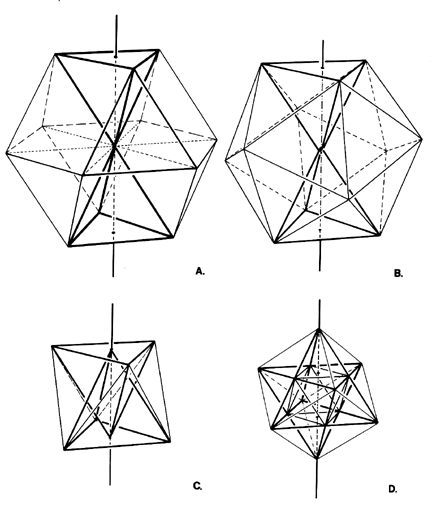
As part of the comprehensively symmetrical contraction of the whole primitive VE system, we may consider the concurrent north-to-south polar-axis contraction (accomplished as the axis remained motionless with respect to the equatorial motions) to have caused the two original vertex-to-vertex regular polar tetrahedra to penetrate one another vertexially as their original two congruent center-of-VE-volume vertices each slid in opposite directions along their common polar-axis line, with those vertices moving toward the centers of area, respectively, of the other polar tetrahedron’s polar triangle, traveling thus until those two penetrating vertices came to rest at the center of area of the opposite tetrahedron’s polar triangle—the planar altitude of the octahedron being the same as the altitude of the regular tetrahedron. (See Figs. 1033.43 and 1033.47.)
1033.44
In this condition they represent the opposite pair of polar triangles of the regular octahedron around whose equator are arrayed the six other equiangular triangles of the regular octahedron’s eight equiangular triangles. (See Fig. 1033.43.) In this state the polarly combined and—mutually and equally—interpenetrated pair of tetrahedra occupy exactly one-half of the volume of the regular octahedron of tetravolume-4. Therefore the remaining space, with the octahedron equatorially surrounding their axial core, is also of tetravolume-2—i.e., one-half inside-out (space) and one-half inside-in (tetracore).
1033.45
At this octahedron-forming state two of the eight vertices of the two polar- axis tetrahedra are situated inside one another, leaving only six of their vertices outside, and these six—always being symmetrically equidistant from one another as well as equidistant from the system center—are now the six vertices of the regular octahedron.
1033.46
In the octahedron-forming state the three polar-base, corner-to-apex- connecting-edges of each of the contracting polar-axis tetrahedra now penetrate the other tetrahedron’s three nonpolar triangle faces at their exact centers of area.
1033.47
With this same omnisymmetrical contraction continuing—with all the external vertices remaining at equal radius from the system’s volumetric center—and the external vertices also equidistant chordally from one another, they find their two polar tetrahedra’s mutually interpenetrating apex points breaking through the other polar triangle (at their octahedral-forming positions) at the respective centers of area of their opposite equiangular polar triangles. Their two regular-tetrahedra-shaped apex points penetrate their former polar-opposite triangles until the six mid-edges of both tetrahedra become congruent, at which symmetrical state all eight vertices of the two tetrahedra are equidistant from one another as well as from their common system center. (See Fig. 987.242A.)
1033.48
The 12 geodesic chords omniinterconnecting these eight symmetrically omniarrayed vertices now define the regular cube, one-half of whose total volume of exactly 3-tetravolumes is symmetrically cored by the eight-pointed star core form produced by the two mutually interpenetrated tetrahedra. This symmetrical core star constitutes an inside-in tetravolume of 1 1/2, with the surrounding equatorial remainder of the cube-defined, insideout space being also exactly tetravolume 1 1/2. (See Fig. 987.242A.)
1033.490
In this state each of the symmetrically interpenetrated tetrahedra’s eight external vertices begins to approach one another as each opposite pair of each of the tetrahedra’s six edges—which in the cube stage had been arrayed at their mutual mid- edges at 90 degrees to one another—now rotates in respect to those mid-edges—which six mutual tetrahedra’s mid-edge points all occur at the six centers of the six square faces of the cube.
1033.491
The rotation around these six points continues until the six edge-lines of each of the two tetrahedra become congruent and the two tetrahedra’s four vertices each become congruent—and the VE’s original tetravolume 20 has been contracted to exactly tetravolume 1.
1033.492
Only during the symmetrical contraction of the tetravolume-3 cube to the tetravolume- 1 tetrahedron did the original axial contraction cease, as the two opposing axis tetrahedra (one inside-out and one outside-out) rotate simultaneously and symmetrically on three axes (as permitted only by four-dimensionality freedoms) to become unitarily congruent as tetravolume-1—altogether constituting a cosmic allspace- filling contraction from 24 to 1, which is three octave quanta sets and 6 × 4 quanta leaps; i.e., six leaps of the six degrees of freedom (six inside-out and six outside-out), while providing the prime numbers 1,2,3,5 and multiples thereof, to become available for the entropic-syntropic, export-import transactions of seemingly annihilated—yet elsewhere reappearing—energy quanta conservation of the eternally regenerative Universe, whose comprehensively closed circuitry of gravitational embracement was never violated throughout the 24 → 1 compaction.
1033.50 Quanta Loss by Congruence
1033.51
Euler’s Uncored Polyhedral Formula:
| V + F = E + 2 | |
|---|---|
| Vector Equilibrium | 12 + 14 = 24 + 2 |
| Octahedron | 6 + 8 = 12 + 2 |
| Tetrahedron | 4 + 4 = 6 + 2 |
1033.52
Although superficially the tetrahedron seems to have only six vector edges, it has in fact 24. The sizeless, primitive tetrahedron—conceptual independent of size—is quadrivalent, inherently having eight potential alternate ways of turning itself inside out— four passive and four active—meaning that four positive and four negative tetrahedra are congruent. (See Secs. 460 and 461.)
1033.53
The vector equilibrium jitterbug provides the articulative model for demonstrating the always omnisymmetrical, divergently expanding or convergently contracting intertransformability of the entire primitive polyhedral hierarchy, structuring as you go in an omnitriangularly oriented evolution.
1033.54
As we explore the interbonding (valencing) of the evolving structural components, we soon discover that the universal interjointing of systems—and their foldability—permit their angularly hinged convergence into congruence of vertexes (single bonding), vectors (double bonding), faces (triple bonding), and volumetric congruence (quadri-bonding). Each of these multicongruences appears only as one vertex or one edge or one face aspect. The Eulerean topological accounting as presently practiced—innocent of the inherent synergetical hierarchy of intertransformability—accounts each of these multicongruent topological aspects as consisting of only one of such aspects. This misaccounting has prevented the physicists and chemists from conceptual identification of their data with synergetics’ disclosure of nature’s comprehensively rational, intercoordinate mathematical system.
1033.55
Only the topological analysis of synergetics can account for all the multicongruent—doubled, tripled, fourfolded—topological aspects by accounting for the initial tetravolume inventories of the comprehensive rhombic dodecahedron and vector equilibrium. The comprehensive rhombic dodecahedron has an initial tetravolume of 48; the vector equilibrium has an inherent tetravolume of 20; their respective initial or primitive inventories of vertexes, vectors, and faces are always present—though often imperceptibly so—at all stages in nature’s comprehensive 48→1 convergence transformation.
1033.56
Only by recognizing the deceptiveness of Eulerean topology can synergetics account for the primitive total inventories of all aspects and thus conceptually demonstrate and prove the validity of Boltzmann’s concepts as well as those of all quantum phenomena. Synergetics’ mathematical accounting conceptually interlinks the operational data of physics and chemistry and their complex associabilities manifest in geology, biology, and other disciplines.
1033.60 Primitive Dimensionality
1033.601
Defining frequency in terms of interval requires a minimum of three intervals between four similar system events. (See Sec. 526.23.) Defining frequency in terms of cycles requires a minimum of two cycles. Size requires time. Time requires cycles. An angle is a fraction of a cycle; angle is subcyclic. Angle is independent of time. But angle is conceptual; angle is angle independent of the length of its edges. You can be conceptually aware of angle independently of experiential time. Angular conceptioning is metaphysical; all physical phenomena occur only in time. Time and size and special-case physical reality begin with frequency. Pre-time-size conceptuality is primitive conceptuality. Unfrequenced angular topology is primitive. (See Sec. 527.70.)
1033.61 Fifth Dimension Accommodates Physical Size
1033.611
Dimension begins at four. Four-dimensionality is primitive and exclusively within the primitive systems’ relative topological abundances and relative interangular proportionment. Four-dimensionality is eternal, generalized, sizeless, unfrequenced.
1033.612
If the system is frequenced, it is at minimum linearly five-dimensional, surfacewise six-dimensional, and volumetrically seven-dimensional. Size is special case, temporal, terminal, and more than four-dimensional.
1033.613
Increase of relative size dimension is accomplished by multiplication of modular and cyclic frequencies, which is in turn accomplished only through subdividing a given system. Multiplication of size is accomplished only by agglomeration of whole systems in which the whole systems become the modules. In frequency modulation of both single systems or whole-system agglomerations asymmetries of internal subdivision or asymmetrical agglomeration are permitted by the indestructible symmetry of the four- dimensionality of the primitive system of cosmic reference: the tetrahedron—the minimum structural system of Universe.
1033.62 Zerovolume Tetrahedron
1033.621
The primitive tetrahedron is the four-dimensional, eight-in-one, quadrivalent, always-and-only-coexisting, inside-out and outside-out zerovolume whose four great- circle planes pass through the same nothingness center, the four-dimensionally articulatable inflection center of primitive conceptual reference.
| 1 tetrahedron = | zerovolume |
|---|---|
| 1 tetrahedron = | 1 alternately-in-and-out 4th power |
| 1 tetrahedron = | 1 1/2-and-1/2 8th power |
|><|= the symbol of equivalence in the converging-diverging intertransforms
Tetrahedron = 1⁴ |><| (←This is the preferred notation for the four-dimensional, inside-out, outside-out, balanced mutuality of tetra intertransformability.)
| 0 Zerovolume Tetra & VE | |
| 4 great circles = | Tetra & VE |
| 3 great circles = | Octa |
| 6 great circles = | Duo-tet Cube |
| 12 great circles = | Rhombic Dodecahedron |
1033.622
Thus the tetrahedron—and its primitive, inside-out, outside-out intertransformability into the prime, whole, rational, tetravolume-numbered hierarchy of primitive-structural-system states—expands from zerovolume to its 24-tetravolume limit via the maximum-nothingness vector-equilibrium state, whose domain describes and embraces the primitive, nucleated, 12-around-one, closest-packed, unit-radius spheres. (See cosmic hierarchy at Sec. 982.62.)
1033.63 Prefrequency and Initial Frequency Vector Equilibrium
1033.631
The primitive tetrahedron has four planes of symmetry—i.e., is inherently four-dimensional. The cosmic hierarchy of relative tetravolumes (Sec. 982.62) is primitive, four-dimensional, and unfrequenced.
1033.632
The primitive micro vector equilibrium is inherently prefrequency and is a priori tetravolume 0. The primitive macro vector equilibrium is inherently prefrequency and is a priori tetravolume 20. We also have the primitive, prefrequency, nuclear vector equilibrium of 2 1/2 active and 2 1/2 passive phases, and the primitive, nucleated, closest- packed-about vector equilibrium of 20. The nucleated vector equilibrium of frequency² has a tetravolume of 160, arrived at as follows:
2-frequency volume inherently 8 × primitive inherent 2 1/2-ness of nuclear
VE = 8 × 2 1/2 = 20
2-frequency volume inherently 8 × primitive inherent 20-ness of nucleated VE 2³ = 8, 8 × 20 = 160
2⁵ × 5, where the fifth dimension introduces time and size.
1033.633
Compare Section 1053.84 and Table 1053.849.
1033.64 Eightness Dominance
1033.641
The quanta involvement sum of the polar pairings of octahedra would be dominant because it consists of 12 Quarter-Octahedra (i.e., 12 - 8 = 4) = involvement dominance of four, whereas eight is the equilibrious totality vector of the 4|><|4: since the eightness is the interbalancing of four, the 12 - 8’s excess four is an unbalanced four, which alone must be either the outside-out or the inside-out four; ergo, one that produces the maximum primitive imbalance whose asymmetric proclivity invites a transformation to rectify its asymmetry. (Compare Sec. 1006.40.)
1033.642
Thus the off-balance four invites the one quantum of six vectors released by the precessed octahedron’s one-quantum “annihilation”—whose entropy cannot escape the Universe.
1033.643
The vector-equilibrious maximum nothingness becomes the spontaneous syntropic recipient of the energy quantum released from the annihilation phase of the transformation.
1033.65 Convergent-divergent Limits
1033.651
Vector equilibrium is never a shape. It is either a tetravolume 0 nothingness or a tetravolume 20 nothingness. The only difference between space nothingness and matter somethingness is vector equilibrium.
1033.652
Primitive, unfrequenced vector equilibrium is both the rationally interstaged, expansive-contractive, minimum 0, 1, 2, 3, 4, 5, 6 → to 20 to maximum 0, as well as the cosmic-resonance occupant of the minimum and maximum event void existing between the primitive, systematic somethingnesses.
1033.653
The vector equilibrium has four inside-out and four outside-out self- intercancelation, eight-congruent, zerovolume tetrahedra, as well as eight centrally single- bonded tetrahedra of maximum zerovolume expansion: both invoke the cosmically intolerable vacuum voids of macro-micro-nothingness essential to the spontaneous capture of one quantum’s six vectors, which—in the VE’s maxi-state—structurally contracts the VE’s 20-ness of spatial Universe nothingness into the 20-ness of icosahedral somethingness, just as the octa-annihilated quantum provides the always-eight-in-one, outside-out tetrahedron to fill the inside-out “black hole” tetravoid.
1033.654
| Symmetrical Tetra: | Asymmetrical Tetra: | |
|---|---|---|
| VE: | 8 | (+12=) 20 |
| Icosa: | |><| | 20 |
1033.655
In the octahedron as the maximum conservation and quantum-annihilability model of substance (Sec. 935) the precessing vector edge of the entropic octahedron drops out 1 tetra; 1 tetra = 6 vectors = 1 quantum of energy which—as the entropically random element of radiation’s nonformedness—may be effortlessly reformed by reentering the vector equilibrium to produce the icosahedron and thus to form new substance or matter.
1033.656
The vector equilibrium has 24 external vector edges: inserting the quantum set of six more makes 30 external edges whose omniintertriangulation resolves as the 30- edged icosahedron. The six added edges are inserted as contractive diagonals of the six square faces of the vector equilibrium . The contracted 30 edges = 5 energy quanta. Icosahedron = tetravolume-5 . Icosahedron is the least dense of all matter.
1033.657
As we approach absolute zero, taking all the energy out of the system,⁵ the chemical elements of which the apparatus parts consist each have unique atomic-frequency temperatures that are inherently different. This is evident to anyone who, within the same room temperature, has in swift succession touched glass, plastic, leather, or whatever it might be. Therefore, as in cryogenics we approach absolute zero (for the whole system’s average temperature), the temperature of some of the elemental components of the experiment go through to the other side of zero, while others stay on this side—with the whole aggregate averaging just short of right on absolute zero. As a consequence of some components going through to the other side of zero, some of the most extraordinary things happen, such as liquids flowing in antigravity directions. This is the inside-out Universe.
(Footnote 5: See Secs. 205.02, 251.02, 427.01, and 443.02.)
1033.658
When the “black hole” phenomenon is coupled with the absolute-zero phenomenon, they represent the special-case manifests of synergetics’ macro-micro- generalization extremes—i.e., both mini-maxi, zero-nothingness phases, respectively.
1033.659
Here are both the macro- and micro-divergence-convergence-limits in which the four-dimensional transformative and conversion behaviors are quite different from the non-scientifically-demonstrable concept of arbitrary cutoffs of exclusively one-dimensional infinity unlimits of linear phenomena. The speed of four-dimensional light in vacuo terminates at the divergent limit. The gravitational integrity of inside-out Reverse Universe becomes convergently operative at the macrodivergence limits.
1033.66 Terminal Reversings of Evolution and Involution
1033.661
In selecting synergetics’ communication tools we avoid such an unresolvable parallel-linear word as equals. Because there are neither positive nor negative values that add or detract from Universe, synergetics’ communication also avoids the words plus and minus. We refer to active and passive phases. Parallel equivalence has no role in an alternatively convergent-divergent Universe. Inflection is also a meaningless two- dimensional linear word representing only a shadow profile of a tetrahelical wave.
1033.662
In four-dimensional conversion from convergence to divergence—and vice versa—the terminal changing reverses evolution into involution—and vice versa. Involution occurs at the system limits of expansive intertransformability. Evolution occurs at the convergent limits of system contraction.
1033.663
The macro-micro-nothingness conversion phases embrace both the maximum-system-complexity arrangements and the minimum-system-simplicity arrangements of the constant set of primitive characteristics of any and all primitive systems. A single special case system embraces both the internal and external affairs of the single atom. A plurality of special case systems and a plurality of special case atoms may associate or disassociate following the generalized interrelationship laws of chemical bonding as well as of both electromagnetics and mass-interattractiveness.
1033.664
Primitive is what you conceptualize sizelessly without words. Primitive has nothing to do with Russian or English or any special case language. My original 4-D convergent-divergent vector equilibrium conceptualizing of 1927-28⁶ was primitive |><| Bow Tie: the symbol of intertransformative equivalence as well as of complementarity:
convergence |><| divergence
|><| Also the symbol of syntropy-entropy,
and of wave and octave,
-4, -3, -2, -1,
+1, +2, +3, +4
1033.665
Minimum frequency = two cycles = 2 × 360°.
Two cycles = 720° = 1 tetra = 1 quantum of energy.
Tetrahedron is the minimum unity-two experience.
1033.666
The center or nuclear sphere always has two polar axes of spin independent of surface forming or intertransforming. This is the “plus two” of the spheric shell growth around the nucleus. NF² + 2, wherefore in four primitive cosmic structural systems:
| Tetra = | 2F² + 2 | 1 | |
|---|---|---|---|
| Octa = | 4F² + 2 | 2 | |
| 2 + 2 | F² | ||
| Duo-tet Cube = | 6F² + 2 | 3 | |
| Icosa = | 10F² + 2 | 5 |
1033.70 Geometrical 20-ness and 24-ness of Vector Equilibrium
1033.701
The maximum somethingness of the VE’s 20-ness does not fill allspace, but the 24-tetravolume Duo-tet Cube (short name for the double-tetrahedron cube) does fill allspace; while the tetravolume-4-ness of the exterior octahedron (with its always-potential one-quantum annihilability) accommodates and completes the finite energy-packing inventory of discontinuous episodic Physical Scenario Universe.
1033.702
The three interior octahedra are also annihilable, since they vanish as the VE’s 20-ness contracts symmetrically to the quadrivalent octahedron jitterbug stage of tetravolume 4: an additive 4-tetravolume octahedron has vanished as four of the VE’s eight tetrahedra (four inside-out, four outside-out) also vanish, thereby demonstrating a quanta-annihilation accomplished without impairment of either the independent motion of the system’s axial twoness or its convergent-divergent, omniconcentric symmetry.
1033.703
The four of the 24-ness of the Duo-tet Cube (which is an f² cube: the double tetrahedron) accounts for the systemic four-dimensional planes of four-dimensional symmetry as well as for the ever-regenerative particle fourness of the quark phenomena characterizing all high-energy-system-bombardment fractionability.
1033.704
24 × 4 = 96. But the number of the self-regenerative chemical elements is 92. What is missing between the VE 92 and the f² Duo-tet Cube’s 96 is the fourness of the octahedron’s function in the annihilation of energy: 92 + 4 = 24 × 4 = 96. The four is the disappearing octa set. The 24 is the second-power 24 unique indig turnabout increment. (See Fig. 1223.12.)
1033.71
We have three expendable interior octa and one expendable exterior octa. This fact accommodates and accounts both the internal and external somethingness-to- nothingness annihilations terminally occurring between the 1 → 20 → 1 → 20 at the macroinvolution and microevolution initiating nothingness phases, between which the total outside-out 1 → 20 quanta and the total inside-out 20 → 1 quanta intertransformabilities occur.
1033.72
The final jitterbug convergence to quadrivalent tetravolume-1 outside-out and tetravolume-1 inside-out is separated by the minimum-nothingness phases. This final conversion is accomplished only by torquing the system axis to contract it to the nothingness phase between the three-petal, triangular, inside-out and outside-out phases. (See Secs. 462.02, 464.01 and 464.02.)
1033.73
The Quantum Leap: Between the maximum nothingness and the minimum nothingness we witness altogether five stages of the 4-tetravolume octa vanishment in the convergent phase and five such 4-tetravolume octa growth leaps in the divergent phase. These five—together with the interior and exterior octa constitute seven octa leaps of four quanta each. The f² of the inherent multiplicative two of all systems provides the eighth fourness: the quantum leap. (Compare Sec. 1013.60.)
1033.74
It requires 24-ness for the consideration of the total atomic behavior because the vector equilibrium is not allspace-fillingly complete in itself. It requires the exterior, inside-out, invisible-phase, eightway-fractionated, transformable octahedron superimposed on the VE’s eight equiangular, triangular faces to complete the allspace-filling, two- frequency Duo-tet Cube’s eight symmetrically arrayed and most-economically interconnected corners’ domain involvement of 24 tetravolumes.
1033.741
The VE’s involvement domain of 24 symmetrical, allspace-filling tetravolumes represents only one of the two alternate intertransformation domains of closest-packed, unit-radius spheres transforming into spaces and spaces intertransforming into spheres: ergo, it requires 48-tetravolumes to accommodate this phenomenon. To allow for each of these 48-tetravolume domains to accommodate their respective active and passive phases, it requires 96-tetravolumes. F² tetravoluming, which is as yet primitive, introduces an allspace-filling, symmetrical cube of 192-tetravolumes as an essential theater of omniatomic primitive interarrayings.
1033.75
The total primitively nucleated Duo-tet Cube’s double-tetra unique increment of allspace filling is that which uniquely embraces the whole family of local Universe’s. nuclearly primitive intertransformabilities ranging through the 24 → 1 and the 1 → 24 cosmic hierarchy of rational and symmetrical “click-stop” holding patterns or minimum-effort self-stabilization states.
1033.76
The Duo-tet Cube (the maxicube) occurring between micronothingness and macronothingness shows how Universe intertransformably accommodates its entropic- syntropic energy-quanta exportings and importings within the two-frequency, allspace- filling minireality of special-case Universe. Thus the entropic-syntropic, special-case Physical Universe proves to be demonstrable within even the most allspace-crowding condition of the VE’s maximum-something 20-ness and its exterior octahedron’s even- more-than-maximum-something 4-tetravolume nothingness.
1033.77
This 24-ness is also a requisite of three number behavior requirements as disclosed in the min-max variabilities of octave harmonics in tetrahedral and VE cumulative closest-packing agglomerations at holistic shell levels as well as in all second- powering “surface” shell growths, as shown in three different columns in Fig. 1223.12.
1033.80 Possible Atomic Functions in Vector Equilibrium Jitterbug
1033.81
There can be nothing more primitively minivolumetric and omnisymmetrically nucleatable than 12 unit-radius spheres closest packed around one such sphere, altogether conformed as the vector equilibrium as produced in multiplication only by division. We can multiply our consideration by endlessly dividing larger into smaller and smaller, ever more highly frequenced, closest-packed spheres. Conversely, the icosahedron is the configuration of nonnucleated, omnisymmetric, unit-radius spheres closest packed circumferentially around a central space inadequate to accommodate one such unit-radius sphere. The icosahedron may be identified as the miniconfiguration of the electron function as well as the second most volumetric, initial, convergent-divergent transformation, with only the vector equilibrium being greater.
1033.82
The 20 triangular faces of the icosahedron may be considered as 10 pairs of regular tetrahedra interpenetrating as internal vertexes. The energetic functions of these 10 pairs (as described in Secs. 464 and 465) are a four-dimensional evolution like the triangles rotating in the cube, generating the double tetrahedra in the process. But according to synergetics’ topological accounting it is necessary to extract one pair of double tetrahedra for the axis of spin: this leaves eight pairs of double tetra. 10—2=8 is the same fundamental octave eightness as the eight Eighth-Octahedra that convert the eight triangular corners of the VE to the involvement domain of the nucleated cube.
1033.83
At the outset of the VE jitterbug evolution there are two polar vertical-axis triangles—if the top one points away from you, the bottom one on the table points toward you. Without itself rotating, this active-passive, triangularly poled, vertical axis permits the jitterbug evolution to rotate its equatorial components either clockwise or counterclockwise, providing for the production of two different icosahedra—an active pair and a passive pair. But since there are four VE axes that can be jitterbugged in the same manner, then there are potentially eight different icosahedra to be generated from any one vector equilibrium.
1033.84
It could be that the eight paired tetrahedra are the positrons while the eight icosahedra are the electrons. Comprehension involves all four axes available.
1033.90 Spheres and Spaces
1033.91
How can an object move through water, which is a noncompressible substance? It does so by the intertransformability of spheres becoming spaces and spaces becoming spheres. (See Sec. 1032.) This is one of the ways in which the octahedron annihilation works in allspace-filling accommodation of local transformative events. The vector equilibrium and the eight Eighth-Octahedra on the triangular facets combine to produce the primitively nucleated cube.
1033.92
The octahedron annihilation model is uniformly fractionated and redeployed eight ways to function structurally as eight asymmetric tetrahedra at the eight corners of the vector equilibrium in an intertransformable manner analogous to the one-quantum- annihilating octahedron which—in Eighth-Octahedra increments—complements the 0→24-tetravolume vector equilibrium furnished with eight corners.