1050.10
Synergy of Synergies: We have the concept of synergy of synergies. Precession is not predicted by mass attraction. Chemical compounds are not prophesied by the atoms. Biological protoplasm is not predicted by the chemical compounds. The design of the elephant or the tree and their unwitting essential respiratory-gas conversion interexchanging is not predicted by the protoplasm. There is nothing about an elephant that predicts islanded star galaxies. As we get into larger and larger systems, the total system is never predicted by its lesser system’s components.
1050.11
We know that there is DNA and RNA, any one genetic code of which dictates both a species and within it an individual or special-case formulation. DNA-RNA codes do not explain why the protoplasm could produce either an elephant, pine tree, or daisy. They elucidate only how. What we call viral steerability as produced by the DNA- RNA codes is simply our familiar and generalized angle-frequency design control.
1050.12
DNA-RNA angle- and frequency-modulated designs are composed exclusively of four unique chemical constituents that operate as guanine and cytosine; and as thymine and adenine: inseparable but reversible tandem pairs. The first pair occur as GC or CG. The second pair occur as TA or AT. The DNA-RNA codes may be read in any sequence of those constituents, for instance, as CG - CG - CG - GC - TA - AT - GC - TA - TA - TA - AT CG - CG - GC, etc. (See Sec. 932.)
1050.13
We know the codes, but we do not know the “how come” of their producing an elephant. The complementarity of the holisticness of these special-case individuals balances out. An elephant does walk. Elephants are successful designs. We have no evidence of biological species that are inherently incomplete designs. In the hierarchy of hierarchies of synergies, Universe is the unpredicted behavior of any of its sublevel synergetics. We must start our synergetic analysis at the level of Universe and thereafter with The known behavior of the greatest whole and the known behavior of some of its parts, then proceed as permitted mathematically to discover its unknown parts. We have the Greek triangle with its known 180 degrees of angle; which together with the knowledge of the magnitude of any two sides and their included angle, or of any two angles and their included side, etc., permit us to discover the magnitude of the balance of the triangle’s six parts. Or, using trigonometry, if we know the magnitude of any two parts, we can ferret out the others.
1050.20
Trigonometry: The way we were taught in school about fractions leads to inconsistency. We were taught that fractions can be multiplied, divided, added, and subtracted only when the fractions consisted of identical entities. We could not divide three elephants by four oranges. However, trigonometry introduced functions—which are fractions or ratios, e.g., the sine, cosine, tangent, cotangent, and so forth. Contradicting our earlier lessons about fractions, these trigonometric fractions do mix together angles and edges of spherical triangles. This inconsistency could have been avoided by starting our geometry with spherical trigonometry. We would recognize that what we call a great circle arc or “edge” is indeed a central angle of the sphere. We would learn that we have central and external angles. We would spontaneously see that plane geometry derived from solid geometry and is an oversimplification of localized and superficial aspects of systems. This brings us back to angle and frequency modulation, i.e., outward, inward, and circumferentially around, complementary angle and frequency oscillations and pulsations and the congruence of the linear and angular frequency modulations. By teaching children plane geometry before teaching them spherical trigonometry, society became harnessed with a mathematical contradiction wherein trigonometry deliberately ratioed edge lines with angles—which clearly seemed to be forbidden by arithmetical fractions’ law. Single lines are seemingly very different from angles, because angles involve two (convergent) lines. If, however, instead of starting elementary education with unrealistic, linear, one-dimensional arithmetic; and then going on to two-dimensional plane geometry; and thence to three-dimensional cubes; and thence to spherical trigonometry … if we instead start synergetically with whole systems such as spherical trigonometry, we altogether avoid the concept of an edge and instead learn that the arc-defined edges of spherical triangles are the central angles of the sphere; wherefore both the arc edges and corners are angles, ergo ratioable. Now, having both surface angles and central angles, we discover that spherical trigonometry is always dealing with whole tetrahedra whose interior apexes are always at the center of the spherical system; and three of whose triangular faces are the great-circle plane triangles hidden within the spheric system; and whose fourth triangular face is always the arc-chord surface triangle of the sphere. These central- and surface-angle understandings are fundamental to transformational thinking, which deals with the falling-inward and precessing-outward proclivities.
1050.30
Simplest Trigonometric Solutions: Sequence to Accompany Poster in color plate 1.
1050.31
Stones may be broken into ever smaller stones, but they cannot be broken into no stones. They may be broken into gravel and the gravel into dust and the dust separated into crystals that are too small to be seen except through a lensed microscope; or they may be further broken apart into atoms that can be seen only through electron field microscopes. But the stones cannot be broken into nothingnesses—only into somethings. And somethings are always systems.⁷
(Footnote 7: The energy of the blow that breaks them asunder entropically releases the energy that previously bound together the atoms of the separate somethings. Disassociative energy is radiant—entropic; associative energy is something-forming—syntropic.)
1050.32
As the stones break, they have cleavage faces. They break into irregular polyhedra that are complex or simplex geometrically definable systems, each of which always has an inherent insideness and outsideness. The number of faces—hedra—of polyhedra cannot be reduced to less than four: the tetrahedron. The number of sides— gons—of a polygon cannot be reduced to less than three: the triangle. The minimum polyhedron of Universe is the tetrahedron, which requires a minimum of three triangles surrounding each of its four corners, whose four corners are omniinterconnected with a minimum of six edges that discretely outline the four triangular (minimum polygon) faces.
1050.33
Make the “V for Victory” sign with two adjacent fingers. The V is visual. The V is a specifically visible angle. The angle is an angle independent of the length of the fingers—that is, independent of the length of the sides of the angle. Angles, triangles, and tetrahedra are conceptual pattern integrities independent of size. Angles are always and only fractional parts of whole circles (of 360 degrees). Likewise, triangles are always and only components of a priori whole physical polyhedral systems (or of a plurality of whole polyhedral systems) each of 720 degrees (or whole multiples of 720 degrees) of angles surrounding all the external vertexes describing those systems. Only triangles produce structural stability. Only triangles produce pattern stability. The omnitriangulated tetrahedron is the minimum structural system of Universe.
1050.34
Drawing or scribing are physical operations executed upon a physical system. Triangles can be drawn or scribed or traced or trajectoried only upon or within an a priori physical system, or defined by a constellation of three physical systems within a greater a priori system.
1050.35
There are six and only six different but always orderly intercovarying geometrical characteristics or integral parts of all triangles: three surface-angle corners A, B, and C, and three sides a, b, and c. In reality these sides are always the central angles of the scribed-upon system and they are only evidenced by their surface-arc lines.
1050.36
Individual angular values or the relative interrelationships or interratios or functions of these parts hold true independent of the size of the triangle. This is to say that an equiangular triangle is equiangular and humanly conceptual independent of the size of any of our special case triangular experiences. The four most useful of these functions and their symbols are:
sine = sin tangent = tan
cosine = cos cotangent = cot
1050.37
The science that measures the respective angle magnitudes of the six ever- orderly intercovarying angles of triangles is called trigonometry. All of the geometrical interrelationships of all triangles—spherical or planar—are discoveringly calculated by the same trigonometry because plane triangles are always very small spherical triangles on very large spheric systems such as high-frequency symmetric polyhedra. A circle is a spherical triangle each of whose three corner angles is 180 degrees.
1050.38
To find the value of all the central angles (sides) and surface (corner) angles of any spherical triangle, we can always start by dropping a perpendicular from any vertex of that triangle upon its opposite side—making it into two “right” triangles. In order to discover all six angular values of a given triangle it is necessary to know—in addition to knowing the 90-degree corner—the surface- or central-angular values of any other two of the to-be-solved triangle’s five other parts: A, B, a, b, c. Many mathematicians have devised strategic formulas for coping with trigonometric solutions, most of them involving plus or minus quadrant symbols that invite errors of calculation.
1050.39
To make the trigonometry of the sea captain’s celestial navigation as simple and foolproof as possible the mathematician Lord Napier (1550 1667)⁸ evolved the following diagrams and procedures. To avoid what is known in navigation as “the 180- degree error”— going in exactly the opposite direction from that which will get you where you want to go—Napier arranged the five non-90-degree “parts” of a triangle in a five- segment “clock.”
(Footnote 8: Napier was the first to use the decimal point; he also invented logarithms for numbers. His mathematical ingenuity contributed greatly to the attainment of world ocean supremacy by the East India Company and the Royal Navy.)
1050.40
Napier had two equally simple ways to solve trigonometric problems without plus or minus symbols, provided that any two of the non-90-degree angles are known at the outset. His superscript ᶜ means that Aᶜ, cᶜ, Bᶜ are the 180-degree complements of A, c, B. For instance, Aᶜ + A = 180°, wherefore sin Aᶜ = cos A; or tan cᶜ = cot c, etc.
1050.41
First we check-mark the two “known-in-advance” non-90-degree parts on Napier’s five-segment clocklike pattern. It is clear that the two already-knowns are always either divided from one another or are side by side. In Napier’s Case One the two knowns are side by side in the clock: Napier calls this the case of Opposites. Opposite Case see Rule 1 chosen unknown for first solution.
1050.42
In Case Two the two knowns are separated from one another in the clock: Napier calls this the case of Adjacents. Adjacent Case see Rule 2 first unknown to be solved.
1050.43
Napier’s two easily remembered rules are:
Rule 1. The sine of any unknown part theta is equal to the product of the cosines of the two known opposite parts. This is written as:
unknown’s angle theta’s sin = cos · cos of its two known opposite parts.
Rule 2. The sine of any unknown part is equal to the product of the tangents of its two known adjacent parts. This is written as:
unknown angle theta’s sin = tan · tan of its two known adjacent parts.
1050.44
Next we employ the appropriate formula with the known cosine or tangent values. Next we must remove the superscript c of the complementaries, if any, by substituting cosines for sines, sines for cosines, tangents for cotangents, and cotangents for tangents.
Example: When the equation as first written is
sin b = cos cᶜ · cos bᶜ
the equation must be rewritten
sin b = sin c · sin b;
or if the equation first reads
sin Aᶜ = tan c · tan b,
it must be rewritten as
cos A = cot c · tan b
before going on to intermultiply the functions of the two knowns whose product will be the function value of the previously unknown angle theta. The angle values of the newly found knowns may be in any table of trigonometric functions or may be “remembered” by computers. When the value is found for an angle’s function (sin, cos, tan, cot), its specific angular value may also be read out of the tables.
1051.00 Circumference and Leverage
1051.10
Complementarity of Circumferential Oscillations and Inward and Outward Pulsations: We have demonstrated circumferential complementarity, the circumferential twoness of systems such as the northern and southern hemispheres of our Earth. There is also concave inward and convex outward complementarity, inward and outward twoness. As a consequence, there are also circumferential skew oscillations and inward and outward pulsations.
1051.20
Central and External Angles of Systems: The tetrahedral integrity of internal (central) angles and external (surface) angles of systems permits the integration of the topological and quantum hierarchies. It is exciting that the three internal radii give us three edges of the tetrahedron’s six edges; while the arc chords give us the three other of the tetrahedron’s six relationships; and the center of the spheric system and the surface triangle’s three corner-vertexes give us the four-vertex-events having the inherent six system relationships; which six are our coincidentally six-positive, six-negative, equieconomical vectorial freedoms (see Sec. 537.10). The central angles gives us what we call the chords of the central-angle arcs. Thus all-system-embracing geodesic lines are expressible in angular fractions of whole circles or cycles.
1051.30
The Circumferential Field: The inward-outward complementations of the system are represented by great-circle arcs on the system’s surface, whose existence is in reality that of the central angles of the system which subtend those external arcs and create the arc cyclic-duration “lengths.” Areal definition of the circumferential—ergo, surface— complementations and their oscillations occur as the surface angles at the vertexes of the system’s external mapping.
1051.40
Angular Functionings of Radiation and Gravity: The differences between the central angles’ and surface angles’ functionings are identifiable with radiational and gravitational functionings. Radiation identifies with central angles. Radiation is outwardly divergent. Gravity identifies with the three surface angles’ convergent closure into the surface triangle’s finite perimeter. Gravity is omniembracing and is not focusable. Gravity is Universe-conservingly effective in its circumferential coherence.
1051.50
Leverage: The principle of leverage is employed in shears, nutcrackers, and pliers. The longer the lever arms, the more powerful the pressure applied between the internal central angles of the nutcracker’s lever arms. We can make an illuminating model of our planet Earth if we think of it as a spherical bundle of nutcrackers with all their fulcrums at the center of the sphere and all the radii of the sphere acting as the lever arms of the pincers. The whole bunch of pincers have a common universal fulcrum at the common center. The farther out we go on the radial lever arms, the less effort is required to squeeze the ends together to exert nutcracking pressure at the center. If we go around the sphere-embracing circumference progressively tying up the ends of the levers together, we find that it takes very little, local, surface effort tensively between any two surface points to build up excruciatingly powerful, central-compression conditions. The bigger the model, the easier it is to tie it up; ever more delicate an exterior web will hold it together.
1051.51
Look at the relative distance of the atom and its outside electron orbit. The atom’s electron field may be equivalent to our magnetic field around this Earth. This elucidates the electromagnetic field of Earth as a world-around, circumferential- embracement field operating ephemerally on the outer ends of 4,000-mile-long levers.
1051.52
Identifying the surface-angle chordings with gravity, we comprehend why it is that as we get deeper and deeper within our Earth, with the pressure continually increasing as we get deeper, we see that the increasing gravitational-compression effect is due to the circumferential containment. The external containment web is always getting hold of the outermost ends of the centrally pinching levers. With this leverage effect, the farther out you go, the more advantage you have and the more powerful work you can do with that lever. Leverage effectiveness increases toward the center, ergo the increasing pressure that we identify with gravity. But it has this circumferential aspect.
1051.53
There is a tendency to misinterpret the increasing pressures occurring inwardly of Earth as “deadweight,” i.e., only as a radiationally-inward force, but it must be realized that the “weight” is omnidirectional compression. The gravitational intermass- attraction is progressively augmented, as we go radially outward, by the circumferential mass-interattraction of the relative abundance of elemental atoms, which increases at the second-power rate of the radial-distance outwardly from the Earth’s center; and as the pressures bring about ever closer presence of the atoms to one another, there is also an additional second-power exponential gain which results in r² varying as proximity² = P⁴, where P = relative compressive force. The surface chordal-angle magnitudes multiplied by radius to the second power produce the relative magnitude of network leverage-advantage resulting in the relative increase in pressure as you go inward toward Earth’s center. This is exciting because we now comprehend that gravity is a circumferentially operative force and not a radial force, with precession bringing about the 90-degreeness.
1051.54
Remembering Newton’s law of gravity, wherein the relative interattractions are directly proportional to the product of the masses increased by the second power of the distances between the respective mass centers, we realize that doubling the size of a sphere brings about an eightfold multiplication of the circumferential mass-interattraction. In effect, we have a network of chordal cables tensively intertriangulating the progressively outmost ends of the spherical nutcracker bundle with circumferential turnbuckles continually tightening the surface-triangulated tensional embracement network. This means that the pressures being exerted internally are proportional to the fourth power of the relative radial depth inward of Earth’s surface.
1051.55
The surface-embracement leverage-advantage of the sphere operating at the fourth power can always overmatch the total volumetric gaining rate as only the third power of radial (frequency), linear gain, as the second-power interproximity attractiveness is further multiplied by the second-power, radial-lever-arm, advantage gains.
1052.00 Universal Integrity
1052.10
Second-Power Congruence of Gravitational and Radiational Constants: The relative mass-energy content magnitude of a polyhedral system is arrived at by multiplying the primitive, frequency-zero, a-priori-state volume (relative to the tetrahedron-equals-one) of the geometric, concentric, structural system’s hierarchy, by the second power of the (both minimum and maximum) limit linear velocity of all classes of radiation when unfettered in a vacuum; i.e., multiplying initial volume by the terminal rate at which a spherical wave’s outermost, unique-event-distinguishability progressively and omniexpansively occurs, as expressed in terms of the second power of relative frequency of modular subdivision of its initially-occurring, polyhedral system’s radius; ergo as manifest in Einstein’s equation E = Mc². Energy equals a given mass with its relative mass-energy compactedness tighteningly modified by the velocity of energy-as-radiation intertransformability potential (not just linearly, but omnidirectionally); ergo as a potentially ever-expansively enlarging spherical wave’s outermost-event, one-radial- wavelength-deep surface; ergo second power of system frequency (because wave surfaces grow omni-outwardly as of the second power of the radial, linear frequency) rate of gain. (See Secs. 231.01, 251.05, 529.03 and 541.)
1052.20
Spherical Field: As already discovered (see Sec. 964), physics’ discovery of universally-multifrequenced, periodic-event-discontinuity outness (in complementation to equally frequenced, event-occurrence in-ness) is inherent in the always-experientially- verifiable, wave-duration frequency, photon-quantum phenomena; wherefore synergetics had to redefine both volumes and surfaces in terms of dense (high-frequency) aggregates of only pointally-positionable, energy events’ geometrical formulations, with spherical “surfaces” being in operational reality a dense, outermost, single-photon-thick, “cloud” layer, everywhere approximately equidistant in all directions from one approximately- locatable event center. For this reason the second-power exponential rate of area gain is not to be identified with a continuum, i.e., with a continuous system, but only with the high-frequency outermost layer population aggregate of energy-event points. With numbers of photons and wave frequency per primitive volume, the relative concentration of given masses are determinable.
1052.21
Isaac Newton discovered the celestial gravitation interrelationship and expressed it in terms of the second power of the relative distance between the different masses as determined by reference to the radius of one of the interattracted masses. The gravitational relationship is also synergetically statable in terms of the second power of relative frequency of volumetric quanta concentrations of the respectively interattracted masses. Newton’s gravitational constant is a radially (frequency) measured rate of spherical surface contraction, while Einstein’s radiational constant is a radial (frequency) rate of spherical expansion. (See Secs. 960.12, 1009.31 and 1052.44.)
1052.30
Gravitational Constant: Excess of One Great Circle over Edge Vectors in Vector Equilibrium and Icosahedron: Pondering on Einstein’s last problem of the Unified Field Theory, in which he sought to identify and explain the mathematical differentiations between electromagnetics and gravity—the two prime attractive forces of Universe—and recalling in that connection the conclusion of synergetics that gravity operates in spherical embracement, not by direct radial vectors, and recalling that electromagnetics follows the high-tension convex surfaces, possibly the great-circle trunk system of railroad tracks (see Secs. 452 and 458); led to pondering, in surprise, over the fact that the vector equilibrium, which identifies the gravitational behaviors, discloses 25 great circles for the vector equilibrium in respect to its 24 external vector edges, and the icosahedron, which identifies the electron behaviors of electromagnetics, discloses 31 great circles in respect to its 30 external vector edges.
1052.31
In each case, there is an excess of one great circle over the edge vectors. Recalling that the vector edges of the vector equilibrium exactly equal the radial explosive forces, while the icosahedron’s 30 external edges are longer and more powerful than its 30 radial vectors, yet each has an excess of one great circle, which great circles must have two polar axes of spin, we encounter once more the excess two polar vertexes characterizing all topological systems, and witness the excess of embracingly cohering forces in contradistinction to the explosively disintegrative forces of Universe.
1052.32
Possibility of Rational Prime Numbers in High-energy Physics Experiments: In recent years the experiments of the physicists, notably at the European Nuclear Research Center (CERN), seem to provide increasing confirmation of the similarities in the behaviors of electromagnetic and gravitational forces—as well as in the bonding and radioactive effects of the atomic nucleus (see Sec. 646.10). The ultimate definition of a Unified Field Theory becomes tantalizingly nearer at hand. The results and findings of the physicists’ experiments should be examined in the light of synergetics’ models, especially the vector equilibrium, and the comprehensive isotropicity which derives from closest-sphere-packing and provides omnirational accounting for radial and circumferential coordination. This kind of examination might account for some of the energetic behaviors of the newly described mass particles—leptons and hadrons, quarks and antiquarks—in which the second-power of their masses displays simple whole-number relationships.
1052.33
In synergetics the number of spheres on the outer surface of symmetrically complete VE aggregations is equal to two plus two times frequency to the second power times five—the prime number that is the key to the respective masses of both the VE and Icosa. The equation of prime number inherency of symmetrical structural systems (2NF² + 2; see Sec. 223.03) could be considered as describing a Unified Field Theory in which the number of vertexes (crossings or events) can be regarded as abstractions from the total field corresponding to a scenario of limited conceptuality. (Compare Secs. 419.10-20.)
1052.350 Microsystems
1052.351
A point is always a microsystem or a plurality of microsystems—ergo, at minimum one tetrahedron.
1052.352
A line is a relationship between any two microsystems.
1052.353
A tetrahedron is defined topologically by four conceptually locatable microsystems interconnected by six interrelationship lines whose 12 ends are oriented to corner-converge in four groups of three lines each; these lines terminate in one of four infratunable microsystem corners, whose at-minimum-of-three-other corner-defining microsystems lie outside in the tune-in-able tetrahedron defined by the six lines. (See Sec. 505.83.)
1052.354
The tetrahedron is the minimum tunable system. A point-to-ability is a tuned-in tetra. Each tuned-in tetra consists of four corners, each of which is an infratunable tetrasystem.
1052.355
The threeness of the quarks shows up at the three minimum convergent lines around each vertex of the minimum system consisting of only six lines.
1052.356
Topological components of systems and their infra-tune-in-able corner- vertex-locating infratunable systems ad infinitum do not and cannot exist independent of systems.
1052.357
The above describes the tunability of corners and is explanatory of the ever- reappearing quarks that disclose the primitive characteristics of all systems, which always—to any one human observer listening at any one tuning-in time—consist of infra- or ultratunable systems ad infinitum.
1052.360 Mite as Model for Quark
1052.361
Proofs must proceed from the minimum whole system to Universe and the differentiation-out of Universe of the special case conceptual system. Proofs must start from the minimum something that is the minimum structural system. All geometrical and numerical values derive from fractionation of the whole.
1052.362
At the maximum limit of the rational cosmic hierarchy of primitive structural systems we have the 120 similar and symmetrical T Quanta Module tetrahedra that agglomerate symmetrically to form the triacontahedron. (See Sec. 986.) At the minimum limit of the hierarchy are the separate A, B, and T Quanta Modules, and at the minimum limit of allspace-filling— ergo, of all Universe structuring—we have the three-module mites consisting each of two A and one B Modules.
1052.363
The mites are the quarks. The two energy-holding A Quanta Modules and the one energy-dispersing B Quanta Module of which the mite is composited exactly correspond with the plus-two, minus-one characteristics model of the three-separate-entity functions of the quark. (See Secs. 262.04 and 262.05.)
1052.40
Vector Equilibrium and Icosahedron: Ratio of Gravitational and Electromagnetic Constants: The vector equilibrium and the icosahedron are the same initial twentyness. But the icosahedron is always in either a positive limit or a negative limit phase of its, only-pulsatingly attained, first-degree structural self-stabilization in the asymmetric transformation of the vector equilibrium, which alternating pulsations are propagated by the eternally opposed, radiant-attractive, always dualistic, inter-self- transformable potential of ideally conceptual unity of Universe.
1052.41
The icosahedral phase of self-structuring is identifiable uniquely with the electron, whose mass relationship to the proton is as 1:18.51, whereas the icosahedron’s volume is to the vector equilibrium’s volume as 20:18.51. In this connection it is significant that the vector equilibrium’s plural unity is 20, ergo we may say the relationship is as unity: 18.51.
1052.42
The number of icosahedral electrons is always equal to the number of protons that are in the vector equilibrium’s idealized form of the same surface layer phenomenon.
1052.43
The nonnucleated icosahedron can and does maintain only one single, one- wave-deep, external layer of omnicircumferentially, omni-intertriangularly tangent, closest-packed, unit-radius, spherically conformed, energy-event packages; while the vector equilibrium is both radially and omnicircumferentially, omnitriangularly closest packed, i.e., in maximum, intertangential, mass-interattractiveness nucleated concentration.
1052.44
Reminiscent of electron proclivities, the icosahedron displays the same surface number of spherically conformed, energy-event packages and its only-one- wavelength-deep, single, outer sphere layer array is omnitriangulated, while the vector equilibrium’s surface is arrayed two-fifths in triangulation and three-fifths in open, unstable, square tangency. As spherical agglomerates decrease in radius—as do the vector equilibria’s contract to the icosahedral phase—their sphere centers approach one another, and Newton’s mass-interattraction law, which shows a second-power gain as the interproximities are halved, imposes an intercoherence condition whereby as their overall system radius decreases, their circumferential mass-interattractions increase exponentially as r², where r = radius of the system. (See Sec. 1052.21.)
1052.50 Syntropy and Entropy
[1052.50-1052.71 Physical Periodicities Scenario]
1052.51
Meshing and Nonmeshing: We know from the scientifically proven knowledge derived from physical experiments that local physical systems are continually losing energy, though they may be concurrently importing or inhibiting energies. This constant energy loss is the dominant characteristic of entropy. Due to each of the local Universe system’s unique complex of chemical-element periodicities the energies that are given off in an orderly manner appear to be disorderly harmonics in respect to the unique harmonic complexes released by other systems. The timings between different energies leaving different systems, like any two different-sized mechanical gears, may not necessarily mesh or synchronize with the timings of energies leaving other systems that they encounter, which encountered energy events also may be separately orderly in themselves.
1052.52
The special-case regenerative system itself may attain maximum orderliness while being acted upon by externally distributive forces. Often the reason that systems do not synchronize is that they derive from different complexes of chemical elements. Since every one of the interorbiting cosmic system’s elements has its unique frequencies, the wave frequencies of the orbiting systems are like the peaks and valleys of gear teeth whose peak-and-valley perimeters have latch-key-like irregularities. We have gears that rarely interlock and must consequently remain only superficially tangent to one another. Hence they take up more room than they would if they had meshed. The centers of the two meshing gears are nearer to one another than are the centers of the same two gears when their teethed perimeters are not meshed. When meshed, they are more powerfully intermass-attracted than when nonmeshed. (See Secs. 263.02 and 522.36.)
1052.53
Gears of equal weight and of the same material might have very many little teeth or relatively few big teeth in each of their great-circle cycles. The frequencies being given off entropically do not expand in planes or lines; they expand omnidirectionally as a complex of differently timed radial spirals. As the omnispheric gears fail to mesh, they employ ever more space, and therefore we realize a physically entropic Universe that is everywhere locally broadcasting its disorderly information to our sensorial receptors. Thus it seems—to short-term, local observation—that the aggregate discards of entropically released energies of the various localities of the physical Universe are expanding and even further expending energies in an increasingly disorderly manner. The syntropic births and growths escape our attention, for they inherently withhold or withdraw information regarding their ultimately syntropic cosmic resolution of apparent disorders—a resolution withheld from Earthian observers who are preoccupied with hindsight and dismayed by the obvious only-initially-entropic disorders. But fundamental complementarity requires that there be other localities and phases of Universe wherein the Universe is reconvening, collecting, and condensively contracting in an increasingly orderly manner as complementary regenerative conservation phases of Universe thus manifesting comprehensive transitions from disorder to order, from entropy to syntropy.
1052.54
Order and Disorder: Birth and Growth: Entropy is locally increasing disorder; syntropy is locally increasing order. Order is obviously the complement, but not mirror-image, of disorder.⁹ Local environments are forever complexedly altering themselves due to the myriad associative and disassociative interpatterning options of syntropy and entropy, with an overall cosmic syntropic dominance insured by an overall local entropic dominance. (See the “Principle of Universal Integrity” at Sec. 231.) Universe is a vast variety of frequency rates of eternally regenerative, explosive, entropic vs implosive, syntropic pulsation systems. Electromagnetic radiant energy is entropic; gravitational energy is syntropic.
(Footnote 9: See “Principle of Irreversibility” at 229.10)
1052.55
Both entropy and syntropy are operative in respect to planet Earth’s biospheric evolution. Wherever entropy is gaining over syntropy, death prevails; wherever syntropy is gaining over entropy, life prevails.
1052.56
Entropy is decadent, putrid, repulsive, disassociative, explosive, dispersive, maximally disordering, and ultimately expansive. Syntropy is impulsive, associative, implosive, collective, maximally ordering, and ultimately compactive. Entropy and syntropy intertransform pulsively like the single rubber glove (see Sec. 507). There is an entropic, self-negating, momentary self: there is also the no-time, nondimensionable eternity of mind. Dimensioning is apprehensible only within temporal relativity. Time is experienced in our relative duration lags and gestation rates as well as in the unique frequency interrelatedness of the electromagnetic spectrum events and novents. Every time we experience the novent disconnects of momentary annihilation into eternity, naught is lost. Mind deals only with eternity—with eternal principles. What is gained to offset any loss is the residual, observational lags in accuracy inherent and operative as cognition and the relativity of awareness that we call life. (See Secs. 638.02 and 1056.20.)
1052.57
The life-propagating syntropy-entropy, birth-to-death transformations constitute the special case realizations of the complex interactive potentials of all the eternal, abstract, dimensionless, nonsubstantial, generalized principles of Universe, interplayed with the absolute “if-this-then-that” integrity of plural cosmic unity’s intercomplementarity. The death and annihilation discontinuities occur as eternal generalization intervenes between the special case, “in-time,” relative intersizing of the realizations.
1052.58
Pattern Sorting and Observing: When we are able to observe for long enough periods of time, however, we find all the gears of Universe eventually meshing, though not simultaneously. The next periodic meshing of any two of the gears might take a thousand years—or 28 1/2 years—or 17 seconds. The important phenomenon to note is that there are great varieties of periods of nonmeshing which altogether make the physically observed totality appear to take up ever more room, and anywhere within this expansiveness the locally predominant events occurring within short spans of time appear to be omnidisorderly. When we compound that realization with the now-known millionfold greater span of electromagnetic reality and the lesser span of direct-sense ranging of the human organism, we begin to comprehend how readily humanity falls into the trap of dismay, fear, and negativism in general. Impatience engenders further myopically disorderly incrementation of information receipts. Those who are impatient for the receipt of the next news broadcasts are only beguiled by negative information. That is what myopia looks for. Chronic shortsightedness spontaneously seeks and tunes in only the broadcast entropy. Syntropy incasts, in contradistinction to entropic broadcast. Syntropy can be apprehended only through overall or comprehensive review of the totally recalled information of long-term experience.
1052.59
Man has no experimental data to suggest that energy is ever created or destroyed. Though our own overall experience leads us to the discovery of cyclic events that return upon themselves, the local, momentary, physical events seem to be giving off energy and taking up more room despite our own syntropic attempts to reestablish local order. Entropy is defined as the law of increase of the random element. But our experience in physical exploration also reveals to us that every pattern phenomenon has its complementary which is rarely a mirror-image and is most frequently invisible. As the complementary has the effect of cosmic integrity balancing, we realize there must be unseen syntropic events of Universe that are always reordering the environment. Syntropy is the law of elsewhere-importing and always-orderly regrouping of the entropic exportings of all dying systems. Aging and death here engender birth and growth elsewhere. (See Sec. 1005.611.)
1052.60 Physical Limit and Metaphysical Absolute
1052.61
This leads us to comprehension of the significance of life on Earth. On this cosmic-energies-importing planet we find life impounding those energies, taking random receipts of cosmic radiation from the stars— more importantly the Sun—and through photosynthesis converting it into organized molecular structures. We find the biologicals making ever more intricately orderly patterns: the little seed becoming a big, superbly organized structural process, a tree, rearranging all its energy receipts from Universe in a beautiful and orderly way. And among the living we find humans and humans’ minds reviewing the many brain-recorded, special case experiences and from time to time discovering generalized relationships interexisting between and coordinating the separate special-case phenomena. In pure principle these generalized principles—such as gravity— are operative and hold true throughout all experiences. The history of humanity revolves around humans’ discovering these principles. Humans also in due course discover principles that encompass a plurality of principles. Humanity trends toward ever greater understanding of the significance of principles, each of which, in order to be principles, must be inherently eternal. The discovery of principles occurs only with patience. Patience is long-wave tuning and is the antithesis of impatience, which is exclusively short-wave tuning. The discovery of great principles inherently requires a periodicity of adequate increments of time. Only through the thought stimulation of discovered and periodically repeated patterns of interrelatedness can mind’s discovery of generalized principles occur.
1052.62
Physical Universe expands, and as its observed components and aggregates of components are found to be larger and larger, their relative operating velocities increase to cope with their greater and greater orbital travel distances. But there seems to be a constant limit velocity of all disintegrative, entropic energy as manifest by the speed of all types of electromagnetic radiation when measured linearly in a vacuum tube. All the various types of radiation—ultraviolet, radio wave, and X-ray—reach speeds of about 000 miles per second, which is also 700 million miles per hour, which incidentally is a million times the speed of sound. These measurements inspired much of Einstein’s exploratory thought. But we note that since light and all other radiation is entropic—ergo, concomitantly disintegrative—there is a constant limit of disorderliness. Here nature turns about and becomes more orderly. There is also a constant limit of orderliness; this absolute turnaround condition is that of the primitive hierarchy. We discuss this elsewhere (Sec. 440) as the limits of pattern aberration in respect to the vector equilibrium, i.e., to the absolute or zerophase of generalized nuclear systems’ orderliness. Whereas the physical disintegrates entropically to a limit of velocity and disorder, the metaphysically operative mind displays a reverse pattern to that of physical entropy, wherewith to define lastingly the mind seeks the orderliness of the principles that are discovered. As the human definitions can never be perfect, the metaphysical mind of humans can only amplify and simplify the human statement of the comprehensive orderliness discovered and periodically reconfirmed by further experiences.
1052.63
From time to time humans learn a little more about a principle, but greater familiarity does not change the principles themselves. As further observation becomes more comprehensive and refined, the statement of the principle becomes ever more incisive and ever less frequently modified and improved. Since the principle itself is eternally changeless, the more accurately it is defined, the more unchangeable is the definition. The word truth is applicable to an earnestly attempted statement of any observed or recollected special case experience. Recollection of a plurality of truths may lead to discovery of a generalized principle intercoordinating the special case experiences. Recollection of truths leads toward discovery of generalized principles. Thus we find the metaphysical definitions of human minds tending to become ever more enduring as human mind trends toward the only absolute perfection, which is the eternal integrity of the omniinteraccommodation of all principles.
1052.64
Thus do words evolve and accumulate to fill the dictionaries as humans discover mutually shared conceptions regarding their common experiences, each of which requires unique and incisive means of identification and communicability. That all humans, always starting naked, helpless, and ignorant, have through the ages so truthfully identified over a hundred thousand experiences each of which is so unique as to deserve—indeed require—a uniquely identifying word, and that humans, despite their propensity to withhold agreement upon any mutual convention, have agreed upon some hundred thousand more or less common words and upon many more hundreds of thousands of scientific words, constitutes the greatest extant memorial in testimony of the supra-ethnic and transgeneration growth of the means of human communication, common understanding, and ultimate integration of all human concern and ever more effectively informed coordination of all human initiatives.
(1052.641 Vitamin D from Sunlight is essential to humans because calcium is essential to the human bone structure. Humans synthesize vitamin D through the action of the Sun’s ultraviolet rays on the skin. This biochemical function is a zoological counterpart of botanical photosynthesis. But vitamin D is one of those vitamins of which humans can have an overdose. In warmer climes, where vitamin D from the Sun is adequate or excessive, humans’ subconsciously functioning organisms employ their chemical-process options to develop Sunlight filters in the skin consisting of darker and darker pigments that prevent excessive absorption of radiation and avoid the overdose of vitamin D. Where there is not much Sunlight, as in the far north, human organisms had to progressively remove their pigment filters, which left only light skin that permitted maximum synthesis of vitamin D from the Sun. But dark skin was the norm. The skin pigmentation effect on human organisms is a generalized phenomenon like that of diet, wherein undernourishment alone can account for mental dullness in otherwise healthy humans. Physiognomic and physiological differentiations in humans result solely from generations of unplanned inbreeding of those types that survive most successfully under unique environmental conditions within which tribes or nations dwelt for protracted periods. Thus there is scientific evidence that there is no organic class or species differentiations of humanity. This thesis is further elaborated in my essay No Race No Class. Communication is ultimately independent of culture or race or class.)
1052.65
The metaphysical drive of humanity is toward total comprehension and an eternally changeless definition of all understanding. Despite the limited conditions governing our special-case human lives we can discern the syntropic cosmic trending of the metaphysical slowdown toward eternal changelessness in inverse complementation of the entropic physical trend to ever greater acceleration toward terminal velocity, frequency, and disorderliness at the speed of all radiation in vacuo. The metaphysical eternity is inherently absolute, whereas physical acceleration is terminated only by exhaustion. The physical limit is special case and suggestively alterable. The metaphysical limit is absolute and unalterable.
1052.66
The metaphysical is comprehensively generalizable. The physical is always realized only as special case experience. The metaphysical reorders the disorderly-prone physical. The metaphysical continually seeks to comprehend, master, harness, and cohere the physical. The metaphysical comprehends and reorders. Humans oscillate between the pushes of their physical incarnation and the tensing of their metaphysical propensities. This ubiquitous push-pulling propagates cosmic regenerativity.
1052.67
The regeneration may be that of a complete new baby or the local regeneration of cells in an ongoing organism. Rebirth is continual. The overall growth and refinement of information and comprehension by continuous humanity transcends the separate generations of life and steadies toward eternal unalterability; the special case physical experiences and the identification of their significance in the overall scheme of eternal cosmic regenerativity ever accelerate as the information bits multiply exponentially; wherefore the overall rate of gain of metaphysical comprehension of the physical behavior in general accelerates exponentially in respect to such arithmetical periodicities as that of the celestial cycles of the solar system.
1052.68
The physical Universe is an aggregate of frequencies. Each chemical element is uniquely identifiable in the electromagnetic spectrum by its special set of unique frequencies. These frequency sets interact to produce more complexly unique cycle frequencies, which are unheard by human ear but which resonate just as do humanly hearable musical chords or dissonances. Thus occurs a great cosmic orchestration, ranging from the microcosmic nuclear isotropicity—directly undetectable by the human senses— through the minuscule range detectable by humans, to the very complex, macrocosmic, supra-to-human-tunability symphonies of multiaggregates of isotropically interpositioned galaxies. (Compare Secs. 515.21 and 530.13.)
1052.69
Thus develops our human awareness of the special-case physical experience events that spontaneously trigger the metaphysical faculties of humans into applying their extraordinary sorting capabilities. The more metaphysically sensitive and comprehendingly effective humans become, the more truly do they fulfill the unique cosmic function for which they were designedly included in the scheme of eternally regenerative Universe. If we seek one word that most succinctly identifies the experience we call life, it is awareness. Since no weight is lost as individual life terminates, and since all the chemical ingredients are as yet present and all the sense organs and their separate information- integrating brains are also intact, we have to conclude that the awareness of otherness, which we identify as the prime characteristic of human life, is indeed a weightless idea, or thought concept, of an also weightless metaphysical thinker. Life is not the corporeal chemical complex. Life is only metaphysical.
1052.70
Humans are born into their physical-sensing and information-inventorying organism not only to experience Universe but to cope with local problem-solving in support of the eternal regenerative integrity of ever complexedly intertransforming physical Universe, employing their metaphysical minds to discover the metaphysical slowdown toward the eternal generalized principles governing Universe: and thereafter to define the principles ever more adequately, incisively, and inclusively until the frequency of redefinability decreases toward zero. Thus the metaphysical processing of humanity’s cognition of a generalized principle tends in time to slow toward zero. It must be noted, however, that the metaphysical mind’s tools of communication with other temporal beings—including the organic self—within the temporal reality are always special case ergo, finitely limited tools—for instance, the arbitrary symbols chosen for a Greek alphabet written with special case ink on special case paper.
1052.71
The physical accelerates to terminal and finite velocity where terminality renders the physical inherently inferior and subservient to the inherently eternal metaphysical comprehensivity’s omnicoherence. Only the self-destructive, special case physical, entropic, negative evolvements accelerate to their own totally disintegrative transition into totally redistributed subfunctionings of other systems.
1052.80 Radiation-Gravitation: Electromagnetic Membrane
1052.81
Membrane Model: The reason why the second-power rate of interattractiveness gains in respect to the arithmetical rate of variation of the relative proximity of remote bodies is that gravity is not a linear, radial force but is a circumferentially tensional embracement force.
1052.82
We will think of two spheres inside a closed elastic membrane so smoothly intimate to each that, when the two spheres are tangent to one another, they appear as two clearly independent spheres momentarily in kissing tangency, the membrane continuity between the two being so intimately clinging as to be observationally subvisible. But as the two spheres are pulled apart, the elastic membrane is locally stretch-pulled away evenly from the surface of each sphere, and the membrane tube running between the two contracts to a progressively invisible, fine-line, spider-thread tube stretched between the two spheres. As the two spheres are pulled further apart, the tube between the two remote spheres will appear to be an invisible line-of-sight perpendicular to each of the enclosed spheres.
1052.83
Since the nuclei of the atoms are not touching one another and only the cosmic totality integrity mantle is cohering the atoms, they can be singled out in space and time array in the same manner as the much larger molecules can be thinned to a film of a single molecular thickness, cohered only by the mass interattractiveness like the vast multiplicity of atomic interattractiveness (as we have seen in Sections 644 through 646.03).
1052.84
As the spheres are next allowed to approach one another, the everywhere self-together-gathering proclivity of the elastic membrane providing the elastic tube between them will redistribute its perpendicular linear multitude of atoms back in both directions, yielding equally to the two stretched membranes around each sphere in much the same way as atoms in a thin stream of viscous maple syrup impinging vertically on a stack of pancakes will spread out in all directions to envelop the pancakes. Thus the two- way flowing stream of stretched-far-apart atoms of the omnihugging elastic membrane tightly embracing the two reapproaching-to-one-another spheres flows outwardly at 90 degrees to their perpendicular impingement to reenvelop thickly each of the two spheres. This means that the linear length of the tautly stretched tube reopens itself at the point of tangency to enclose each of the tube’s separate spheres. The atoms previously invested in the remote-from-one-another, stretched-out tube of tension between the two spheres have now returned to the two spheres and have rejoined their nearest neighboring atoms around the elastic-membrane spherical sheath of the two tangent spheres.
1052.85
What had been a linear requirement becomes a surface requirement for the elastic membrane. Surfaces of omnisymmetrical geometrical objects are always second powers of the object’s linear dimensions. If we were to remove one of the spheres from the omniclingingly embracing sheath, the elastic membrane would snap-contract to enclose only the remaining sphere, but the rate of atomic population gain of the spherical, surface- clinging membrane derived from the previous intersphere linear tendon is of the second power of the arithmetical rate of linear contraction of the elastic tendon. Soon the thickness of the membrane on each sphere would multiply into a plurality of closest- packed atomic layers, and the volume of the atoms will thus increase at a third-power rate in respect to an arithmetical rate of distance-halving between any two spheres. This two- sphere-embracing, few-atoms-thick, clinging elastic membrane fed into, or spread out from, an intersphere tension may be thought of as an electromagnetic membrane acting just like electric charges fed onto the convex surface of a copper Van de Graaff sphere or a copper wire (electric charges always inhabiting only the convex surfaces).
1052.86
Please now think of all the tensional forces of Universe as one single membrane containing all the radiational, explosive forces we have enumerated. Now think of the original compression sphere exploding into many parts inside the endlessly stretchable membrane, whose rate of ductility-adjustment-to-stretch equals the speed of light or radiation, c². Inside our tensile membrane unitary bag would be a number of individual, exploded-apart, spherical mass components, each of which is tightly embraced by the membrane—leaving only intervening perpendicular linear tubes. (See Fig. 1052.86.)
1052.87
To understand the linear expansion rate think of making soap bubbles: Deeply layered molecules get stretched into a single layer as the single atoms guarantee the interattractiveness integrity of the area-stretching thin-out of the atoms. We now come to the balancing of the vectors of the vector equilibrium and the arrangement of the 24 external vectors end-to-end, closing back upon themselves—in four great-circle planes, constituting an “additional” vector force magnitude of 24, embracing the outwardly and separatingly exploding 24 internal vectors, which now operate in increasing independence of one another—each thus producing a force of only one. We have the surface net drawing on a force resource of 24—multiplied by radius frequency to the second power— while the originally-24-force, radially explosive events separate out from one another and thus produce only separate first-power effectiveness. Hence the gravitational force’s geometrical progression rate of gain—i.e., its second-power, surface-embracing finiteness closure is always at a high-energy effectiveness advantage over the disintegrative, linear, first-power, or only arithmetical progression rate of gain in force.
1052.88
The second-power rate of gain in interattractiveness occurring with each halving of the intervening distance of two heavenly bodies recalls Pythagoras’s whole, rational-number, harmonic-octave integrity progression (or regression) occurring with each halving of the length of the tensed cord (thirding results in sharping or flatting key progressions); wherefore the gravitational-radiational, second-power, spherical surface rate of gain occurs in respect to the radial linear rate of identification of omnidirectionally propagated sound waves—at a gain of the second power of the linear. This gravitational omnisurface-embracement mathematics apprehending coincides with harmonic resonances:
1053.00 Superficial and Volumetric Hierarchies
1053.10
Spherical Triangular Grid Tiles: The interrelationship of the vector equilibrium and the icosahedron when their respective 25- and 31-great-circle grids are superimposed on one another, with the center of area of the vector equilibrium’s eight spherical triangles congruent with the areal centers of eight of the icosahedron’s 20 spherical triangles, reveals a fundamental, asymmetrical, six-axis, alternative, impulsive- pulsative potential of surface intertransformabilities in respect to which the vector equilibrium serves as the zero between the positive and negative, “relative” asymmetry, deviations.
1053.11
The vector equilibrium’s 25 and the icosahedron’s 31 spherical-great-circle grids manifest different least-common-denominator, identically angled, spherical triangular “tiles,” which together exactly cover and subdivide the spherical surface in whole even numbers of tiles; the vector equilibrium having 48 such LCD triangles and the icosahedron having 2 1/2 times as many LCD triangles, i.e., 120.
1053.12
The fundamental fiveness of the icosahedron is split two ways, with 2 1/2 going one way (the outside-out way) and 2 1/2 going the other way (the inside-out way). The least-common-denominator triangular surface subdivision of the vector equilibrium’s sphere provides 48 angularly identical (24 inside-out and 24 outside-out) subdivisions as spherical surface “tiles” that exactly cover one sphere.
1053.13
120/48 = 2 1/2; and there are always both the four positively skew-rotated and the four negatively skew-rotated sets of spherical triangles (two sets of four each), symmetrically borrowed from among the spherical total of 20 equiangled, spherical triangles of each of two spherical icosahedra (each of radius 1)— which four out of 20 (20/4 = 5) spherical icosahedron’s triangles’ centers of area are exactly concentrically registerable upon every other one of the spherical octahedron’s eight triangles, which areal centers of the octahedron’s eight triangles are also always concentrically and symmetrically in register with the eight equiangled, spherical triangles of the spherical vector equilibrium when the octahedron and the vector equilibrium spheres are all of the same unity-l radius. With this registration of four out of eight centers of the icosahedron upon the octahedron-vector equilibrium’s eight triangular surfaces each, we find that one icosa set of four skews rotationally positive, while the set of four from another icosahedron phase registers the negative skew rotation, which is a +30 degrees or -30 degrees circumferentially-away-from-zero, rotational askewness for a total of 60 degrees differential between the extremes of both. The remaining 16 out of the total of 20 triangles of each of the two different (plus-or-minus-30-degree) phase icosahedra, subdivide themselves in four sets of four each, each of which sets of four arrange themselves in polarized symmetry upon each of the octahedron’s four other spherical triangles which are not concentrically occupied by either the positively- or negatively-skew, concentric sets, of four each, triangles, neither of which four sets of four each non-triangularly-concentric sets repeat the other sets’ complementary, asymmetric but polarized, array in superimposition upon the octahedron’s four nonconcentrically occupied triangles.
1053.14
It was in discovering this alternate, concentric askewness of icosa-upon- octa, however, that we also learned that the symmetrical, equiangular, spherical triangle areas, filled evenly—but rotationally askew—with sets of 15 of the icosahedron’s 120 LCD triangles, exactly registered with the spherical surface area of one of the spherical octahedron’s eight triangular faces (each of which are bound by 90-degree corners and 90- degree arc edges). This meant, however, that the 15 LCD icosa triangles’ plusly-rotated askew phases are not congruent with one another but are superimposed in alternately askewed arrays, both in the cases of the four concentric triangles and in the cases of the nonconcentrically-registered triangles.
1053.15
Because each of the octahedron’s eight faces is subdivided by its respective six sets of spherical “right” triangles (three positive—three negative), whose total of 6 × 8 = 48 triangles are the 48 LCD’s vector-equilibrium, symmetric-phase triangles, and because 120/48 = 2 1/2, it means that each of the vector equilibrium’s 48 triangles has superimposed upon it 2 1/2 positively askew and 2 1/2 negatively askew triangles from out of the total inventory of 120 LCD asymmetric triangles of each of the two sets, respectively, of the two alternate phases of the icosahedron’s limit of rotational aberrating of the vector equilibrium. This 2 1/2 positive superimposed upon the 2 1/2 negative, 120- LCD picture is somewhat like a Picasso duo-face painting with half a front view superimposed upon half a side view. It is then in transforming from a positive two-and- one-halfness to a negative two-and-one-halfness that the intertransformable vector- equilibrium-to-icosahedron, icosahedron-to-vector-equilibrium, equilibrious-to- disequilibriousness attains sumtotally and only dynamically a spherical fiveness (see Illus. 982.61 in color section).
1053.16
This half-in-the-physical, half-in-the-metaphysical; i.e., half-conceptual, half- nonconceptual; i.e., now you see it, now you don’t—and repeat, behavior is characteristic of synergetics with its nuclear sphere being both concave and convex simultaneously, which elucidates the microcosmic, turn-around limit of Universe as does the c2 the spherical-wave-terminal-limit velocity of outwardness elucidate the turn-around-and- return limit of the macrocosm.
1053.17
This containment of somethingness by uncontained nothingness: this split personality +2 1/2, -2 1/2; + 5, - 5, + 0, -0; plural unity: this multiplicative twoness and additive twoness of unity; this circumferential-radial; this birth-death, birth-death; physical- metaphysical, physical-metaphysical; yes-no, yes-no-ness; oscillating-pulsating geometrical intertransformability field; Boltzmann importing-exporting elucidates the a priori nature of the associative-disassociative; entropic-syntropic; energetic-synergetic inherency of cosmic discontinuity with its ever locally renewable cyclic continuities, wherewith Universe guarantees the eternally regenerative scenario integrity.
1053.20
Platonic Polyhedra: There are 48 spherical triangular tiles of the vector equilibrium nuclear sphere, which 48 triangles’ pattern can be symmetrically subdivided into five different sets of symmetrical interpatterning which coincide exactly with the projection outward onto a sphere of the five omnisymmetrical planar-defined Platonic polyhedra, whose linear edges are outlined by the respective chords of the congruent vector equilibrium’s symmetrical 25-great-circle grid and the icosahedron’s 31-great-circle grid. These equiedged Platonic solids are the icosahedron, the octahedron, the cube, the tetrahedron, and the regular dodecahedron. (The vector equilibrium is one of the Archimedean polyhedra; it was called cuboctahedron by the Greeks.)
1053.21
The chords of these five spherical geometric integrities all interact to produce those well-known equiedged polyhedra commonly associated with Plato. The intervolumetric quantation of these five polyhedra is demonstrated as rational when referenced to the tetrahedron as unity. Their surface values can also be rationally quantized in reverse order of magnitude by the 48 spherical triangle tiles in whole, low- order, even numbers. These hierarchies are a discovery of synergetic geometry.
1053.30
LCD Superficial Quantation of Systems: Because the icosahedron’s 31- great-circle grid discloses 120 least-common-denominator, spherical triangular, whole tiling units, we require a special-case, least-common-surface-denominator identity as a name for the 48 spherical tiles of the vector equilibrium. The 120 spherical surface triangular tiles (60 insideout and 60 outside-out) do indeed constitute the least-common- spherical and planar polyhedra’s whole-surface denominators, ergo LCDs, of all closed systems; for all systems are either simplex (atomic) or complex (molecular) manifests of polyhedra. All systems, symmetrical or asymmetrical, have fundamental insideness (micro) and outsideness (macro) irrelevancies that leave the residual-system relevancies accountable as topological characteristics of the polyhedra.
1053.31
As we have learned elsewhere, the sphere, as demonstrated by the spherical icosahedral subdivisions, discloses a different least-common-denominator spherical subdivision in which there are 120 such tiles (60 positive and 60 negative), which are generalizable mathematically as the least-common surface denominator of surface unity, ergo, of systems in general superficially quantated. Because the icosahedron provides the maximum asymmetries into which the vector equilibrium’s universally zero-balanced surface can be transformed, and since the effect of the icosahedron—which introduces the prime number five into Universe systems—is one of transforming, or splitting, equilibrium two ways, we find time after time that the interrelationship of the vector equilibrium and the icosahedron surfaces to be one such elegant manifestation of the number 2 1/2—2 1/2 positive and 2 1/2 negative, of which the icosahedron’s fiveness consists. This half- positive and half-negative dichotomization of systems is the counterpart in pure principle of the nuclear accounting that finds that the innermost ball of the closest-packed symmetrical aggregate always belongs half to a positive world and half to a negative world; that is, the inbound half (implosive) and the outbound half (explosive) altogether make a kinetically regenerative whole centrality that never belongs completely to either world.
1053.32
It is a condition analogous to the sphere with its always and only complementarity of insideness and outsideness, convexity and concavity. A sphere may be thought of as half concave and half convex as well as having two different poles.
1053.33
For the moment, considering particularly spherical-system surfaces, we find the same 2 1/2-ness relationship existing between the vector equilibrium and the icosahedron, with their respective least common denominator’s surface triangle building tiles (of which the vector equilibrium’s 48 LCDs have five of the equiedged Platonic solids and the icosahedron’s 120 LCDs have two of the equiedged Platonic solids). The icosahedron-coexistent pentagonal dodecahedron is the special-case system of domains of the icosahedron’s 12 vertexes; it is not a structure in its own right. Plato’s five omniequifaceted, equiedged and -vertexed, “solids” were the cube, tetrahedron, octahedron, icosahedron, and dodecahedron. All five of these solids are rationally accounted by the LCD spherical surface triangular tilings of the vector equilibrium and the icosahedron.
1053.34
The icosahedron has 120 triangles (60+, 60-), which are the least common denominators of spherical surface unity of Universe; ergo, so important as to have generated, for instance, the ancient Babylonians’ adoption of 60 both for increments of time and for circular mensuration. The Babylonians attempted to establish a comprehensive coordinate mensural system that integrated time and matter. Their artifacts show that they had discovered the 60 positive and 60 negative, 120 spherical right triangles of spheres. That their sixtyness did not uncover nature’s own rational coordinate system should not be permitted to obscure the fact that the Babylonians were initiating their thinking systematically in polyhedral spherical wholeness and in 60-degree vs. 90- degree coordination, which was not characteristic of the geometrical exploration of a later date by the Egyptians and Greeks, who started very locally with lines, perpendiculars, and planes.
1053.35
The great 2 1/2 transformation relations between the vector equilibrium and the icosahedron once again manifest in surface equanimity as the LCD surface triangular tiling, which is 2 1/2 times 48, or 120.
1053.36
Sphere: Volume-surface Ratios: The largest number of similar triangles into which the whole surface of a sphere may be divided is 120. (See Secs. 905 and 986.) The surface triangles of each of these 120 triangles consist of one angle of 90 degrees, one of 60 degrees, and one of 36 degrees. Each of these 120 surface triangles is the fourth face of a similar tetrahedron whose three other faces are internal to the sphere. Each of these tetra has the same volume as have the A or B Quanta Modules. Where the tetra is 1, the volume of the rhombic triacontahedron is approximately 5. Dividing 120 by 5 = 24 = quanta modules per tetra. The division of the rhombic triacontahedron of approximately tetravolume-5 by its 120 quanta modules discloses another unit system behavior of the number 24 as well as its appearance in the 24 external vector edges of the VE. (See Sec. 1224.21)
1053.37
Fig. 1053.37
Fig. 1053.37 Spherical Great Circles Are Commensurable with Spherical Triangles of Three Prime Structural Systems: Tetra Octa and Icosa:
A. Internal area of one great circle of a sphere
B. Surface triangle of spherical tetrahedron
C. Surface triangle of spherical octahedron
D. Surface triangle of spherical icosahedron[1 great circle = 1 tetra triangle = 2 octa triangles = 5 icosa triangles = 30 basic LCD triangles]
Link to original
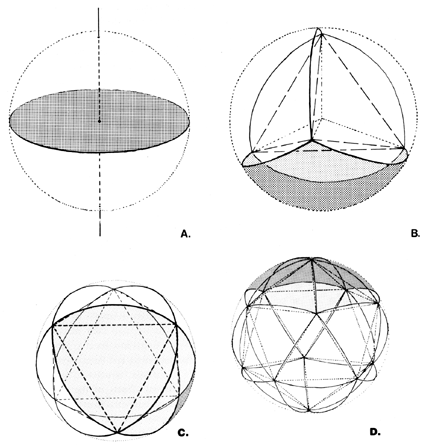
Since the surface of a sphere exactly equals the internal area of the four great circles of the sphere, and since the surface areas of each of the four triangles of the spherical tetrahedron also equal exactly one-quarter of the sphere’s surface, we find that the surface area of one surface triangle of the spherical tetrahedron exactly equals the internal area of one great circle of the sphere; wherefore
| 1 spherical tetra’s triangle | = 1 great circle |
| 2 spherical octa’s triangles | = 1 great circle |
| 5 spherical icosa’s triangles | = 1 great circle |
| 30 spherical Basic LCD triangles | = 1 great circle |
1053.40
Superficial Hierarchy: We have here a total spherical surface subdivisioning hierarchy predicated upon (a) the relative number of LCD (48/n) tiles necessary to define each of the following’s surface triangles, wherein the tetrahedron requires 12; the octahedron 6; cube 8; and rhombic dodecahedron 4; in contradistinction to (b) their respective volumetric quantations expressed in the terms of the planar-faceted tetrahedron as unity.
1053.41
Table: Spherical Surface Hierarchy
| Number of LCD (48 VE) | Spherical Conformation | Nuclear Sphere’s Radius-1 Volumetric Hierarchy | |
|---|---|---|---|
| 48 define one | Vector Equilibrium | 1 | |
| 12 define one | Tetrahedron face | 3 | |
| 8 define one | Cube face | 4 | |
| 6 define one | Octahedron face | 6 | |
| 4 define one | Rhombic Dodecahedron | ||
| 4 define one | Regular Dodecahedron | ||
| define one | Icosahedron face |
1053.50
Volumetric Hierarchy: With a nuclear sphere of radius-1, the volumetric hierarchy relationship is in reverse magnitude of the superficial hierarchy. In the surface hierarchy, the order of size reverses the volumetric hierarchy, with the tetrahedron being the largest and the rhombic dodecahedron the smallest.
1053.51
Table: Volumetric Hierarchy: The space quantum equals the space domain of each closest-packed nuclear sphere:
| Space quantum | = 1 |
| Tetrahedron | = 1 |
| Nuclear vector equilibrium | = 2 1/2 |
| Nuclear icosahedron | = 2 1/2 |
| Cube | = 3 |
| Octahedron | = 4¹⁰ |
| Nuclear sphere | = 6 |
| Rhombic dodecahedron | = 6 |
(Footnote 10: The octahedron is always double, ergo, its fourness of volume is its prime number manifest of two, which synergetics finds to be unique to the octahedron.)
1053.51A
Table: Volumetric Hierarchy (revised): The space quantum equals the space domain of each closest-packed nuclear sphere:
| Space Quantum | Value |
|---|---|
| Space quantum | = 1 |
| Tetrahedron | = 1 |
| Nuclear vector equilibrium | = 2 1/2 |
| Nuclear icosahedron | = 2 1/2 |
| Cube | = 3 |
| Octahedron | = 4 |
| Rhombic triacontahedron | = 5+ |
| Rhombic dodecahedron | = 6 |
1053.60
Reverse Magnitude of Surface vs. Volume: Returning to our consideration of the reverse magnitude hierarchy of the surface vs. volume, we find that both embrace the same hierarchical sequence and have the same membership list, with the icosahedron and vector equilibrium on one end of the scale and the tetrahedron on the other. The tetrahedron is the smallest omnisymmetrical structural system in Universe. It is structured with three triangles around each vertex; the octahedron has four, and the icosahedron has five triangles around each vertex. We find the octahedron in between, doubling its prime number twoness into volumetric fourness, as is manifest in the great- circle foldability of the octahedron, which always requires two sets of great circles, whereas all the other icosahedron and vector equilibrium 31 and 25 great circles are foldable from single sets of great circles .
1053.601
Octahedron: The octahedron—both numerically and geometrically—should always be considered as quadrivalent; i.e., congruent with self; i.e., doubly present. In the volumetric hierarchy of prime-number identities we identify the octahedron’s prime- number twoness and the inherent volume-fourness (in tetra terms) as volume 22, which produces the experiential volume 4.
1053.61
The reverse magnitudes of the surface vs. volume hierarchy are completely logical in the case of the total surface subdivision starting with system totality. On the other hand, we begin the volumetric quantation hierarchy with the tetrahedron as the volumetric quantum (unit), and in so doing we build from the most common to the least common omnisymmetrical systems of Universe. In this system of biggest systems built of smaller systems, the tetrahedron is the smallest, ergo, most universal. Speaking holistically, the tetrahedron is predominant; all of this is analogous to the smallest chemical element, hydrogen, being the most universally present and plentiful, constituting the preponderance of the relative abundance of chemical elements in Universe.
1053.62
The tetrahedron can be considered as a whole system or as a constituent of systems in particular. It is the particulate.
1053.70 Container Structuring: Volume-surface Ratios
1053.71
When attempting to establish an international metric standard of measure for an integrated volume-weight unit to be known as “one gram” and deemed to consist of one cubic centimeter of water, the scientists overlooked the necessity for establishing a constant condition of temperature for the water. Because of expansion and contraction under changing conditions of temperature a constant condition of 4 degrees centigrade was later established internationally. In much the same way scientists have overlooked and as yet have made no allowance for the inherent variables in entropic and syntropic rates of energy loss or gain unique to various structurally symmetrical shapes and sizes and environmental relationships. (See Sec. 223.80, “Energy Has Shape.“) Not only do we have the hierarchy of relative volume containments respectively of equiedged tetra, cube, octa, icosa, “sphere,” but we have also the relative surface-to-volume ratios of those geometries and the progressive variance in their relative structural-strength-to-surface ratios as performed by flat planes vs simple curvature; and as again augmented in strength out of the same amount of the same material when structured in compound curvature.
1053.72
In addition to all the foregoing structural-capability differentials we have the tensegrity variables (see Chap. 7), as all these relate to various structural capabilities of various energy patternings as containers to sustain their containment of the variously patterning contained energies occurring, for instance, as vacuum vs crystalline vs liquid vs gaseous vs plasmic vs electromagnetic phases; as well as the many cases of contained explosive and implosive forces. Other structural variables occur in respect to different container-contained relationships, such as those of concentrated vs distributive loadings under varying conditions of heat, vibration, or pressure; as well as in respect to the variable tensile and compressive and sheer strengths of various chemical substances used in the container structuring, and their respective heat treatments; and their sustainable strength-time limits in respect to the progressive relaxing or annealing behaviors of various alloys and their microconstituents of geometrically variant chemical, crystalline, structural, and interproximity characteristics. There are also external effects of the relative size- strength ratio variables that bring about internal interattractiveness values in the various alloys as governed by the second-power rate, i.e., frequency of recurrence and intimacy of those alloyed substances’ atoms.
1053.73
As geometrical systems are symmetrically doubled in linear dimension, their surfaces increase at a rate of the second power while their volumes increase at a third- power rate. Conversely, as we symmetrically halve the linear dimensions of geometrical systems, their surfaces are reduced at a second-root rate, while their volumes decrease at a third-root rate.
1053.74
A cigar-shaped piece of steel six feet (72 inches) long, having a small hole through one end and with a midgirth diameter of six inches, has an engineering slenderness ratio (length divided by diameter) of 12 to 1: It will sink when placed on the surface of a body of water that is more than six inches deep. The same-shaped, end-pierced piece of the same steel of the same 12-to-1 slenderness ratio, when reduced symmetrically in length to three inches, becomes a sewing needle, and it will float when placed on the surface of the same body of water. Diminution of the size brought about so relatively mild a reduction in the amount of surface of the steel cigar-needle’s shape in respect to the great change in volume—ergo, of weight—that its shape became so predominantly “surface” and its relative weight so negligible that only the needle’s surface and the atomic-intimacy- produced surface tension of the water were importantly responsible for its interenvironmental relationship behaviors.
1053.75
For the same reasons, grasshoppers’ legs in relation to a human being’s legs have so favorable a volume-to-surface-tension relationship that the grasshopper can jump to a height of 100 times its own standing height (length) without hurting its delicate legs when landing, while a human can jump and fall from a height of only approximately three times his height (length) without breaking his legs.
1053.76
This same volume-to-surface differential in rate of change with size increase means that every time we double the size of a container, the contained volume increases by eight while the surface increases only fourfold. Therefore, as compared to its previous half-size state, each interior molecule of the atmosphere of the building whose size has been symmetrically doubled has only half as much building surface through which that interior molecule of atmosphere can gain or lose heat from or to the environmental conditions occurring outside the building as conductively transferable inwardly or outwardly through the building’s skin. For this reason icebergs melt very slowly but accelerate progressively in the rate of melting. For the same reason a very different set of variables governs the rates of gain or loss of a system’s energy as the system’s size relationships are altered in respect to the environments within which they occur.
1053.77
As oil tankers are doubled in size, their payloads grow eightfold in quantity and monetary value, while their containing hulls grow only fourfold in quantity and cost. Because the surface of the tankers increases only fourfold when their lengths are doubled and their cargo volume increases eightfold, and because the power required to drive them through the sea is proportional to the ship’s surface, each time the size of the tankers is doubled, the cost of delivery per cargo ton, barrel, or gallon is halved. The last decade has seen a tenfolding in the size of the transoceanic tankers in which both the cost of the ship and the transoceanic delivery costs have become so negligible that some of the first such shipowners could almost afford to give their ships away at the end of one voyage. As a consequence they have so much wealth with which to corrupt international standards of safety that they now build them approximately without safety factors—ergo, more and more oil tanker wrecks and spills.
1053.80 Growth and Decay
[1053.80-1053.85 Growth and Decay Scenario]
1053.801
In chemical interbonding of atomic systems single-bonded (univalent) tetrahedra are only single-vertex-to-single-vertex congruent. This means that only one of each of any two tetrahedra’s directionally differentiable four corners—which are as yet only infra- or ultratunable, only noisy subsystem, vertexial somethingnesses—are subcongruent critically intimate; that is, the magnitude of their mutual interattractiveness is greater than any other of their cosmic attracters. Singly interbonded tetrahedra are always attracted in critically intimate degree by one—and only one—of their corner-identifying infratunable systems attractively bonded with a neighboring tetrahedron’s corner vertex subdifferentiable-system “points.” For ages the vertexial somethingnesses only superficially apprehended by humans were experientially identified visually as “specks,” audibly as noises, tactilely as prickly points, topologically as vertexes, and geometrically as sharp (corner) angles.
1053.802
Topology enumerates the critical-proximity-bonded pairs of “points” as constituting only one point and not as an almost tangent two. Topological accounting is confined to only superficially visible characteristics of systems. (See Sec. 262.02.)
1053.803
We learn experientially that lines are trajectories (Sec. 521.20), that two events and their trajectories cannot pass through the same point at the same time (Secs. 517.01-06), and that when we have such conflict or transit interference, they result in smashes (always separating each of the intersmashing bodies into a plurality of smaller systems, not dirt or dust), plunge-ins such as meteors plunging into Earth (to form more complex systems), refractions, reflections, or critical-proximity interrattractiveness cotravelings (Earth and Moon). When we do not have interference conflicts but we have two independent event trajectories converging to pass “near” one another only at a precessionally critical-course-refracting, mass-interattractive distance, they may converge and diverge in a twist vertex exit (see Secs. 921.15 and 942.12). The term vertex embraces all of the foregoing system-furnished, local-focal, event cases.
1053.804
In chemical double-bonding the edge vectors of the tetrahedra—as well as the terminal vertexes—are also so critically proximate as superficially to seem to be congruent and are topologically accredited numerically only as “one” because of their superficial aspect of unity as a single hinge-pin.
1053.810
The vector equilibrium consists of eight tetrahedra each of which is edge- bonded; i.e., vertexially double-interbonded with three others, with each of their pre-time- size internal vertexes theoretically congruent as eight-in-one. Each of the pre-time-size vector equilibrium’s eight tetrahedra has six vector edges (6 × 8 = 48). (There are 24 internal and 24 external vector edges, 48 vector edges in all.) Each of the eight tetrahedra has four vertexes (4 × 8 = 32), and in each of the tetrahedra three of these vertexes are external (3 × 8 = 24): There are thus 12 externally paired sets (24/2 = 12) of visible vertexes. Three of each of the eight tetrahedra’s vector edges (3 × 8 = 24) are displayed on the outside of the vector equilibrium. (Compare Sec. 1033.020.)
1053.811
There are 24 external vector edges of the vector equilibrium (8 × 3 = 24). The other three vector edges of each of the eight tetrahedra are arrayed inwardly as 24 internal edges (8 × 3 = 24), but these inwardly arrayed vector edges of the eight tetrahedra, being double-bonded or hinged together, appear as only 12 radial spokes of the vector equilibrium, which has 24 separate vectors in its four closed chordal rims of the four great-circle planes of the tetrahedra’s four dimensionality; these four great circles produce the zerovolume tetrahedron. (See Sec. 441.)
1053.812
Nature never stops or even pauses at dead center. Nature contracts convergently to the center of its nuclear sphere, where each of its frequency-tuned integrities self-interfere convergently and react reflectively—ergo, omnidivergently—from their own terminally convergent self-frequency interferings. Unity is plural and at minimum two. (See Secs. 905.11 and 1070.)
1053.813
In the vector-diametered VE the convergent 2 1/2 phase coalesces with the divergent 2 1/2 phase and produces a univalent 5-ness whose consequence is also quadrivalent—producing also the vector-radiused VE’s 5 × 4 = 20-ness of the vector equilibrium’s subfrequency embracement of its eight edge-bonded, bivalent tetra and their six half-octahedra interstices.
1053.82 Life and Death
1053.821
The decaying and growing are complementary. Death is a cofunction of birth: the father is dying; the child is being born. There never has been a real negative except as a positively complementary function of the oppositely directioned positive.
1053.822
We do not have two Universes—“this world” and “the next world.” Death is only the nonresonant, between-frequency silence of our oscillatory “no-stopover” passages through the Grand Central Station of the vector equilibrium’s equilibrious center, as the lags in our cognition “realizations” time us into life’s inherently aberrated imperfection aspects— somewhere off center.
1053.823
As we learn through experience to identify and comprehend ever more inclusively and precisely the generalized principles manifest in our experiences, and as we learn to communicate and share our recognitions of these manifests, we gradually reduce the lag rates in human cognition and come ever nearer to realization of the perfection.
1053.824
Apprehension is the physical brain’s coordinate storing of all the special case, physically sensed information of otherness, integral (the child’s thumb sucked by its mouth) or separate (the mother’s udder sucked by the child’s mouth.) Comprehension is the metaphysical mind’s discovery of the meaningful interrelationship between the special- case information data that are neither implicit in, nor inferred by, any of the special-case information data when taken only separately—the meaning discovered by mind being the generalized principles manifest exclusively by the interrelationship variables and constants. Awareness means apprehending while also intuitively comprehending that the excitement over the novelty of the incoming information is significant because possibly pregnant with meaningful principles. (Compare Sec. 526.18.)
1053.825
Since “life” is experientially demonstrable to be weightless—ergo, metaphysical—its awareness and comprehension of meanings synchronize exclusively with the nonphysical intervals concentrically occurring between the only physically sensed frequencies of exclusively inanimate, radiantly propagated, electromagnetic-wave phenomena.
1053.826
Both death and life are complementary metaphysical functions interspersing and embracing our electromagnetic physical experience. Life’s physical reality is constituted by the unique frequency identifications of the chemical elements and their atomic components as well as the humanly tune-in-able “color” frequencies of the electromagnetic spectrum’s concentrically interpositioned occurrences (usually published by humans as a chart of positions along any one radius of the omnidirectional comprehensive concentric system). The metaphysical cognition of life-death reality is constituted exclusively by all the intervals between and beyond—inwardly and outwardly— all of the comprehensive electromagnetic phenomena sensed by human organisms.
1053.827
The music of John Cage is preoccupied with the silent intervals; his growing audience constitutes the dawning of the transition of all humanity into synchronization with the metaphysical rather than the physical. The decibel amplification of youth’s “rock” music has switched its physical beat into the old silent intervals and is inducing metaphysical preoccupation in its listeners.
1053.83 Positive Visible and Integral Invisible
1053.831
To free ourselves from our preconditioned ill-chosen words of plus-minus and positive-negative, we may say operationally that there never has been a minus Universe to cofunction with Universe. There has always been cosmically integral, visible and invisible experience, which we have learned only in the past 100 years to be the consequence of whether or not we are integrally equipped organically with receiving sets having frequency tunability under the particular electromagnetic-waveband circumstances considered.
1053.832
Radiation outcasts. Radiation does not broadcast; broadcast is a planar statement; there are no planes. Out is inherently omnidivergent. Radiation omnicasts but does not and cannot incast; it can only go-in-to-go-out. In is gravity.
1053.833
If radiation “goes through” a system and comes out on the other side, it does so because (I) there was no frequency interference—it just occurred between the system’s occurrence frequencies—or (2) there was tangential interference and deflection thereby of the angle of travel, wherefore it did not go through; it went by.
1053.84 Cay and Decay
1053.841
In Webster’s dictionary cay is an “emergent reef of coral or sand.” We deduce that its earlier etymological meaning is a “growth,” a coming together of parts (of sand or coral creatures)— ergo, we have cay and de-cay. Cay is convergently associative and syntropically cumulative. Decay is divergently disassociative and entropically dispersive.
1053.842
The nuclear vector equilibrium with a frequency of one has a double intensity (quadrivalent) tetravolume of 5 with a convergent cay volume of 2 1/2 and a divergent decay volume of 2 1/2; a congruent double 2 1/2 whose energy involvement potential is 5.
1053.843
In the generalized (subfrequency) case of the nuclear vector equilibrium (pulsatively impotent), either convergent or divergent (not both) quadrivalent tetravolume where frequency is half-zero, the tetravolume of the VE⁰ = 2 1/2.
1053.844
In the generalized (subfrequency case) of the nuclear vector equilibrium (potentially pulsative), congruently one-half-convergent and one-half-divergent quadrivalent tetravolume where frequency is zero, the half-convergent tetravolume of 2 2 compounded with the half-divergent tetravolume of 2 1/2 produces a double intensity two-and-a-halfness which has—an only potential—quadrivalent tetravolume of 5; ergo, VE⁰ = 5, one-half of which is alternatively invisible; ergo, VE⁰ appears deceptively to have a tetravolume of 2 1/2.
1053.845
In the generalized (subfrequency) nucleus-embracing, convergent-divergent, bivalent tetravolume vector equilibrium of frequency one, its tetravolume is 20. VE¹ = 20.
1053.846
In the generalized (subfrequency) nucleus-embracing, convergent-divergent vector equilibrium of frequency two, the tetravolume is 160. VE² = 160. (See Sec. 966.05 and Fig. 966.05B.)
1053.847
What must be remembered in considering all the foregoing is that unity is plural and at minimum two, as elucidated in Secs. 905.11 and 1070; wherefore the zero- frequency vector equilibrium, the VE⁰ of “apparent” tetravolume 2 1/2, has an inherent but invisible double value that will have an operational resource effectiveness of 5, 2 1/2 of which is convergently effective and 2 1/2 divergently effective. This produces the state of equilibrium whose untenability induces cosmic resonance.
1053.848
In the symmetrical doubling of linear (radial) dimension the surface area increases four times and the volume eight times their original magnitude. In the case of the nuclear (one sphere) vector equilibrium with radius = 1 and volume = 2 1/2, when surrounded with 12 closest-packed, uniradius spheres and when the center of the nuclear sphere is connected to the respective centers of the 12 surrounding spheres, the distance between the center of the nuclear sphere and the center of any one of its 12 surrounding spheres is equal to 2 radii, or one diameter of the uniradius spheres. With radius 2, 2 1/2 × 8 = 20. (Compare Sec. 1033.63. )
1053.849
Table: Initial Frequencies of Vector Equilibrium:
| Closest-packed Uniradius Spheres | Frequency | Tetravolumes |
|---|---|---|
| Radius 1 | VE0/2 | 2 1/2 |
| Radius 1 | VE0 | 5 |
| Radius 2 | VE1 | 20 |
| Radius 4 | VE2 | 160 |
1053.85 Inventory of Alternatives to Positive
| TACTILE: | — | range-reachable, frequency dense, ergo interferable, ergo “solidly” or firmly touchable vs out-of-reach untunable |
| — | cold-warm; also frequency conditions | |
| — | push-pull | |
| AUDIBLE: | — | infra- or ultratunable |
| — | sound and noise; we say “noise” when the frequencies are not differentiable but altogether overlap the frequency limit of our equipment | |
| VISUAL: | — | frequency; again, electromagnetic |
| — | infra- and ultratunable | |
| — | distance factor not a matter of resolution but of wavelength | |
| — | you can’t differentiate the untunable | |
| OLFACTORY: | — | sweet vs obnoxious |
| — | decay; the divergent, the coming apart; decaying tends to be malodorous | |
| — | cay (growth); the convergent freshness tends to be olfactorily welcome | |
| ELECTRO- MAGNETICS: | — | attractions and repulsions. |
| What are the relative frequency ranges involved? (Compare [[100.01 Introduction - Scenario of the Child#100020-human-sense-awareness | Sec. 100.020]].) |
1054.00 Relationship of Gibbs to Euler
1054.10
Synergetic Analysis: Euler’s topology and Willard Gibbs’ phase rule give us synergetic-analysis capability. Euler differentiated all physical Universe into lines, crossings, and areas: the fundamental visual aspects of our experiences having to do with our eyes, radiation frequencies, and conceptual images. Gibbs’ phase rule differentiated the physical Universe into liquid, crystalline, and gaseous phases, which are not so much visual as thermal, which is tactile, and which are always characterized by unique whole- number interattractions, i.e., restraints. Conversely, with successive whole-number degrees of freedom, thermal, sonic, or viscosity frequencies are differentiated in respect to their condition within their respective states as well as between those states.
1054.11
Euler’s synergetic differentiation and equatingly accomplished reintegration of Universe deals with energy disassociative as radiation; Gibbs deals with energy associative as matter at various thermal stages. Euler’s and Gibbs’ are two different system aspects or behaviors of Universe. Euler deals with the static, geometrical field aspects of Universe. Gibbs deals with energy associative as matter, and what the degrees of energetic freedom may be within a local physical complex, and what amounts of energy would have to be added locally to bring about other states.
1054.20
Relationship of Gibbs to Euler
EULER GIBBS
Visual Tactile
Energy as radiation Energy as matter
(coming apart) (associative)
Differentiated Integrated
Locally superfical Internal
They come together
in vertexial bonding
which implies
which is always = Mass attraction = which is kinetically
potentially directional active in GIBBS
and descriptive in EULER
1054.30
Synergetic Integration of Topology and Quanta: Synergetics’ “breakthrough” integration of Euler’s topology and Willard Gibbs’ phase rule is explained by the number of intertetrahedral bonds:
Phases: Bonds: States:
R
Face I
Eccentric 3 bonds = Ice bond G
tetra I
D
F
Edge L
Concentric 2 bonds = Water bond E
(medium phase) (medium phase) tetra X
F C
Point L O
Eccentric 1 bond = Vapor bond E M
tetra X P
R
E
Additional bond S
energies present in = Medium +2 S
the eccentric phases phase I
V
3+1, 1+3 = 2+2 E
1054.31
The rigid ice stage is characterized by load concentration, no degrees of freedom, and slow creep. The flexible, fluid stage is characterized by hinge-bonding, load distribution, one degree of freedom, and noncompressibility. The flexible, fluid vapor stage is characterized by universal jointing, load distribution, six degrees of freedom, and compressibility.
1054.32
Median unity is two, therefore unity plus two equals four.
Median state = Unity + 2
Frozen state = Median unity - 1 = 1
Vapor state = Median unity + 1 = 3
(3+ 1 =4; 1 +3=4; 2+2=4)
Ice = Median freedom minus one freedom
Water = Median freedoms
Vapor = Median freedoms plus one freedom
1054.40
Topology and Phase (see Table 1054.40)
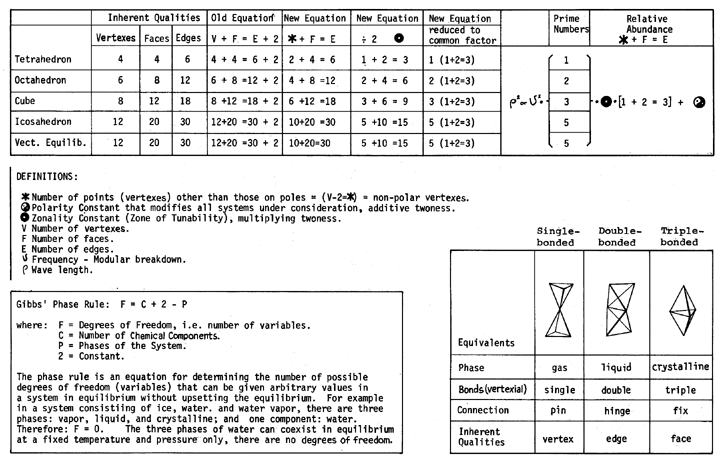
1054.50
Polyhedral Bonding: Willard Gibbs’ phase rule treats with the states of the environment you can sense with your eyes closed: crystallines, liquids, gases, and vapors. Euler’s points, lines, and areas are visually described, but they too could be tactilely detected (with or without fingers).
1054.51
The mathematicians get along synergetically using Euler’s topology alone. It is the chemists and physicists who cannot predict synergetically without using Gibbs’ phase rule.
1054.52
Euler deals with the superficial aspects of polyhedra: of visual conceptuality. He deals only with the convex surfaces of polyhedral systems. Euler deals with unit, integral, single polyhedra, or with their subaspects. He is not concerned with the modus operandi of the associabilities or disassociabilities of a plurality of polyhedra.
1054.53
But Gibbs unknowingly deals with polyhedra that are composited of many polyhedra, i.e., compounds. He does not think or talk about them as polyhedra, but we find the connection between Euler and Gibbs through the polyhedral bonding in respect to Euler’s aspects. Euler’s lines are double bonds, i.e., hinges. Euler’s vertexes are single bonds. Euler’s areas are triple bonds. Gibbs accommodates the omnidirectional system complementations of the other senses—thermal, tactile, aural, and olfactory—not just associatively, but radiationally. Gibbs brings in time. Time is tactile. Time is frequency. Our pulses measure its passing.
1054.54
People see things move only relative to other things and feel small vibrations when they cannot see motion. The tactile feels angular promontories or sinuses with the fingers or body. Sinus means “without”— “nothing,” invisible, ergo, nonidentified by Euler. The frequencies we call heat are tactilely sensed. We have radiation-frequency tunability range. Our skin structuring is tuned to frequencies beyond the eye-tunable range, i.e., to ultraviolet and infrared.
1054.55
Euler did not anticipate Gibbs. Gibbs complements Euler—as does synergetics’ identification of the two excess vertexes as constituting the axis of conceptual observation in respect to all independent, individual orientations of all systems and subsystems; i.e., quantum mechanics’ abstract, nonspinnable “spin.”
1054.56
We find Euler and Gibbs coming together in the vertexial bonds, or polyhedral “corners,” or point convergency of polyhedral lines. The bonds have nothing to do with the “faces” and “edges” they terminally define. Two bonds provide the hinge, which is an edge bonding. One bond gives a universal joint. Triple or areal bonding gives rigidity.
1054.57
Mass-interattraction is always involved in bonding. You may not have a bond without interattraction, mass or magnetic (integral or induced), all of which are precessional effects. As Sun’s pull on Earth produces Earth orbiting, orbiting electrons produce directional field pulls. This was not considered by Euler because he was dealing only with aspects of a single system.
1054.58
Gibbs requires the mass-interattraction without saying so. Mass- interattraction is necessary to produce a bond. Gases may be tetrahedrally bonded singly, corner to corner, or as a universal joint. Gibbs does not say this. But I do.
1054.60
Orbit as Normal: Ninety-nine point nine-nine plus percent of the bodies in motion in physical Universe are operating orbitally; therefore interyielding normally; i.e., at 90 degrees to the direction of the applied force.
1054.61
The rare special case of critical proximity, where bodies converge due to the extreme disparity of relative mass magnitude, happens also to be the rare special case in Universe wherein humans happen to exist, being thereby conditioned to think of the special-case exceptional as “normal,” thus to misapprehend the normal general behavior. The misapprehension regards the 99.99 percent normal orbital as being strangely perverse. There is much evidence within the critical-proximity environment that demonstrates the normal 90-degree, precessional resultants—as, for instance, when a rope is tensed and reacting at 90 degrees to the direction of the tensing and thus becoming tauter.
1054.70
Time as Frequency: The Babylonians tried unsuccessfully to reconcile and coordinate time and space with circular-arc degrees, minutes, and seconds. The XYZ, c.gts. metric system accounted time as an exponent. Time was not a unique dimension. It was a uniquely qualifying increment of experience, of obvious existence.
1054.71
Synergetics is the first to introduce the time dimension integrally as the frequency of systems, which initially are metaphysically independent of time and size but, when physically realized, have both time and size, which are identified in synergetics as the frequency of the system: the modular subdividing of the primitive, metaphysical, timeless system.
1054.72
You cannot have time without growthability, which implicitly has a nucleus from which to grow. We would not have discovered the frequency or time dimensions had we not explored the expansiveness-contractiveness and radiational-gravitational behavior of nuclei in pure metaphysical sizeless and timeless principle.
1054.73
It follows that the isotropic-vector-matrix field discovery represents the frame of reference through which all the interpulsating transformations of time realizations transit, but which will never be directly witnessable in the eternally instant static state.
1054.74
Synergetics is an integration of the frequency of Gibbs with the timelessness of Euler. In Table 223.64, Columns 7, 8, and 9 represent the metaphysical timelessness of Euler; Columns 13, 14, and 15 represent the physical-in-time of Gibbs, the thermal, acoustical, sensorial characteristics that are expressible only as frequency.
1055.00 Twentyfoldness of Amino Acid System Indestructibility
1055.01
Return to the Shell of Homogenized Contents of an Egg: There are 20 amino acids, and they can all be made in the laboratory. They always reorganize themselves in geodesic tensegrity patterns. That’s why you can pull all of the liquid out of an egg through a tiny needlelike hole, homogenize the contents, and then put it back in the shell, and the embryo will reorganize itself—even after the embryo chick is a week old and has started to form. The amino acids themselves do this.
1055.02
In connection with the 20-amino-acid system’s indestructibility, we intuitively sense the necessity to consider the possible interrelations of all of the 20 amino acids’ indestructible pattern integrities with other twentyfoldnesses. The number 20 is particularly significant in a plurality of nature’s most elementary aspects.
1055.03
Icosahedral Twentyness: There is, for instance, the minimum twentyfoldness of the icosahedron’s 20 equiangular, triangular (ergo, structural) facets, which constitute the highest common unit-angle, unit-edge, and unit-vertex structural denominator of universal structural systems. The icosahedron encloses the most volume with the least energy investment as matter or work. Universal limits of eternal abstract principles are indestructible. The discontinuous-compression, continuous-tension, multifrequency geodesic, icosahedral structures are approximately indestructible pattern integrities. They are employed as the protein shells of almost all the viruses. In principle, they are probably involved in the 20 amino acids.
1055.04
Magic Number Twentyness: Then there is the Magic Number twentyness in the relative cosmic abundances of all the atomic-element isotopes, which Magic Numbers we have now identified with mathematical exactitude as constituting a hierarchy of symmetrical, geometrical patterns occurring in mathematical sequence and manifest in the icosahedron-tetrahedron shell-frequency symmetry relationships (see Illus. 995.02).
1055.05
Vector Equilibrium Twentyness: Twentyness is significant as the inherent minimum twentyfoldness of the time-space, energy-mass, volume potential of the subfrequency vector equilibrium as quantized by using as unity the geometric volume of the minimum structural system of Universe: the tetrahedron, whose fractional integrity subdivided by the complex of A and B Module reorientations is in the high order number of magnitude of the amino acid’s interrelationship permutations.
1055.06
Twentyness in Mass Ratio of Electron and Neutron: It is relevant in this exploratory speculating to consider that since enzymes are molecular event integrities and involve electron-binding proclivities, this introduces further identification with the fact that the icosahedron’s non-closest-packability tends mathematically to be identifiable exclusively with the migrating, trading independence of the electron and its volumetric relationship to the vector equilibrium, i.e., 18.51:20, which is akin to the fractional-number relationship of the electron’s mass to the proton’s mass.
1055.07
Twentyness of Maximum Limit Nonnuclear Tetrahedron: There is another twentyness that seems highly relevant, and that is the twentyness of spherical atoms composing the largest single-shell tetrahedron that can be closest-packingly assembled without a nucleus of its own, which 20-sphered (atomed) tetrahedron has the new potential nucleus to be “crowned” when further layers are added; this tetrahedron of 20 occupies each of the eight triangular face regions of the outermost shell of the highest frequency vector equilibrium which is inherently nuclear—that is, it contains only one interior closest-packed sphere. This is its exact volumetric center (see Sec. 414).
1055.08
Twenty-Sphere Models of DNA-RNA Compounds: Furthermore, the 20- sphere (atom), closest-packed, non-nucleused tetrahedron consists of five basic (because minimum limit) four-ball tetrahedra that, unlike their planar-faceted polyhedral counterpart tetrahedra, can be closest-packingly assembled without octahedral complementation because the octahedra are internal to the four-ball basic tetrahedra. It is further relevant to these considerations that the DNA-RNA code consists always and only of the four chemical compounds—guanine, cytosine, adenine, and thymine—and that the helix that they generate consists entirely of tetrahedra whose four constituents in all vast variety of combinations will always be the same tetrahelixes.
1056.00 Hierarchy of Generalizations
1056.01
Epistemology: The more we know the more mysterious it becomes that we can and do know both aught and naught. The number one a priori characteristic of the entirely mysterious life is awareness—which develops gradually into comprehension only to become aware of how inherently little we know. But that little we know or may come to know additionally is ever subject to further vast integral exploration, discovery, differentiation, and comprehension.
1056.02
Nature is all that we think we do know plus all that we don’t know whether or not we know that we don’t know. Whatever nature permits is natural. If nature does not permit it, it cannot and does not occur.
1056.03
That there is an a priori unknown is proven by the ever unscheduled, unexpected succession of revelations of additional, theretofore unknown, unconceived-of, generalized principles all of which are discovered and experientially reverifiable as implicit in Universe. It is also retrospectively manifest that this progressively amplifying knowledge, discovered by intuition and mind as constituting eternally operative cosmic relationships, was revealed only because of intuitively pursued, frequent reconsiderations of information complexes redrawn from the ever-recallable special-case experience inventory stored in the humans’ brain neuron bank. All that is known emanated exclusively from the previously unknown. (See Sec. 529.21.)
1056.10 Cosmic Hierarchy of Comprehensively Embracing Generalizations
1056.11
= Integrity:
The cosmic intellectual integrity manifest by Universe. The orderly interaccommodation of all the generalized principles constitutes a design. Design as a concept of ordered relationships is apprehendable and comprehendable exclusively by intellect. As the human mind progressively draws aside the curtain of unknownness the great design laws of eternally regenerative Universe are disclosed to human intellect. (See Sec. 1056.20, line 38.)
1056.12
= Synergy:
The behavior of whole systems unpredicted by behaviors or characteristics of any of the system’s parts when assessed separately from the other parts of the system. (See Sec. 1056.20 line 37.)
1056.13
N = Nature: The totality of both all that is known, U (Universe), and all that is unknown, O. N is the integral of all the integrities always manifest in the progressively discovered generalized eternal principles. (See Sec. 1056.20, line 36.)
1056.14
O = All the Unknown: The a priori mystery experientially and operationally manifest as a cosmic source by the scientific record of all the known, which has always been unpredictedly and successively harvested exclusively from the a priori unknown, which nonsimultaneous succession of discoveries thereby discloses that no discovery has as yet exhausted the a priori mysterious exclusive source of all the scientific knowledge—all of which discoveries are always experimentally reverifiable to be forever a priori existent and waiting to be reverified as being eternally coexistent with all the other principles. (See Sec. 1056.20, line 35.)
1056.15
U = Universe: All The Known: All the thus-far observationally known to exist phenomena. Universe is the aggregate of all of humanity’s alltime, consciously apprehended and communicated experiences, including both the explicable and the as-yet unexplained. Communication in this definition can be either self-to-self, or by selves-to-others. It is only by such eternal-generalized-principles- discovering mind’s conscious communication to the brain’s neuron bank that each generalized-principle-discovering experience becomes an integral special-case asset of humanity’s awareness-processing facility. All the foregoing integrate as the known. Human awareness first apprehends, then sometimes goes on to comprehend. No guarantees.
1056.20 Cosmic Hierarchy of Comprehensively Embracing and Permeating Generalizations-of-Generalization = ggⁿ
.png)
.png)
.png)
.png)