1230.10
Prime-Number Accommodation: Integration of Seven: The Babylonians did not accommodate a prime number like 7 in their mathematics. Plato had apparently been excited by this deficiency, so he multiplied 360 by 7 and obtained 2,520. And then, seeing that there were always positives and negatives, he multiplied 2,520 by 2 and obtained 5,040. Plato apparently intuited the significance of the number 5,040, but he did not say why he did. I am sure he was trying to integrate 7 to evolve a comprehensively rational circular dividend.
1230.11
H2O is a simple low number. As both chemistry and quantum physics show, nature does all her associating and disassociating in whole rational numbers. Humans accommodated the primes 1, 2, 3, and 5 in the decimal and duodecimal systems. But they left out 7. After 7, the next two primes are 11 and 13 . Humans’ superstition considers the numbers 7, 11, and 13 to be bad luck. In playing dice, 7 and 11 are “crapping” or drop-out numbers. And 13 is awful. But so long as the comprehensive cyclic dividend fails to contain prime numbers which may occur in the data to be coped with, irrational numbers will build up or erode the processing numbers to produce irrational, ergo unnatural, results. We must therefore realize that the tables of the trigonometric functions include the first 15 primes 1, 2, 3, 5, 7, 11, 13, 17, 19, 23,29,31,41,43.
1230.12
We know 7 × 11 is 77. If we multiply 77 by 13, we get 1,001. Were there not 1,001 Tales of the Arabian Nights? We find these numbers always involved with the mystical. The number 1,001 majors in the name of the storytelling done by Scheherazade to postpone her death in the Thousand and One Nights. The number 1,001 is a binomial reflection pattern: one, zero, zero, one.
1230.20
SSRCD Numbers: If we multiply the first four primes, we get 30. If we multiply 30 times 7, 11, and 13, we have 30 × 1,001 or 30,030, and we have used the first seven primes.
1230.21 We can be intuitive about the eighth prime since the octave seems to be so important. The eighth prime is 17, and if we multiply 30,030 by 17, we arrive at a fantastically simple number: 510,510. This is what I call an SSRCD Number, which stands for Scheherazade Sublimely Rememberable Comprehensive Dividend. As an example we can readily remember the first eight primes factorial__510,510! (Factorial means successively multiplied by themselves, ergo 1 × 2 × 3 × 5 × 7 × 11 × 13 × 17= 510,510.)
1230.30
Origin of Scheherazade Myth: I think the Arabian priest-mathematicians and their Indian Ocean navigator ancestors knew that the binomial effect of 1,001 upon the first four prime numbers 1, 2, 3, and 5 did indeed provide comprehensive dividend accommodation of all the permutative possibilities of all the ”story-telling-taling-tallying,” or computational systems of the octave system of integers.
1230.31
The function of the grand vizier to the ruler was that of mathematical wizard, the wiz of wiz-dom; and the wiz-ard kept secret to himself the mathematical navigational ability to go to faraway strange places where he alone knew there existed physical resources different from any of those occurring ”at home,” then voyaging to places that only the navigator-priest knew how to reach, he was able to bring back guaranteed strange objects that were exhibited by the ruler to his people as miracles obviously producible only by the ruler who secretly and carefully guarded his vizier’s miraculous power of wiz-dom.
1230.32
To guarantee their own security and advantage, the Mesopotamian mathematicians, who were the overland-and-overseas navigator-priests, deliberately hid their knowledge, their mathematical tools and operational principles such as the mathematical significance of 7 × 11 × 13 = 1,001 from both their rulers and the people. They used psychology as well as outright lies, combining the bad-luck myth of the three prime integers with the mysterious inclusiveness of the Thousand and One Nights. The priests warned that bad luck would befall anyone caught using 7s, 11s, or 13s.
1230.33
Some calculation could only be done by the abacus or by positioning numbers. With almost no one other than the high priests able to do any calculation, there was not much chance that anyone would discover that the product of 7, 11, and 13 is 001, but “just in case,” they developed the diverting myth of Scheherazade and her postponement of execution by her Thousand and One Nights.
1231.00 Cosmic Illions
1231.01
Western-world humans are no longer spontaneously cognizant of the Greek or Latin number prefixes like dec-, or non-, or oct-, nor are they able spontaneously to formulate in appropriate Latin or Greek terms the larger numbers spoken of by scientists nowadays only as powers of ten. On the other hand, we are indeed familiar with the Anglo-American words one, two, and three, wherefore we may prefix these more familiar designations to the constant illion, suffix which we will now always equate with a set of three successive zeros. (See Table 1238.80.)
1231.02
We used to call 1,000 one thousand. We will now call it oneillion. Each additional set of three zeros is recognized by the prefixed number of such three-zero sets. 1,000,000= two-illion. 1,000,000,000 is 1 three-illion. (This is always hyphenated to avoid confusion with the set of subillion enumerators, e.g., 206 four-illions.) The English identified illions only with six zero additions, while the Americans used illions for every three zeros, starting, however, only after 1,000, overlooking its three zeros as common to all of them. Both the English and American systems thus were forced to use awkward nomenclature by retaining the initial word thousand as belonging to a different concept and an historically earlier time. Using our consistent illion nomenclature, we express the largest experientially conceivable measurement, which is the diameter of the thus-far- observed Universe measured in diameters of the nucleus of the atom, which measurement is a neat 312 fourteenillions. (See Sec. 1238.50.)
1232.00 Binomial Symmetry of Scheherazade Numbers
1232.10
Exponential Powers of 1,001: As with all binomials, for example A2 + 2AB +B2, the progressive powers of the 1,001 Scheherazade Number produced by 7 × 11 × the product of which, multiplied by itself in successive stages, provides a series of symmetrical reflection numbers. They are not only sublimely rememberable but they resolve themselves into a symmetrical mirror pyramid array:
| 1001² | 1,002,001 |
| 1001³ | 1,003,003,001 |
| 1001⁴ | 1,004,006,004,001 |
| 1001⁵ | 1,005,010,010,005,001 |
| 1001⁶ | 1,006,015,020,015,006,001 |
| 1001⁷ | 1,007,021,035,035,021,007,001 |
| 1001⁸ | 1,008,028,056,070,056,028,008,001 |
| 1001⁹ | 1,009,036,084,126,126,084,036,009,001 |
| 1001¹⁰ | 1,010,045,120,210,252,210,120,045,010,001 |
1232.11
The binomial symmetry expands all of its multiples in both left and right directions in reflection balance. Note that the exponential power to which the 1,001 Scheherazade Number is raised becomes the second whole integer from either end. As with (A + B)² = A² + 2AB + B², the interior integers consist of expressions and products of the exponent power.
1232.20
Cancellation of “Leftward Spillover”: In the pyramid array of 1,001 Scheherazade Numbers (see Sec. 1232.10), we observe that due to the double-symbol notation of the number 10, the symmetry seems to be altered by the introduction of the leftward accommodation of the two integers of 10 in a single-integer position. For instance,
1001⁵ = 1 ,005 ,010 ,010 ,005 ,001
                 10   10
1001⁵ = 1 ,005 ,000 ,000 ,005 ,001
                  1    1
1001⁵ = 1 ,005 ,000 ,000 ,005 ,001
Ten could be written vertically as
1
0
instead of 10, provided we always assumed that the vertically superimposed integer was to be spilled into the addition of the next leftward column, for we build leftward positively and rightward negatively from our decimal zero-zero.
1232.21
Table 1232.21 Cancellation of 'Leftward Spillover' to Disclose Basic Reflection Symmetry of Successive Powers of the Scheherazade Numbers
Cancellation of “Leftward Spillover” to Disclose Basic Reflection Symmetry of Successive Powers of the Scheherazade Numbers: Raising 1001 to ten successive powers, we recognize basic reflective symmetry plus compounding of five basic primes. 7 × 11 × 13 = 1001.
Link to original
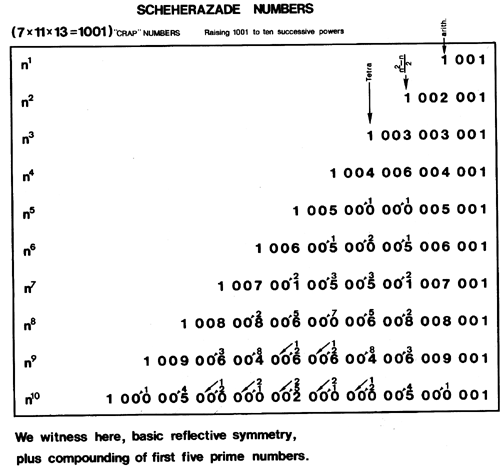
The abacus with its wires and beads taught humans how to fill a column with figures and thereafter to fill additional columns, by convention to the left. The Arabic numerals developed as symbols for the content of the columns. They filled a column and then they emptied it, but the cipher prevented them from using the column for any other notation, and the excess — by convention — was moved over to the left. This ”spillover” can begin earlier or later, depending on the modulus employed. The spillover to the next column begins later when we are employing Modulo 12 than when we are employing Modulo 10. To disembarrass the symmetry of the leftward spillover, the spillover number in the table has been written vertically.
1232.22
The table of the ten successive powers of the 1,001 Scheherazade Number accidentally discloses a series of progressions:
(1) in the extreme right-hand column, a progression of zeros;
(2) in the fourth column from the right, an arithmetical progression of
which we will call triangular; and
(3) in the seventh column from the right, a tetrahedral progression.
1232.23
The tetrahedron can be symmetrically or asymmetrically altered to accommodate the four unique planes that produce the fourth-dimensional accommodation of the vector equilibrium. The symmetry disclosed here may very well be four-dimensional symmetry that we have simply expressed in columns in a plane.
1232.24
The number 1,001 looks exciting because we are very close to the binary system of the computers. (We remember that Polynesians only counted to one and two.) The binary yes-no sequence looks so familiar. The Scheherazade Number has all the numbers you have in the binary system. The l,001-ness keeps persisting throughout the table.
1232.25
The numbers 7 × 11 × 13 × 17 included in the symmetric dividend 510,510 may have an important function in atomic nucleation, since it accommodates all the prime numbers involved in the successive periods.
1232.26
Many mathematicians assume that the integer 1 is not to be counted as a prime. Thus 2, 3, 5, 7, 11, and 13 make a total of six effective primes that may be identified with the fundamental vector edges of the tetrahedron and the six axes of conglomeration of 12 uniradius spheres closest packed around one nuclear sphere, and the fundamental topological abundance of universal lines that always consist of even sets of six.
1232.30
Scheherazade Reflection Patterns:
| 1 · 2 · 3 · 5 | 30 |
| 7 · 11 · 13 | 1,001 |
| 1 · 2 · 3 · 5 · 7 · 11 · 13 | 30,030 |
| (1 · 2 · 3 · 5 · 7 · 11 · 13)² | 901,800,900 |
| (1 · 2 · 3 · 5 · 7 · 11 · 13)² · 5 | 4,509,004,500 |
| (1 · 2 · 3 · 5 · 7 · 11 · 13)³ | 27,081,081,027,000 |
| (1 · 2 · 3 · 5 · 7 · 11 · 13)³ · 9 | 243,729,729,243,000 |
| (1 · 2 · 3 · 5 · 7 · 11 · 13)⁴ | 813,244,863,240,810,000 |
| (1 · 2 · 3 · 5 · 7 · 11 · 13)⁴ · 3 | 2,439,734,589,722,430,000 |
| (1 · 2 · 3 · 5 · 7 · 11 · 13)⁵ | 24,421,743,243,121,524,300,000 |
| 1 · 2 · 3 · 5 · 7 · 11 · 13 · 17 | 510,510 |
| (1 · 2 · 3 · 5 · 7 · 11 · 13 · 17)² | 260,620,460,100 |
| 1 · 2 · 3 · 5 · 7 · 11 · 13 · 17 · 19 | 9,699,690 |
| 1 · 2 · 3 · 5 · 7 · 11 · 13 · 17 · 19 · 23 · 29 | 6,469,693,230 |
| 1 · 2 · 3 · 5 · 7 · 11 · 13 · 17 · 19 · 23 · 29 · 31 | 200,560,490,130 |
| (1 · 2 · 3 · 5 · 7 · 11 · 13) · (1 · 2 · 3 · 5 · 7 · 11 · 13 · 17) | 153,306,153 |
| (1 · 2 · 3 · 5 · 7 · 11 · 13) · (1 · 2 · 3 · 5 · 7 · 11 · 13 · 17)³ | 459,918,459 |
1234.00 Seven-illion Scheherazade Number
1234.01
The Seven-illion Scheherazade Number includes the first seven primes, which are:
(1·2·3·5·7·11·13)⁵ … to the fifth power.
It reads,
24,421,743,243,121,524,300,000
1234.02
In the first days of electromagnetics, scientists discovered fourth-power energy relationships and Einstein began to find fifth-power relationships having to do with gravity accommodating fourth- and fifth-powering. The first seven primes factorial is a sublimely rememberable number. It is a big number, yet rememberable. When nature gives us a number we can remember, she is putting us on notice that the cosmic communications circuits are open: you are connected through to many sublime truths!
1234.03
Though factored by seven prime numbers, it is expressible entirely as various-sized increments of three to the fifth power. There is a four-place overlapping of one. Three to the fifth power means five-dimensionality triangulation, which means that five-dimensional structuring as triangulation is structure.
1234.04
When it is substituted as a comprehensive dividend for 360° 00’ 00” to express cyclic unity in increments equal to one second of arc, while recalculating the tables of trigonometric functions, it is probable that many, if not most, and possibly all the function fractions will be expressible as whole rational numbers. The use of 24,421,743,243,121,524,300,000 as cyclic unity will eliminate much cumulative error of the present trigonometric-function tables.
1234.10
Seven-illion Scheherazade Number: Symmetrical Mirror Pyramid Array:
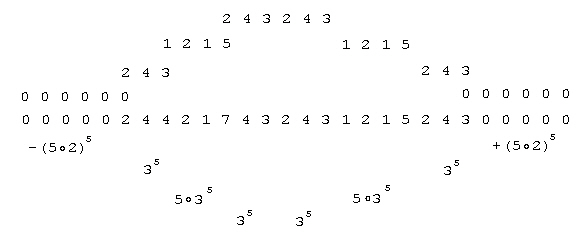
35 = 243, 5·35 = 1,215, −(5·2)⁵ = five zero prefix, + (5·2)⁵ = five zero suffix
1236.00 Eight-illion Scheherazade Number
1236.01
The Eight-illion Scheherazade Number is
1 · 2 · 3 · 5 · 7 · 11 · 13
1 · 2 · 3 · 5 · 7 · 11 · 13 · 17
1 · 2 · 3 · 5 · 7 · 11 · 13 · 17 · 19 · 23 · 29 · 31
Which is:
1ⁿ · 2³ · 3⁸ · 5⁵ · 7⁴ · 11³ · 13³ · 17² · 19 · 23 · 29 · 31
It reads:
1, 452, 803, 177, 020, 770, 377, 302, 500
1236.02
The Eight-illion Scheherazade Number accommodates all trigonometric functions, spherical and planar, when unity is 60 degrees; its halfway turnabout is 30 degrees. It also accommodates the octave-nine-zero of the icosahedron’s corner angles of 72 degrees, one-half of which is 36 degrees (ergo, 31 is the greatest prime involved), which characterizes maximum spherical excess of the vector equilibrium’s sixty- degreeness.
1237.00 Nine-illion Scheherazade Number
1237.01
The Nine-illion Scheherazade Number includes the first 12 primes, which are:
1ⁿ · 2¹⁰ · 3⁸ · 5⁸ · 7⁴ · 11³ · 13³ · 17² · 19 · 23 · 29 · 31
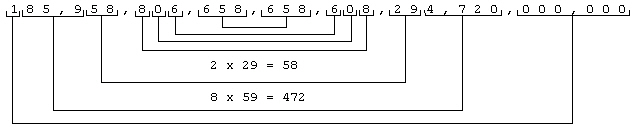
It reads:
185, 958, 806, 658, 658, 608, 294, 720, 000, 000
It is full of mirrors:
1238.00 Fourteen-illion Scheherazade Number
1238.20
Trigonometric Limit: First 14 Primes: The Fourteen-illion Scheherazade Number accommodates all the omnirational calculations of the trigonometric function tables whose largest prime number is 43 and whose highest common variable multiple is 45 degrees, which is one-eighth of unity in a Universe whose polyhedral systems consist always of a minimum of four positive and four negative quadranted hemispheres.
1238.21
45 degrees is the zero limit of covarying asymmetry because the right triangle’s 90-degree corner is always complemented by two corners always together totalling 90 degrees. The smallest of the covarying, 90-degree complementaries reaches its maximum limit when both complementaries are 45 degrees. Accepting the concept that one is not a prime number, we have 14 primes__2, 3, 5, 7, 11, 13, 17, 19, 23, 29, 31, 37, 41, 43__which primacy will accommodate all the 14 unique structural faceting of all the crystallography, all the biological cell structuring, and all bubble agglomerating: the 14 facets being the polar facets of the seven and only seven axes of symmetry of Universe, which are the 3-, 4-, 6-, 12-great circles of the vector equilibrium and the 6-, 10-, 15-great circles of the icosahedron.
1238.22
Tetrahedral Complementations: The sphere-to-space, space-to-sphere intertransformability is a conceptual generalization holding true independent of size, which therefore permits us to consider the generalized allspace-filling complementarity of the convex (sphere) and concave (space) octahedra with the convex (sphere) and concave (space) vector equilibria; this also permits us to indulge our concentrated attention upon local special-case events without fear of missing further opportunities of enjoying total synergetically conceptual advantage regarding nonsimultaneously considerable Scenario Universe. (See Secs. 970.20 and 1032.)
1238.23
We know the fundamental intercomplementations of the external convex macrotetra and the internal concave microtetra with all conceptual systems. Looking at the four successive plus, minus, plus, minus, XYZ coordination quadrants, we find that a single 90-degree quadrant of one hemisphere of the spherical octahedron contains all the trigonometric functioning covariations of the whole system. When the central angle is 90 degrees, then the two small corner angles of the isosceles triangle are each 45 degrees. After 45 degrees the sines become cosines, and vice versa. At 45 degrees they balance. Thereafter all the prime numbers that can ever enter into prime trigonometric computation (in contradistinction to complementary function computation) occur below the number 45. What occasions irrationality is the inability of dividends to be omni-equi-divisible, due to the presence of a prime number of which the dividend is not a whole product.
1238.24
This is why we factor completely or intermultiply all of the first 14 prime numbers existing between 1 and 45 degrees. Inclusive of these 14 numbers we multiply the first eight primes to many repowerings, which produces this Scheherazade Number, which, when used as the number of units in a circle, becomes a dividend permitting omnirational computation accommodation of all the variations of all the trigonometries of Universe.
1238.25
The four vertexial stars A, B, C, D defining the minimum structural__ergo, triangulated__system of Universe have only four possible triangular arrangements. There are only four possible different topological vertex combinations of a minimum structural system: ABC, ABD, ACD, BCD. In multifrequenced, modular subdivisioning of the minimum structural system, the subdividing grid may develop eight positive and negative aspects:
| ABC obverse (convex) | ABC reverse (concave) |
| ABD obverse (convex) | ABD reverse (concave) |
| ACD obverse (convex) | ACD reverse (concave) |
| BCD obverse (convex) | BCD reverse (concave) |
1238.26
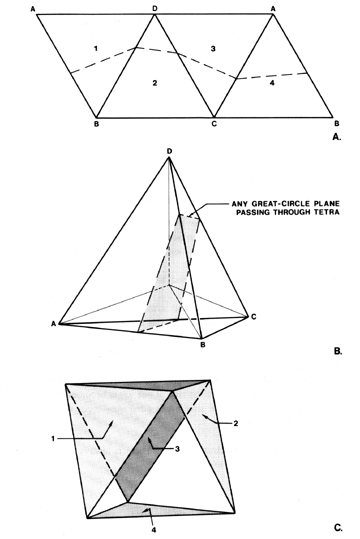
Three unopened edges AB, AD, BC. (Fig. 1238.26A.)
Four edge-bonded triangles of the tetrahedron. (Fig. 1238.26B.)
Three pairs of opened edges; three pairs of unopened edges. Each triangle has also both obverse and reverse surfaces; ergo, minimum closed system of Universe has four positive and four negative triangles__which equals eight cases of the same.
The same four triangles vertex-bond to produce the octahedron. (Fig. 1238.26C.)
1238.27
In a spherically referenced symmetrical structural system one quadrant of one hemisphere contains all the trigonometric variables of the whole system. This is because each hemisphere constitutes a 360-degree encirclement of its pole and because a 90-degree quadrant is represented by three equi-right-angle surface-angle corners and three equi-90-degree central-angle-arc edges, half of which 90-degree surface and central angles is 45 degrees, which is the point where the sine of one angle becomes the cosine of the other and knowledge of the smallest is adequate__ergo, 45° 45° is the limit case of the smallest.
1238.28
Spherical Quadrant Phase: There is always a total of eight (four positive, four negative) unique
interpermutative,
intertransformative,
interequatable,
omniembracing
phases of all cyclically described symmetrical systems (see Sec. 610.20), within any one octave of which all the intercovariable ranging complementations of number occur. For instance, in a system such as spherical trigonometry, consisting of 360 degrees per circle or cycle, all the numerical intervariabilities occur within the first 45 degrees, .: 45 × 8 = 360. Since the unit cyclic totality of the Fourteen-illion Scheherazade Number is the product of the first 15 primes, it contains all the prime numbers occurring within the 45- degree-limit numerical integer permutations of all cyclic systems together with an abundance of powers of the first eight primes, thus accommodating omnirational integrational expressibility to a 1 × 10-42 fraction of cyclic unity, a dividend so comprehensive as to permit the rational description of a 22 billion-light-year-diameter Universe in whole increments of 1/10,000ths of one atomic nucleus diameter.
1238.29
(+) · (+) = (+)
(+) · (-) = (-)       Multiply
(-) · (+) = (-)
(-) · (-) = (+)

(+) / (+) = (+)
(+) / (-) = (-)       Divide
(-) / (+) = (-)
(-) / (-) = (+)
1238.30
Cosmic Commensurability of Time and Size Magnitudes: Each degree of 360 degrees of circular arc is subdivided into 60 minutes and the minutes into 60 seconds each. There are 1,296,000 seconds of arc in a circle of 360 degrees.
1238.31
One minute of our 8,000-mile-diameter planet Earth’s great circle arc = one nautical mile = 6,076 feet approximately. A one-second arc of a great circle of Earth is 6,076/60 = 101.26 feet, which means one second of great-circle arc around Earth is approximately 100 feet, or the length of one tennis court, or one-third of the distance between the opposing teams’ goal posts on a football field. We can say that each second of Earth’s great circle of arc equals approximately 1,200 inches (or 1,215.12 “exact”). There are 2 1/2 trillion atomic-nucleus diameters in one inch. A hundredth of an inch is the smallest interval clearly discernible by the human eye. There are 25 billion atomic-nucleus diameters in the smallest humanly visible “distance” or linear size increment. A hundredth of an inch equals 1/120,000th of a second of great-circle arc of our spherical planet Earth. This is expressed decimally as .0000083 of a second of great-circle arc = .01 inch; or it is expressed scientifically as .01 inch = 83 × 10⁻⁷. A hundredth of an inch equals the smallest humanly visible dust speck; therefore: minimum dust speck = 83 × 10⁻⁷ seconds of arc, which equals 25 billion atomic-nucleus diameters__or 2 1/2 million angstroms. This is to say that it requires seven places to the right of the decimal to express the fractional second of the greatcircle arc of Earth that is minimally discernible by the human eye.
1238.40
Fourteen-illion Scheherazade Number: The Fourteen-illion Scheherazade Number includes the first 15 primes, which are:
1ⁿ · 2¹² · 3⁸ · 5⁶ · 7⁶ · 11⁶ · 13⁶ · 17² · 19 · 23 · 29 · 31 · 37 · 41 · 43
It reads:
3,128,581,583,194,999,609,732,086,426,156,130,368,000,000
1238.41
Declining Powers of Factorial Primes: The recurrence of the prime number 2 is very frequent. The number of operational occasions in which we need the prime number 43 is very less frequent than the occasions in which the prime numbers 2, 3, 5, 7, and 11 occur. This Scheherazade Number provides an abundance of repowerings of the lesser prime numbers characterizing the topological and vectorial aspects of synergetics’ hierarchy of prime systems and their seven prime unique symmetrical aspects (see Sec. 1040) adequate to take care of all the topological and trigonometric computations and permutations governing all the associations and disassociations of the atoms.
1238.42
We find that we can get along without multirepowerings after the second repowering of the prime number 17. The prime number 17 is all that is needed to accommodate both the positive and negative octave systems and their additional zero- nineness. You have to have the zero-nine to accommodate the noninterfered passage between octave waves by waves of the same frequency. (See Secs. 1012 and 1223.)
1238.43
The prime number 17 accommodates all the positive-negative, quanta-wave primes up to and including the number 18, which in turn accommodates the two nines of the invisible twoness of all systems. It is to be noted that the harmonics of the periodic table of the elements add up to 92:
   2
   8       18
   8
  18
  18
  18
  18       36
   2
  ----
   92
There are five sets of 18, though the 36 is not always so recognized. Conventional analysis of the periodic table omits from its quanta accounting the always occurring invisible additive twoness of the poles of axial rotation of all systems. (See Sec. 223.11 and Table 223.64, Col. 7.)
1238.50
Properties: The 3 fourteen-illion magnitude Scheherazade Number has 3 × 10⁴³ whole-number places, which is 10³⁷ more integer places than has the 1 × 10⁶ number expressing the 1,296,000 seconds in 360 degrees of whole-circle arc, and can therefore accommodate rationally not only calculations to approximately 1/100th of an inch (which is the finest increment resolvable by the human eye), but also the 10⁻⁷ power of that minimally visible magnitude, for this 3 × 10⁴³ SSRCD has enough decimal places to express rationally the 22-billion-light-years-diameter of the omnidirectional, celestial-sphere limits thus far observed by planet Earth’s humans expressed in linear units measuring only 1,000ths of the diameter of one atomic nucleus.
1238.51
Scheherazade Numbers: 47: The first prime number beyond the trigonometric limit is 47. The number 47 may be a flying increment to fill allspace, to fill out the eight triangular facets of the non-allspace-filling vector equilibrium to form the allspace-filling first nuclear cube. If 47 as a factor produces a Scheherazade Number with mirrors, it may account not only for all the specks of dust in the Universe but for all the changes of cosmic restlessness, accounting the convergent-divergent next event, which unbalances the even and rational whole numbers. If 47 as a factor does not produce a Scheherazade Number with mirrors, it may explain that there can be no recurring limit symmetries. It may be that 47 is the cosmic random element, the agent of infinite change.
1238.52
Addendum Inspired by inferences of Secs. 1223.12, 1224.30-34 inclusive and 1238.51, just before going to press with Synergetics 2, we obtained the following 71 integer, multi-intermirrored, computer-calculated and proven, volumetric (third power) Scheherazade number which we have arranged in ten, “sublimely rememberable,” unique characteristic rows.
212·38·56·76·116·136·174·193·233·293·313·373·413·433·473
the product of which is 616,494,535,0,868

49,2,48,0
51,88
27,49,49
00,6996,185
494,27,898
35,17,0
25,22,
73,66,0
864,000,000
If all the trigonometric functions are reworked using this 71 integer number, embracing all prime numbers to 50, to the third power, employed as volumetric, cyclic unity, all functions will prove to be whole rational numbers as with the whole atomic populations.
1238.60 Size Magnitudes
Note
The symbol for Atomic Nucleus Diameter as used in the online version of Synergetics:
The symbol used here: ⌀ₙ (Scientifically valid)

An Atomic Nucleus Diameter = A.N.D. = ⌀ₙ
Atomic Nucleus Diameters:
| 10,000 ⌀ₙ | = | 1 Angstrom (One atomic diameter) | = | 10 one-illion |
| 1·10⁴ ⌀ₙ | = | 1 Angstrom | = | 10 one-illion |
| 25·10⁹ ⌀ₙ | = | 1 Speck of Dust (= One hair’s breadth) | = | 25 three-illion |
| 25·10¹¹ ⌀ₙ | = | 1 Inch | = | 2 1/2 four-illion |
| 3·10¹³ ⌀ₙ | = | 1 Foot | = | 30 four-illion |
| 1·10¹⁴ ⌀ₙ | = | 1 Meter | = | 100 four-illion |
| 10·10¹⁶ ⌀ₙ | = | 1 Kilometer | = | 100 five-illion |
| 18·10¹⁶ ⌀ₙ | = | 1 Mile (Nautical) | = | 180 five-illion |
| 144·10¹⁹ ⌀ₙ | = | 1 Diameter of Earth | = | 1.44 seven-illion |
| 144·10²¹ ⌀ₙ | = | 1 Diameter of Sun | = | 144 seven-illion |
| 144·10²⁵ ⌀ₙ | = | 1 Diameter of Solar System | = | 1 1/2 nine-illion |
| 108·10²⁸ ⌀ₙ | = | 1 Light Year (6 trillion miles) | = | 1 ten-illion |
| 2 1/3·10⁴⁰ ⌀ₙ | = | Diameter of astro observed sweepout (22 billion light years) | = | 23 thirteen-illion |
1238.70 Time Magnitudes: Heartbeats (Seconds of Time)
| 1·10⁶ | = 1 million | = 1 two-illion heartbeats ago | = 2 weeks |
| 31·10⁶ | = 31 million | = 31 two-illion heartbeats ago | = 1 year |
| 5ù10⁸ | = 500 million | = 500 two-illion heartbeats ago | = 16 years (college) |
| 1·10⁹ | = 1 billion | = 1 three-illion heartbeats ago | = 32 years (prime life) |
| 2·10⁹ | = 2 billion | = 2 three-illion heartbeats ago | = Average lifetime |
| 42·10⁹ | = 42 billion | = 42 three-illion heartbeats ago | = Mohammed |
| 60·10⁹ | = 60 billion | = 60 three-illion heartbeats ago | = Christ |
| 78·10⁹ | = 78 billion | = 78 three-illion heartbeats ago | = Buddha |
| 200·10⁹ | = 200 billion | = 200 three-illion heartbeats ago | (8,000 years ago) = Earliest Egypt |
| 500·10⁹ | = 500 billion | = 500 three-illion heartbeats ago | (15,000 years ago) = Earliest artistic culture (Thailand) |
| 1·10¹² | = 1 trillion | = 1 four-illion heartbeats ago | = 30,000 years ago (Last Ice Age) |
| 75·10¹² | = 75 trillion | = 75 four-illion heartbeats ago | = Leakey: Earliest human skull: 2 1/2 million years ago |
| 75·10¹² | = 75 trillion | = Capital Wealth of World | |
| 1·10¹⁷ | = 100 quadrillion | = 100 five-illion heartbeats ago | = Age of our planet Earth |
| 3·10¹⁷ | = 300 quadrillion | = 300 five-illion heartbeats ago | = Known limit age of Universe (10 billion years ago) |
1238.80 Number Table: Significant Numbers (see Table 1238.80)
1239.00 Limit Number of Maximum Asymmetry
1239.10
Powers of Primes as Limit Numbers: Every so often out of an apparently almost continuous absolute chaos of integer patterning in millions and billions and quadrillions of number places, there suddenly appears an SSRCD rememberable number in lucidly beautiful symmetry. The exponential powers of the primes reveal the beautiful balance at work in nature, which does not secrete these symmetrical numbers in irrelevant capriciousness. Nature endows them with functional significance in her symmetrically referenced, mildly asymmetrical, structural formulations. The SSRCD numbers suddenly appear as unmistakably as the full Moon in the sky.
1239.11
There is probably a number limit in nature that is adequate for the rational, whole-number accounting of all the possible general atomic systems’ permutations. For instance, in the Periodic Table of the Elements, we find 2, 8, 8, 18. These number sets seem familiar: the 8 and the 18, which is twice 9, and the twoness is perfectly evident. The largest prime number in 18 is 17. It could be that if we used all the primes that occur between 1 and 17, multiplied by themselves five times, we might have all the possible number accommodations necessary for all the atomic permutations.
1239.20
Pairing of Prime Numbers: I am fascinated by the fundamental interbehavior of numbers, especially by the behavior of primes. A prime cannot be produced by the interaction of any other numbers. A prime, by definition, is only divisible by itself and by one. As the integers progress, the primes begin to occur again, and they occur in pairs. That is, when a prime number appears in a progression, another prime will appear again quite near to it. We can go for thousands and thousands of numbers and then find two primes appearing again fairly close together. There is apparently some kind of companionship among the primes. Euler, among others, has theories about the primes, but no one has satisfactorily accounted for their behavior.
1239.30
Maximum Asymmetry: In contrast to all the nonmeaning, the Scheherazade Numbers seem to emerge at remote positions in numerical progressions of the various orders. They emerge as meaning out of nonmeaning. They show that nature does not sustain disorder indefinitely.
1239.31
From time to time, nature pulses inside-outingly through an omnisymmetric zerophase, which is always our friend vector equilibrium, in which condition of sublime symmetrical exactitude nature refuses to be caught by temporal humans; she refuses to pause or be caught in structural stability. She goes into progressive asymmetries. All crystals are built in almost-but-not quite-symmetrical asymmetries, in positive or negative triangulation stabilities, which is the maximum asymmetry stage. Nature pulsates torquingly into maximum degree of asymmetry and then returns to and through symmetry to a balancing degree of opposite asymmetry and turns and repeats and repeats. The maximum asymmetry probably is our minus or plus four, and may be the fourth degree, the fourth power of asymmetry. The octave, again.