220.01 Principles
220.011
The synergetics principles described in this work are experimentally demonstrable.
220.02
Principles are entirely and only intellectually discernible. The fundamental generalized mathematical principles govern subjective comprehension and objective realization by man of his conscious participation in evolutionary events of the Universe.
220.03
Pure principles are usable. They are reducible from theory to practice.
220.04
A generalized principle holds true in every case. If there is one single exception, then it is no longer a generalized principle. No one generalization ever contradicts another generalization in any respect. They are all interaccommodating .
220.05
The physical Universe is a self-regenerative process. Its regenerative interrelationships and intertransformings are governed by a complex code of weightless, generalized principles. The principles are metaphysical. The complex code of eternal metaphysical principles is omni-interaccommodative; that is, it has no intercontradiction. To be classifiable as “generalized,” principles cannot terminate or go on vacation. If indeed they are generalized, they are eternal, timeless.
220.10 Reality and Eternality
220.11
What the mathematicians have been calling abstraction is reality. When they are inadequate in their abstraction, then they are irrelevant to reality. The mathematicians feel that they can do anything they want with their abstraction because they don’t relate it to reality. And, of course, they can really do anything they want with their abstractions, even though, like masturbation, it is irrelevant to the propagation of life.
220.12
The only reality is the abstraction of principles, the eternal generalized principles. Most people talk of reality as just the afterimage effects — the realization lags that register superficially and are asymmetric and off center and thereby induce the awareness called life. The principles themselves have different lag rates and different interferences. When we get to reality, it’s absolutely eternal.
220.13
The inherent inaccuracy is what people call the reality. Man’s way of apprehending is always slow: ergo, the superficial and erroneous impressions of solids and things that can be explained only in principle.
221.00 Principle of Unity
221.01
Synergetics constitutes the original disclosure of a hierarchy of rational quantation and topological interrelationships of all experiential phenomena which is omnirationally accounted when we assume the volume of the tetrahedron and its six vectors to constitute both metaphysical and physical unity. (See chart at 223.64.) (See Sec. 620.12.)
222.00 Omnidirectional Closest Packing of Spheres
222.01
Fig. 222.01
Fig. 222.01 Equation for Omnidirectional Closest Packing of Spheres: Omnidirectional concentric closest packings of equal spheres about a nuclear sphere form series of vector equilibria of progressively higher frequencies. The number of spheres or vertexes on any symmetrically concentric shell outer layer is given by the equation 10 F2 + 2, where F = Frequency. The frequency can be considered as the number of layers (concentric shells or radius) or the number of edge modules on the vector equilibrium. A one-frequency sphere packing system has 12 spheres on the outer layer (A) and a one-frequency vector equilibrium has 12 vertexes. If another layer of spheres are packed around the one-frequency system, exactly 42 additional spheres are required to make this a two-frequency system (B). If still another layer of spheres is added to the two-frequency system, exactly 92 additional spheres are required to make the three-frequency system (C). A four-frequency system will have 162 spheres on its outer layer. A five-frequency system will have 252 spheres on its outer layer, etc.
Link to original
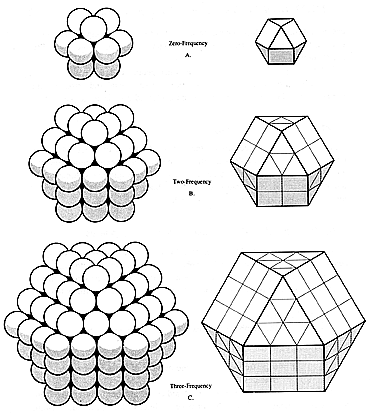
Definition: The omnidirectional concentric closest packing of equal radius spheres about a nuclear sphere forms a matrix of vector equilibria of progressively higher frequencies. The number of vertexes or spheres in any given shell or layer is edge frequency (F) to the second power times ten plus two.
222.02
Equation:
10F² + 2 = the number of vertexes or spheres in any layer,
Where,
F = edge frequency, i.e., the number of outer-layer edge modules.
222.03
The frequency can be considered as the number of layers (concentric shells or radius) or the number of edge modules of the vector equilibrium. The number of layers and the number of edge modules is the same. The frequency, that is the number of edge modules, is the number of spaces between the spheres, and not the number of spheres, in the outer layer edge.
222.10
Equation for Cumulative Number of Spheres: The equation for the total number of vertexes, or sphere centers, in all symmetrically concentric vector equilibria shells is:
10(F₁² + F₂² + F₃² + · · · + Fn²) + 2Fₙ + 1
222.20
Characteristics of Closest Packing of Spheres: The closest packing of spheres begins with two spheres tangent to each other, rather than omnidirectionally. A third sphere may become closest packed by becoming tangent to both of the first two, while causing each of the first two also to be tangent to the two others: this is inherently a triangle.
222.21
A fourth sphere may become closest packed by becoming tangent to all three of the first three, while causing each of the others to be tangent to all three others of the four-sphere group: this is inherently a tetrahedron.
222.22
Further closest packing of spheres is accomplished by the omniequiangular, intertriangulating, and omnitangential aggregating of identical-radius spheres. In omnidirectional closest-packing arrays, each single sphere finds itself surrounded by, and tangent to, at most, 12 other spheres. Any center sphere and the surrounding 12 spheres altogether describe four planar hexagons, symmetrically surrounding the center sphere.
222.23
Excess of Two in Each Layer: The first layer consists of 12 spheres tangentially surrounding a nuclear sphere; the second omnisurrounding tangential layer consists of 42 spheres; the third 92, and the order of successively enclosing layers will be 162 spheres, 252 spheres, and so forth. Each layer has an excess of two diametrically positioned spheres which describe the successive poles of the 25 alternative neutral axes of spin of the nuclear group. (See illustrations 450.11a and 450.11b.)
222.24
Three Layers Unique to Each Nucleus: In closest packing of spheres, the third layer of 92 spheres contains eight new potential nuclei which do not, however, become active nuclei until each has three more layers surrounding it — three layers being unique to each nucleus.
222.25
Isotropic Vector Matrix: The closest packing of spheres characterizes all crystalline assemblages of atoms. All the crystals coincide with the set of all the polyhedra permitted by the complex configurations of the isotropic vector matrix (see Sec. 420), a multidimensional matrix in which the vertexes are everywhere the same and equidistant from one another. Each vertex can be the center of an identical-diameter sphere whose diameter is equal to the uniform vector’s length. Each sphere will be tangent to the spheres surrounding it. The points of tangency are always at the mid-vectors.
222.26
The polyhedral shape of these nuclear assemblages of closest-packed spheres reliably interdefined by the isotropic vector matrix’s vertexes**is always that of the vector equilibrium, having always six square openings (“faces”) and eight triangular openings (“faces”).
222.30
Fig. 222.30
Fig. 222.30 Volume Of Vector Equilibrium: The volume of the vector equilibrium consists of eight tetrahedra and six half-octahedra. Therefore, the volume of the vector equilibrium is exactly twenty.
Link to original
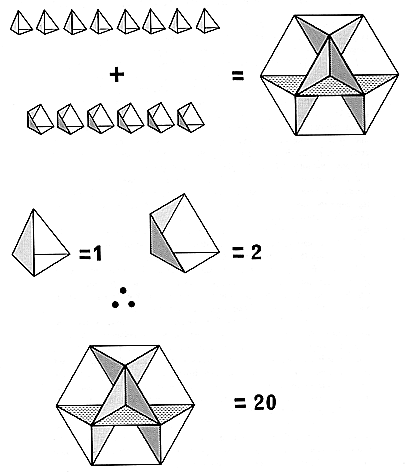
Volume of Vector Equilibrium: If the geometric volume of one of the uniform tetrahedra, as delineated internally by the lines of the isotropic vector matrix system, is taken as volumetric unity, then the volume of the vector equilibrium will be 20.
222.31
The volume of any series of vector equilibria of progressively higher frequencies is always frequency to the third power times 20.
222.32
Equation for Volume of Vector Equilibrium:
Volume of vector equilibrium = 20F³,
Where F = frequency.
222.40
Mathematical Evolution of Formula for Omnidirectional Closest Packing of Spheres: If we take an inventory of the number of balls in successive vector equilibria layers in omnidirectional closest packing of spheres, we find that there are 12 balls in the first layer, 42 balls in the second layer, and 92 balls in the third. If we add a fourth layer, we will need 162 balls, and a fifth layer will require 252 balls. The number of balls in each layer always comes out with the number two as a suffix. We know that this system is a decimal system of notation. Therefore, we are counting in what the mathematician calls congruence in modulo ten — a modulus of ten units — and there is a constant excess of two.
222.41
In algebraic work, if you use a constant suffix — where you always have, say, 33 and 53 — you could treat them as 30 and 50 and come out with the same algebraic conditions. Therefore, if all these terminate with the number two, we can drop off the two and not affect the algebraic relationships. If we drop off the number two in the last column, they will all be zeros. So in the case of omnidirectional closest packing of spheres, the sequence will read; 10, 40, 90, 160, 250, 360, and so forth. Since each one of these is a multiple of 10, we may divide each of them by 10, and then we have 1, 4, 9, 16, 25, and 36, which we recognize as a progression of second powering**two to the second power, three to the second power, and so forth.
222.42
In describing the number of balls in any one layer, we can use the term frequency of modular subdivisions of the radii or chords as defined by the number of layers around the nuclear ball. In the vector equilibrium, the number of modular subdivisions of the radii is exactly the same as the number of modular subdivisions of the chords (the “edge units”), so we can say that frequency to the second power times ten plus two is the number of balls in any given layer.
222.43
This simple formula governing the rate at which balls are agglomerated around other balls or shells in closest packing is an elegant manifest of the reliably incisive transactions, formings, and transformings of Universe. I made that discovery in the late 1930s and published it in 1944. The molecular biologists have confirmed and developed my formula by virtue of which we can predict the number of nodes in the external protein shells of all the viruses, within which shells are housed the DNA-RNA-programmed design controls of all the biological species and of all the individuals within those species. Although the polio virus is quite different from the common cold virus, and both are different from other viruses, all of them employ frequency to the second power times ten plus two in producing those most powerful structural enclosures of all the biological regeneration of life. It is the structural power of these geodesic-sphere shells that makes so lethal those viruses unfriendly to man. They are almost indestructible.
222.50
Classes of Closest Packing: There are three classes of closest packing of unit-radius spheres:
222.51
SYSTEMATIC Symmetrical Omnidirectional Closest Packing: Twelve spheres closest pack omnitangentially around one central nuclear sphere. Further symmetrical enclosure by closest-packed sphere layers agglomerate in successive vector equilibria. The nucleus is inherent.
222.52
ASYMMETRICAL Closest Packed Conglomerates: Closest-packed conglomerates may be linear, planar, or “crocodile.” Closest packed spheres without nuclear organization tend to arrange themselves as the octet truss or the isotropic vector matrix. The nuclei are incidental.
222.53
VOLUMETRIC Symmetrical Closest Packing: These are nonnuclear symmetrical embracements by an outer layer. The outer layer may be any frequency, but it may not be expanded or contracted by the addition inwardly or outwardly of complete closest-packed layers. Each single-layer frequency embracement must be individually constituted. Volumetric symmetrical closest packing aggregates in most economical forms as an icosahedron geodesic network. The nucleus is excluded.
223.00 Principle of Prime Number Inherency and Constant Relative Abundance of the Topology of Symmetrical Structural Systems
223.01
Definition: The number of vertexes of every omnitriangulated structural system is rationally and differentially accountable, first, by selecting and separating out the always additive two polar vertexes that must accommodate the neutral axis of spin inherent in all individual structural systems to permit and account for their independent motional freedom relationship from the rest of Universe. The number of nonpolar vertexes is called the base number. Second, we identify the always multiplicative duality factor of two characterizing the always coexistent insideness-outsideness of systems and their inherently positively and negatively congruent disparity of convexity and concavity. Third, we find the multiplicative duality factor of two to be multiplied by one of the first four prime numbers, 1, 2, 3, or 5 (multiplied by 1 if the structural system is tetrahedral, by 2 if it is octahedral, by 3 if it is the triangularly structured cube, or by 5 if it is the icosahedron or the triangularly stabilized vector equilibrium), or factored by a variety of multiples comprised of combinations of only those first four prime numbers, whether the polyhedra are, in the Platonic, Archimedean, or any other progression of symmetrical structural systems. When the vector edges of the symmetrical systems are modularly subdivided, all of the foregoing products are found to be multiplied again to the second power by the frequency of uniform modular subdivisions of the vector edges of the symmetrical structural system. In respect to the original base number of nonpolar vertexes, there will always be twice as many openings (“faces”) and three times as many vector edges of the symmetrical structural system, always remembering that the two polar vertexes were first extracted from the inventory of topological characteristics before multiplying the remaining number of vertexes in the manner described and in relation to which the number of nonpolar vertexes and the relative abundance of the other topological characteristics are accurately derived and operationally described.
223.02
Axis of Spin: Any two vertexes may be selected as the axis of spin, whether or not the axis described by them is immediately conceivable as the logical axis of spinnability, i.e., the axis need not be statically symmetrical. (You can take hold of a boy by his two hands and, holding one above the other and leaning backward spin him centrifugally around you. Although his two hands do not represent the symmetrical static axis of the boy’s body, their dynamic positions defined the axis of your mutual spinning.)
223.03
Equation of Prime Number Inherency of All Symmetrical Structural Omnitriangulated Systems:
X = 2NF² + 2
Where:
X = number of vertexes (crossings) or spheres in the outer layer or shell of any symmetrical system;
N = one of the first four prime numbers: 1, 2, 3, or 5; and
F = edge frequency, i.e., the number of outer layer edge modules.
223.04
Equation of Constant Relative Abundance of Topological Aspects of All Symmetrical Structural Systems: Multiplication of one of the first four prime numbers or their powers or multiples by the constant of relative topological characteristics abundance:
1 + 2 = 3
1 Nonpolar vertex
2 Faces
3 Edges
In addition to the product of such multiplication of the constant relative abundance equation by one of the first four prime numbers — 1, 2, 3, or 5 — or their powers or multiples, there will always be two additional vertexes assigned as the poles of the axial spinnability of the system.
223.05
Two Kinds of Twoness:
There are two kinds of twoness:
(1) the numerical, or morphationally unbalanced twoness; and
(2) the balanced twoness.
The vector equilibrium is the central symmetry through which both balanced and unbalanced asymmetries pulsatingly and complexedly intercompensate and synchronize. The vector equilibrium’s frequency modulatability accommodates the numerically differentiated twonesses.
223.06
There are four kinds of positive and negative:
(1) the eternal, equilibrium-disturbing plurality of differentially unique, only- positively-and-negatively-balanced aberratings;
(2) the north and south poles;
(3) the concave and convex; and
(4) the inside (microcosm) and outside (macrocosm), always cosmically complementing the local system’s inside-concave and outside-convex limits.
223.07
There is a fourfold twoness: one of the exterior, cosmic, finite (“nothingness”) tetrahedron — i.e., the macrocosm outwardly complementing all (“something”) systems — and one of the interior microcosmic tetrahedron of nothingness complementing all conceptually thinkable and cosmically isolatable “something” systems. (See Sec. 1070.)
223.08
A pebble dropped into water precessionally produces waves that move both outwardly from the circle’s center — i.e., circumferentially of the Earth sphere — and reprecessionally outwardly and inwardly from the center of the Earth — i.e., radially in respect to the Earth sphere. Altogether, this interregeneratively demonstrates (1) the twoness of local precessional system effects at 90 degrees, and (2) the Universe-cohering gravitational effects at 180 degrees. These are the two kinds of interacting forces constituting the regenerative structural integrity of both subsystem local twonesses and nonunitarily conceptual Scenario Universe. The four cosmically complementary twonesses and the four local system twonesses altogether eternally regenerate the scientific generalization known as complementarity. Complementarity is sum-totally eightfoldedly operative: four definitive local system complementations and four cosmically synergetic finitive accountabilities.
223.09
Topologically the additive twoness identifies the opposite poles of spinnability of all systems; the multiplicative twoness identifies the concave-insideness and convex-outsideness of all systems: these four are the four unique twonesses of the eternally regenerative, nonunitarily conceptual Scenario Universe whose conceptual think- aboutedness is differentially confined to local “something” systems whose insideness-and- outsideness-differentiating foci consist at minimum of four event “stars.” (See Secs. 510.04 and 510.09.)
223.10
Constant Relative Abundance: Topological systems that are structurally stabilized by omnitriangulation reveal a constant relative abundance of certain fundamental characteristics deriving from the additive twoness and the multiplicative twoness of all finite systems.
223.11
The additive twoness derives from the polar vertexes of the neutral axis of spin of all systems. This twoness is the beginning and essence of consciousness, with which human awareness begins: consciousness of the other, the other experience, the other being, the child’s mother. To describe that of which we are aware, we employ comparison to previous experience. That which we are aware of is hotter, or bigger, or sharper than the other experience or experiences. The a priori otherness of comparative awareness inherently requires time. Early humanity’s concept of the minimum increment of time was the second, because time and awareness begin with the second experience, the prime other. If there is only one think, one think is naught. Life and Universe that goes with it begins with two spheres: you and me … and you are always prior to me. I have just become by my awareness of you.
223.12
The multiplicative twoness is inherent in the disparity of the congruent convexity and concavity of the system. The multiplicative twoness is because both you and I have insideness and outsideness, and they are not the same: one is convex and one is concave.
223.13
Conceptual systems having inherent insideness and outsideness are defined at minimum by four event foci and are, ergo, tetrahedral; at maximum symmetrical complexity, they are superficially “spherical” — that is, they are a spherelike array of event foci too minute for casual resolution into the plurality of individual event foci of which, in experiential fact, they must consist, each being approximately equidistant from one approximately identifiable event focus at the spherical array’s center. Since all the “surface” event foci may be triangularly interconnected with one another by chords that are shorter than arcs, all spherical experience arrays are, in fact, polyhedra. And all spheres are polyhedra. Spherical polyhedra may at minimum consist of the four vertexes of the regular tetrahedron.
223.14
We discover that the additive twoness of the two polar (and a priori awareness) spheres at most economical minimum definition of event foci are two congruent tetrahedra, and that the insideness and outsideness of complementary tetrahedra altogether represent the two invisible complementary twoness that balances the visible twoness of the polar pair. This insideouting tetrahedron is the minimum compound curve — ergo, minimum sphere. (See Sec. 624.)
223.15
When the additive twoness and the multiplicative twoness are extracted from any symmetrical and omnitriangulated system, the number of vertexes will always be a rational product of one or more of the first four prime numbers, 1, 2, 3, or 5, or their powers or multiples.
223.16
The number of openings (or “faces”) will be twice that of the vertexes, minus two.
223.17
The number of vector edges will be three times the number of vertexes, minus two.
223.18
When we reduce the topological inventory of basic vertexes, areas, and edges of all omnitriangulated structural systems in Universe — whether symmetrical or asymmetrical — by taking away the two poles and dividing the remaining inventory by two, we discover a constant relative abundance of two faces and three lines for every one vertex. This is to say that there is a constant topological abundance characterizing all systems in Universe in which for every nonpolar vertex there are always two faces and three (vectorial) edges.
223.19
In an omnitriangulated structural system:
the number of vertexes (“crossings” or “points”) is always evenly divisible by two;
the number of faces (“areas” or “openings”) is always evenly divisible by four; and
the number of edges (“lines,” “vectors,” or “trajectories”) is always evenly divisible by six.
223.20
Primary Systems: Only four primary systems or contours can be developed by closest packing of spheres in omnisymmetrical concentric layers. The exterior contours of these points are in the chart:
| Primary System | Vertex Formula | Vertexes | After subtracting the two Polar vertices: the Additive two | And dividing by the Duality Factor Two | Outer Layer of Two Frequency (crossings) | Outer Layer of Three Frequency (crossings) |
|---|---|---|---|---|---|---|
| (a) Tetrahedron (four sides) | 2+[(2×1)×F2]=4 vertexes | 4 | 2 | 1 | 10 | 20 |
| (b) Octahedron (eight sides) | 2+[(2×2)×F2]=6 vertexes | 6 | 4 | 2 | 18 | 38 |
| (c) Cube (six sides) | 2+[(2×3)×F2]=8 vertexes | 8 | 6 | 3 | 26 | 56 |
| (d) Vector Equilibrium (fourteen sides) | 2+[(2×5)×F2]=12 vertexes | 12 | 10 | 5 | 42 | 92 |
223.21
Primary Systems: Equations: The formulas for the number of spheres in the outer layer of closest packed spheres in primary systems is as follows:
(a) Tetrahedron:
X = 2F² + 2
(b) Octahedron:
X = 4F² + 2
(c) Cube:
X = 6F² + 2
(d) Vector Equilibrium (Icosahedron):
X = 10F² + 2
Where:
X = the number of spheres in the outer layer or shell of the primary system;
F = edge frequency, i.e., the number of outer-layer edge modules.
223.30
Symmetrical Analysis of Topological Hierarchies: Symmetrical means having no local asymmetries. Omnisymmetrical permits local asymmetries .
223.31
The following omnitriangulated systems are symmetrical:
Tetrahedron
Octahedron
Icosahedron
223.32
The following omnitriangulated systems are omnisymmetrical:
Cube
Diagonal Rhombic Dodecahedron
Rhombic Dodecahedron
Dodecahedron
Tetraxidecahedron
Triacontahedron
Enenicontrahedron
223.33
The vector equilibrium is locally mixed symmetrical and asymmetrical.
223.34
Symmetrical Analysis of Topological Hierarchies: Whenever we refer to an entity, it has to be structurally valid, and therefore it has to be triangulated. Being locally mixed, vectorially symmetrical but facially asymmetrical, being triangulated but not omnitriangulated, vector equilibrium may function as a system but not as a structure.
223.40
Powering: Second powering in the topology of synergetics is identifiable only with the vertexes of the system and not with something called the “surface area.” Surfaces imply experimentally nondemonstrable continuums. There are no topologically indicated or implied surfaces or solids. The vertexes are the external points of the system. The higher the frequency of the system, the denser the number of external points. We discover then that second powering does not refer to “squaring” or to surface amplification. Second powering refers to the number of the system’s external vertexes in which equating the second power and the radial or circumferential modular subdivisions of the system multiplied by the prime number one if a tetrahedral system; by the prime number two if an octahedral system; by the prime number three if a triangulated cubical system; and by the prime number five if an icosahedral system; each, multiplied by two, and added to by two, will accurately predict the number of superficial points of the system.
223.41
This principle eliminates our dilemma of having to think of second and third powers of systems as referring exclusively to continuum surfaces or solids of the systems, neither of which states have been evidenced by experimental science. The frequencies of systems modify their prime rational integer characteristics. The second power and third power point aggregations identify the energy quanta of systems and their radiational growth or their gravitational contraction. They eliminate the dilemma in which physics failed to identify simultaneously the wave and the particle. The dilemma grew from the misconceived necessity to identify omnidirectional wave growth exclusively with the rate of a nonexperimentally existent spherical surface continuum growth, the second power of radiational growth being in fact the exterior quanta and not the spherical surface being considered as a continuum.
223.50
Prime Number Inherency: All structurally stabilized polyhedra are characterized by a constant relative abundance of Euler’s topological aspects in which there will always be twice as many areas and three times as many lines as the number of points in the system, minus two (which is assigned to the polar axis of spin of the system).
223.51
The number of the topological aspects of the Eulerian system will always be an even number, and when the frequency of the edge modulation of the system is reduced to its second root and the number of vertexes is divided by two, the remainder will be found to consist exclusively of a prime number or a number that is a product exclusively of two or more intermultiplied prime numbers, which identify the prime inherency characteristics of that system in the synergetic topological hierarchy of cosmically simplest systems.
223.52
All other known regular symmetrical polyhedra (other than the tetrahedron and the octahedron) are described quantitatively by compounding rational fraction elements of the tetrahedron and the octahedron. These elements are known as the A and B Quanta Modules (see Sec. 920 through 940). They each have a volume of one-twenty-fourth of a tetrahedron.
223.60
Analysis of Topological Hierarchies: Omnitriangulation: The areas and lines produced by omnitriangularly and circumferentially interconnecting the points of the system will always follow the rule of constant relative abundance of points, faces, and lines.
223.61
Only triangles are structures, as will be shown in Sec. 610. Systems have insideness and outsideness ergo, structural systems must have omnitriangulated isolation of the outsideness from the insideness. Flexibly jointed cubes collapse because they are not structures. To structure a cubical form, the cube’s six square faces must be diagonally divided at minimum into 12 triangles by one of the two inscribable tetrahedra, or at maximum into 24 triangles by both the inherently inscribable positive-negative tetrahedra of the cube’s six faces.
223.62
Lacking triangulation, there is no structural integrity. Therefore, all the polyhedra must become omnitriangulated to be considered in the Table. Without triangulation, they have no validity of consideration. (See Sec. 608, “Necklace.”)
223.64 Table: Synergetics Hierarchy of Topological Characteristics of Omnitriangulated Polyhedral Systems (See pp. 46-47.)
223.65
The systems as described in Columns 1 through 5 are in the prime state of conceptuality independent of size: metaphysical. Size is physical and is manifest by frequency of “points-defined” modular subdivisions of lengths, areas, and volumes. Size is manifest in the three variables of relative length, area, and volume; these are all expressible in terms of frequency. Frequency is operationally realized by modular subdivision of the system.
223.66
Column 1 provides a statement of the true rational volume of the figure when the A and B Quanta Modules are taken as unity.
Column 2 provides a statement of the true rational volume of the figure when the tetrahedron is taken as unity.
Columns 1 and 2 describe the rationality by complementation of two selected pairs of polyhedra considered together. These are (a) the vector-edged icosahedron and the vector-edged cube; and (b) the vector-edged rhombic dodecahedron and the vector-edged dodecahedron.
Column 3 provides the ratio of area-to-volume for selected polyhedra.
Column 4 denotes self-packing, allspace-filling polyhedra.
Column 5 identifies complementary allspace-filling polyhedra. These are: (a) the A and B Quanta Modules in combination with each other; (b) the tetrahedron and octahedron in combination with each other; and (c) the octahedron and vector equilibrium in combination with each other.
Column 6 presents the topological analysis in terms of Euler.
Columns 7 through 15 present the topological analysis in terms of synergetics, that is, with the polar vertexes extracted from the system and with the remainder divided by two.
Column 7 accounts the extraction of the polar vertexes. All systems have axes of spin. The axes have two poles. Synergetics extracts two vertexes from all Euler topological formulas to function as the poles of the axis of spin. Synergetics speaks of these two polar vertexes as the additive two. It also permits polar coupling with other rotative systems. Therefore a motion system can have associability.
Column 9 recapitulates Columns 7 and 8 in terms of the equation of constant relative abundance.
Column 10 accounts synergetics multiplicative two.
Column 11. The synergetics constants of all systems of Universe are the additive two and the multiplicative two__the Holy Ghost; the Heavenly Twins; a pair of twins.
Columns 12 and 15 identify which of the first four prime numbers are applicable to the system considered.
Column 13 recapitulates Columns 11 and 12.
223.67
Synergetics Hierarchy: The Table of Synergetics Hierarchy (223.64) makes it possible for us to dispense with the areas and lines of Euler’s topological accounting; the hierarchy provides a definitive description of all omnitriangulated polyhedral systems exclusively in terms of points and prime numbers.
223.70 Planck’s Constant
223.71
Planck’s constant: symbol = h. h = 6.6 — multiplied by l0⁻²⁷ grams per square centimeters per each second of time. The constant h is the invariable number found empirically by Planck by which the experimentally discovered, uniformly energized, minimum increment of all radiation, the photon, must be multiplied to equate the photon’s energy value as rated by humans’ energy-rating technique, with the effort expended in lifting weights vertically against gravity given distances in given times. Thus automotive horsepower or electromagnetic kilowatts per hour performance of stationary prime movers, engines, and mobile motors are rated.
223.72
Max Planck’s photons of light are separately packaged at the radiation source and travel in a group-coordinated flight formation spherical surface pattern which is ever expanding outwardly as they gradually separate from one another. Every photon always travels radially away from the common origin. This group-developed pattern produces a sum-totally expanding spherical wave-surface determined by the plurality of outwardly traveling photons, although any single photon travels linearly outwardly in only one radial direction. This total energy effort is exactly expressed in terms of the exponential second-power, or areal “squaring,” rate of surface growth of the overall spherical wave; i.e., as the second power of the energy effort expended in lifting one gram in each second of time a distance of one “vertical” centimeter radially outward away from the origin center.
223.73
Whereas: All the volumes of all the equi-edged regular polyhedra are irrational numbers when expressed in the terms of the volume of a cube = 1;
Whereas: The volume of the cube and the volumes of the other regular polyhedra, taken singly or in simple groups, are entirely rational;
Whereas: Planck’s constant was evaluated in terms of the cube as volumetric unity and upon the second-power rate of surface expansion of a cube per each second of time;
Whereas: Exploring experimentally, synergetics finds the tetrahedron, whose volume is one-third that of the cube, to be the prime structural system of Universe: prime structure because stabilized exclusively by triangles that are experimentally demonstrable as being the only self-stabilizing polygons; and prime system because accomplishing the subdivision of all Universe into an interior microcosm and an external macrocosm; and doing so structurally with only the minimum four vertexes topologically defining insideness and outsideness;
Whereas: Structuring stability is accomplished by triangularly balanced energy investments;
Whereas: Cubes are unstable;
Whereas: The radial arrangement of unit tetrahedral volumes around an absolute radiation center (the vector equilibrium) constitutes a prime radiational-gravitational energy proclivity model with a containment value of 20 tetrahedra (where cube is 3 and tetrahedron 1);
Whereas: Max Planck wished to express the empirically emerged value of the photon, which constantly remanifested itself as a unit-value energy entity in the energy-measuring terms of his contemporary scientists;
Wherefore: Planck employed the XYZ rectilinear frame of shape, weight, volume, surface, time, distance, antigravity effort, and metric enumeration, mensuration tools adopted prior to the discovery of the photon value.
223.74
Planck’s constant emerged empirically, and to reconvert it to conformity with synergetics the 6.6ness is canceled out:
Therefore, to convert to synergetics accounting, we multiply Planck’s 6.6 × 3 = 20. As seen elsewhere in synergetics’ topology, the number of surface points of the identically vector-radiused and vector-chorded system’s vector equilibrium — as well as of its spherical icosahedron counterpart — always multiplies at a second-power rate of the frequency (of modular subdivision of the radius vector of the system) times 10 to the product of which is added the number 2 to account for the axial rotation poles of the system, which twoness, at the relatively high megacycle frequencies of general electromagnetic wave phenomena, becomes an undetectable addition.
223.75
In synergetics’ topological accounting, surface areas are always structural triangles of the systems, which systems, being vectorially structured, are inherently energy- investment systems. As synergetics’ topology also shows, the number of triangular surface areas of the system increases at twice the rate of the nonpolar surface points, ergo the rate of energetic system’s surface increase is accounted in terms of the number of the triangular areas of the system’s surface, which rate of system surface increase is 20F², where F = frequency; while the rate of volumetric increase is 20F³. The vector is inherent in the synergetics system since it is structured with the vector as unity. Because vectors = mass × velocity, all the factors of time, distance, and energy, as both mass and effort as well as angular direction, are inherent; and E as energy quantum of one photon = 20F².
223.80 Energy Has Shape
223.81
I recognize the experimentally derived validity of the coordinate invariant the result does not depend on the coordinate system used. Planck’s constant is just what it says it is: an experimentally ascertained constant cosmic relationship. Planck’s constant as expressed is inherently an irrational number, and the irrationality relates to the invariant quantum of energy being constantly expressed exclusively in the volume-weight terms of a special-case shape which, in the geometrical shape-variant field of weight-strength and surface-volume ratio limits of local structural science containment of energy, as mass or effort, by energy-as-structure, is neither maximum nor minimum. The special-case geometrical shape chosen arbitrarily by the engineering-structures-eschewing pure scientists for their energy-measurement accommodation, that of the cube, is structurally unstable; so much so as to be too unstable to be classified as a structure. Unwitting of this mensural shortcoming, Planck’s constant inadvertently refers to the cube, implicit to the gram, as originally adopted to provide an integrated unit of weight-to-volume mensuration, as was the “knot” adopted by navigators as a velocity unit which integrates time-space incrementation values. The volume and weight integrate as a gram. The gram was arbitrarily assumed to be constituted by a cubic centimeter of water at a specific temperature, 4 degrees centigrade.
223.82
Relationship constants are always predicated on limits. Only limits are invariable. (This is the very essence of the calculus.) Variation is between limits. Though Planck’s constant is indirectly predicated on a limit condition of physical phenomena, it is directly expressed numerically only as a prefabricated, constantly irrational number- proportionality to that limit, but it is not the inherently rational unit number of that limit condition. This is because the cube was nonstructural as well as occurring structurally between the specific limit cases of surface-to-volume ratio between whose limits of 1 → 20, the cube rates as 3.
223.83
Max Planck found a constant energy-value relationship emergent in all the photon-discovery experimental work of others. A great variety of exploratory work with measurements of energy behaviors in the field of radiation disclosed a hitherto unexpected, but persistent, minimum limit in relation to such energy phenomena. Planck expressed the constant, or limit condition, in the scientifically prevailing numerical terms of the physical and metaphysical equipment used to make the measuring. The measuring system included:
- the decimal system;
- the CGₜS and;
- XYZ coordinate analysis,
which themselves were procedurally assumed to present the comprehensively constant limit set of mensuration systems’ input factors.
223.84
Let us assume hypothetically that Ponce de Leon did find the well of eternal- youth-sustaining water, and that the well had no “spring” to replenish it, and that social demand occasioned its being bailed out and poured into evaporation-proof containers; and that the scientists who bailed out that precious well of water used a cubically-shaped, fine- tolerance, machined and dimensioned one-inch-thick shelled, stainless steel bucket to do their carefully measured bailing and conserving task. They did so because they knew that cubes close-pack to fill allspace, and because water is a constant substance with a given weight per volume at a given temperature. And having ten fingers each, they decided to enumerate in the metric system without any evidence that meters are whole rational linear increments of a cosmic nature. Thus organized, the Ponce de Leon scientists soon exhausted the well, after taking out only six and two-thirds cubic bucket loads — with a little infinitely unaccountable, plus-or-minus, spillage or overestimate.
223.85
Planck’s constant, h, denotes the minimum energy-as-radiation increment known experimentally by humans to be employed by nature, but the photon’s energy value could and should be expressed in terms of a whole number as referenced directly by physical experiment to nature’s limit-case transforming states.
223.86
Had, for instance, the well-of-youth-measuring scientists happened to be in a hurry and had they impatiently used a cubical container of the same size made of a thin- wall plastic such as the cubically shaped motel waste containers, they would have noticed when they stood their waterfilled plastic cube bucket on the ground beside the well that its sides bulged and that the level of the water lowered perceptibly below the container’s rim; though this clearly was not caused by leaking, nor by evaporating, but because its shape was changing, and because its volume-to-container-surface ratio was changing.
223.87
Of all regular polyhedra, the sphere (i.e., the high-frequency, omnitriangulated, geodesic, spheroidal polyhedron) encloses the most volume with the least surface. Whereas the tetrahedron encloses the least volume with the most surface. The contained energy is at minimum in the tetrahedron. The structure capability is at maximum in the tetrahedron.
223.88
Planck did not deliberately start with the cube. He found empirically that the amount of the photon’s energy could be expressed in terms of the CGₜS-XYZ decimal- enumeration coordinate system already employed by science as the “frame of reference”³ for his photon evaluation which, all inadvertently, was characterized by awkwardness and irrationality.
(Footnote 3: For “frame of reference” synergetics speaks of the “multi-optioned omni-orderly scheme of behavioral reference.” See sec. 540.)
223.89
Energy has shape. Energy transforms and trans-shapes in an evoluting way. Planck’s contemporary scientists were not paying any attention to that. Science has been thinking shapelessly. The predicament occurred that way. It’s not the size of the bucket — size is special case — they had the wrong shape. If they had had the right shape, they would have found a whole-rational-number constant. And if the whole number found was greater than unity, or a rational fraction of unity, they would simply have had to divide or multiply to find unity itself.
223.90
The multiplier 10⁻²⁷ is required to reduce the centimeter magnitude of energy accounting to that of the tuned wavelength of the photon reception. Frequency and wave are covariably coupled; detection of one discloses the other. Since synergetics’ vector equilibrium’s energy converging or dispersing vector is both radially and chordally subdivided evenly by frequency — whatever that frequency may be — the frequency fractionates the unit vector energy involvement by one-to-one correspondence.
223.91
If they had taken the same amount of water at the same temperature in the form of a regular tetrahedron, they would have come out with a rational fraction of unity. They happened to be enumerating with congruence in modulo 10, which does not include any prime numbers other than 1, 2, and 5. The rational three-ness of the cube in relation to the tetrahedron is not accommodated by the decimal system; nor is the prime 7 inherent in modulo 10. Therefore, Planck’s constant, while identifying a hitherto undiscovered invariant limit condition of nature, was described in the wrong frame of reference in awkward — albeit in a constantly awkward — term, which works, because it is the truth; but at the same time it befogs the otherwise lucid and rational simplicity covering this phenomenon of nature, just as does nature’s whole number of utterly rational atoms exchanging rates in all her chemical combining and separating transactions accounting.
224.00 Principle of Angular Topology
224.01
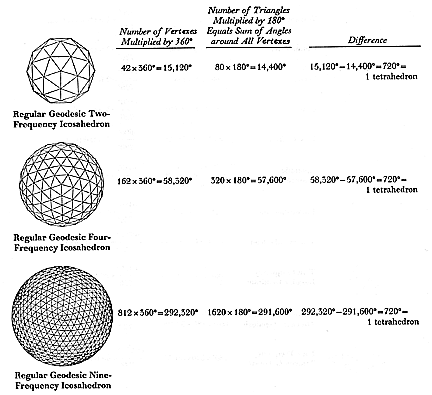
Definition: When expressed in terms of cyclic unity the sum of the angles around all the vertexes of a structural system, plus 720 degrees, equals the number of vertexes of the system multiplied by 360 degrees.
224.02
All local structural systems in Universe are always accomplished by nature through the elimination of 720 degrees of angle. This is the way in which nature takes two complete 360-degree angular tucks in the illusory infinity of a plane to render systems locally and visibly finite. The difference between visually finite systems and illusory infinity is two cyclic unities.
224.03
Structural systems are local, closed, and finite. They include all geometric forms, symmetric or asymmetric, simple or complex. Structural systems can have only one inside and only one outside. Two or more structures may be concentric and triangularly interconnected to operate as one structure.
224.04
The difference between the sum of all the angles around all the vertexes of any system and the total number of vertexes times 360º (as angular unity) is 720º, which equals two unities. The sum of the angles of a tetrahedron always equals 720º. The tetrahedron may be identified as the 720 differential between any definite local geometrical system (such as Greek “solid” geometry) and finite universe.
224.05
Line: A line has two vertexes with angles around each of its vertexial ends equal to 0º. The sum of these angles is 0º . The sum of the vertexes (two) times angular unity (360º ) is 720º. The remainder of 0º from 720º is 720º, or two unities, or one tetrahedron. Q.E.D.
224.06
Triangle: The three angles of one “face” of a planar triangle always add up to 180º as a phenomenon independent of the relative dimensional size of the triangles. One-half of definitive cyclic unity is 180º. Every triangle has two faces — its obverse and reverse. Unity is two. So we note that the angles of both faces of a triangle add up to 360º. Externally, the sum of the angles around each of the triangle’s three vertexes is 120º, of which 60º is on the obverse side of each vertex; for a triangle, like a line, if it exists, is an isolatable system always having positive and negative aspects. So the sum of the vertexes around a triangle (three) times 360º equals 1080º. The remainder of 360º from 1080º leaves 720º, or one tetrahedron. Q.E.D.
224.07
Sphere: The Greeks defined the sphere as a surface outwardly equidistant in all directions from a point. As defined, the Greeks’ sphere’s surface was an absolute continuum, subdividing all the Universe outside it from all the Universe inside it; wherefore, the Universe outside could be dispensed with and the interior eternally conserved. We find local spherical systems of Universe are definite rather than infinite as presupposed by the calculus’s erroneous assumption of 360-degreeness of surface plane azimuth around every point on a sphere. All spheres consist of a high-frequency constellation of event points, all of which are approximately equidistant from one central event point. All the points in the surface of a sphere may be interconnected. Most economically interconnected, they will subdivide the surface of the sphere into an omnitriangulated spherical web matrix. As the frequency of triangular subdivisions of a spherical constellation of omnitriangulated points approaches subvisibility, the difference between the sums of the angles around all the vertex points and the numbers of vertexes, multiplied by 360 degrees, remains constantly 720 degrees, which is the sum of the angles of two times unity (of 360 degrees), which equals one tetrahedron. Q.E.D.
224.08
Tetrahedron: The sum of the angles of a tetrahedron, regular or irregular, is always 720º, just as the sum of the angles of a planar triangle is always 180º. Thus, we may state two propositions as follows:
224.081
The sum of the surface angles of any polyhedron equals the number of vertexes multiplied by 360º minus one tetrahedron; and
224.082
The sum of the angles of any polyhedron (including a sphere) is always evenly divisible by one tetrahedron.
224.10
Descartes: Descartes is the first of record to have discovered that the sum of the angles of a polyhedron is always 720º less than the number of vertexes times 360º. Descartes did not equate the 720º with the tetrahedron or with the one unit of energy quantum that it vectorially constitutes. He did not recognize the constant, whole difference between the visibly definite system and the invisibly finite Universe, which is always exactly one finite invisible tetrahedron outwardly and one finite invisible tetrahedron inwardly.
224.11
The Calculus: The calculus assumes that a sphere is infinitesimally congruent with a sphere to which it is tangent. The calculus and spherical trigonometry alike assume that the sum of the angles around any point on any sphere’s surface is always 360 degrees. Because spheres are not continuous surfaces but are polyhedra defined by the vectorially interconnecting chords of an astronomical number of event foci (points) approximately equidistant from one approximate point, these spherically appearing polyhedra — whose chords emerge from lesser radius midpoints to maximum radius convergences at each of the spherically appearing polyhedra’s vertexes, ergo, to convex external joining — must follow the law of polyhedra by which the sum of all the angles around the vertexes of the polyhedra is always 720 degrees less than 360 degrees times the number of vertexes. The demonstration thus far made discloses that the sum of the angles around all the vertexes of a sphere will always be 720 degrees or one tetrahedron — less than the sum of the vertexes times 360 degrees — ergo, one basic assumption of the calculus and spherical trigonometry is invalid.
224.12
Cyclic Unity: We may also say that: where unity (1) equals 360º , 180º equals one-half unity (1/2), and that 720º equals two times unity (2); therefore, we may identify a triangle as one-half unity and a tetrahedron as cyclic unity of two. As the sum of a polyhedron’s angles, 720º is unique to the tetrahedron; 720º is the angular name of the tetrahedron. 720º is two cyclic unities. The tetrahedron is the geometrical manifest of “unity is plural and, at minimum, is two.” The tetrahedron is twoness because it is congruently both a concave tetrahedron and a convex tetrahedron.
224.13
Where cyclic unity is taken as 360 degrees of central angle, the difference between infinity and finity is always exactly two, or 720 degrees, or two times 360 degrees, or two times unity. Cyclic unity embraces both wave and frequency since it represents angles as well as cycles. This is topologically manifest in that the number of vertexes in any structural system multiplied by 360 degrees, minus two times 360 degrees, equals the sum of the angles around all the vertexes of the system.
224.20
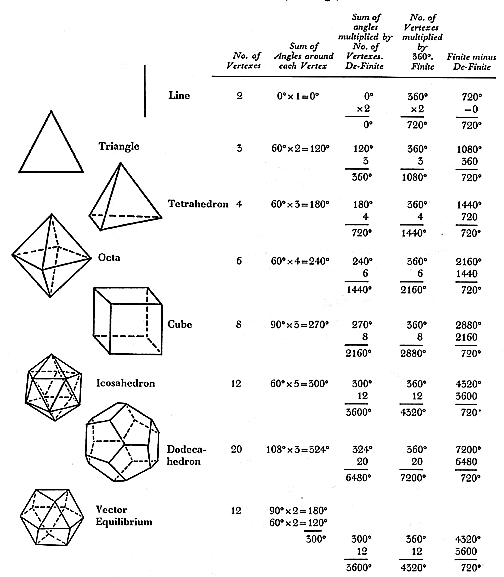
Equation of Angular Topology:
S + 720º = 360º Xⁿ
Where:
S = the sum of all the angles around all the vertexes (crossings)
Xⁿ = the total number of vertexes (crossings)
224.30
Polarity: Absolutely straight lines or an absolutely flat plane would theoretically continue outward to infinity. The difference between infinity and finity is governed by the taking out of angular sinuses, like pieces of pie, out of surface areas around a point in an absolute plane. This is the way lampshades and skirts are made. Joining the sinused fan-ends together makes a cone; if two cones are made and their open (ergo, infinitely trending) edges are brought together, a finite system results. It has two polar points and an equator. These are inherent and primary characteristics of all systems.
224.40
Multivalent Applications: Multiple-bonded bivalent and trivalent tetrahedral and octahedral systems follow the law of angular topology. Single-bonded monovalent tetrahedral and octahedral arrangements do not constitute a system; they are half systems, and in their case the equation would be:
S + 360º = 360º Xⁿ
224.50
Corollary: Principle of Finite Universe Conservation: By our systematic accounting of angularly definable convex-concave local systems, we discover that the sum of the angles around each of every local system’s interrelated vertexes is always two cyclic unities less than universal nondefined finite totality. We call this discovery the principle of finite Universe conservation. Therefore, mathematically speaking, all defined conceptioning always equals finite Universe minus two. The indefinable quality of finite Universe inscrutability is exactly accountable as two.
224.60
Tetrahedral Mensuration: The sum of the angles around all vertexes of any polyhedral system is evenly divisible by the sum of the angles of a tetrahedron. The volumes of all systems may be expressed in tetrahedra.
224.70
Table 224.70A Tetrahedral Mensuration Applied to Well-Known Polyhedra.
Table 224.70A Tetrahedral Mensuration Applied to Well-Known Polyhedra. We discover that the sum of the angles around all vertexes of all solids is evenly divisible by the sum of the angles of a tetrahedron. The volumes of all solids may be expressed in tetrahedra.
Link to original
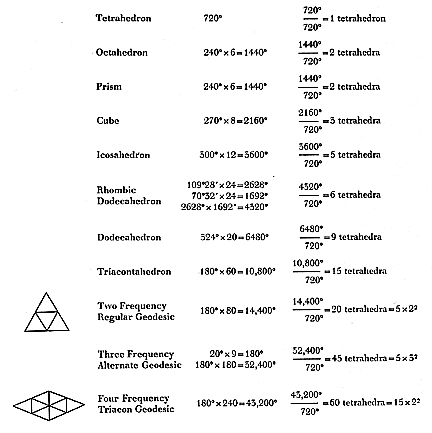
Equation of Tetrahedral Mensuration:
Where: 720º = one tetrahedron
225.00 Principle of Design Covariables
225.01
Definition: The principle of design covariables states that angle and frequency modulation, either subjective or objective in respect to man’s consciousness, discretely defines all events or experiences which altogether constitute Universe.
225.02
There are only two possible covariables operative in all design in the Universe. They are modifications of angle and frequency.
225.03
Local structure is a set of frequency associable (spontaneously tunable), recollectible experience relationships, having a regenerative constellar patterning as the precessional resultants of concentrically shunted, periodic self-interferences, or coincidences of its systematic plurality of definitive vectorial frequency wavelength and angle interrelationships.
226.00 Principle of Functions
226.01
Definition: The principle of functions states that a function can always and only coexist with another function as demonstrated experimentally in all systems as the outside-inside, convex-concave, clockwise-counterclockwise, tension-compression couples.
226.02
Functions occur only as inherently cooperative and accommodatively varying subaspects of synergetically transforming wholes.
226.10
Corollary: Principle of Complementarity: A corollary of the principle of functions is the principle of complementarity, which states that two descriptions or sets of concepts, though mutually exclusive, are nevertheless both necessary for an exhaustive description of the situation.
226.11
Every fundamental behavior patterning in Universe always and only coexists with a complementary but non-mirror-imaged patterning.
227.00 Principle of Order Underlying Randomness
227.01
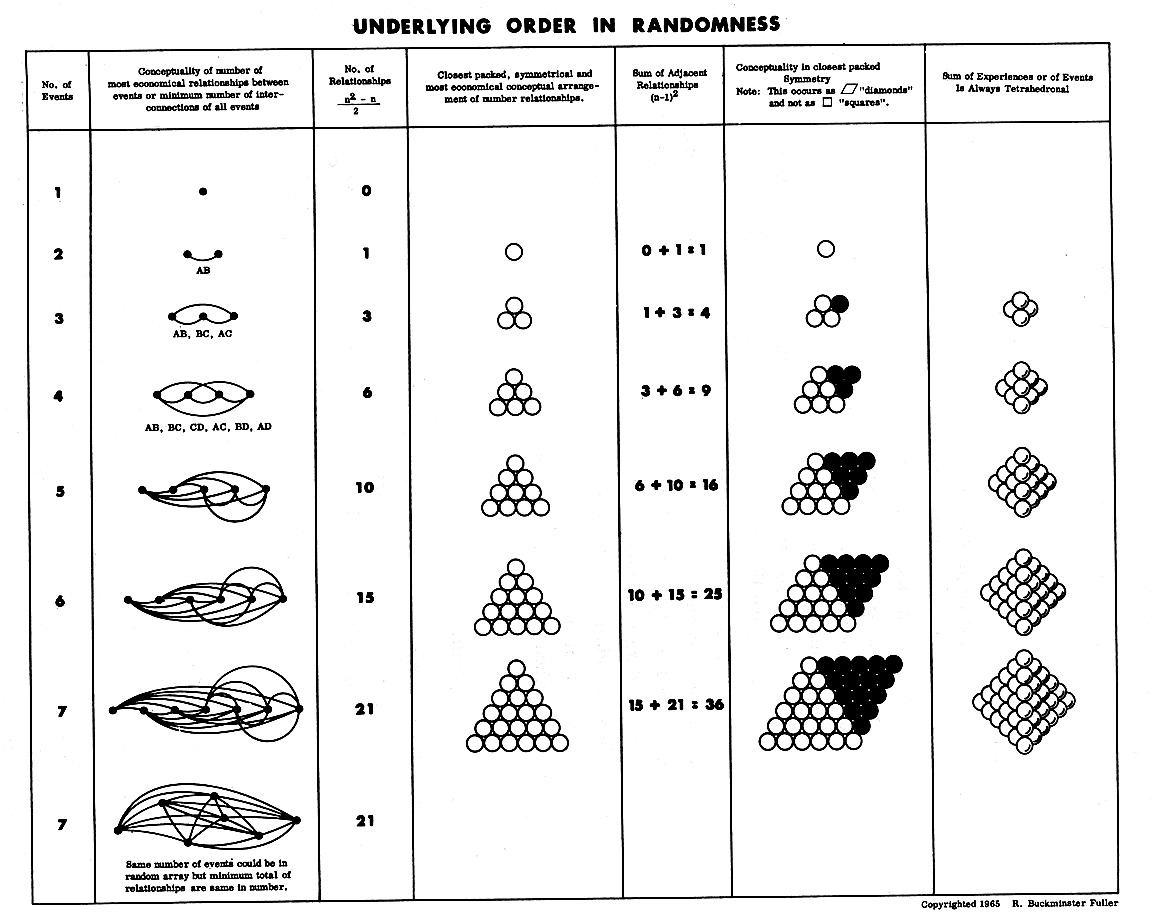
Definition: The number of relationships between events is always
Where: N = the number of events of consideration
227.02
The relationships between four or more events are always greater in number than the number of events. The equation expresses the conceptuality of the number of the most economical relationships between events or the minimum number of interconnections of all events.
227.03
The number of telephone lines necessary to interequip various numbers of individuals so that any two individuals will always have their unique private telephone line is always (N² - N)/2, where N is the number of telephones. This is to say that all the special interrelationships of all experiences define comprehension, which is the number of connections necessary to an understanding of “what everything is all about.” When we understand, we have all the fundamental connections between the star events of our consideration. When we add up all the accumulated relationships between all the successive experiences in our lives, they will always combine cumulatively to comprise a tetrahedron, simple or compound.
228.00 Scenario Principle
228.01
Definition: The scenario principle discloses that the Universe of total man experience may not be simultaneously recollected and reconsidered, but may be progressively subdivided into a plurality of locally tunable event foci or “points,” of which a minimum of four positive and four negative are required as a “considerable set,” that is, as the first finite subdivision of finite Universe.
228.10
Considerable Set: All experience is reduced to nonsimultaneously “considerable sets”; irrelevant to consideration are all those experiences that are either too large and therefore too infrequent, or too minuscule and therefore too frequent, to be tunably considerable as pertaining to the residual constellation of approximately congruent recollections of experiences.
228.11
A “considerable set” inherently subdivides all the rest of irrelevant experiences of Universe into macrocosmic and microcosmic sets immediately outside or immediately inside the considered set of experience foci.
228.12
Scenario Principle: Considerable Set: In considering all experiences, the mistakes of the past and the anticipations of the future are metaphysically irrelevant. We do not have to be preoccupied with hypothetical or potential experiences because we are always living in the now. Living in the present tense obviates impatience. (See Sec. 529.11.)
229.00 Principle of Synergetic Advantage
229.01
Definition: The principle of synergetic advantage states that macro → micro does not equal micro → macro. Synergetic advantage is only to be effected by macro → micro procedure. Synergetic advantage procedures are irreversible. Micro → macro procedures are inherently frustrated.
229.02
The notion that commencing the exploration of the unknown with unity as one (such as Darwin’s single cell) will provide simple and reliable arithmetical compounding (such as Darwin’s theory of evolution: going from simple → complex; amoeba → monkey → man) is an illusion that as yet pervades and debilitates elementary education.
229.03
Synergy discloses that the information to be derived from micro → macro educational strategy fails completely to predict the experimentally demonstrable gravitational or mass-attraction integrities of entropically irreversible, universal scenario reality.
229.04
Human experience discloses the eminent feasibility of inbreeding biological species by mating like types, such as two fast-running horses. This concentrates the fast- running genes in the offspring while diminishing the number of general adaptability genes within the integral organism. This requires the complementary external care of the inbred specialist through invention or employment of extracorporeal environmental facilities — biological or nonbiological. It is easy to breed out metaphysical intellection characteristics, leaving a residual concentration of purely physical proclivities and evoluting by further inbreeding from human to monkey. (Witness the millions of dollars society pays for a “prizefight” in which two organisms are each trying to destroy the other’s thinking mechanism. This and other trends disclose that a large segment of humanity is evoluting toward producing the next millennia’s special breed of monkeys.) There is no experimental evidence of the ability to breed in the weightless, metaphysically oriented mind and its access to conceptionings of eternal generalized principles.
229.05
All known living species could be inbreedingly isolated from humans by environmental complementation of certain genetic proclivities and lethal exclusion of others, but there is no experimental evidence of any ability to compound purely physical proclivity genes to inaugurate metaphysical behaviors humanity’s complex metaphysical- physical congruence with the inventory of complex behavioral characteristics of Universe.
229.06
Universe is the aggregate of eternal generalized principles whose nonunitarily conceptual scenario is unfoldingly manifest in a variety of special cases in local time-space transformative evolutionary events. Humans are each a special-case unfoldment integrity of the complex aggregate of abstract weightless omni- interaccommodative maximally synergetic non-sensorial Universe of eternal timeless principles. Humanity being a macro → micro Universe, unfolding eventuation is physically irreversible yet eternally integrated with Universe. Humanity cannot shrink and return into the womb and revert to as yet unfertilized ova.
229.10
Corollary: Principle of Irreversibility: The principle of irreversibility states that the evolutionary process is irreversible locally in physical “time-space” — that is, in frequency and angle definitioning, because the antientropic metaphysical world is not a mirror-imaged reversal of the entropic physical world’s disorderly expansiveness.
230.00 Tetrahedral Number
230.01
Definition: The number of balls in the longest row of any triangular unit- radius ball cluster will always be the same as the number of rows of balls in the triangle, each row always having one more than the preceding row, and the number of balls in the complete triangular cluster will always be
Where: R = the number of rows of balls, or the number of balls in the longest row.
230.02
We can stack successively rowed triangular groups of balls on top of one another with one ball on the top, three below that, and six below that, as cannon balls or oranges are stacked. Such stacks are always inherently tetrahedral. We can say that the sum of all the interrelationships of all our successive experiences from birth to now — for each individual, as well as for the history of all humanity — is always a tetrahedral number.
231.00 Principle of Universal Integrity
231.01
Definition: The principle of universal integrity states that the wide-arc tensive or implosive forces of Universe always inherently encompass the short-arc vectorial, explosive, disintegrative forces of Universe.
231.02
The gravitational constant will always be greater than the radiational constant — minutely, but always so. (For further exposition of this principle, see Secs. 251.05, 529.03, 541 and 1052.)
232.00 Principle of Conservation of Symmetry
232.01
Definition: Whereas the tetrahedron has four symmetrically interarrayed poles in which the polar opposites are four vertexes vs. four faces; and whereas the polar axes of all other symmetrical structural systems consist of vertex vs. vertex, or mid-edge vs. mid-edge, or face vs. face; it is seen that only in the case of vertex vs. face — the four poles of the tetrahedron — do the four vertexial “points” have polar face vacancies or “space” into which the wavilinear coil spring legs of the tetrahedron will permit those four vertexes to travel. The tetrahedron is the only omnisymmetrical structural system that can be turned inside out. (See Secs. 624.05, 905.18 and 905.19.)
232.02
Take the rubber glove that is green outside and red inside. Stripped off, it becomes red. The left-handedness is annihilated: inside-outing. You do not lose the convex-concave; all you lose is the leftness or the rightness. Whether it is a tree or a glove, each limb or finger is a tetrahedron.
232.03
Synergetics shows that the tetrahedron can be extrapolated into life in all its experience phases, thus permitting humanity’s entry into a new era of cosmic awareness.