410.01 Nature’s Coordination
410.011
About 1917, I decided that nature did not have separate, independently operating departments of physics, chemistry, biology, mathematics, ethics, etc. Nature did not call a department heads’ meeting when I threw a green apple into the pond, with the department heads having to make a decision about how to handle this biological encounter with chemistry’s water and the unauthorized use of the physics department’s waves. I decided that it didn’t require a Ph.D. to discern that nature probably had only one department and only one coordinate, omnirational, mensuration system.
410.02
I determined then and there to seek out the comprehensive coordinate system employed by nature. The omnirational associating and disassociating of chemistry — always joining in whole low-order numbers, as for instance H₂O and never HₚᵢO — persuaded me that if I could discover nature’s comprehensive coordination, it would prove to be omnirational despite academic geometry’s fortuitous development and employment of transcendental irrational numbers and other “pure,” nonexperimentally demonstrable, incommensurable integer relationships.
410.03
I was dissatisfied with abstract, weightless, unstable, ageless, temperatureless, straight-line-defined squares and cubes as models for calculating our omnicurvilinear experience. I was an early rebel against blockheads and squares. Reviewing the history of chemical science, I became intuitively aware that the clue to vectorial, volumetric, geometrical coordination with physical reality and all the fundamental energetic experiences of reality, such as temperature, time, and force, might be found in Avogadro’s experimental proof of his earlier hypothesis, which stated that all gases under identical conditions of heat and pressure will always disclose the same number of molecules per given volume. Here was disclosed a “Grand Central Station” accommodating all comers; despite “fundamental” or elementarily unique differences of identity, all accommodated on a common volume (space)-to-number basis. One molecule of any element: One space. A cosmic democracy.
410.04
I felt intuitively that inasmuch as the variety of gases experimented with often consisted of only one unique chemical element, such as hydrogen or oxygen, and that inasmuch as these gases also could be liquefied, and also inasmuch as most of the elements are susceptible to some heat- or pressure-produced transformation between their liquid, crystalline, and vapor, or incandescent, states, it might also be hypothetically reasonable to further generalize Avogadro’s hypothesis by assuming that, under identical energy conditions, all elements may disclose the same number of “somethings” per given volume. Such a generalized concept is not limited to pressure and heat: we wanted to be much more inclusive, so we said we assume that all the conditions of energy are identical; this includes not only the pressure and heat conditions of thermodynamics, which developed before electromagnetics became an applied realization, but also the conditions of electromagnetics as constant.
410.05
I went on from there to reason that vectors, being the product of physical energy constituents, are “real,” having velocity multiplied by mass operating in a specific direction; velocity being a product of time and size; and mass being a volume-weight relationship. On impact, mass at velocity transforrns into heat and work. These energy factors can be translated not only into work, but into heat or into time as well. Furthermore, electromagnetic scientists had found that all their EMF (electromotive force) problems could be graphed vectorially; the fact that “graphable” or “modelable” vectors can interact modelably in real Universe space seemed to promise that the equations of nature’s omnicoordinate transactions, expressed in omni-space-intruding vectorial models, might produce real models of reality of nature’s Grand Central Station of omnicoordination.
410.06
So I then went on to say that, if all the energy conditions were everywhere the same, then all the vectors would be the same length and all of them would interact at the same angle. I then explored experimentally to discover whether this “isotropic vector matrix,” as so employed in matrix calculus, played with empty sets of symbols on flat sheets of paper, could be realized in actual modeling. Employing equilength toothpicks and semi-dried peas, as I had been encouraged to do in kindergarten at the age of four (before receiving powerful eyeglasses and when I was unfamiliar with the rightangled structuring of buildings as were the children with normal vision), I fumbled tactilely with the toothpicks and peas until I could feel a stable structure, and thus assembled an omnitriangulated complex and so surprised the teachers that their exclamations made me remember the event in detail. I thus rediscovered the octet truss whose vertexes, or convergent foci, were all sixty-degree-angle interconnections, ergo omniequilateral, omniequiangled, and omni-intertriangulated; ergo, omnistructured. Being omnidirectionally equally interspaced from one another, this ornni-intertriangulation produced the isotropic matrix of foci for omni-closest-packed sphere centers. This opened the way to a combinatorial geometry of closest-packed spheres and equilength vectors.
410.07
Over and over again, we are confronted by nature obviously formulating her structures with beautiful spherical agglomerations. The piling of oranges, coconuts, and cannonballs in tetrahedral or half-octahedral pyramids has been used for centuries and possibly for ages. Almost a half-century ago, F. W. Aston, the British scientist first identified for physics the most economical uniradius spherical interagglomerations as the “closest packing of spheres,” which had fresh interest for the physicist and crystallographer because of the then recently discovered microscopic realization that nature frequently employed omni-intertriangulated systems, which hold mathematical clues to the principles of symmetrical coordination governing natural structure, the dynamic vectorial geometry of the atomic nucleus, as well as of the atoms themselves.
410.10 Omnitriangulation of Sixty Degrees
410.11
The closest packing of unit radius spheres always associates in omnitriangulations of 60 degrees, whether in planar or omnidirectional arrays. Six unit radius spheres pack most tightly around one sphere on a billiard table. Twelve unit radius spheres compact around one sphere in omnidirectional closest packing.
410.12
If we take three billiard balls on a flat table, we find that they compact beautifully into a triangle. If we arrange four of them on a billiard table in a square, they tend to be restless and roll around each other. If compacted into a condition of stability, the four form a 60-degree-angled diamond shape made of two stable triangles.
411.00 Four Spheres as Minimum System
411.01
The South Seas islander piling his coconuts, the fruit dealer selling oranges, and the cannoneer stacking equiradius cannonballs, or the much earlier round-rock- slinging soldiers were probably the first to learn about the closest packing of spheres. The stacking of balls in symmetrical rows and layers leads inevitably to a stable pyramidal aggregate.
411.02
Closest packing of spheres does not begin with a nucleus. Closest packing begins with two balls coming together.
411.03
One ball cannot zoom around alone in Universe. Without otherness, there is no consciousness and no direction. If there were only one entity — say it is a sphere called “me” — there would be no Universe: no otherness: no awareness: no consciousness: no direction. Once another entity — let’s say a *sphere — *is sighted, there is awareness and direction. There is no way to tell how far away the other sphere may be or what its size may be. Size sense comes only with a plurality of comparative experiences.
411.04
As a single sphere, now aware of an otherness sphere somewhere out there, “me” has to rotate about without restraint and can observe its rotation in relation to the otherness, but could misassume the otherness sphere to be zooming around it, as there are no third, or more, othernesses by which to judge.
411.05
Fig. 411.05 Four Spheres Lock as Tetrahedron
Link to original
- A. A single sphere is free to rotate in any direction.
- B. Two tangent spheres although free to rotate in any direction must do so cooperatively.
- C. Three spheres can rotate cooperatively only about respective axes which are parallel to the edges of the equilateral triangle defined by joining the sphere centers, i.e. each sphere rotates toward the center of the triangle.
- D. Four spheres lock together. No rotation is possible, making the minimum stable closest-packed-sphere system: the tetrahedron.
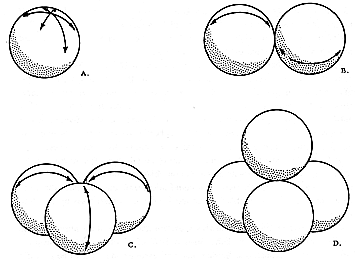
When moved unknowingly toward another by mass attraction, the “other” ball and the “me” ball, either or both of which could have been rotating as they approach one another, each misassumes the other to be growing bigger, until finally they touch each other. Now they can roll around upon one another, and they might be cotraveling together, but there is not as yet anywhere to go because there is no otherness than their joint selves relative to which to travel. They can’t go through each other and they can’t get away from each other. They are only free to rotate upon each other, and because of friction they must do so cooperatively.
411.06
When a third ball looms into sight, providing a sense of direction for the tangently rolling-upon-each-other first couple, the third one and the first two are mass- attracted toward each other and finally make contact. The newcomer third sphere may roll around on one of the first couple until it rolls into the valley between the first two. The third ball then gets locked into the valley between the first two by double mass attraction, and now becomes tangent to both of the first two.
411.07
The three balls, each one tangent to both of the others, now form an equiangular triangular group with a small opening at their center. The friction of each of their double contacts with the other two gives them a geartooth interaction effect. With two gears, one can turn clockwise and the other can tum counterclockwise. Even numbers of gears reciprocate; odd numbers of gears block one another. Thus our three balls can no longer roll circumferentially around each other; they can only rotate cooperatively on the three axes formed between each of their two tangent contact points. The friction between their surface contacts forces all three to rotate unidirectionally about their respective contact axes, which are parallel to the edges of the equilateral triangle defined by the three sphere centers; i.e., the three spheres can now only co-rotate over and into the hole at the center of the triangle, and out and away upwardly again from the bottom of the center hole. Thus the three balls can involute or evolute axially, like a rubber doughnut in respect to the hole at their triangular center, but they cannot rotate circumferentially.
411.08
Finally, a fourth ball appears in Universe and is mass-attracted to tangency with one of the three previously triangulated spheres, then rolls on one of the joined balls until it falls into the valley formed by the hole at the top center of the triangulated three; but being of equal diameter with the other three balls, it cannot fall through that hole whose radius is less than those of the associated spheres. Thus nested in the central valley, the fourth sphere now touches each of the other three and vice versa. The four closest- packed spheres make a closest-packing array. They are mass-attractively locked together as a tetrahedron.¹ No further interrotation is possible. As a tetrahedron, they form the minimum stable structural system and provide the nuclear matrix for further mass attraction and closest-packed growth of additional spheres falling into their four-surface triangular nests. This produces increasing numbers of closest-packed nests. Thus do atoms agglomerate in closest packing in tetrahedrally conformed arrays, often truncated asymmetrically at corners and along edges to obscure the tetrahedral origin of the collection.
(Footnote 1: There is an alternative sequence, which is perhaps more likely, in which the balls would first join as two pairs — like dumbbells “docking” in space. Then our old friend precession would cause them to form a momentary square, only to have one pair revolve until its axis is at 90 degrees to the other couple’s axis, whereafter they dock to interlock as a tetrahedron.)
411.10
Unpredicted Degrees of Freedom: Reviewing the history of self-discoveries of restraints progressively and mutually interimposed upon one another by the arrival of and association with successive othernesses, self may discover through progressive retrospections and appreciate the significance of theretofore unrecognized and unrealized degrees of cosmic freedom successively and inadvertently deducted from the original total inventory of unexpended self-potentials with which the individual is initially, always and only, endowed. Only with the progressive retrospection inventoryings induced only by otherness-developed experience of awareness does the loss of another degree of freedom become consciously subtracted from the previous experience inventory of now consciously multiplying rememberable events.
411.11
With the discovery of principles through progressive deprivations dawns new awareness of the elective employability of the principles initially separated out from their special-case experiencing to self-control more and more of the pattern of events.
411.12
Only through relationships with otherness can self learn of principles; only by discovery of the relationships existing between self and othernesses does inspiration to employ principles objectively occur. There is nothing in self per se, or in otherness per se, that predicts the interrelatedness behaviors and their successively unique characteristics. Only from realization of the significance of otherness can it be learned further that only by earnest commitment to others does self become inadvertently behaviorally advantaged to effect even greater commitment to others, while on the other hand all selfseeking induces only ever greater self-loss. There is an alternate sequence, which is perhaps more likely, in which the balls would first join as two pairs — like dumbbells “docking” in space. Then our old friend precession would cause them to form a momentary square, only to have one pair revolve until its axis is at 90 degrees to the other couple’s axis, whereafter they dock to interlock as a tetrahedron.
411.20
Discovery as a Function of Loss: It is a basic principle that you only discover what you had had by virtue of losing it. Due to our subconscious organic coordination, you don’t know what you are losing until you lose it. Naught can be so advantageous as thoughtfully considered loss and resolve to employ the principles thereby discovered for others. You don’t know how much you have to give until you start trying to give. The more you try to give effectively to advantage others, the more you will possess to give, and vice versa.
411.21
Retrospective awareness of losses can bring preoccupation with self, blinding self to recognition of the synergetic gains that, by virtue of the second-power law, have brought group advantage gains in which the individual has attained fourth-power continuance potential often way offsetting individual freedom losses, particularly in view of the group’s discovery that as a group it can enjoy all the original freedoms individually lost but never realized by the individual to exist — ergo, unemployable consciously by the individual, who was more of a victim of the unknown freedoms than an enjoyer.
411.22
Only as group structuring occurs do the discovered cosmic freedoms become consciously employable — employable effectively only for all and not for self. It is when this retrospective discovering is made by the grouped-in individual and he tries to employ the freedoms exclusively for self or exclusive subdivisions of the group, that his attempts become inherently unfulfillable and scheduled for ultimate failure.
411.23
Self-seeking brings a potential loss that engenders first caution, then fear: fear of change; change being inexorable, fear increases and freezes. Self-seeking always eventuates in self-destruction through inability to adapt.
411.30
Intergeared Mobility Freedoms: Only with the arrival of the second otherness do individuals become aware of the loss of mutual anywherearound-one-another rollability, and then discover that they have also lost the ability to go in all directions, for they cannot go through each other. It is inferred that they haven’t lost mutually accomplishable omnidirectional mobility. (Here is an example of one of those comprehendings from an apprehending.) With the acquisition of the second otherness, self discovers what it has lost which self didn’t know it had, until the loss brought retrospective awareness of the lost freedom: an inter-anywhere-roll-aroundness with the first other.
411.31
With the mutually interattracted threeness, each having two contacts with their two otherness partners, they learn, as a fourth otherness nests into their triangular opening, that they have now lost a frictionally intergeared mutually evoluting-involuting rotational freedom (torus). Now blocked by the frictionally intergeared fourth otherness, the mutual omnidirectionality of the structural system so produced by that structural system can be discovered only by the self-observation of the realization of another structural system’s cumulative repetition repeating the evolutionary accumulation of its own fourfolding; observing that the other structural system can move omnidirectionally, their observed rotations and magnitude changes can be explained only by the omnidirectional freedom only mutually experienceable by the whole individual structural system as it had been originally and only subconsciously experienced by the individual self. Naught has been lost. Much has been mutually gained. Each can take off from and return to the others.
411.32
The variations of the features of second-structural-system otherness can be explained only by the self-structural system assumption of increasing distance of travel of the otherness to and away, or by the other system’s experiencing a freedom theretofore unself-realized: that of individual expansion and contraction. For any one of the four members of a structural system team can expand and contract coordinatedly at individual rates, mutual rates, or interpaired rates, provided one does not become so small as to “fall through” the triangular opening at its nest bottom. (If it fell through, one otherness would start rotating hingewise around the axis of tangent contact with the next-largest, without touching the fourth and next-smallest-to-self.)
411.33
Thus the self-structural system discloses by observation of otherness’s system changing features that its own system had been enjoying, as with freedoms of which it was previously unconscious.
411.34
Our inventory of intergeared mobility freedoms is fourfold. It is four- dimensional:
omnidirectionality of united movement;
roll-aroundness (orbiting);
polarized evoluting-and-involuting, and polarized spin; and
inward-outward expandability singly, doubly, three- or four-partite.
411.35
The inward-outward expandability is the basis of convergence-divergence and radiation-gravitation pulsation — which seems furthest from man’s awareness. This is what science has discovered: a world of waves in which waves are interpenetrated by waves in frequency modulation. There is a systemic interrelationship of basic fourness always accompanied by a sixness of alternatives of freedoms.
411.36
When a sphere gets so small that it can roll through a hole between other close packed spheres, the omnidirectionality of any one individual would not be impeded under the following circumstances:
a. The individual mass-attracted by any threeness being drawn through the hole of any other threeness.
b. Where a fourth otherness could be attracted by a momentary critical-proximity threeness.
c. We learn there is individuality and magnitude change; then we learn that, due to the energy losses and gains of systems occasioned by the continual variations of omnidirectional proximities and omnivariability of expansion- contraction system accumulating rates, there is a degree of freedom phenomena rate as well as a terminal condition.
411.37
Rate occurs only when there is terminal. Rate is a modulation between terminals. With termination, a system’s integrity is brought about by the individually covarying magnitudes and the omnidirectional experience pulls on the system.
411.38
The degree of freedom that is lost is discoverable only retrospectively by the very fact of the loss. It is an inverse synergetic behavior wherein no feature of the self part predicted the successive behaviors of the whole and where the individual part freedoms were only mutually disclosed by their subsequently realized loss.
412.00 Closest Packing of Rods
412.01
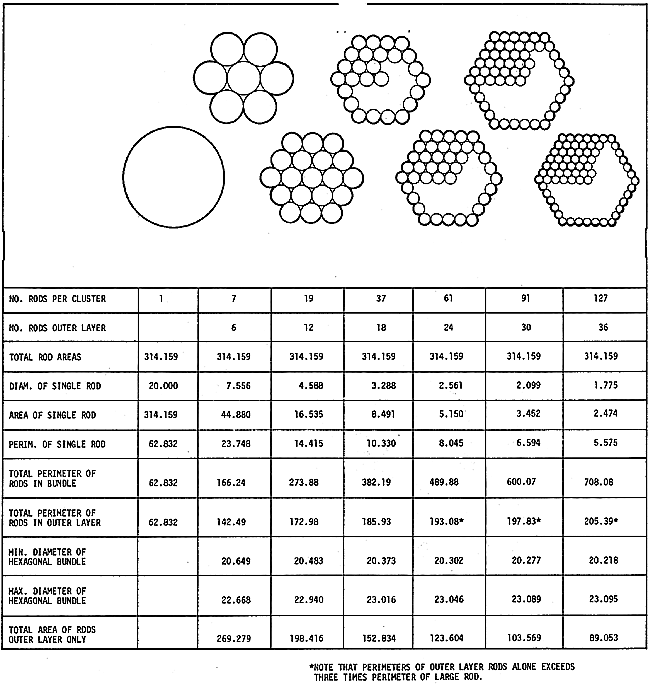
Just as six balls may be closest packed around a nuclear ball in a plane, six rods or wires may be closest packed around a nuclear rod or wire in a cluster. When the seven wires are thus compacted in a parallel bunch, they may be twisted to form a cable of hexagonal cross section, with the nuclear wire surrounded by the other six. The hexagonal pattern of cross section persists as complete additional layers are symmetrically added to the cluster. These progressive symmetrical surroundments constitute circumferentially finite integrities in universal geometry.
412.02
Surface Tension Capability: We know by conclusive experiments and measuring that the progressive subdivision of a given metal fiber into a plurality of approximately parallel fibers provides tensile behavior capabilities of the smaller fibers at increased magnitudes up to hundreds- and thousandsfold that of the unit solid metal section. This is because of the increased surface-to-mass ratios and because all high tensile capability is provided by the work hardening of the surfaces. This is because the surface atoms are pressed into closer proximity to one another by the drawing tool through which the rod and wire are processed.
413.00 Omnidirectional Closest Packing
413.01
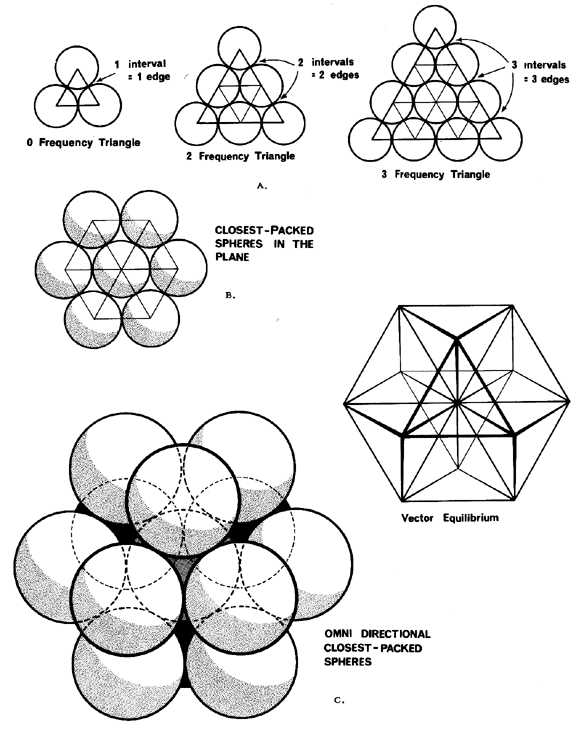
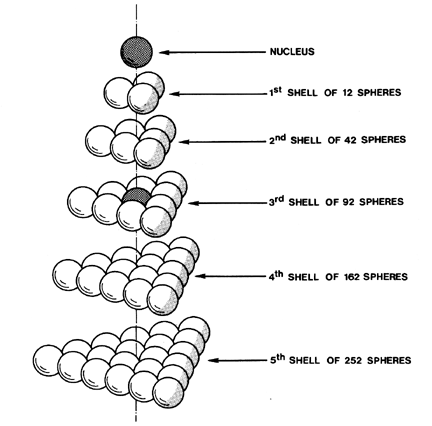
In omnidirectional closest packing of equiradius spheres around a nuclear sphere, 12 spheres will always symmetrically and intertangentially surround one sphere with each sphere tangent to its immediate neighbors. We may then close-pack another symmetrical layer of identical spheres surrounding the original 13. The spheres of this outer layer are also tangent to all of their immediate neighbors. This second layer totals 42 spheres. If we apply a third layer of equiradius spheres, we find that they, too, compact symmetrically and tangentially. The number of spheres in the third layer is 92.
413.02
Equiradius spheres closest packed around a nuclear sphere do not form a supersphere, as might be expected. They form a symmetrical polyhedron of 14 faces: the vector equilibrium.
413.03
If we add on more layers of equiradius spheres to the symmetrical polyhedron of 14 faces close-packed around one sphere, we find that they always compact symmetrically and tangentially, and that this process of enclosure may seemingly be repeated indefinitely. Each layer, however, is in itself a finite or complete and symmetrical embracement of spheres. Each of these embracing layers of spheres constitutes a finite system. Each layer always takes the 14-face conformation and consists of eight triangular and six square faces. Together with the layers they enclose and the original sphere center, or nucleus, these symmetrically encompassing layers constitute a concentric finite system.
413.04
As additional layers are added, it is found that a symmetrical pattern of concentric systems repeats itself. That is, the system of three layers around one sphere, with 92 spheres in the outer layer, begins all over again and repeats itself indefinitely with successively enclosing layers in such a way that the successive layers outside of the 92- sphere layer begin to penetrate the adjacent new nuclear systems. We find then that only the concentric system of spheres within and including the layer of 92 are unique and individual systems. We will pursue this concept of a finite system in universal geometry still further (see Sec. 418, et seq.) in order to relate it to the significance of the 92 self- regenerative chemical elements.
414.00 Nucleus
414.01
In closest packing of equiradius spheres, a nucleus by definition must be tangentially and symmetrically surrounded. This means that there must be a ball in every possible tangential and optically direct angular relationship to the nucleus. This does not happen with the first layer of 12 balls or with the second layer of 42 balls. Not until the third layer of 92 balls is added are all the tangential spaces filled and all the optically direct angles of nuclear visibility intercepted. We then realize a nucleus.
414.02
It will also be discovered that the third layer of 92 spheres contains eight new potential nuclei; however, these do not become realized nuclei until each has two more layers enveloping it — one layer with the nucleus in it and two layers enclosing it. Three layers are unique to each nucleus. This tells us that the nuclear group with 92 spheres in its outer, or third, layer is the limit of unique, closest-packed symmetrical assemblages of unit wavelength and frequency. These are nuclear symmetry systems.
414.03
It is characteristic of a nucleus that it has at least two surrounding layers in which there is no nucleus showing, i.e., no potential. In the third layer, however, eight potential nuclei show up, but they do not have their own three unique layers to realize them. So the new nuclei are not yet realized, they are only potential.
414.04
The nucleus ball is always two balls, one concave and one convex. The two balls have a common center. Hydrogen’s one convex proton contains its own concave nucleus.
415.00 Concentric Shell Growth Rates
415.01
Minimal Most Primitive Concentric Shell Growth Rates of Equiradius, Closest-Packed, Symmetrical Nucleated Structures: Out of all possible symmetrical polyhedra produceable by closest-packed spheres agglomerating, only the vector equilibrium accommodates a one-to-one arithmetical progression growth of frequency number and shell number developed by closest-packed, equiradius spheres around one nuclear sphere. Only the vector equilibrium — “equanimity” — accommodates the symmetrical growth or contraction of a nucleus-containing aggregate of closest-packed, equiradius spheres characterized by either even or odd numbers of concentric shells.
415.02
Odd or Even Shell Growth: The hierarchy of progressive shell embracements of symmetrically closest-packed spheres of the vector equilibrium is generated by a smooth arithmetic progression of both even and odd frequencies. That is, each successively embracing layer of closest-packed spheres is in exact frequency and shell number atunement. Furthermore, additional embracing layers are accomplished with the least number of spheres per exact arithmetic progression of higher frequencies.
415.03
Chart 415.03
Link to original
10F²+2 4F²+2 2F²+2 12F²+2 6F²+2 Shell Vector Equilibrium
Outer ShellVector Equilibrium
All Shells CumulativeOctahedron
4(F+2)²+2Tetrahedron
2(F+4)²+2Rhombic Dodecahedron
Octa=1/4 Tet × 8Cube
12F²+2 + 1/8 Octa × 8Icosahedron & Dodecahedron are Inherently Non-Nuclear at All Frequencies 0 zero=2 zero=2 zero=2 zero=2 zero=2 zero=2 1 12 12 2 42 54 18 3 92 146 34 74 210 4 162 308 Outer shell 66 Cumulative 84 92 364 5 252 560 6 362 922 Outer shell 514 Cumulative 1098 7 492 1414 8 642 2056 Outer shell 130 Cumulative 164 386 470 9 812 2868 10 1002 3870
or refer to Chart 415.03 (original).png
Even-Number Shell Growth: The tetrahedron, octahedron, cube, and rhombic dodecahedron are nuclear agglomerations generated only by even-numbered frequencies:
| Nuclear tetrahedron: | F = 4 (34 around one) F = 8 (130 around one) |
| Nuclear octahedron: | F = 2 (18 around one) F = 4 (66 around one) |
| Nuclear cube: | F = 4 (210 around one) F = 6 (514 around one) |
| Nuclear rhombic dodecahedron: | F = 4 (74 around one) F = 8 (386 around one) |
415.10
Yin-Yang As Two (Note to Chart 415.03): Even at zero frequency of the vector equilibrium, there is a fundamental twoness that is not just that of opposite polarity, but the twoness of the concave and the convex, i.e., of the inwardness and outwardness, i.e., of the microcosm and of the macrocosm. We find that the nucleus is really two layers because its inwardness tums around at its own center and becomes outwardness. So we have the congruence of the inbound layer and the outbound layer of the center ball.
10F² + 2
F = 0
10 × 0 = 0
0 + 2 = 2 (at zero frequency)
Because people thought of the nucleus only as oneness, they for long missed the significant twoness of spherical unity as manifest in the atomic weights in the Periodic Table of the Elements.
415.11
When they finally learned that the inventory of data required the isolation of the neutron, they were isolating the concave. When they isolated the proton, they isolated the convex.
415.12
As is shown in the comparative table of closest-packed, equiradius nucleated polyhedra, the vector equilibrium not only provides an orderly shell for each frequency, which is not provided by any other polyhedra, but also gives the nuclear sphere the first, or earliest possible, polyhedral symmetrical enclosure, and it does so with the least number — 12 spheres; whereas the octahedron closest packed requires 18 spheres; the tetrahedron, 34; the rhombic dodecahedron, 92; the cube, 364; and the other two symmetric Platonic solids, the icosahedron and the dodecahedron, are inherently, ergo forever, devoid of equiradius nuclear spheres, having insufficient radius space within the triangulated inner void to accommodate an additional equiradius sphere. This inherent disassociation from nucleated systems suggests both electron and neutron behavior identification relationships for the icosahedron’s and the dodecahedron’s requisite noncontiguous symmetrical positioning outwardly from the symmetrically nucleated aggregates. The nucleation of the octahedron, tetrahedron, rhombic dodecahedron, and cube very probably plays an important part in the atomic structuring as well as in the chemical compounding and in crystallography. They interplay to produce the isotopal Magic Number high point abundance occurrences. (See Sec. 995.)
415.13
The formula for the nucleated rhombic dodecahedron is the formula for the octahedron with frequency plus four (because it expands outwardly in four-wavelength leaps) plus eight times the closest-packed central angles of a tetrahedron. The progression of layers at frequency plus four is made only when we have one ball in the middle of a five-ball edge triangle, which always occurs again four frequencies later.
415.14
The number of balls in a single-layer, closest-packed, equiradius triangular assemblage is always
415.15
To arrive at the cumulative number of spheres in the rhombic dodecahedron, you have to solve the formula for the octahedron at progressive frequencies plus four, plus the solutions for the balls in the eight triangles .
415.16
The first cube with 14 balls has no nucleus. The first cube with a nucleus occurs by the addition of 87-ball corners to the eight triangular facets of a four-frequency vector equilibrium.
415.17
Fig. 415.17 Nucleated Cube
Fig. 415.17 Nucleated Cube: The “External” Octahedron: ABC shows that eight additional closest- packed spheres are required to form the minimum allspace-filling nuclear cube to augment the nuclear vector equilibrium. DEF show the eight Eighth-Octa required to complete the polyhedral transformation. (Compare Fig. 1006.32.)
Link to original
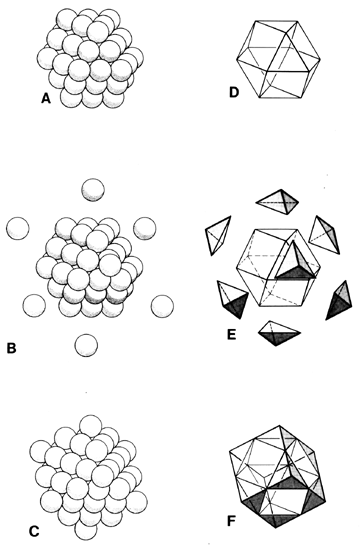
Nucleated Cube: The “External” Octahedron: The minimum allspace- filling nuclear cube is formed by adding eight Eighth-Octahedra to the eight triangular facets of the nucleated vector equilibrium of tetravolume-20, with a total tetravolume involvement of 4 + 20 = 24 quanta modules. This produces a cubical nuclear involvement domain (see Sec. 1006.30) of tetravolume-24: 24 × 24 = 576 quanta modules. (See Sec. 463.05 and Figs. 415.17A-F.)
415.171
The nuclear cube and its six neighboring counterparts are the volumetrically maximum members of the primitive hierarchy of concentric, symmetric, pre-time-size, subfrequency-generalized, polyhedral nuclear domains of synergetic-energetic geometry.
415.172
The construction of the first nuclear cube in effect restores the vector- equilibrium truncations. The minimum to be composited from closestpacked unit radius squares has 55 balls in the vector equilibrium. The first nucleated cube has 63 balls in the total aggregation.
415.20
Organics: It could be that organic chemistries do not require nuclei.
415.21
The first closest-packed, omnitriangulated, ergo structurally stabilized, but non-nuclear, equiradius-sphered, cubical agglomeration has 14 spheres. This may be Carbon 14, which is the initially closest-packed, omnisymmetrical, polyhedral fourteenness, providing further closest-packability surface nests suitable for structurally mounting hydrogen atoms to produce all organic matter.
415.22
Fig. 415.22 Rational Volumes of Tetrahedroning
A. The cube may be formed by placing four 1/8-octahedra with their equilateral faces on the faces of a tetrahedron. Since tetrahedron volume equals one, and 1/8-octahedron equals 1/2, the volume of the cube will be: 1 + 4(1/2) =3.
B. The rhombic dodecahedron may be formed by placing eight 1/4-tetrahedra with their equilateral faces on the faces of an octahedron. Since the octahedron volume equals four and 1/4-tetrahedron equals 1/4, the volume of the rhombic dodecahedron will be: 4 + 8 (1/4) = 6.
Link to original
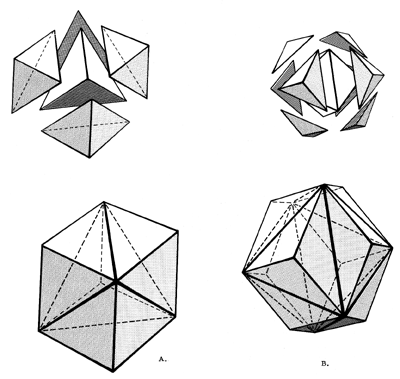
The cube is the prime minimum omnisymmetrical allspace filler. But the cube is nonstructural until its six square faces are triangularly diagonaled. When thus triangularly diagonaled, it consists of one tetrahedron with four one-eighth octahedra, of three isosceles and one equilateral-faced tetrahedron, outwardly applied to the nuclear equilateral tetrahedron’s four triangular faces. Thus structurally constituted, the superficially faced cube is prone to closest-packing self-associability. In order to serve as the carbon ring (with its six-sidedness), the cube of 14 spheres (with its six faces) could be joined with six other cubes by single atoms nestable in its six square face centers, which singleness of sphericity linkage potential is providable by Hydrogen 1.
415.23
In the atoms, we are always dealing in equiradius spheres. Chemical compounds may, and often do, consist of atomic spheres with a variety of radial dimensions. Since each chemical element’s atoms are characterized by unique frequencies, and unique frequencies impose unique radial symmetries, this variety of radial dimensionality constitutes one prime difference between nuclear physics and chemistry.
415.30
Eight New Nuclei at Fifth Frequency of Vector Equilibrium: Frequency five embraces nine nuclei: the original central nucleus plus eight new nuclei occurring at the centers of volume of the eight tetrahedra symmetrically surrounding the nucleus, with each of the nine enclosed with a minimum of two layers of spheres.
415.31
The vector equilibrium at = 12; at = 42; = 92; = 162 spheres in the outer shell; and at = 252 we get eight new nuclei. Therefore, their eightness of “begetness” relates to the eight triangles of the vector equilibrium.
415.32
Six nucleated octahedra with two layer omni-enclosure of their nuclei does not occur until = 362 in the outer shell of the vector equilibrium. At this stage we have six new nuclei, with 14 nuclei surrounding the 15th, or original, nucleus.
415.40
Begetted Eightness: The “begetted” eightness as the system-limit number of nuclear uniqueness of self-regenerative symmetrical growth may well account for the fundamental octave of unique interpermutative integer effects identified as plus one, plus two, plus three, plus four, as the interpermutated effects of the integers one, two, three, and four, respectively; and as minus four, minus three, minus two, minus one, characterizing the integers five, six, seven, and eight, respectively. The integer nine always has a neutral, or zero, intermutative effect on the other integers. This permutative, synergetic or interamplifying or dimensioning effect of integers upon integers, together with the octave interinsulative accommodation produced by the zero effect of the nineness, is discussed experientially in our section on Indigs in Chapter 12, Numerology.
415.41
The regenerative initial eightness of first-occurring potential nuclei at the frequency-four layer and its frequency-five confirmation of those eight as constituting true nuclei, suggest identity with the third and fourth periods of the Periodic Table of Chemical Elements, which occur as
1st period = 2 elements
2nd period = 8 elements
3rd period = 8 elements
415.42
Starting with the center of the nucleus: plus one, plus two, plus three, plus four, outwardly into the last layer of nuclear uniqueness, whereafter the next pulsation becomes the minus fourness of the outer layer (fifth action); the sixth event is the minus threeness of canceling out the third layer; the seventh event is the minus twoness canceling out the second layer; thc eighth event is the minus oneness returning to the center of the nucleus — all of which may be identified with the frequency pulsations of nuclear systems.
415.43
The None or Nineness/Noneness permits wave frequency propagation cessation. The Nineness/Zeroness becomes a shutoff valve. The Zero/Nineness provides the number logic to account for the differential between potential and kinetic energy. The Nineness/Zeroness becomes the number identity of vector equilibrium, that is, energy differentiation at zero.(See Secs. 1230 et seq. and the Scheherazade Number.)
415.44
The eightness being nucleic may also relate to the relative abundance of isotopal magic numbers, which read 2, 8, 20, 50, 82, 126…
415.45
The inherent zero-disconnectedness accounts for the finite energy packaging and discontinuity of Universe. The vector equilibria are the empty set tetrahedra of Universe, i.e., the tetrahedron, being the minimum structural system of Universe independent of size, its four facet planes are at maximum remoteness from their opposite vertexes and may have volume content of the third power of the linear frequency. Whereas in the vector equilibrium all four planes of the tetrahedra pass through the same opposite vertex — which is the nuclear vertex — and have no volume, frequency being zero: F⁰.
415.50
Vector-Equilibrium Closest-Packing Configurations: The vector equilibrium has four unique sets of axes of symmetry:
- The three intersymmetrical axes perpendicular to, i.e., normal to, i.e., joining, the hemispherically opposite six square faces;
- The four axes normal to its eight triangular faces;
- The six axes normal to its 12 vertexes; and
- the 12 axes normal to its 24 edges.
The tetrahedron, vector equilibrium, and octahedron, with all their planes parallel to those of the tetrahedron, and therefore derived from the tetrahedron, as the first and simplest closest-packed, ergo omnitriangulated, symmetrical structural system, accept further omnidirectional closest packing of spheres. Because only eight of its 20 planar facets are ever parallel to the four planes of the icosahedron, the icosahedron refuses angularly to accommodate anywhere about its surface further omnidirectional closest packing of spheres, as does the tetrahedron.
415.51
Consequently, the (no-nucleus-accommodating) icosahedron formed of equiradius, triangularly closest-packed spheres occurs only as a one-sphere-thick shell of any frequency only. While the icosahedron cannot accommodate omnidirectionally closest- packed multishell growth, it can be extended from any one of its triangular faces by closest-packed sphere agglomerations. Two icosahedra can be face-bonded.
415.52
The icosahedron has three unique sets of axes of symmetry:
- The 15 intersymmetric axes perpendicular to and joining the hemispherically opposite mid-edges of the icosahedron’s 30 identical, symmetrically interpatterned edges;
- The 10 intersymmetric axes perpendicular to the triangular face centers of the hemispherically opposite 20 triangular faces of the icosahedron; and
- The six intersymmetric axes perpendicularly interconnecting the hemispheric opposites of the icosahedron’s 12 vertexes, or vertexial corner spheres of triangular closest packing.
415.53
While the 15-axes set and the 6-axes set of the icosahedron are always angularly askew from the vector equilibrium’s four out of its 10 axes of symmetry are parallel to the set of four axes of symmetry of the vector equilibrium. Therefore, the icosahedron may be face-extended to produce chain patterns conforming to the tetrahedron, octahedron, vector equilibrium, and rhombic dodecahedron in omnidirectional, closest-packing coordination — but only as chains; for instance, as open linear models of the octahedron’s edges, etc.
415.55
Fig. 415.55 Tetrahedral Closest Packing of Spheres - Nucleus and Nestable Configurations
Fig. 415.55 Tetrahedral Closest Packing of Spheres: Nucleus and Nestable Configurations:
A. In any number of successive planar layers of tetrahedrally organized sphere packings, every third triangular layer has a sphere at its centroid (a nucleus). The 36-sphere tetrahedron with five spheres on an edge (four-frequency tetrahedron) is the lowest frequency tetrahedron system which has a central sphere or nucleus.
Link to original
B. The three-frequency tetrahedron is the highest frequency without a nucleus sphere.
C. Basic “nestable” possibilities show how the regular tetrahedron, the 1/4-tetrahedron and the 1/8- octahedron may be defined with sets of closest packed spheres. Note that this “nesting” is only possible on triangular arrays which have no sphere at their respective centroids.
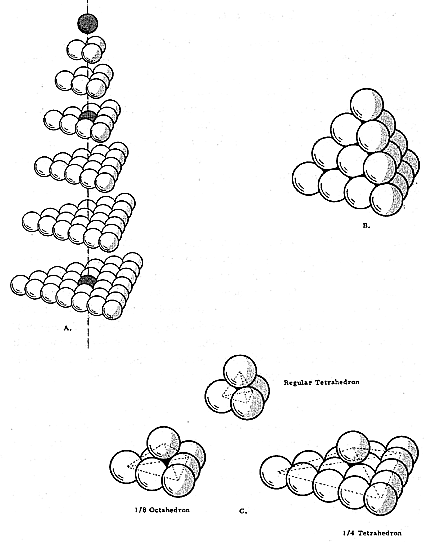
Nucleus and Nestable Configurations in Tetrahedra: In any number of successive planar layers of tetrahedrally organized sphere packings, every third triangular layer has a sphere at its centroid (nucleus). The dark ball rests in the valley between three balls, where it naturally falls most compactly and comfortably. The next layer is three balls to the edge, which means two-frequency. There are six balls in the third layer, and there very clearly is a nest right in the middle. There are ten balls in the fourth layer: but we cannot nest a ball in the middle because it is already occupied by a dark centroid ball. Suddenly the pattern changes, and it is no longer nestable.
415.56
At first, we have a dark ball at the top; then a second layer of three balls with a nest but no nucleus. The third layer with six balls has a nest but no nucleus. The fourth layer with ten balls has a dark centroid ball at the nucleus but no nestable position in the middle. The fifth layer (five balls to the edge; four frequency) has 15 balls with a nest again, but no nucleus. This 35 sphere tetrahedron with five spheres on each edge is the lowest frequency tetrahedron system that has a central sphere or nucleus. (See Fig. A, illustration 415.55.)
415.57
The three-frequency tetrahedron is the highest frequency singlelayer, closest- packed sphere shell without a nuclear sphere. This three-frequency, 20-sphere, empty, or nonsphere nucleated, tetrahedron may be enclosed by an additional shell of 100 balls; and a next layer of 244 balls totaling 364, and so on. (See Fig. B, illustration 415.55.)
415.58
Basic Nestable Configurations: There are three basic nestable possibilities shown in Fig. C. They are (1) the regular tetrahedron of four spheres; (2) the one-eighth octahedron of seven spheres; and (3) the quarter tetrahedron, with a 16th sphere nesting on a planar layer of 15 spheres. Note that this “nesting” is only possible on triangular arrays that have no sphere at their respective centroids. This series is a prime hierarchy. One sphere on three is the first possibility with a central nest available. One sphere on six is the next possibility with an empty central nest available. One sphere on 10 is impossible as a ball is already occupying the geometrical center. The next possibility is one on 15 with a central empty nest available.
415.59
Note that the 20-ball empty set (see Fig. B, illustration 415.55) consists of five sets of four-ball simplest tetrahedra and can be assembled from five separate tetrahedra. The illustration shows four four-ball tetrahedra at the vertexes colored “white.” The fifth four-ball tetrahedron is dark colored and occupies the central octahedral space in an inverted position. In this arrangement, the four dark balls of the inverted central tetrahedron appear as center balls in each of the four 10-ball tetrahedral faces.
416.00 Tetrahedral Precession of Closest-Packed Spheres
416.01
Fig. 416.01 Tetrahedral Precession of Closest Packed Spheres
A. Two pairs of seven-ball, triangular sets of closest packed spheres precess in 60 degree twist to associate as the cube. This 14-sphere cube is the minimum structural cube which may be produced by closest-packed spheres. Eight spheres will not close-pack as a cube and are utterly unstable.
Link to original
B. When two sets of two tangent balls are self-interprecessed into closest packing, a half-circle inter- rotation effect occurs. The resulting figure is the tetrahedron.
C. The two-frequency (three-sphere-to-an-edge) square-centered tetrahedron may also be formed through one-quarter-circle precessional action.
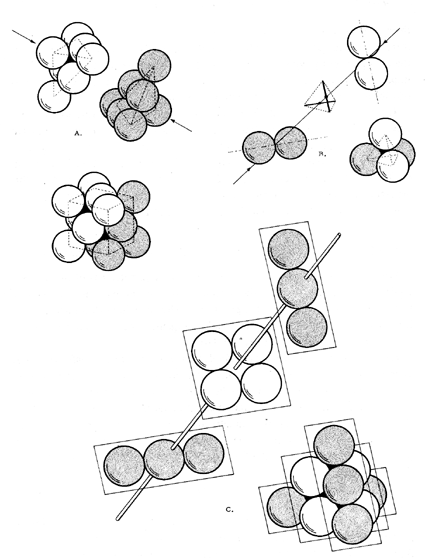
You will find, if you take two separate parallel sets of two tangent equiradius spheres and rotate the tangential axis of one pair one-quarter of a full circle, and then address this pair to the other pair in such a manner as to bring their respective intertangency valleys together, that the four now form a tetrahedron. (See Fig. B, illustration 416.01.)
416.02
If you next take two triangles, each made of three balls in closest packing, and twist one of the triangles 60 degrees around its center hole axis, the two triangular groups now may be nested into one another with the three spheres of one nesting in the three intersphere tangency valleys of the other. We now have six spheres in symmetrical closest packing, and they form the six vertexes of the octahedron. This twisting of one set to register it closepackedly with the other, is the first instance of two pairs internested to form the tetrahedron, and in the next case of the two triangles twisted to internestability as an octahedron, is called interprecessing of one set by its complementary set.
416.03
Two pairs of two-layer, seven-ball triangular sets of closestpacked spheres precess in a 60-degree twist to associate as the cube. (See Fig. A, illustration 416.01.) This 14-sphere cube is the minimum cube that may be stably produced by closest-packed spheres. While eight spheres temporarily may be tangentially glued into a cubical array with six square hole facades, they are not triangulated; ergo, are unstructured; ergo, as a cube are utterly unstable and will collapse; ergo, no eight-ball cube can be included in a structural hierarchy.
416.04
The two-frequency (three spheres to an edge), two-layer tetrahedron may also be formed into a cube through 90-degree interprecessional effect. (See Fig. A.)
417.00 Precession of Two Sets of 60 Closest-Packed Spheres
417.01
Fig. 417.01 Precession of Two Sets of 60 Closest-Packed Spheres as Seven-Frequency Tetrahedron
Fig. 417.01 Precession of Two Sets of 60 Closest-Packed Spheres as Seven-Frequency Tetrahedron: Two identical sets of 60 spheres in closest packing precess in 90-degree action to form a seven-frequency, eight-ball-edged tetrahedron with a total of 120 spheres, of which exactly 100 spheres are on the surface of the tetrahedron and 20 are inside but have no geometrical space accommodation for an equiradius nuclear sphere. The 120-sphere, nonnucleated tetrahedron is the largest possible double-shelled tetrahedral aggregation of closest-packed spheres having no nuclear sphere.
Link to original
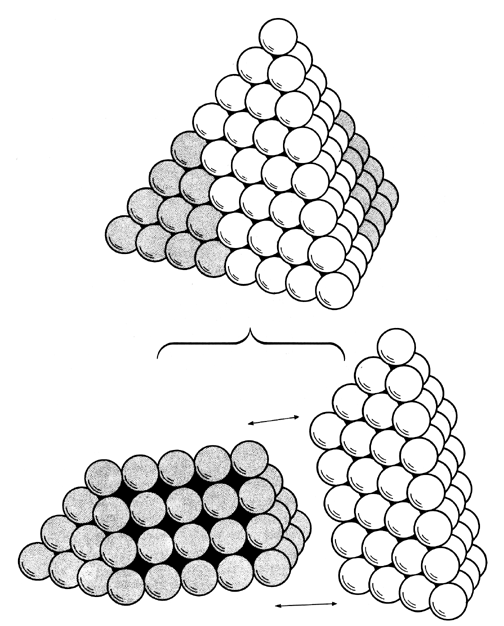
Two identical sets of 60 spheres in closest packing precess in 90 degree action to form a seven-frequency, eight-ball-to-the-edge tetrahedron with a total of 120 spheres; exactly 100 spheres are on the outer shell, exactly 20 spheres are in theinner shell, and there is no sphere at the nucleus. This is the largest possible double-shelled tetrahedral aggregation of closest-packed spheres having no nuclear sphere. As long as it has the 20- sphere tetrahedron of the inner shell, it will never acquire a nucleus at any frequency.
417.02
The 120 spheres of this non-nuclear tetrahedron correspond to the 120 basic triangles that describe unity on a sphere. They correspond to the 120 identical right- spherical triangles that result from symmetrical subdividing of the 20 identical, equilateral, equiangular triangles of either the spherical or planar-faceted icosahedron accomplished by the most economical connectors from the icosahedron’s 12 vertexes to the mid-edges of the opposite edges of their respective triangles, which connectors are inherently perpendicular to the edges and pass through one another at the equitriangles’ center and divide each of the equilaterals into six similar right triangles. These 120 triangles constitute the highest common multiple of system surface division by a single module unit area, as these 30º , 60º , 90º triangles are not further divisible into identical parts.
417.03
When we first look at the two unprecessed 60-ball halves of the 120-sphere tetrahedron, our eyes tend to be deceived. We tend to look at them “three-dimensionally,” i.e., in the terms of exclusively rectilinear and perpendicular symmetry of potential associability and closure upon one another. Thus we do not immediately see how we could bring two oblong quadrangular facets together with their long axes crossing one another at right angles.
417.04
Our sense of exclusively perpendicular approach to one another precludes our recognition that in 60-degree (versus 90-degree) coordination, these two sets precess in 60-degree angular convergence and not in parallel-edged congruence. This 60-degree convergence and divergence of mass-attracted associabilities is characteristic of the four- dimensional system.
418.00 Analogy of Closest Packing, Periodic Table, and Atomic Structure
418.01
The number of closest-packed spheres in any complete layer around any nuclear group of layers always terminates with the digit 2. First layer, 12; second, 42; third, 92 … 162, 252, 362, and so on. The digit 2 is always preceded by a number that corresponds to the second power of the number of layers surrounding the nucleus. The third layer’s number of 92 is comprised of the 3 multiplied by itself (i.e., 3 to the second power), which is 9, with the digit 2 as a suffix.
418.02
This third layer is the outermost of the symmetrically unique, nuclear-system patterns and may be identified with the 92 unique, selfregenerative, chemical-element systems, and with the 92nd such element — uranium.
418.03
The closest-sphere-packing system’s first three layers of 12, 42, and 92 add to 146, which is the number of neutrons in uranium — which has the highest nucleon population of all the self-regenerative chemical elements; these 146 neutrons, plus the 92 unengaged mass-attracting protons of the outer layer, give the predominant uranium of 238 nucleons, from whose outer layer the excess two of each layer (which functions as a neutral axis of spin) can be disengaged without distorting the structural integrity of the symmetrical aggregate, which leaves the chain-reacting Uranium 236.
418.04
All the first 92 chemical elements are the finitely comprehensive set of purely abstract physical principles governing all the fundamental cases of dynamically symmetrical, vectorial geometries and their systematically self-knotting, i.e., precessionally self-interfered, regenerative, inwardly shunting events.
418.05
The chemical elements are each unique pattern integrities formed by their self-knotting, inwardly precessing, periodically synchronized selfinterferences. Unique pattern evolvement constitutes elementality. What is unique about each of the 92 self- regenerative chemical elements is their nonrepetitive pattern evolvement, which terminates with the third layer of 92.
418.06
Independent of their isotopal variations of neutron content, the 92 self- regenerative chemical elements belong to the basic inventory of cosmic absolutes. The family of prime elements consists of 92 unique sets of from one to 92 electron-proton counts inclusive, and no others.
419.00 Superatomics
419.01
Those subsequently isolated chemical elements beyond the 92 prime self- regenerative chemical elements constitute super-atomics. They are the non-self- regenerative chemical elements of negative Universe.
419.02
Negative Universe is the complementary but invisible Universe. To demonstrate negative Universe, we take one rubber glove with an external green surface and an internal red surace. On the green surface a series of 92 numbers is patterned; and on the red surface a continuance of 93, 94, through to 184, with number 184 at the inside end of the pinky — each of the inner surface numbers being the inner pole of the outer pole point number positionings. The positions of the numbers on the inside correspond to the positions of the numbers on the outside. The numbering starts with the position of the five fingernails, then their successive first joints, and then their successive second joints from the tips: 5, 10, 15, and 20 numbers accommodated by the digits. The other 62 members are arranged in four rows of 12 each around the back and front of the palm of the hand. There is a final row of 14 at the terminal edge of the glove opening — this makes a total of 92. Now we can see why the 92 numbers on the outside were discoverable in a random manner requiring very little physical effort. It was just a matter of which part of your gloved hand you happened to be looking at. But if we become curious about what may be on the inside of the glove we discover that the glove is powerfully resilient. It takes a great deal of power to turn it up, to roll back the open edge — and it takes increasing amounts of power to cope with the increasing thickness of the rubber that rolls up as the glove opens. The elements from 93 on are revealed progressively by the numbers.
419.03
Fig. 419.03
Link to original
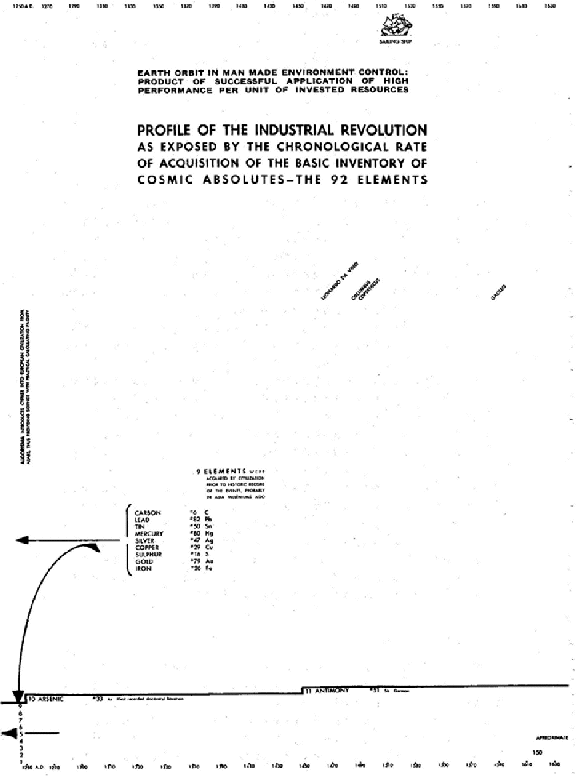
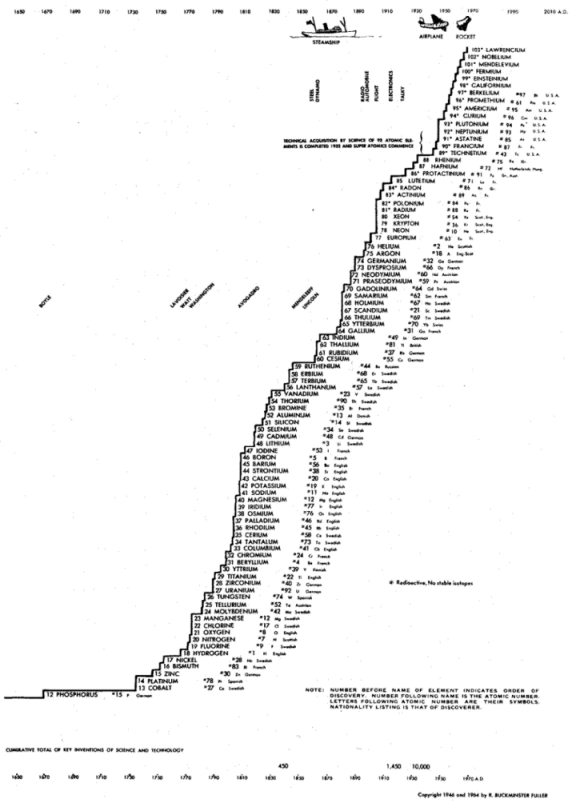
The discovery of the first 92 self-regenerative chemical elements was not by the numbers starting with one, but in a completely random sequence. In the super-atomics, beyond Uranium, number 92, the split-second-lived chemical elements have been discovered in a succession that corresponds to their atomic number — for example, the 94th discovery had the atomic weight of 94; the 100th discovery was atomic weight 100, etc.
419.04
This orderly revelation is in fundamental contrast to the discoveries of the 92 self-regenerative elements and their naturally self-regeneratively occurring isotopes. The discovery of the post-uranium elements has involved the employment of successively greater magnitudes of energy concentration and focusing. As each of the super-atomic trans-uranium elements was isolatingly discovered, it disintegrated within split seconds. The orderliness of the succession of the discovery of super-atomics corresponds to the rate of increase of the magnitudes of energy necessary to bring them into split-second identifiability before they revert to their inside — ergo, invisible to outside — position.
419.05
Every layer of a finite system has both an interior, concave, associability potential and an exterior, convex, associability potential. Hence the outer layer of a vector-equilibrium-patterned atom system always has an additional full number “unemployed associability” count. In the example cited above (Sec. 418.03), an additional 92 was added to the 146 as the sum of the number of spheres in the first three shells. The total is 238, the number of nucleons in uranium, whose atomic weight is 238. Four of the nucleons on the surface of one of the square faces of the vector equilibrium’s closest-packed aggregation of nucleons may be separated out without impairing the structural-stability integrity of the balance of the aggregate. This leaves a residue of 236 nucleons, which is the fissionable state of uranium — which must go on chain-reacting due to its asymmetry.
419.10 Nuclear Domain and Elementality
419.11
Where the primitive polyhedron considered is the vector equilibrium, the closest-packed-sphere-shell growth rate is governed by the formula 10F² + 2 (Sec. 222). Where the most primitive polyhedron is the tetrahedron, the growth rate is governed by the formula 2F² + 2; in the cases of the octahedron and the cube see Sec. 223.21. The formula is reliably predictable in the identification of the chemical elements and their respective neutron inventories for each shell. The identifications are related exclusively to the unique nuclear domain pattern involvements.
419.12
When a new nucleus becomes completely surrounded by two layers, then the exclusively unique pattern surroundment of the first nucleus is terminated. Thereafter, at three enclosure levels or more, the initial nucleus is no longer the unique nucleus. The word elemental relates to the original unique patterning around any one nucleus of closest-packed spheres. When we get beyond the original unique patterning, we find the patternings repeating themselves, and we enter into the more complex structurings of the molecular world.
419.13
Uranium-92 is the limit case of what we call inherently selfregenerative chemical elements. Beyond these we get into demonstrations of non-self-regenerative elements with the split-second life of Negative Universe. These demonstrations are similar to having a rubber ball with a hole in its skin and stretching that hole’s rubber outwardly around the hole until we can see the markings on the inner skin that correspond to markings on the outer skin — but when we release the ball, the momentarily outwardly displayed markings on the inside will quickly resume their internal positions.
419.14
As we see in Sec. 624, the inside-outing of Universe occurs only at the tetrahedral level. In the nucleated, tetrahedral, closest-packed-sphereshell growth rates the outward layer sphere count increases as frequency to the second power times two plus two — with the outer layer also always doubled in value.
419.20 Elemental Identification of First and Second Shell Layers
419.21
The outer layer of the vector equilibrium aggregates always equals the shell wave frequencies to the second power times 10 plus two. The sum of all the layers equals the number of neutrons of the elements, and the outer layer is always complemented by an equal number of active nucleons, which, if added to the sum of the previously encompassed neutron layer, equals the isotope number.
419.22
The omnidirectional closest packing of spheres in all six symmetrical conformations of the primitive hierarchy of polyhedra probably provides models for all the chemical elements in a hierarchy independent of size in which the sum of the spheres in all the layers and the nuclear sphere equals the most prominent number of neutrons, and the number in the outer layer alone equals the number of protons of each atom. In the VE symmetry of layer growth the sum of the spheres is one and the outer layer is one: the initial sphere represents the element hydrogen, with the atomic number 1, having one neutron and one proton. The second VE assembly layer, magnesium, with the atomic number 12, has 12 protons and 24 neutrons. The third layer, molybdenum, with the atomic number 42, has 42 protons and a majority of 54 neutrons. The fourth layer, uranium, with the atomic number 92, has 92 protons and an isotopal majority of 146 neutrons. (Compare Secs. 986.770 and 1052.32.)
419.23
Table: Number of Protons and Neutrons in Magnesium, Molybdenum, and Uranium
| Element | Protons | Neutrons | Mass Number | Abundance | ||
|---|---|---|---|---|---|---|
| Hydrogen | 1 | + | 1 | = | 2 | |
| Magnesium | 12 | + | 12 | = | 24 | 78.6 % |
| 12 | + | 13 | = | 25 | 10.11 | |
| 12 | + | 14 | = | 26 | 11.29 | |
| Molybdenum | 42 | + | 52 | = | 94 | 9.12 |
| 42 | + | 53 | = | 95 | 15.7 | |
| 42 | + | 54 | = | 96 | 16.5 | |
| 42 | + | 55 | = | 97 | 9.45 | |
| 42 | + | 56 | = | 98 | 23.75 | |
| Uranium | 92 | + | 142 | = | 234 | 0.0051 |
| 92 | + | 143 | = | 235 | 0.71 | |
| 92 | + | 146 | = | 238 | 99.28 |
Vector Equilibrium Shell Growth Rate: 10F² + 2
Zero Frequency 1 + 1 = 2
Initial Frequency 12 × 2 = 24
Frequency² 42 + 42 + 12 = 96
Frequency³ 92 + 92 + 42 + 12 = 238
419.30
Fig. 419.30 Realized Nucleus Appears at Fifth Shell Layer
Fig. 419.30 Realized Nucleus Appears at Fifth Shell Layer: In concentric closest packing of successive shell layers potential nuclei appear at the third shell layer, but they are not realized until surrounded by two shells at the fifth layer.
Link to original
.png)
Closest-sphere-packing Analogy to Atomic Structure: In 1978 Philip Blackmarr, a student of synergetics from Pasadena, proposed a novel analogy of closest- sphere-packing geometry to electron-proton-neutron interrelationships and atomic structure. He took note of the following four facts;
- In the closest packing of unit radius spheres each spheric and interspheric space domain is equally and symmetrically embraced by allspace-filling rhombic dodecahedra. (Sec. 426.20.)
- The concentrically embracing shells of the vector equilibrium have a successive population growth rate of 10F² + 2, resulting in 12 spheres in the first layer, in the second, 92 in the third, and 162 in the fourth. (See Chart 415.03.)
- In the concentric successive shells of closest-packed spheres a new nucleus does not appear until the fifth frequency — the fifth shell layer. (Secs. 414 and 415.30)
- The ratio of the electron mass to the proton mass is 1:1836. (Sec. 433.02.)
Bearing those four facts in mind Blackmarr employed a symmetrical fourshell aggregate of 308 rhombic dodecahedra to represent the total allspacefilling domains of the 308 spheres of the maximum limit nuclear domain. He then intuitively divided the number 1836 by 6, the latter being the volume of the rhombic dodecahedron in respect to the volume of the tetrahedron as one. The number 1836/6= 306 becomes significant as it represents the total number of neutron spheric domains in the vector equilibrium concentric shell packingess the number two of their integral number to serve as poles of the axis of spin of the symmetrical system. The spheres in the successive shell layers — 12, 42, 92, 162 — add up to 308; 308 - 2 = 306. (Compare Sec. 418.)
419.31
Blackmarr then hypothetically identified the electron as the volume of the unit-vector-edge tetrahedron as ratioed to the volume of the four-frequency vector equilibrium, representing a symmetrical and “solid” agglomeration of 308 rhombic dodecahedra (with two of the outer-layer rhombic dodecahedra assigned to serve as the symmetrically opposite poles of the system’s axis of spin), or of 308 unit-radius spheres and their interspaces. This evidences that the space filled by the 308 rhombic dodecahedra is the maximum, cosmic-limit, unit-vector, symmetrical polyhedral space occupiable by a single nucleus.
419.32
419.33
Here is an elegant realization that two spheres of the outer-layer spheres (or rhombic dodecahedra) of the symmetrical system have to serve as the polar axis of the system spin. (See Secs. 223 and 1044.)
419.34
Thus by experimental evidence we may identify the electron with the volume of the regular, unit-vector-radius-edge tetrahedron, the simplest symmetrical structural system in Universe. We may further identify the electron tetrahedra with the maximum possible symmetrical aggregate of concentrically-packed, unit-radius spheres symmetrically surrounding a single nucleus — there being 12 new potential nuclei appearing in the three-frequency shell of 92 spheres, which three-frequency shell, when surroundingly embraced by the four-frequency shell of 162 spheres, buries the 12 candidate new nuclei only one shell deep, whereas qualifying as full-fledged nuclei in their own right requires two shells all around each, which 12, newborn nuclei event calls for the fifth-frequency shell of 252 spheres.
419.35
Together with the closest-packed spheres of the outer layer of the icosahedron of frequencies 1 and 4 (and of the outer layers of the closestpacked spheres of the one — and only one — nucleus-embracing, symmetrically and closest-packed, unit-radius sphere aggregates in the form of the octahedron, rhombic dodecahedron, rhombic triacontahedron, and enenicontahedron) as well as the already identified four-frequency vector equilibrium, the rhombic dodecahedron is the maximum nuclear domain within which the pretime-size set of chemical-element-forming atoms’ proton-neutron-and- electron interrelationship events can and may occur.
419.36
All of the foregoing is to say that the size of one spinnable proton consisting of 308 rhombic dodeca closest packed in the symmetrical form of the four-frequency vector equilibrium is 1836 times the size of one prime, pre-time-size, prefrequency, unit- vector-edge tetrahedron or of one electron. Multiplication only by division means that the time-size frequencies of the elements (other than hydrogen) occur as various concentric- shell symmetry phases of the single-nucleus-embracing, symmetrically closest-packed, single-nucleus aggregates in the multiconcentric-layered forms of the vector equilibrium, tetrahedron, octahedron, rhombic dodecahedron, rhombic triacontahedron, and cube.
419.37
Synergetics has long associated the electron with the icosahedron. Icosahedra cannot accommodate concentric shells; they occur as single-layer shells of closest-packed, unit-radius spheres. Since the proton has only the outer shell count, it may be identified with the icosa phase by having the total volume of the rhombic- dodecahedron-composed four-frequency vector equilibrium transformed from the 306 (non-axial) nucleon rhombic dodecahedron into each of the closest-packed, single-layer icosahedra shells as an emitted wave entity. The rhombic dodecahedron neutrons are packed into concentric layers of the vector equilibria to produce the various isotopes. For example:
\begin{array}{r@{\;}c@{\;}l} \text{VE } f^{1} & = & 12 \text{ neutrons} \\ \text{VE } f^{2} & = & 42 \text{ neutrons} \\ \text{VE } f^{3} & = & 92 \text{ neutrons} \\ & & \begin{array}{@{}l} \hline 146 \text{ neutrons in Uranium} \end{array} \end{array} \begin{array}{r@{\;}c@{\;}l} 92 \text{ Tetra} & = & 92 \text{ electrons in Uranium} \end{array}