420.01
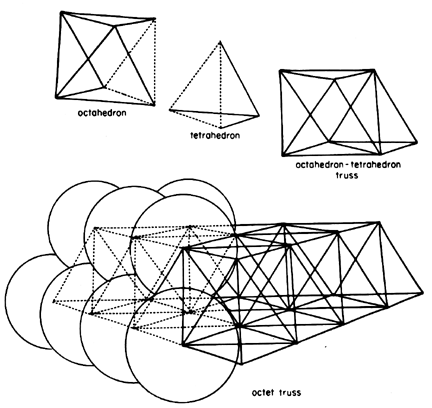
When the centers of equiradius spheres in closest packing are joined by most economical lines, i.e., by geodesic vectorial lines, an isotropic vector matrix is disclosed— “isotropic” meaning “everywhere the same,” “isotropic vector” meaning “everywhere the same energy conditions.” This matrix constitutes an array of equilateral triangles that corresponds with the comprehensive coordination of nature’s most economical, most comfortable, structural interrelationships employing 60-degree association and disassociation. Remove the spheres and leave the vectors, and you have the octahedron- tetrahedron complex, the octet truss, the isotropic vector matrix. (See Secs. 650 and 825.28.)
420.02
Fig. 420.02
When the centers of equiradius spheres in closest packing are joined with lines, an isotropic vector matrix is formed. This constitutes an array of equilateral triangles which is seen as the comprehensive coordination frame of reference of nature’s most economical, most comfortable structural interrelationships employing 60-degree association and disassociation. This provides an omnirational accounting system which, if arbitrarily accounted on a 90-degree basis, becomes inherently irrational. The isotropic vector matrix demonstrates the capability of accommodating all symmetrically and asymmetrically terminaled, high-frequency energy vectors of any structural shaping
Link to original
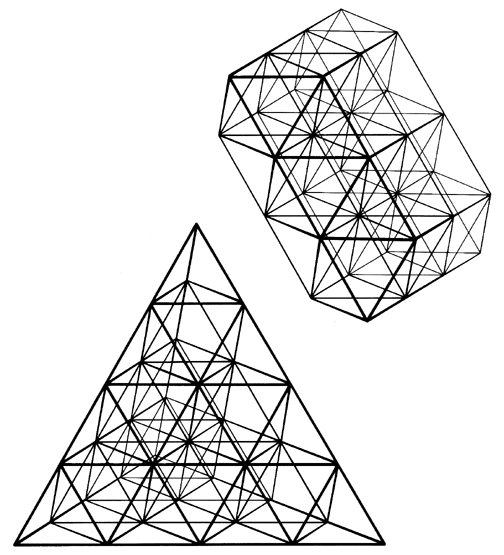
The isotropic vector matrix is four-dimensional and 60-degree coordinated. It provides an omnirational accounting system that, if arbitrarily accounted on a three- dimensional, 90-degree basis, becomes inherently irrational. The isotropic vector matrix demonstrates the ability of the symmetrically and asymmetrically terminaled, high- frequency energy vectors to accommodate the structuring of any shape. (See Sec. 923.)
420.03
Our extension of the Avogadro hypothesis (Sec. 410) generalizes that all energy conditions are the same. Inasmuch as vectors describe energy conditions, this would mean a volumetric aggregation of vectors in a structural complex in which all of the interacting vectors would have to be of the same length and all of their intersecting angles would have to be the same. This state of omnisameness of vectors stipulates the “isotropic,” meaning everywhere the same. This prescribes an everywhere state of equilibrium.
420.04 Equilibrium
420.041
Nature is said to abhor an equilibrium as much as she abhors a perfect vacuum or a perfect anything. Heisenberg’s indeterminism and quasiprecision mechanics’ recognition of inherent inaccuracy of observation or articulation seems to suggest that the asymmetric deviations and aberrations relative to equilibrium are inherent in the imperfection of a limited life of humans with a tightly limited range of perceptible differentiation of details of its experience. Nature demonstrates her abhorrence of equilibrium when an airplane in flight slows to a speed that reduces the airfoil “lift” and brings the airplane’s horizontal flight forces into equilibrium with Earth gravity’s vertically Earthward pull. The plane is said then to stall, at which moment the plane’s indeterminate direction makes it unmanageable because the rudder and elevator surfaces lack enough passing air to provide steerability, and the plane goes swiftly through equilibrium and into an Earthward-spinning plunge. Despite the untenability of equilibrium, it seemed to me that we could approach or employ it referentially as we employed a crooked line—the deliberately nonstraight (see Sec. 522) line that approaches but never reaches the perfect or exact. A comprehensive energy system could employ the positive and negative pulsations and intertransformative tendencies of equilibrium. The vector equilibrium became the logical model of such omnidimensional, omniexperience-accommodation studies. Because we have learned that scientists have experimental evidence only of waves and wavilinearity and no evidence of straight lines, it became evident that the radial and circumferential vectors of the vector equilibrium must be wavilinear, which meant that as coil springs when compressioned will lessen in length and when tensed will be increased in length—ergo, the explosive disintegrative radial forces of Universe would compress and lessen in outward disintegrative length and would be well inside the closed-back-on-itself, hexagonally tensed, embracing vectors, indicating a higher effectiveness of tensile integrity of Universe over any locally disintegrative forces. The comprehensive vector-equilibrium system would also have to recognize all the topological interpatterning characteristics and components; also, as a quasi-equilibrious system, all of its structural component vectors would have to be approximately the same length; therefore, all the interangulation would have to be in aberration increments relative to 60 degrees as the equilibrious norm.
420.05
The closest-packing-of-spheres model coincides with the observed real world’s atomic packing of like atoms with their own counterparts.
420.06
We find that the space compartmentation formed by the vectors connecting the sphere centers always consists only of tetrahedra and octahedra. The spheres in closest packing coincide with the Eulerian vertexes; the vectors between the sphere centers are the Eulerian edges; and the triangles so formed are the “faces.”
420.07
All of the polygons formed by the interacting vectors of the isotropic vector matrix consist entirely of equilateral triangles and squares. The squares occur as equatorial cross sections of the octahedra. The triangles occur as the external facets of both the tetrahedra and the octahedra.
420.08
All the polygons are reducible to triangles and are not further reducible. All polyhedra are reducible to triangulation, i.e., to trusses and are not further reducible. Infinite polyhedra are infinitely faceted by basic trusses.
421.00 Function of Nucleus in Isotropic Vector Matrix
421.01
Because the spacing of absolutely compacted spheres is tangential and hexagonal in great-circle cross section around any one sphere, the contact points are always spaced equidistant from the centers of the spheres and from their immediately neighboring points, respectively; wherefore the dimensions of a system of lines joining each and all adjacent spherical centers are identical to the universal radii of the identical spheres and, therefore, to each other. Such a universal system of identically dimensioned lines, growing outwardly from any one nuclear vertex, constitutes a universal vector system in dynamic equilibrium, for all the force lines are of equal magnitude.
421.02
In the isotropic vector matrix, every vector leads from one nuclear center to another, and therefore represents the operational effect of a merging of any two or more force centers upon each other. Each vector is composed of two halves, each half belonging respectively to any two adjacent nuclear centers Each half of the interconnecting vectors represents the radius of one of the two spheres tangent to one another at the vector midpoints.
421.03
Unity as represented by the internuclear vector modulus is of necessity always of the value of two, for it represents union of a minimum of two energy centers. (See Sec. 240.40.)
421.031
Function of Nucleus in Isotropic Vector Matrix: Every vector has two ends both of which join with other vectors to produce both structural systems and total cosmic integrity of regeneration. Every vector unites two ends.
421.04
Each nuclear ball can have a neutral function among the aggregates. It is a nuclear ball whether it is in a planar array or in an omnidirectional array. It has a unique function in each of the adjacent systems that it bonds.
421.05
The nucleus can accommodate wave passage without disrupting the fundamental resonance of the octaves. The tetrahedron is the minimum, ergo prime, non- nucleated structural system of Universe. The vector equilibrium is the minimum, ergo prime, nucleated structural system of Universe.
421.10
Corollary: Identically dimensioned nuclear systems and layer growths occur alike, relative to each and every absolutely compacted sphere of the isotropic vector matrix conglomerate, wherefore the integrity of the individual energy center is mathematically demonstrated to be universal both potentially and kinetically (Sec. 240.50).
421.20 Ideal Vectorial Geometry of Nucleated Systems
421.21
It is experientially suggested that the structural interpatterning principles apparently governing all atomic associability behaviors are characterized by triangular and tetrahedral accommodation, wherein the tetrahedron’s six positive and six negative vectorial edge forces match a total of 12 universal degrees of freedom. The tetrahedron’s exclusively edge-congruent-agglomeratability around any one nuclear point produces the vector equilibrium. These structural, pattern-governing, conceptualizable principles in turn govern all eternally regenerative design evolution, including the complex patterning of potential, symmetrically and asymmetrically limited, pulsative regenerations, only in respect to all of which are ideas conceivable. These patternings are experientially manifest in synergetics’ closed-system topological hierarchy through which we can explore the ramifications of the idealistic vectorial geometry characteristics of inherently nucleated systems and their experientially demonstrable properties. (For possible relevance to the periodic table of the elements see Sec. 955.30.)
422.00 Octet Truss
422.01
In an isotropic vector matrix, there are only two clear-space polyhedra described internally by the configuration of interacting vectors: these are the regular tetrahedron and the regular octahedron operating as complementary space fillers. The single octahedron-tetrahedron deep truss system is known in synergetics as the octet truss.
422.02
The octet truss, or the isotropic vector matrix, is generated by the asymmetrical closest-packed sphere conglomerations. The nuclei are incidental.
422.03
When four tetrahedra of a given size are symmetrically intercombined by single bonding, each tetrahedron will have one of its four vertexes uncombined, and three combined with the six mutually combined vertexes symmetrically embracing to define an octahedron; while the four noncombined vertexes of the tetrahedra will define a tetrahedron twice the edge length of the four tetrahedra of given size; wherefore the resulting central space of the double-size tetrahedron is an octahedron. Together, these polyhedra comprise a common octahedron-tetrahedron system.
422.04
The tetrahedronated octahedron and all other regular symmetrical polyhedra known are described repetitiously by compounding two types of rational fraction asymmetric elements of the tetrahedron and octahedron. These elements are known in synergetics as the A and B Quanta Modules. (See Sec. 920.)
422.10
Force Distribution: In the three-way grid octet truss system, concentrated energy loads applied to any one point are distributed radially outward in nine directions and are immediately diffused into the finite hexagonally arranged six vectors entirely enclosing the six-way-distributed force. Each of the hexagon’s six vertexes distribute the loads 18 ways to the next outwardly encircling vectors, which progressively diffusing system ultimately distributes the original concentrated energy force equally to all parts of the system as with a pneumatic tire. Thus the system joins together synergetically to distribute and inhibit the forces.
422.20
Geometry of Structure: Considered solely as geometry of structure, the final identification of the octet truss by the chemists and physicists as closest packing also identifies the octet truss and vector equilibria structuring as amongst the prime cosmic principles permeating and facilitating all physical experience.
423.00 60-Degree Coordination
423.01
In the octet truss system, all the vectors are of identical length and all the angles around any convergence are the same. The patterns repeat themselves consistently. At every internal convergence, there are always 12 vectors coming together, and they are always convergent at 60 degrees with respect to the next adjacent ones.
423.02
There are angles other than 60-degrees generated in the system, as for instance the square equatorial mid-section of the octahedron. These angles of other than 60-degrees occur between nonadjacently converging vectorial connectors of the system. The prime structural relationship is with the 60 degree angle.
423.03
Fundamental 60-degree coordination operates either circumferentially or radially. This characteristic is lacking in 90-degree coordination, where the hypotenuse of the 90-degree angles will not be congruent and logically integratable with the radials.
423.04
When we begin to integrate our arithmetical identities, as for instance n² or n³ , with a 60-degree coordination system, we find important coincidence with the topological inventories of systems, particularly with the isotropic vector matrix which makes possible fourth- and fifth-power modeling.
423.10
Hexagon as Average of Angular Stabilizations: The irrational radian and pi are not used by nature because angular accelerations are in finite package impellments³ which are chordal (not arcs) and produce hexagons because the average of all angular stabilizations from all triangular interactions average at 60 degrees—ergo, radii and 60-degree chords are equal and identical; ergo, six 60-degree chords equal one frequency cycle; ergo, one quantum. Closest packed circles or spheres do not occupy all area or space, but six-triangled, nucleated hexagons do constitute the shortest route cyclic enclosure of closest-packed nucleation and do uniformly occupy all planar area or volumetric space.
(Footnote 3: For a related concept see Secs. 1009.50, Acceleration, and 1009.60, Hammerthrower.)
424.00 Transformation by Complementary Symmetry
424.01
The octet truss complex is a precessionally nonredundant, isotropic vector- tensor evolutionary relationship whose energy transformation accountings are comprehensively rational—radially and circumferentially—to all chemical, biological, electromagnetic, thermodynamic, gravitational, and radiational behaviors of nature. It accommodates all transformations by systematic complementary symmetries of concentric, contractile, involutional, turbo-geared, rational, turbulence-accommodating, inside-outing, positive-tonegative-to-equilibrium, pulsative coordinate displacements.
424.02
Thus we see both the rational energy quantum of physics and the topological tetrahedron of the isotropic vector matrix rationally accouming all physical and metaphysical systems and their transforrnative transactins. (See Sec. 620.12.)
424.03
This indefinitely extending vector system in dynamic equilibrium provides a rational frame of reference in universal dimension for measurement of any energy conversion or any degree of developed energy factor disequilibrium or its predictable reaction developments—of impoundment or release— ergo, for atomic characteristics.
425.00 Potentiality of Vector Equilibrium
425.01
Where all the frequency modulations of the local vectors are approximately equal, we have a potentially local vector equilibrium, but the operative vector frequency complexity has the inherent qualities of accommodating both proximity and remoteness in respect to any locally initiated actions, ergo, a complex of relative frequencies and velocities of realization lags are accommodated (Corollary at Sec. 240.37).
426.00 Spherics
426.01
An isotropic vector matrix can be only omnisymmetrically, radiantly, and “broadcastingly” generated, that is, propagated and radiantly regenerated, from only one vector equilibrium origin, although it may be tuned in, or frequency received, at any point in Universe and thus regenerate local congruence with any of its radiantly broadcast vector structurings.
426.02
An isotropic vector matrix can be only radiantly generated at a “selectable” (tunable) propagation frequency and vector-size (length) modular spacing and broadcast omnidirectionally or focally beamed outward from any vector-center-fixed origin such that one of its symmetrically regenerated vector-convergent fixes will be congruent with any other identical wavelength and frequency attuned and radiantly reachable vector-center fixes in Universe.
426.03
In time-vectorable Universe, the maximal range of radiant-regenerative reachability in time is determined by the omnidirectional velocity of all radiation: c², i.e., (186,000)².⁴
(Footnote 4: Within a week after this paragraph was drafted The New York Times of 22 November 1972 reported that the National Bureau of Standards laboratories at Boulder, Colorado, had determined the speed of light as “186,282.3960 miles per second with an estimated error margin no greater than 3.6 feet a second… Multiplying wavelength by frequency gives the speed of light.”)
426.04
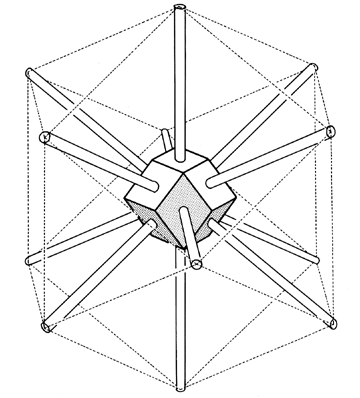
Spherics: Employing the rhombic dodecahedron as the hub at the vector crossings of the octet truss (the isotropic vector matrix) provides unique economic, technical, and geometric advantages: its 12 facets represent the six pairs of planes perpendicular to the six degrees of freedom. (See Sec. 537.10.) Its 12 diamond faces also provide the even-numbered means of allowing the vectors to skew-weave around the nucleus at critical-proximity distances without touching the nucleus or one another. Because two or more lines cannot go through the same point at the same time, this function of the rhombic dodecahedron’s hub makes all the difference between regenerative success or failure of Universe. (See Figs. 955.52 and 426.04.)
426.10
Definition of a Spheric: A “spheric” is any one of the rhombic dodecahedra symmetrically recurrent throughout an isotropic-vector-matrix geometry wherein the centers of area of each of the rhombic dodecahedra’s 12 diamond facets are exactly and symmetrically tangent at 12 omnisymmetrically interarrayed points Iying on the surface of any one complete sphere, entirely contained within the spheric-identifying rhombic dodecahedra, with each of any such rhombic dodecahedra’s tangentially contained spheres symmetrically radiant around every other, i.e., every omnidirectionally alternate vertex of every isotropic vector matrix, with the 12 points of spherical tangency of each of the rhombic dodecahedra exactly congruent also with the 12 vertexes of the vector equilibrium most immediately surrounding the vertex center of the sphere, each of whose 12 vector equilibrium radii are the special set of isotropic vector matrix vectors leading outwardly from the sphere’s center vertex to the 12 most immediately surrounding vertexes.
426.11
These 12 vertexes, which are omni-equidistant from every other vertex of the isotropic vector matrix, also occur at the diamond-face centers of the “spheric” rhombic dodecahedra and are also the points of tangency of 12 uniradius spheres immediately and omni-intertangentially surrounding (i.e., closest-packing) the sphere first defined by the first rhombic dodecahedron. Each rhombic dodecahedron symmetrically surrounds every radiantly alternate vertex of the isotropic vector matrix with the other radiantly symmetrical unsurrounded set of vertexes always and only occurring at the diamond-face centers of the rhombic dodecahedra.
426.12
One radiantly alternate set of vertexes of the isotropic vector matrix always occurs at the spheric centers of omni-closest-packed, uniradius spheres; whereas the other radiantly alternate set of vertexes of the isotropic vector matrix always occurs at the spheric intertangency points of omniclosest-packed, uniradius spheres.
426.20
Allspace Filling: The rhombic dodecahedra symmetrically fill allspace in symmetric consort with the isotropic vector matrix. Each rhombic dodecahedron defines exactly the unique and omnisimilar domain of every radiantly alternate vertex of the isotropic vector matrix as well as the unique and omnisimilar domains of each and every interior-exterior vertex of any aggregate of closest-packed, uniradius spheres whose respective centers will always be congruent with every radiantly alternate vertex of the isotropic vector matrix, with the corresponding set of alternate vertexes always occurAng at all the intertangency points of the closest-packed spheres.
426.21
The rhombic dodecahedron contains the most volume with the least surface of all the allspace-filling geometrical forms, ergo, rhombic dodecahedra are the most economical allspace subdividers of Universe. The rhombic dodecahedra fill and symmetrically subdivide allspace most economically, while simultaneously, symmetrically, and exactly defining the respective domains of each sphere as well as the spaces between the spheres, the respective shares of the inter-closest-packed-sphere-interstitial space. The rhombic dodecahedra are called “spherics,” for their respective volumes are always the unique closest-packed, uniradius spheres’ volumetric domains of reference within the electively generatable and selectively “sizable” or tunable of all isotropic vector matrixes of all metaphysical “considering” as regeneratively reoriginated by any thinker anywhere at any time; as well as of all the electively generatable and selectively tunable (sizable) isotropic vector matrixes of physical electromagnetics, which are also reoriginatable physically by anyone anywhere in Universe.
426.22
The rhombic dodecahedron’s 12 diamond faces are the 12 unique planes always occurring perpendicularly to the midpoints of all vector radii of all the closest- packed spheres whenever and wherever they may be metaphysically or physically regenerated, i.e., perpendicular to the midpoints of all vectors of all isotropic vector matrixing.
426.30
Spherics and Modularity: None of the rhombic dodecahedra’s edges are congruent with the vectors of the isotropic vector matrix, and only six of the rhombic dodecahedra’s 14 vertexes are congruent with the symmetrically co-reoccurring vertexes of the isotropic vector matrix. The other eight vertexes of the rhombic dodecahedra are congruent with the centers of volume of the eight edge-interconnected tetrahedra omnisymmetrically and radiantly arrayed around every vertex of the isotropic vector matrix, with all the edges of all the tetrahedra always congruent with all the vectors of the isotropic vector matrix, and all the vertexes of all the tetrahedra always congruent with the vertexes of the isotropic vector matrix, all of which vertexes are always most economically interconnected by three edges of the tetrahedra.
426.31
A spheric is any one of the rhombic dodecahedra, the center of each of whose 12 diamond facets is exactly tangent to the surface of each sphere formed equidistantly around each vertex of the isotropic vector matrix.
426.32
A spheric has 144 A and B modules, and there are 24 A Quanta Modules (see Sec. 920 and 940) in the tetrahedron, which equals 1/6th of a spheric. Each of the tetrahedron’s 24 modules contains 1/144th of a sphere, plus 1/144th of the nonsphere space unique to the individual domain of the specific sphere of which it is a 1/144th part, and whose spheric center is congruent with the most acute-angle vertex of each and all of the A and B Quanta Modules. The four corners of the tetrahedron are centers of four embryonic (potential) spheres.
426.40
Radiant Valvability of Isotropic-Vector-Matrix-Defined Wavelength: We can resonate the vector equilibrium in many ways. An isotropic vector matrix may be both radiantly generated and regenerated from any vector-centered fixed origin in Universe such that one of its vertexes will be congruent with any other radiantly reachable center fix in Universe; i.e., it can communicate with any other noninterfered-with point in Universe. The combined reachability range is determined by the omnidirectional velocity of all radiation, c² within the availably investable time.
426.41
The rhombic dodecahedron’s 144 modules may be reoriented within it to be either radiantly disposed from the contained sphere’s center of volume or circumferentially arrayed to serve as the interconnective pattern of six 1/6th-spheres, with six of the dodecahedron’s 14 vertexes congruent with the centers of the six individual l/6th spheres that it interconnects. The six 1/6th spheres are completed when 12 additional rhombic dodecahedra are close-packed around it.
426.42
The fact that the rhombic dodecahedron can have its 144 modules oriented as either introvert-extrovert or as three-way circumferential provides its valvability between broadcasting-transceiving and noninterference relaying. The first radio tuning crystal must have been a rhombic dodecahedron.
426.43
Multiplying wavelength by frequency equals the speed of light. We have two experimentally demonstrable radiational variables. We have to do whatever we do against time. Whatever we may be, each we has only so much commonly experienceable time in scenario Universe within which to articulate thus and so. Therefore, the vector equilibrium’s radiant or gravitational “realizations” are always inherently geared to or tuned in with the fundamental time-sizing of = 186,000 mps (approximately), which unique time-size- length increments of available time can be divided into any desirable frequency. One second is a desirable, commonly experienceable increment to use, and within each unit of it we can reach = 186,000 miles (approximately) in any non-frequency-interferedwith direction.
426.44
Wavelength times frequency is the speed of all radiation. If the frequency of the vector equilibrium is four, its vector radius, or basic wavelength = 186,000 / 4 miles reachable within one second = 46,500 reach-miles. Electromagnetically speaking, the unarticulated vector equilibrium’s onesecond vector length is always 186,282.396 miles.
426.45
We multiply our frequency by the number of times we divide the vector of the vector equilibrium, and that gives c² ; our reachable points in Universe will multiply at a rate of F² × 10 + 2.
426.46
All the relative volumetric intervaluations of all the symmetric polyhedra and of all uniradius, closest-packed spheres are inherently regenerated in omnirational respect to isotropic vector matrixes, whether the matrixes are inadvertently—i.e., subjectively— activated by the size-selective, metaphysical-consideration initiatives, whether they are objectively and physically articulated in consciously tuned electromagnetic transmission, or whether they are selectively tuned to receive on that isotropic-vector-matrix-defined “wavelength.”
426.47
Humans may be quite unconscious of their unavoidable employment of isotropic vector matrix fields of thought or of physical articulations; and they may oversimplify or be only subconsciously attuned to employ their many cosmically intertunable faculties and especially their conceptual and reasoning faculties. However, their physical brains, constituted of quadrillions times quadrillions of atoms, are always and only most economically interassociative, interactive, and intertransforming only in respect to the closestpacked isotropic vector matrix fields which altogether subconsciously accommodate the conceptual geometry picturing and memory storing of each individual’s evolutionary accumulation of special-case experience happenings, which human inventories are accumulatingly stored isotropic-vector-matrix wise in the brain and are conceptually retrievable by brain and are both subconsciously and consciously reconsidered reflexively or by reflex-shunning mind.