450.10 Great Circles of the Vector Equilibrium
.png)
450.11
Fig. 450.11A Axes of Rotation of Vector Equilibrium
Fig. 450.11A Axes of Rotation of Vector Equilibrium:
A. Rotation of vector equilibrium on axes through centers of opposite trianglar faces defines four equatorial great-circle planes.
Link to original
B. Rotation of the vector equilibrium on axes through centers of opposite square faces defines three equatorial great-circle planes.
C. Rotation of vector equilibrium on axes through opposite vertexes defines six equatorial great-circle planes.
D. Rotation of the vector equilibrium on axes through centers of opposite edges defines twelve equatorial great-circle planes.
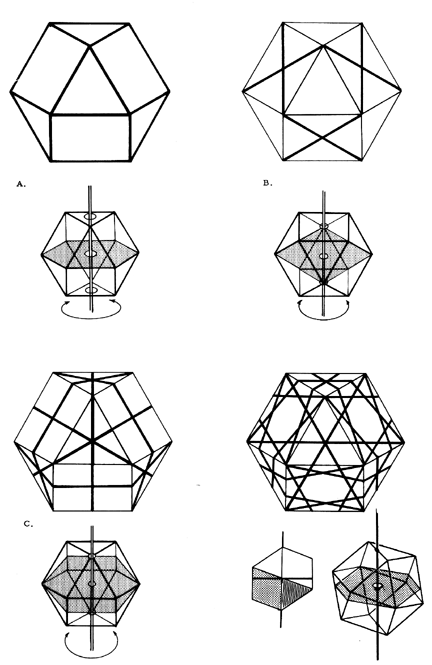
Fig. 450.11B Projection of 25 Great-Circle Planes in Vector Equilibrium Systems 1
Fig. 450.11B Projection of 25 Great-Circle Planes in Vector Equilibrium Systems: The complete vector equilibrium system of 25 great-circle planes, shown as both a plane faced-figure and as the complete sphere (3 + 4 + 6 + 12 = 25). The heavy lines show the edges of the original 14-faced vector equilibrium.
Link to original
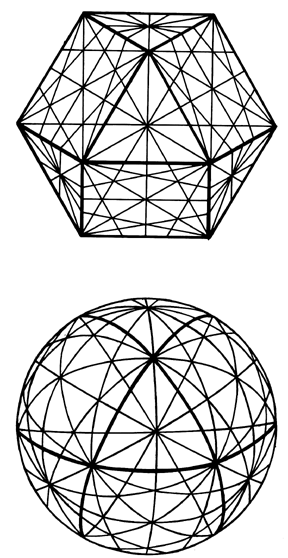
Four Sets of Axes of Spin: The omni-equi-edged and radiused vector equilibrium is omnisymmetrical, having 12 vertexes, six square faces, eight triangular faces, and 24 edges for a total of 50 symmetrically positioned topological features. These four sets of unique topological aspects of the vector equilibrium provide four different sets of symmetrically positioned polar axes of spin to generate the 25 great circles of the vector equilibrium. The 25 great circles of the vector equilibrium are the equators of spin of the 25 axes of the 50 unique symmetrically positioned topological aspects of the vector equilibrium.
450.12
Six of the faces of the vector equilibrium are square, and they are only cornerjoined and symmetrically arrayed around the vector equilibrium in respect to one another. We can pair the six opposite square faces so that there are three pairs, and we can interconnect their opposite centers of area to provide three axes, corresponding to the XYZ coordinates of Cartesian geometry. We can spin the vector equilibrium on each of these three intersymmetrically positioned axes of square symmetry to produce three equators of spin. These axes generate the set of three intersymmetrical great-circle equators of the vector equilibrium. Together the three great circles subdivide the vector equilibrium into eight octants.
450.13
There are also eight symmetrically arrayed triangular faces of the vector equilibrium. We can pair the symmetrically opposite triangular faces so that there are four pairs, and we can interconnect their opposite centers of area to provide four intersymmetrically positioned axes. We can spin the vector equilibrium on each of these four axes of symmetry to produce four intersymmetrical equators of spin. These axes generate the set four intersymmetrical great-circle equators of the vector equilibrium.
450.14
When the 12 intersymmetrically positioned vertexes of the vector equilibrium are polarly interconnected, the lines of most economical interconnection provide six symmetrically interpositioned axes of spin. These six axes generate the set of six intersymmetrical great-circle equators of the vector equilibrium.
450.15
We may also most economically interconnect the 24 polarly opposed midpoints of the 24 intersymmetrically arrayed edges of the vector equilibrium to provide 12 sets of intersymmetrically positioned axes of spin. These axes generate the set of twelve intersymmetrical great-circle equators of the vector equilibrium.
450.16
As described, we now have sum-totally three square-face-centered axes, plus four triangular-face-centered axes, plus six vertex-centered axes, plus 12 edge-centered axes (3 + 4 + 6 + 12 = 25). There are a total of 25 complexedly intersymmetrical great circles of the vector equilibrium.
451.00 Vector Equilibrium: Axes of Symmetryand Points of Tangency in Closest Packing of Spheres
451.01
It is a characteristic of all the 25 great circles that each one of them goes through two or more of the vector equilibrium’s 12 vertexes. Four of the great circles go through six vertexes; three of them go through four vertexes; and 18 of them go through two vertexes.
451.02
We find that all the sets of the great circles that can be generated by all the axes of symmetry of the vector equilibrium go through the 12 vertexes, which coincidentally constitute the only points of tangency of closestpacked, uniform-radius spheres. In omnidirectional closest packing, we always have 12 balls around one. The volumetric centers of the 12 uniformradius balls closest packed around one nuclear ball are congruent with the 12 vertexes of the vector equilibrium of twice the radius of the closest-packed spheres.
451.03
The network of vectorial lines most economically interconnecting the volumetric centers of 12 spheres closest packed around one nuclear sphere of the same radius describes not only the 24 external chords and 12 radii of the vector equilibrium but further outward extensions of the system by closest packing of additional uniform-radius spheres omnisurrounding the 12 spheres already closest packed around one sphere and most economically interconnecting each sphere with its 12 closest-packed tangential neighbors, altogether providing an isotropic vector matrix, i.e., an omnidirectional complex of vec torial lines all of the same length and all interconnected at identically angled convergences. Such an isotropic vector matrix is comprised internally entirely of triangular-faced, congruent, equiedged, equiangled octahedra and tetrahedra. This isotropic matrix constitues the omnidirectional grid.
451.04
The basic gridding employed by nature is the most economical agglomeration of the atoms of any one element. We find nature time and again using this closest packing for most economical energy coordinations.
452.00 Vector Equilibrium: Great-Circle Railroad Tracks of Energy
452.01
The 12 points of tangency of unit-radius spheres in closest packing, such as is employed by any given chemical element, are important because energies traveling over the surface of spheres must follow the most economical spherical surface routes, which are inherently great circle routes, and in order to travel over a series of spheres, they could pass from one sphere to another only at the 12 points of tangency of any one sphere with its closestpacked neighboring uniform-radius sphere.
452.02
The vector equilibrium’s 25 great circles, all of which pass through the 12 vertexes, represent the only “most economical lines” of energy travel from one sphere to another. The 25 great circles constitute all the possible “most economical railroad tracks” of energy travel from one atom to another of the same chemical elements. Energy can and does travel from sphere to sphere of closest-packed sphere agglomerations only by following the 25 surface great circles of the vector equilibrium, always accomplishing the most economical travel distances through the only 12 points of closestpacked tangency.
452.03
If we stretch an initially flat rubber sheet around a sphere, the outer spherical surface is stretched further than the inside spherical surface of the same rubber sheet simply because circumference increases with radial increase, and the more tensed side of the sheet has its atoms pulled into closerradial proximity to one another. Electromagnetic energy follows the most highly tensioned, ergo the most atomically dense, metallic element regions, wherefore it always follows great-circle patterns on the convex surface of metallic spheres. Large copper-shelled spheres called Van De Graaff electrostatic generators are employed as electrical charge accumulators. As much as two million volts may be accumulated on one sphere’s surface, ultimately to be discharged in a lightninglike leap- across to a near neighbor copper sphere. While a small fraction of this voltage might electrocute humans, people may walk around inside such high-voltage-charged spheres with impunity because the electric energy will never follow the concave surface paths but only the outer convex great-circle paths for, by kinetic inherency, they will always follow the great-circle paths of greatest radius.
452.04
You could be the little man in Universe who always goes from sphere to sphere through the points of intersphere tangencies. If you lived inside the concave surface of one sphere, you could go through the point of tangency into the next sphere, and you could go right through Universe that way always inside spheres. Or you could be the little man who lives on the outside of the spheres, always living convexly, and when you came to the point of tangency with the next sphere, you could go on to that next sphere convexly, and you could go right through Universe that way. Concave is one way of looking at Universe, and convex is another. Both are equally valid and cosmically extensive. This is typical of how we should not be fooled when we look at spheres — or by just looking at the little local triangle on the surface of our big sphere and missing the big triangle⁶ always polarly complementing it and defined by the same three edges but consisting of all the unit spherical surface area on the outer side of the small triangle’s three edges. These concave-convex, inside-out, and surface-area complementations are beginning to give us new clues to conceptual comprehending.
(Footnote 6: See Sec. 810, “One Spherical Triangle Considered as Four.”)
452.05
As was theoretically indicated in the foregoing energy-path discoveries, we confirm experimentally that electric charges never travel on the concave side of a sphere: they always stay on the convex surface. In the phenomenon of electroplating, the convex surfaces are readily treated while it is almost impossible to plate the concave side except by use of a close matrix of local spots. The convex side goes into higher tension, which means that it is stretched thinner and tauter and is not only less travel-resistant, but is more readily conductive because its atoms are closer to one another. This means that electromagnetic energy automatically follows around the outside of convex surfaces. It is experimentally disclosed and confirmed that energy always seeks the most economical, ergo shortest, routes of travel. And we have seen See Sec. 810, “One Spherical Triangle Considered as Four.” that the shortest intersphere or interatom routes consist exclusively of the 25 great-circle geodesic-surface routes, which transit the 12 vertexes of the vector equilibrium, and which thus transit all the possible points of tangency of closest-packed spheres.
452.06
There always exists some gap between the closest-packed spheres due to the nuclear kinetics and absolute discontinuity of all particulate matter. When the 12 tangency gaps are widened beyond voltage jumpability, the eternally regenerative conservation of cosmic energy by pure generalized principles will reroute the energies on spherically closed great-circle “holding patterns” of the 25 great circles, which are those produced by the central-angle foldings of the four unique great-circle sets altogether comprising the vector equilibrium’s 25 great circles.
452.07
High energy charges in energy networks refuse to take the longest of the two great-circle arc routes existing between any two spherical points. Energy always tends to “short-circuit,” that is, to complete the circuit between any two spherical surface points by the shortest great-circle arc route. This means that energy automatically triangulates via the diagonal of a square or via the triangulating diagonals of any other polygons to which force is applied. Triangular systems represent the shortest, most economical energy networks. The triangle constitutes the self-stabilizing pattern of complex kinetic energy interference occasioned angular shuntings and three-fold or more circle interaction averaging of least-resistant directional resultants, which always trend toward equiangular configurations, whether occurring as free radiant energy events or as local self- structurings.
453.00 Vector Equilibrium: Basic Equilibrium LCD Triangle
Fig. 453.01 Great Circles of Vector Equilibrium Define Lowest Common Multiple Triangle
Fig. 453.01 Great Circles of Vector Equilibrium Define Lowest Common Multiple Triangle: 1/48th of a Sphere: The shaded triangle is 1/48th of the entire sphere and is the lowest common denominator (in 24 rights and 24 lefts) of the total spherical surface. The 48 LCD triangles defined by the 25 great circles of the vector equilibrium are grouped together in whole increments to define exactly the spherical surface areas, edges, and vertexes of the spherical tetrahedron, spherical cube, spherical octahedron, and spherical rhombic dodecahedron. The heavy lines are the edges of the four great circles of the vector equilibrium. Included here is the spherical trigonometry data for this lowest-common-denominator triangle of 25-great-circle hierarchy of the vector equilibrium.
Link to original
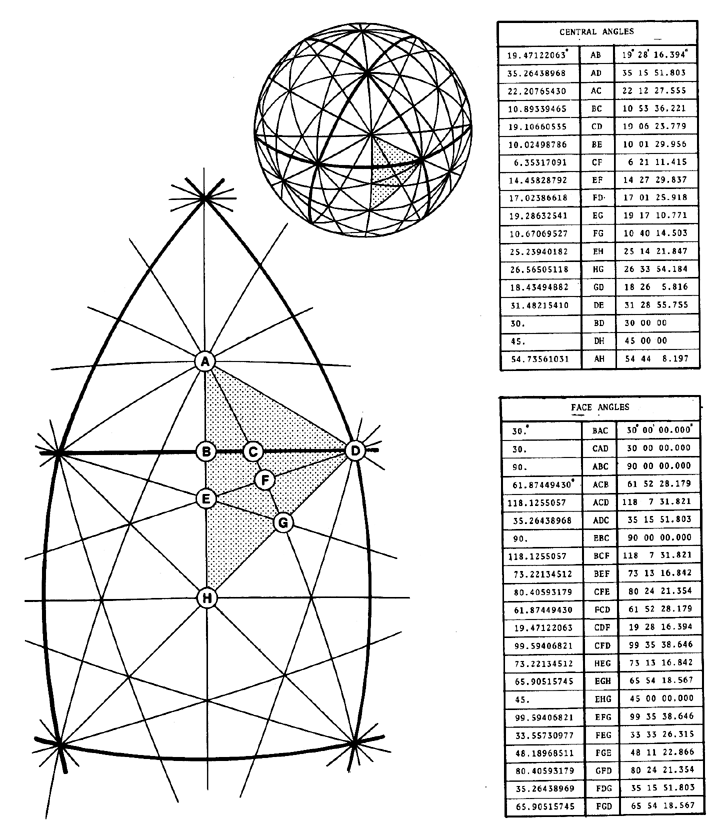
453.01
The system of 25 great circles of the vector equilibrium defines its own lowest common multiple spherical triangle, whose surface is exactly 1/48th of the entire sphere’s surface. Within each of these l/4sth-sphere triangles and their boundary arcs are contained and repeated each time all of the unique interpatterning relationships of the 25 great circles. Twenty-four of the 48 triangles’ patternings are “positive” and 24 are “negative,” i.e., mirrorimages of one another, which condition is more accurately defined as “inside out” of one another. This inside-outing of the big triangles and each of their contained triangles is experimentally demonstrable by opening any triangle at any one of its vertexes and holding one of its edges while sweeping the other two in a 360-degree circling around the fixed edge to rejoin the triangle with its previous outsideness now inside of it. This is the basic equilibrium LCD triangle; for a discussion of the basic disequilibrium LCD triangle, see Sec. 905.
Fig. 453.02 Inside-Outing of Triangle
Fig. 453.02 Inside-Outing of Triangle: This illustrates the insid-outing of a triangle, which transformation is usually misidentified as “left vs. right” or “positive and negative” or as “existence vs. annihilation” in physics. The inside-outing is four-dimensional and often complex. The insid-outing of the rubber glove explains “annihilation” and demonstrates complex into-extroverting.
Link to original
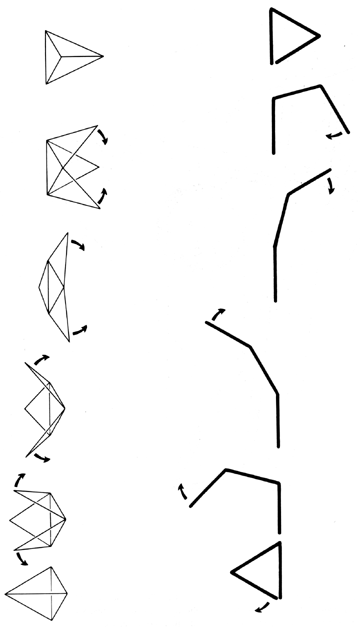
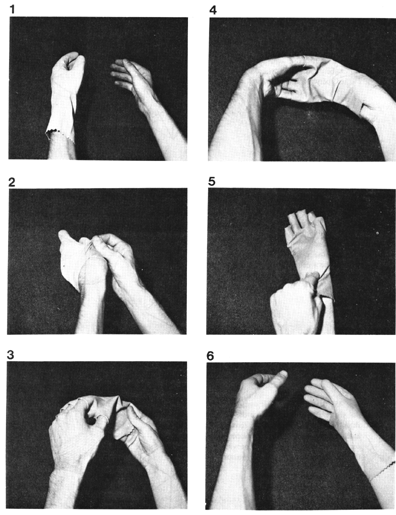
453.02
Inside-Outing of Triangle: The inside-outing transformation of a triangle is usually misidentified as “left vs. right,” or “positive and negative,” or as “existence vs. annihilation” in physics.
453.03
The inside-outing is four-dimensional and often complex. It functions as complex intro-extroverting.
454.00 Vector Equilibrium: Spherical Polyhedra Described by Great Circles
Fig. 454.01A
Fig. 454.01A The six great circles of the vector equilibrium disclose the spherical tetrahedra and the spherical cube and their chordal, flat-faceted, polyhedral counterparts.
Link to original
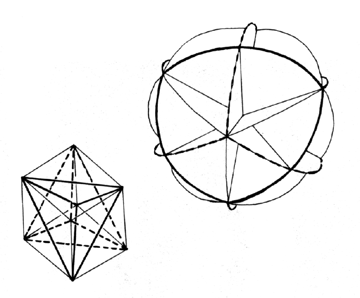
Fig. 454.01B
Fig. 454.01B The six great circles of the vector equilibrium disclose the six square faces of the spherical cube facets whose eight vertexes are centered in the areal centers of the vector equilibrium’s eight spherical triangles.
Link to original
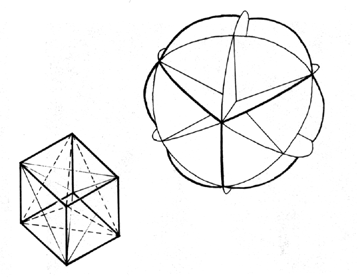
Fig. 454.01C
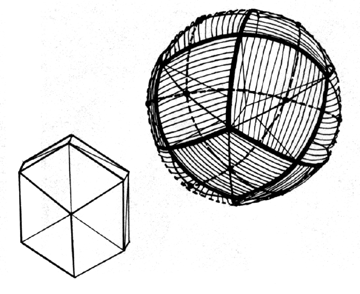
Fig. 454.01C The six great circles of the vector equilibrium disclose the 12 rhombic diamond facets (cross-hatching) of the rhombic dodecahedron, whose centers are coincident the the 12 vertexes (dots) of the vector equilibrium.
Link to original
454.01
The 25 great circles of the spherical vector equilibrium provide all the spherical edges for five spherical polyhedra: the tetrahedron, octahedron, cube, rhombic dodecahedron, and vector equilibrium, whose corresponding planar-faceted polyhedra are all volumetrically rational, even multiples of the tetrahedron. For instance, if the tetrahedron’s volume is taken as unity, the octahedron’s volume is four, the cube’s volume is three, the rhombic dodecahedron’s is six, and the vector cquilibrium’s is 20 (see drawings section).
454.02
This is the hierarchy of rational energy quanta values in synergetics, which the author discovered in his youth when he first sought for an omnirational coordinate system of Universe in equilibrium against which to measure the relative degrees of orderly asymmetries consequent to the cosmic myriad of pulsatively propagated energetic transactions and transformations of eternally conserving evolutionary events. Though almost all the involved geometries were long well known, they had always been quantized in terms of the cube as volumetric unity and its edges as linear unity; when employed in evaluating the other polyhedra, this method produced such a disarray of irrational fraction values as to imply that the other polyhedra were only side-show geometric freaks or, at best, “interesting aesthetic objets d’art.” That secondpowering exists today in academic brains only as “squaring” and thirdpowering only as cubing is manifest in any scientific blackboard discourse, as the scientists always speak of the x² they have just used as “x squared” and likewise always account x³ as “x cubed” (see drawings section).
454.03
The spherical tetrahedron is composed of four spherical triangles, each consisting of 12 basic, least-common-denominator spherical triangles of vector equilibrium.
454.04
The spherical octahedron is composed of eight spherical triangles, each consisting of six basic-vector-equilibrium, least-common-denominator triangles of the 25 great-circle, spherical-grid triangles.
454.05
The spherical cube is composed of six spherical squares with corners of 120 each, each consisting of eight basic-vector-equilibrium, leastcommon-denominator triangles of the 25 great-circle spherical-grid triangles.
454.06
Fig. 454.06 Definition of Spherical Polyhedra in 25-Great-Circle Vector Equilibrium System
Fig. 454.06 Definition of Spherical Polyhedra in 25-Great-Circle Vector Equilibrium System: The 25 great circles of the spherical vector equilibrium provide all the spherical edges for four spherical polyhedra in addition to the vector equilibrium whose edges are shown here as heavy lines. The shading indicates a typical face of each as follows:
Link to original
A. The edges of one of the spherical tetrahedron’s four spherical triangles consists of 12 VE basic LCD triangles.
B. The edges of one of the spherical octahedron’s eight spherical triangles consists of six VE basic LCD triangles.
C. The edges of one of the spherical cube’s six spherical squares consists of eight VE basic LCD triangles.
D. The edges of one of the spherical rhombic dodecahedron’s 12 spherical rhombic faces consists of four VE basic LCD triangles.
E. The edges of one of the spherical octahedron’s eight spherical triangles consists of a total area equal to six VE basic LCD triangles.
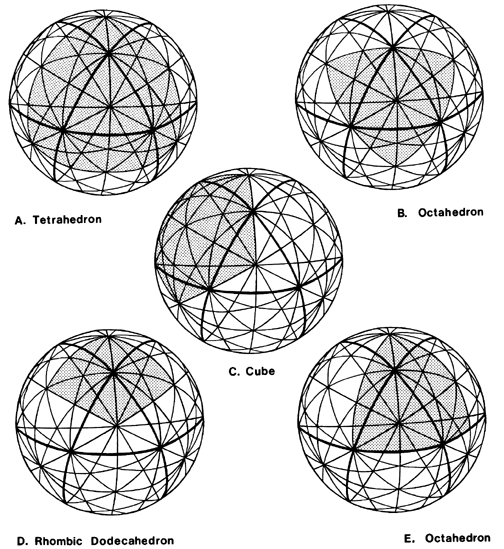
The spherical rhombic dodecahedron is composed of 12 spherical diamond- rhombic faces, each composed of four basic-vector-equilibrium, least-common- denominator triangles of the 25 great-circle, spherical-grid triangles.
455.00 Great-Circle Foldabilities of Vector Equilibrium
455.01
Foldability of Vector Equilibrium Four Great-Circle Bow Ties: All of the set of four great circles uniquely and discretely describing the vector equilibrium can be folded out of four whole (non-incised), uniformradius, circular discs of paper, each folded radially in 60-degree central angle increments, with two diametric folds, mid-circle, hinge-bent together and locked in radial congruence so that their six 60-degree arc edges form two equiangled spherical triangles, with one common radius-pairing fastened together at its external apex, that look like a bow tie. The pattern corresponds to the external arc trigonometry, with every third edgefold being brought into congruence to form great-circle-triangled openings at their top with their pointed lower ends all converging ice-cream-cone-like at the center of the whole uncut and only radially folded great circles. When the four bow ties produced by the folded circles are assembled together by radii congruence and locking of each of their four outer bow-tie corners to the outer bow-tie corners of one another, they will reestablish the original four great-circle edge lines of the vector equilibrium and will accurately define both its surface arcs and its central angles as well as locating the vector-equilibrium axes of symmetry of its three subsets of great-circle-arc-generating to produce, all told, 25 great circles of symmetry. When assembled with their counterpart foldings of a total number corresponding to the great-circle set involved, they will produce a whole sphere in which all of the original great circles are apparently restored to their completely continuing-around-the-sphere integrity.
455.02
The sum of the areas of the four great-circle discs elegantly equals the surface area of the sphere they define. The area of one circle is πr². The area of the surface of a sphere is 4πr². The area of the combined four folded great-circle planes is also 4πr² and all four great-circle planes go through the exact center of the sphere and, between them, contain no volume at all. The sphere contains the most volume with the least surface enclosure of any geometrical form. This is a cosmic limit at maximum. Here we witness the same surface with no volume at all, which qualifies the vector equilibrium as the most economic nuclear “nothingness” whose coordinate conceptuality rationally accommodates all radiational and gravitational interperturbational transformation accounting. In the four great-circle planes we witness the same surface area as that of the sphere, but containing no volume at all. This too, is cosmic limit at zero minimumness.
455.03 It is to be noted that the four great-circle planes of the vector equilibrium passing exactly through its and one another’s exact centers are parallel to the four planes of the eight tetrahedra, which they accommodate in the eight triangular bow-tie concavities of the vector equilibrium. The four planes of the tetrahedra have closed on one another to produce a tetrahedron of no volume and no size at all congruent with the sizeless center of the sphere defined by the vector equilibrium and its four hexagonally intersected planes. As four points are the minimum necessary to define the insideness and outsideness unique to all systems, four triangular facets are the minimum required to define and isolate a system from the rest of Universe.
455.04
Four is also the minimum number of great circles that may be folded into local bow ties and fastened corner-to-corner to make the whole sphere again and reestablish all the great circles without having any surfaces double or be congruent with others or without cutting into any of the circles.
455.05
These four great-circle sets of the vector equilibrium demonstrate all the shortest, most economical railroad “routes” between all the points in Universe, traveling either convexly or concavely. The physical-energy travel patterns can either follow the great-circle routes from sphere to sphere or go around in local holding patterns of figure eights on one sphere. Either is permitted and accommodated. The four great circles each go through six interspherical tangency points.
455.10
Foldability of Vector Equilibrium Six Great-Circle Bow Ties: The foldable bow ties of the six great circles of the vector equilibrium define a combination of the positive and negative spherical tetrahedrons within the spherical cube as well as of the rhombic dodecahedron.
455.11
Fig. 455.11 Folding of Great Circles into Spherical Cube or Rhombic Dodecahedron and Vector Equilibrium
Fig. 455.11 Folding of Great Circles into Spherical Cube or Rhombic Dodecahedron and Vector Equilibrium: Bow-Tie Units:
A. This six-great-circle construction defines the positive-negative spherical tetrahedrons within the cube. This also reveals a spherical rhombic dodecahedron. The circles are folded into “bow-tie” units as shown. The shaded rectangles in the upper left indicates the typical plane represented by the six great circles.
Link to original
B. The vector equilibrium is formed by four great circle folded into “bow-ties.” The sum of the areas of the four great circles equals the surface area of the sphere. (4πr²).
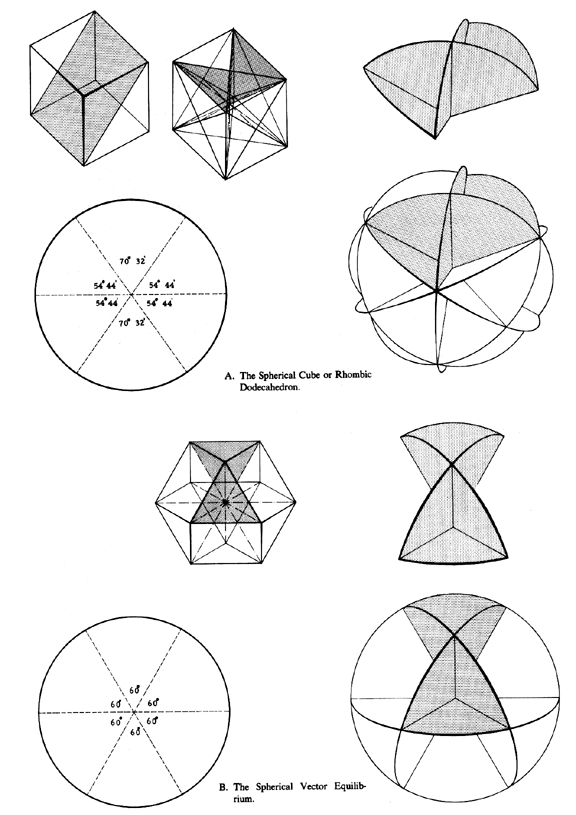
In the vector equilibrium’s six great-circle bow ties, all the internal, i.e., central angles of 70° 32’ and 54° 44’, are those of the surface angles of the vector equilibrium’s four great-circle bow ties, and vice versa. This phenomenon of turning the inside central angles outwardly and the outside surface angles inwardly, with various fractionations and additions, characterizes the progressive transformations of the vector equilibrium from one greatcircle foldable group into another, into its successive stages of the spherical cube and octahedron with all of their central and surface angles being both 90 degrees even.
455.20
Fig. 455.20
Fig. 455.20 The 10 great circles of the Icosahedron Constructed from 10 folded units (5 positive units + 5 negative units)
Link to original
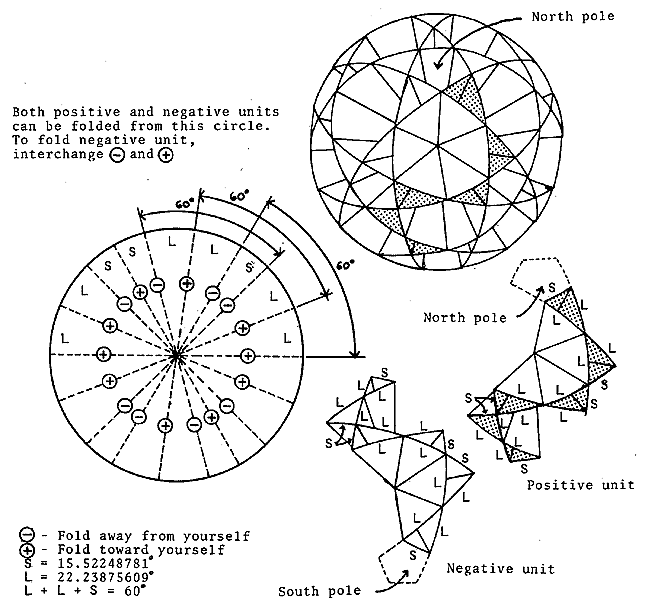
Foldability of 12 Great Circles into Vector Equilibrium: We can take a disc of paper, which is inherently of 360 degrees, and having calculated with spherical trigonometry all the surface and central angles of both the associated and separate groups of 3— 4— 6— 12 great circles of the vector equilibrium’s 25 great circles, we can lay out the spherical arcs which always subtend the central angles. The 25 great circles interfere with and in effect “bounce off” or penetrate one another in an omnitriangulated, nonredundant spherical triangle grid. Knowing the central angles, we can lay them out and describe foldable triangles in such a way that they make a plurality of tetrahedra that permit and accommodate fastening together edge-to-edge with no edge duplication or overlap. When each set, 312, of the vector equilibrium is completed, its components may be associated with one another to produce complete spheres with their respective great- circle, 360-degree integrity reestablished by their arc increment association.
455.21
The 25 folded great-circle sections join togetha to reestablish the 25 great circles. In doing so, they provide a plurality of 360-degree local and long-distance travel routes. Because each folded great circle starts off with a 360-degree disc, it maintains that 360-degree integrity when folded into the bow-tie complexes. It is characteristic of electromagnetic wave phenomena that a wave must retum upon itself, completing a 360- degree circuit. The great-circle discs folded or flat provide unitary-wave-cycle circumferential circuits. Therefore, folded or not, they act like waves coming back upon themselves in a perfect wave control. We find their precessional cyclic sdf-interferences producing angular resultants that shunt themselves into little local 360-degree, bow-tie “holding patterns.” The entire behavior is characteristic of generalized wave phenomena.
455.22
In the case of the 12 great circles of the vector equilibrium, various complex transformative, anticipatory accommodations are manifest, such as that of the 12 sets of two half-size pentagons appearing in the last, most complex great-circle set of the vector equilibrium, which anticipates the formation of 12 whole pentagons in the six great-circle set of the 31 great circles of the icosahedron into which the vector equilibrium first transforms contractively.
456.00 Transformation of Vector Equilibrium into Icosahedron
456.01
While its vertical radii are uniformly contracted from the vector equilibrium’s vertexial radii, the icosahedron’s surface is simultaneously and symmetrically askewed from the vector equilibrium’s surface symmetry. The vector equilibrium’s eight triangles do not transform, but its six square faces transform into 12 additional triangles identical to the vector equilibrium’s original eight, with five triangles cornered together at the same original 12 vertexes of the vector equilibrium.
456.02
The icosahedron’s five-triangled vertexes have odd-number-imposed, inherent interangle bisectioning, that is, extensions of the 30 great circle edges of any of the icosahedron’s 20 triangles automatically bisecting the apex angle of the adjacently intruded triangle into which it has passed. Thus extension of all the icosahedron’s 20 triangles’ 30 edges automatically bisects all of its original 60 vertexial-centered, equiangled 36-degree corners, with all the angle bisectors inherently impinging perpendicularly upon the opposite mid-edges of the icosahedron’s 20 equilateral, equiangled 72-degreecornered triangles. The bisecting great-circle extensions from each of all three of the original 20 triangles’ apexes cross inherently (as proven elsewhere in Euclidian geometry) at the areal center of those 20 original icosahedral triangles. Those perpendicular bisectors subdivide each of the original 20 equiangled triangles into six right-angled triangles, which multiplies the total surface subdivisioning into 120 “similar” right-angled triangles, 60 of which are positive and 60 of which are negative, whose corners in the spherical great-circle patterning are 90°, 60°, and 36°, respectively, and their chordally composed corresponding planar polyhedral triangles are 90, 60, and 30 degrees, respectively. There is exactly 6 degrees of “spherical excess,” as it is formally known, between the 120 spherical vs. 120 planar triangles.
456.03
This positive-negative subdivision of the whole system puts half the system into negative phase and the other half into positive phase, which discloses an exclusively external “surface” positive-negative relationship quite apart from that of the two surface polar hemispheres. This new aspect of complementarity is similar to the systematic omnicoexistence of the concave and convex non-mirror-imaged complementarity whose concavity and convexity make the 60 positive and 60 negative surface triangle subdivisions of spherical unity inherently noninterchangeable with one another when turned inside out, whereas they are interchangeable with one another by insideouting when in their planar- faceted polyhedral state.
456.04
We thus find the split-phase positive-and-negativeness of oddnumber-of- vertexial-angle systems to be inherently askewed and insideoutingly dichotomized omnisymmetries. This surface phase of dichotomization results in superficial, disorderly interpatterning complementation. This superficially disarrayed complementation is disclosed when the 15 great circles produced by extension of all 30 edges of the icosahedron’s 20 triangles are folded radially in conformity to the central interangling of the 120 triangles’ spherical arc edges.
456.05
The 15 great circles of the icosahedron interact to produce 15 “chains” of three varieties of four corner-to-corner, sausage-linked, right triangles, with four triangles in each chain. These 15 chains of 60 great-circle triangles are each interconnectible corner- to-corner to produce a total spherical surface subdivided into 120 similar spherical triangles. An experiment with 15 unique coloring differentiations of the 15 chains of three sequential varieties of four triangles each, will exactly complete the finite sphere and the 15 great-circle integrities of total spherical surface patterning, while utterly frustrating any systematically orderly surface patterning. The 15 chains’ 60 triangles’ inadvertent formation of an additional 60 similar spherical triangles occurring between them, which exactly subdivides the entire spherical surface into 120 symmetrically interpatterned triangles—despite the local surface disorder of interlinkage of the three differently colored sets of four triangles composing the 15 chains—dramatically manifests the half-positive, half-negative, always and only coexisting, universal non-mirror-imaged complementarity inherently permeating all systems, dynamic or static, despite superficial disorder, whether or not visibly discernible initially.
456.10
Icosahedron as Contraction of Vector Equilibrium: The icosahedron represents the 12-way, omniradially symmetrical, transformative, rotational contraction of the vector equilibrium. This can be seen very appropriately when we join the 12 spheres tangent to one another around a central nuclear sphere in closest packing: this gives the correspondence to the vector equilibrium with six square faces and eight triangular faces, all with 60degree internal angles. If we llad rubber bands between the points of tangency of those 12 spheres and then removed the center sphere, we would find the 12 tangent spheres contracting immediately and symmetrically into the icosahedral conformation.
456.11
The icosahedron is the vector equilibrium contracted in radius so that the vector equilibrium’s six square faces become 12 ridge-pole diamonds. The ridge-pole lengths are the same as those of the 12 radii and the 24 outside edges. With each of the former six square faces of the vector equilibrium now turned into two equiangle triangles for a total of 12, and with such new additional equiangled and equiedged triangles added to the vector equilibrium’s original eight, we now have 20 triangles and no other surface facets than the 20 triangles. Whereas the vector equilibrium had 24 edges, we now have added six more to the total polyhedral system as it transforms from the vector equilibrium into the icosahedron; the six additional ridge poles of the diamonds make a total of 30 edges of the icosahedron. This addition of six vector edge lengths is equivalent to one great circle and also to one quantum. (See Sec. 423.10.)
456.12
We picture the location of the vector equilibrium’s triangular faces in relation to the icosahedron’s triangular faces. The vector equilibrium could contract rotatively, in either positive or negative manner, with the equator going either clockwise or counterclockwise. Each contraction provides a different superposition of the vector equilibrium’s triangular faces on the icosahedron’s triangular faces. But the centers of area of the triangular faces remain coincidental and congruent. They retain their common centers of area as they rotate.
456.13
We find that the 25 great circles of the icosahedron each pass through the 12 vertexes corresponding to the 25 great circles of the vector equilibrium, which also went through the 12 vertexes, as the number of vertexes after the rotational contraction remains the same.
456.20
Single-Layer Contraction: The icosahedron, in order to contract, must be a single-layer affair. You could not have two adjacent layers of vector equilibria and then have them collapse to become the icosahedron. But take any single layer of a vector equilibrium with nothing inside it to push it outward, and it will collapse into becoming the icosahedron. If there are two layers, one inside the other, they will not roll on each other when the radius contracts. The gears block each other. So you can only have this contraction in a single layer of the vector equilibrium, and it has to be an outside layer remote from other layers.
456.21
The icosahedron has only the outer shell layer, but it may have as high a frequency as nature may require. The nuclear center is vacant.
456.22
The single-shell behavior of the icosahedron and its volume ratio of 18.63 arouses suspicions about its relation to the electron. We appear to have the electron kind of shells operating in the nucleus-free icosahedron and are therefore not frustrated from contracting in that condition.
457.00 Great Circles of Icosahedron
457.01
Three Sets of Axes of Spin: The icosahedron has three unique symmetric sets of axes of spin. It provides 20 triangular faces, 12 vertexes, and 30 edges. These three symmetrically interpatterned topological aspects— faces, vertexes, and mid-edges— provide three sets of axes of symmetric spin to generate the spherical icosahedron projection’s grid of 31 great circles.
457.02
The icosahedron has the highest number of identical and symmetric exterior triangular facets of all the symmetrical polyhedra defined by great circles.
457.10
When we interconnect the centers of area of the 20 triangular faces of the icosahedron with the centers of area of their diametrically opposite faces, we are provided with 10 axes of spin. We can spin the icosahedron on any one of these 10 axes toproduce 10 equators of spin. These axes generate the set of 10 great-circle equators of the icosahedron. We may also interconnect the midpoints of the 30 edges of the icosahedron in 15 sets of diametrically opposite pairs. These axes generate the 15 great-circle equators of the icosahedron. These two sets of 10 and 15 great circles correspond to the 25 great circles of the vector equilibrium.
457.20
Six Great Circles of Icosahedron: When we interconnect the 12 vertexes of the icosahedron in pairs of diametric opposites, we are provided with six axes of spin. These axes generate the six great-circle equators of the icosahedron. The six great circles of the icosahedron go from mid-edge to mid-edge of the icosahedron’s triangular faces, and they do not go through any of its vertexes.
457.21
The icosahedron’s set of six great circles is unique among all the seven axes of symmetry (see Sec. 1040), which include both the 25 great circles of the vector equilibrium and the 31 great circles of the icosahedron. It is the only set that goes through none of the 12 vertexes of either the vector equilibrium or the icosahedron. In assiduously and most geometrically avoiding even remote contact with any of the vertexes, they represent a new behavior of great circles.
457.22
The 12 vertexes in their “in-phase” state in the vector equilibria or in their “out-of-phase” state in the icosahedra constitute all the 12 points of possible tangency of any one sphere of a closest-packed aggregate with another sphere, and therefore these 12 points are the only ones by which energy might pass to cross over into the next spheres of closest packing, thus to travel their distance from here to there. The six great circles of the icosahedron are the only ones not to go through the potential intertangency points of the closest-packed unit radius spheres, ergo energy shunted on to the six icosahedron great circles becomes locked into local holding patterns, which is not dissimilar to the electron charge behaviors.
457.30
Fig. 457.30A Axes of Rotation of Icosahedron
Fig. 457.30A Axes of Rotation of Icosahedron:
Link to original
A. The rotation of the icosahedron on axes through midpoints of opposite edges define 15 great-circle planes.
B. The rotation of the icosahedron on axes through opposite vertexes define six equatorial great-circle planes, none of which pass through any vertexes.
C. The rotation of the icosahedron on axes through the centers of opposite faces define ten equatorial great-circle planes, which do not pass through any vertexes.
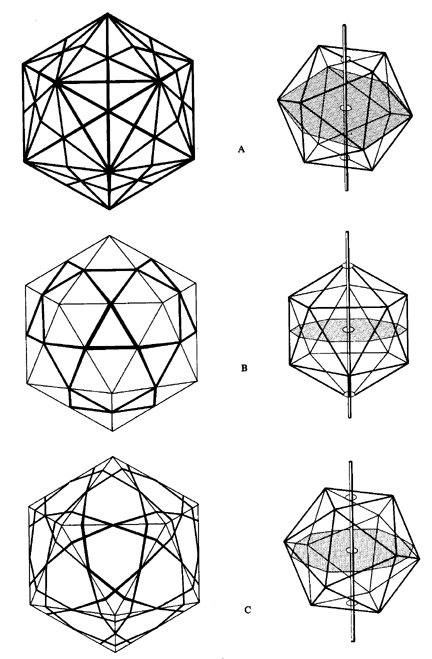
Fig. 457.30B Projection of 31 Great-Circle Planes in Icosahedron System
Fig. 457.30B
Link to original
Projection of 31 Great-Circle Planes in Icosahedron System: The complete icosahedron system of 31 great-circle planes shown with the planar icosahedron as well as true circles on a sphere (6+10+15=31). The heavy lines show the edges of the original 20-faced icosahedron.
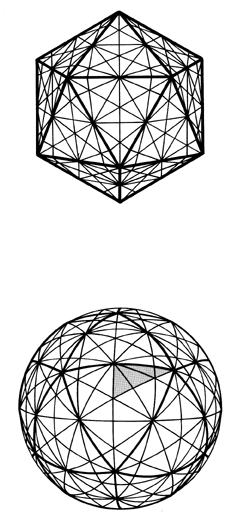
Axes of Symmetry of Icosahedron: We have now described altogether the 10 great circles generated by the 10 axes of symmetry occurring between the centers of area of the triangular faces; plus 15 axes from the midpoints of the edges; plus six axes from the vertexes. 10 + 15 + 6 = 31. There is a total of 31 great circles of the icosahedron.
457.40
Fig. 457.40 Definition of Spherical Polyhedra in 31-Great-Circle Icosahedron System
Fig. 457.40
Link to original
Definition of Spherical Polyhedra in 31-Great-Circle Icosahedron System: The 31 great circles of the spherical icosahedron provide spherical edges for three other polyhedra in addition to the icosahedron itself, whose edges are shown as heavy lines. The shading indicates a typical face, as follows:
A. The rhombic triacontahedron with 30 spherical rhombic faces, each consisting of four basic, least- common-denominator triangles.
B. The octahedron with 15 basic, least-common-denominator spherical triangles.
C. The pentagonal dodecahedron with ten basic, least-common-denominator spherical triangles.
D. Skewed spherical vector equilibrium.
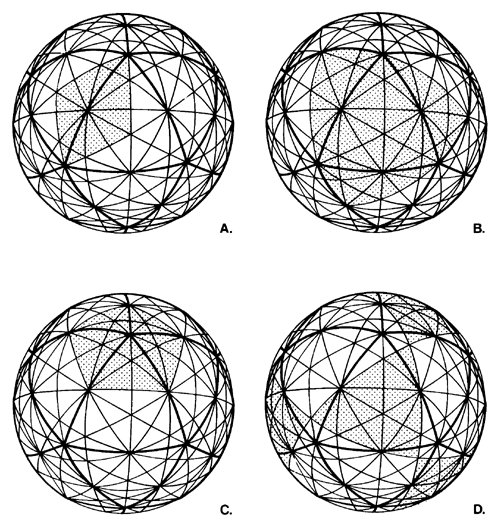
Spherical Polyhedra in Icosahedral System: The 31 great circles of the spherical icosahedron provide spherical edges for three other polyhedra in addition to the icosahedron: the rhombic triacontrahedron, the octahedron, and the pentagonal dodecahedron. The edges of the spherical icosahedron are shown in heavy lines in the illustration.
457.41
The spherical rhombic triacontrahedron is composed of 30 spherical rhombic diamond faces.
457.42
The spherical octahedron is composed of eight spherical triangles.
457.43
The spherical pentagonal dodecahedron is composed of 12 spherical pentagons.
458.00
Icosahedron: Great Circle Railroad Tracks of Energy
458.01
Whereas each of the 25 great circles of the vector equilibrium and the icosahedron goes through the 12 vertexes at least twice; and whereas the 12 vertexes are the only points of intertangency of symmetric, unit-radius spheres, one with the other,in closest packing of spheres; and inasmuch as we find that energy charges always follow the convex surfaces of systems; and inasmuch as the great circles represent the most economical, the shortest distance between points on spheres; and inasmuch as we find that energy always takes the most economical route; therefore, it is perfectly clear that energy charges passing through an aggregate of closest-packed spheres, from one to another, could and would employ only the 25 great circles as the greatcircle railroad tracks between the points of tangency of the spheres, ergo, between points in Universe. We can say, then, that the 25 great circles of the vector equilibrium represent all the possible railroad tracks of shortest energy travel through closest-packed spheres or atoms.
458.02
When the nucleus of the vector equilibrium is collapsed, or contracted, permitting the 12 vertexes to take the icosahedral conformation, the 12 points of contact of the system go out of register so that the 12 vertexes that accommodate the 25 great circles of the icosahedron no longer constitute the shortest routes of travel of the energy.
458.03
The icosahedron could not occur with a nucleus. The icosahedron, in fact, can only occur as a single shell of 12 vertexes remote from the vector equilibrium’s multi- unlimited-frequency, concentric-layer growth. Though it has the 25 great circles, the icosahedron no longer represents the travel of energy from any sphere to any tangent sphere, but it provides the most economical route between a chain of tangent icosahedra and a face-bonded icosahedral structuring of a “giant octahedron’s” three great circles, as well as for energies locked up on its surface to continue to make orbits of their own in local travel around that single sphere’s surface.
458.04
This unique behavior may relate to the fact that the volume of the icosahedron in respect to the vector equilibrium with the rational value of 20 is 18.51 and to the fact that the mass of the electron is approximately one over 18.51 in respect to the mass of the neutron. The icosahedron’s shunting of energy into local spherical orbiting, disconnecting it from the closest-packed railroad tracks of energy travel from sphere to sphere, tends to identify the icosahedron very uniquely with the electron’s unique behavior in respect to nuclei as operating in remote orbit shells.
458.05
The energy charge of the electron is easy to discharge from the surfaces of systems. Our 25 great circles could lock up a whole lot of energy to be discharged. The spark could jump over at this point. We recall the name electron coming from the Greeks rubbing of amber, which then discharged sparks. If we assume that the vertexes are points of discharge, then we see how the six great circles of the icosahedron—which never get near its own vertexes—may represent the way the residual charge will always remain bold on the surface of the-icosahedron.
458.06
Maybe the 31 great circles of the icosahedron lock up the energy charges of the electron, while the six great circles release the sparks.
458.10
Icosahedron as Local Shunting Circuit: The icosahedron makes it possible to have individuality in Universe. The vector equilibrium never pauses at equilibrium, but our consciousness is caught in the icosahedron when mind closes the switch.
458.11
The icosahedron’s function in Universe may be to throw the switch of cosmic energy into a local shunting circuit. In the icosahedron energy gets itself locked up even more by the six great circles—which may explain why electrons are borrowable and independent of the proton-neutron group.
458.12
Fig. 458.12 Folding of Great Circles into the Icosahedron System
Fig. 458.12 Folding of Great Circles into the Icosahedron System:
Link to original
A. The 15 great circles of the icosahedron folded into “multi-bow-ties” consisting of four tetrahedrons each. Four times 15 equals 60, which is 1/2 the number of triangles on the sphere. Sixty additional triangles inadvertently appear, revealing the 120 identical (although right- and left- handed) spherical triangles, which are the maximum number of like units that may be used to subdivide the sphere.
B. The six great-circle icosahedron system created from six pentagonal “bow-ties.”
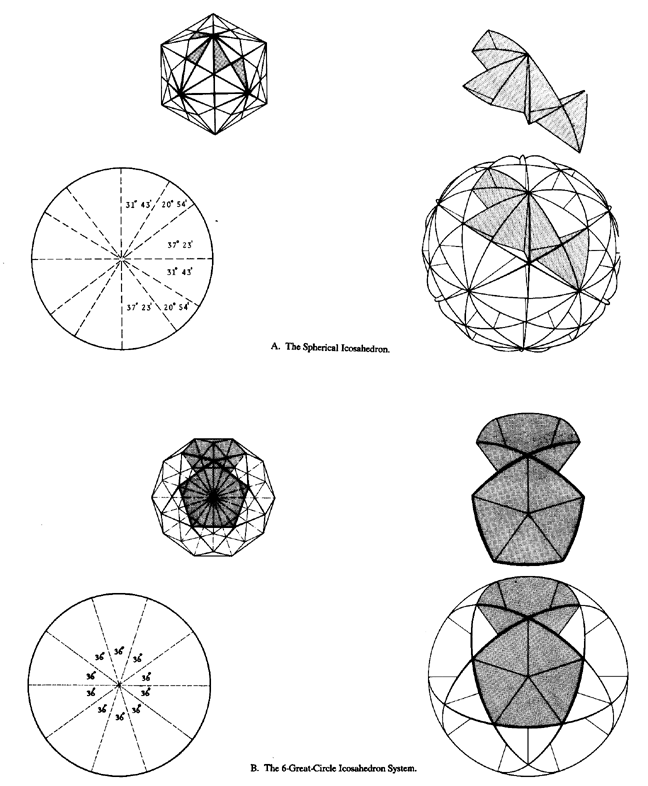
The vector-equilibrium railroad tracks are trans-Universe, but the icosahedron is a locally operative system.
459.00 Great Circle Foldabilities of Icosahedron
459.01
Fig. 459.01 Great Circle Foldabilities of Icosahedron
Link to original
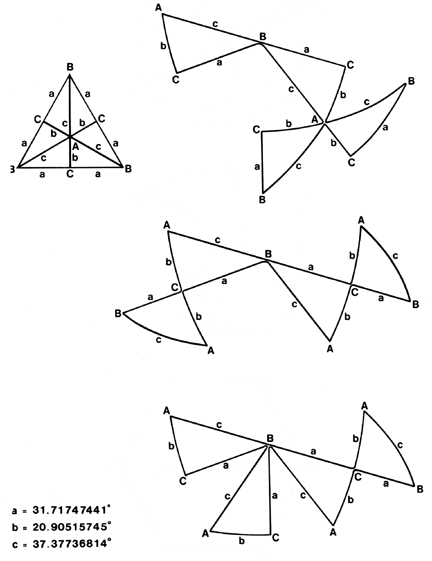
The great circles of the icosahedron can be folded out of circular discs of paper by three different methods: (a) 15 multi-bow ties of four tetrahedra each; (b) six pentagonal bow ties; and (c) 10 multi-bow ties. Each method defines certain of the surface arcs and central angles of the icosahedron’s great circle system, but all three methods taken together do not define all of the surface arcs and central angles of the icosahedron’s three sets of axis of spin.
459.02
The 15 great circles of the icosahedron can be folded into multibow ties of four tetrahedra each. Four times 15 equals 60, which is half the number of triangles on the sphere. Sixty additional triangles inadvertently appear, revealing the 120 identical spherical triangles which are the maximum number of like units which may be used to subdivide the sphere.
459.03
The six great circles of the icosahedron can be folded from central angles of 36 degrees each to form six pentagonal bow ties. (See illustration 458.12.)