511.01
A single event is integrally complex. As angles are conceptual, independent of size, events are conceptual, independent of frequency of occurrence. An “original” or “prime” energy event is conceptual. An energy event is inherently complex. It is a nuclear component, but it is not the nucleus. Nuclei—complexedly composed of prime or original energy events—are themselves “prime” and “original,” originality being inherently complex integrals. Energy transactions occur between nuclei as an extramural complex of events—as a “chemical compound.”
511.02
All energy-event experimentation discloses omnioptimally economic, behavioral patterning of physical events. Every physical event in nonsimultaneous scenario Universe is characterized by three multidimensionally interlinked vectors that interact precessionally, i.e., at angles other than 180 degrees to one another, as in the multidimensional, helically zig-zagging pattern of lightning.
511.03
There are six positive and six negative degrees of fundamental transformation freedoms, which provide 12 alternate ways in which nature can behave most economically upon each and every energy-event occurrence. You have six vectors or none for every energy event.
511.04
One set of three-vector groups corresponds to the proton (with its electron and anti-neutrino), and the other set of three-vector groups corresponds to the neutron (with its positron and neutrino). Each of these three vector teams is identified by nuclear physics as
one-half Planck’s constant; or
one-half spin; or
one-half quantum.
When we bring together these two sets of three vectors each, they integrate as six vectors and coincidentally also make one tetrahedron (of six vector edges). The tetrahedron is the veritably conceptualizable unit of one energy quantum.
511.10
Fig. 511.10 Two Triangular Energy Events Make Tetrahedron
Fig. 511.10 Two Triangular Energy Events Make Tetrahedron: The open-ended triangular spiral can be considered one “energy event” consisting of an action, reaction and resultant. Two such events (one positive and one negative) combine to form the tetrahedron.
Link to original
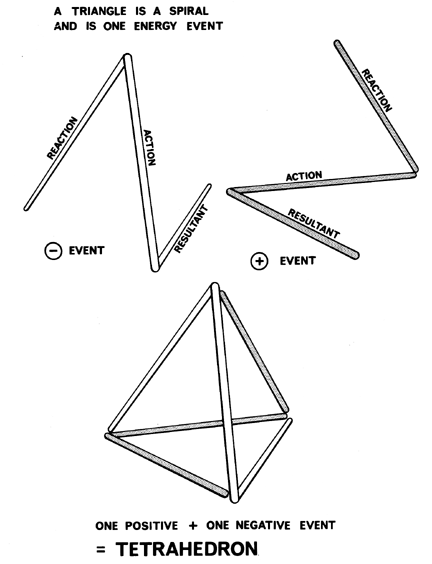
The open-ended tripartite spiral can be considered as one energy event consisting of an action, reaction, and resultant. Two such tripartite-vectored “spirals,” one negative and one positive, combine to form the tetrahedron. (See illustration 108.01.) The tripartite vector set looks like an “erected cobra” Z, that is, with two of its interlinked vector lines on the ground and one erected. One erected Z cobra erects its third vector member clockwise, and the other Z cobra erects its third vector in a counter-clockwise direction in respect to its base. (See Sec. 620.)
511.11
We find that the triangular Z cobra, is not operating in a plane because there is no such thing as a plane. Therefore, one of the legs sticks up a bit. We have a positive Z cobra and a negative Z cobra, and one cannot nest in the other. They will never be congruent with one another, but they can complement one another to become the tetrahedron. An event is a triangle. A triangle is an event. Two of them together make the tetrahedron.
511.12
Each of the three-vector, action, reaction, and resultant, minimum event Z cobras has two open ends and two internal angles. The two Z cobras have together four ends and four internal angles. We will call the open ends male and the internal angles female. We can marry the two Z cobra, half quantum events in an always consistent, orderly manner, by always having a male end interconnected with an internal female angle. When all four such marriage ceremonies have been consummated, we have produced one tetrahedron, i.e., one quantum, i.e., one prime minimum structural system of Universe. When the end of one energy action comes over the middle of another energy vector, there is a precessional effect, a tensional effect. One energy event gets angularly precessed, the next energy event goes by the center of another mass, and each one of them interaffects the other. It is a basketry interweaving, where each one precesses the other angularly so that they hold together very much as a cotton ball.
511.13
The energy event of an action, a reaction, and a resultant is inherently precessional.
511.20
Fig. 511.20 One Energy Event
Fig. 511.20 One Energy Event: Action, Reaction, and Resultant: One energy as demonstrated by the man jumping from the boat. His action demonstrates the action, reaction, and resultant of the open-ended triangular spiral.
Link to original
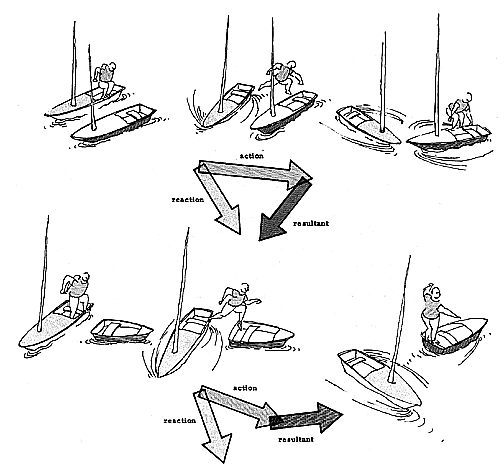
An energy event is illustrated by a diagram of a man jumping from one boat to another. At the top of the picture, a man standing in one boat jumps. He does not glide horizontally: he jumps.¹ That is, he goes outwardly from the center of Earth, and that is a vector. That is an energy action in itself. He jumps. He is the action. The action was not just horizontal, it was also vertical. It was mildly vertical in that he went outwardly. As he jumps, the boat goes into reaction and shoots off the other way. A moment later, he lands, and the second boat moves in a complex that is both horizontal and vertical. There is a reaction and a result, so there really is a four-foldedness going on. It may appear as threefolded because the man does not jump very high. We should consider it as a tetrahedron of very low altitude.
(Footnote 1: In this way, we begin to discover that force diagrams in engineering result from over-simplification.
511.21
At the outset, the boats are more or less parallel to one another. As the man jumps from the stern of the boat, it turns and whirls around, so that the reaction is following the resultant. They are not going in opposite directions. The reaction and resultant run into each other. Notice that it begins to look like a triangle, but with a vertical component, so it ends up as our friend, tetrahedron.
511.22
Engineers have been proud of pointing out that the difference between engineers and lay society is that engineers know that every action has its reaction and that lay society thinks only of the actions. Before the speed of light was measured, light seemed, to all humanity, to be instantaneous. Since we now know experientially that neither light nor any other phenomenon is instantaneous, we may conclude that an action and the vectors that it creates are neither simultaneously occurring nor instantaneous. Because vectors have discrete length, whose dimension represents the energy mass multiplied by its velocity, every action vector has two terminals—a “beginning” and an “ending” at the end of its noninstantaneous action. The beginnings and the endings are nonsimultaneously occurrent. Therefore, the “ending” terminal of an action’s vector occurs later than its “beginning.” Therefore, every action must have a reaction vector at its “beginning” terminal and a resultant vector at its “ending” terminal. The reaction vectors and the resultant vectors are never angled at 180 degrees to the action vectors. They are always angled precessionally at other than 180 degrees.