516.00 Frequency Modulation
516.01
There are only two possible covariables operative in all design in Universe: they are the modifications of angle and of frequency.
516.02
Frequency means a discrete plurality of cycles within a greater cyclic increment. An angle is an angle independent of the length of its sides. An angle is inherently a subdivision of a single cycle and is conceptually independent of linear, areal, and volumetric size considerations. A triangle is a triangle independent of size. A tetrahedron is a tetrahedron independent of size.
516.03
Fig. 516.03 Frequency
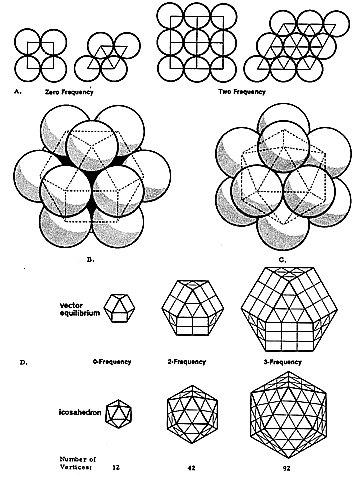
Fig. 516.03 Frequency: A square of any frequency is topologically equivalent to two adjacent triangles of corresponding frequency, i.e. a square has the same number of vertexes as two adjacent triangles (A). When the central sphere is removed from the vector equilibrium (B), it contracts symmetrically to a more compact arrangement (C), which is the icosahedron. The vector equilibrium has eight triangular faces and six square faces. The six square faces shift to become 12 triangular faces: 12+8=20 triangular faces of the icosahedron. Outer shells of the vector equilibrium and icosahedron of the same frequency will always have the same number of vertexes or spheres (D). Therefore the equation 10F2 + 2 applies to both figures.
Link to original
By designedly synchronized frequency of reoccurrence of their constituent event patternings, a machine gun’s bullets may be projected through a given point in the rotational patterning of an airplane’s propeller blades. Such purposeful synchronization of a succession of alternate occupations at a point, first by a bullet and then by a discretely angled propeller blade, and repeat, is called angle and frequency modulation; together, they avoid interferences. All physical phenomena, from the largest to the smallest, are describable as frequencies of discrete angular reoccurrence of intimately contiguous but physically discontinuous events. All physical phenomena are subject to either use or nonuse of angular- and frequency-modulating interference capabilities.