521.01
A vector manifests a unique energy event—either potential or realized—expressed discretely in terms of direction, mass, velocity, and distance. A vector is a partial generalization, being either metaphysically theoretical or physically realized, and in either sense an abstraction of a special case, as are numbers both abstract (empty sets) or special-case (filled sets).
521.02
A vector always has unique direction relative to other events. It is discrete because it has a beginning and an end. Its length represents energy magnitude, the produce of its velocity and its mass. The direction is angular in respect to the axis of reference of the observer or in respect to an omnidirectional coordinate system.
521.03
Vectors are wavilinear lines of very high frequency regeneration of events whose high frequencies and whose short wavelengths only superficially appear to be “straight.” Since neither light nor any other experiential phenomena are instantaneous. They are “linear.” If they were instantaneous, they would be less than a point. The terminal of an action’s vector occurs “later. “
521.04
Vectors are spearlike lines representing the integrated velocities, directions, and masses of the total aggregate of nonredundant forces operating complexedly within a given energy event as it transpires within a generalized environment of other experiences whose angular orientations and interdistance relationships are known.
521.05
Vectors always and only coexist with two other vectors, whether or not expressed; i.e., every event has its nonsimultaneous action, reaction, and resultant. (See Sec. 511, Energy Event.) But every event has a cosmic complementary; ergo, every vector’s action, reaction, and resultant have their cosmic tripartite complementaries.
521.06
A vector has two vertexes with angles around each of its vertexial ends equal to 0 degrees. Every vector is reversible, having its negative alternate. For every point in Universe, there are six uniquely and exclusively operative vectors. (See Sec. 537, Twelve Universal Degrees of Freedom.)
521.07
Every event is six-vectored. There are six vectors or none.
521.08
Vectors are size. The size of a vector is its overall wavilinear length.
521.09
A vector is one-twelfth of relevant system potential.
521.10 Tensors
521.101
Vectors and tensors constitute all elementary dimension. A vector represents an expelling force and a tensor an impelling force.
521.20 Lines
521.201
Pure mathematics’ axiomatic concepts of straight lines are completely invalid. Lines are vector trajectories.
521.21
The word line was nondefinable: infinite. It is the axis of intertangency of unity as plural and minimum two. Awareness begins with two. This is where epistemology comes in. The “line” becomes the axis of spin. Even two balls can exhibit both axial and circumferential degrees of freedom. (See Sec. 517.01, Sec. 537.22, and Sec. 240, Synergetics Corollaries, Subsec. 06, 13, 14, 15, 20, 21, 22, 24, 25, 26, 27, 29, 30, 31, |35, 36.)
521.22
A line is a directional experience. A line is specific like in, while out is anydirectional. Lines are always curvilinearly realized because of universal resonance, spinning, and orbiting.
521.23
A point is not a relationship. A line is the simplest relationship. Lines are relativity. A line is the first order of relativity: the basic sixness of minimum system and the cosmically constant sixness of relationship identifies lines as the relativity in the formula
521.30 Omnidirectional Force Vectors
521.30
Fig. 521.30 Omnidirectional Lines of Forces
Fig. 521.30 Omnidirectional Lines of Forces: Ships colliding on the globe after sudden acceleration reveal the inadequacy of parallelogram force diagrams for explaining the omnidirectional interaction of forces.
Link to original
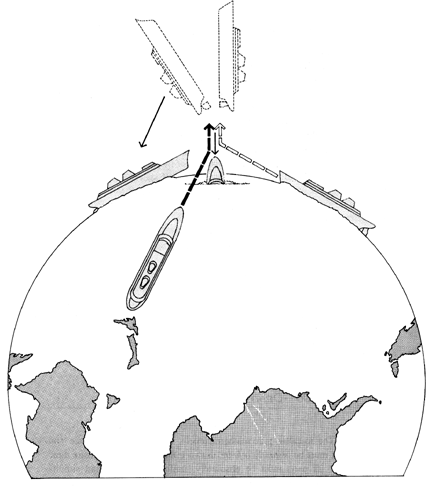
Galileo’s parallelogram of forces is inadequate to account for resultants other than in the special-case, one-plane, billiard-table situation. Force vectors must express the omnidirectional interaction of forces, with lengths proportional to their mass times the velocity, and indicating that there are unique directions in Universe.
521.31
When we vector the course of one ship on a collision course with a second ship, the resultant of forces in Galileo’s diagram would have them waltzing off together some 12 miles to the north-northeast. But all sane men can see such behavior is just what ships do not display after a collision. One of the two ships colliding on the wavy surface of spherical Earth may go a few hundred feet in the direction of Galileo’s resultant of forces, but not 12 miles. But the other one probably goes in toward the center of Earth—which isn’t in the diagram at all.
521.32
When ships run into each other, they actually first rise outwardly from Earth’s center because in acceleration both were trying to leave Earth. (If they could accelerate faster, like rockets, they would leave Earth.) In reality, there are four forces operating. Two rise outwardly against gravity, accelerating conically together before they subside, when one or both go to the bottom. In addition to the vector for each ship, there is gravity plus the resultant. We are operating omnidimensionally, and this is what the minimum set of forces is. The pattern of force lines looks very much like a music stand: three vectorial legs spread out with a fourth vertical vector. (See Secs. 621.20 and 1012.37.)