530.01
Thought discovers that we divide Universe into an “outwardness and inwardness,” so thinking is the first subdivision of Universe, because Universe, we discovered, was finite. Thinking is a nonsimultaneously recallable aggregate of inherently finite experiences and finite experience furniture—such as photons of light. One of the most important observations about our thought is the discovery that experiences are nonsimultaneous. Nonsimultaneity is a fundamental characteristic, and if experiences are nonsimultaneous, you cannot have simultaneous reconsideration.
530.02
All the words of all the vocabularies could be said to represent all the formalized attempts of men to communicate all their experiences. So we could set out to examine all the dictionaries of the world. We can pick up any one dictionary and discover that it is a nice finite package. We can open one page, but we cannot look at all the words at once. If we cannot look at all the words even on one page, we certainly cannot look at all the words of a whole dictionary at once. It does not make the dictionary infinite because we cannot look at all the words at once or think about all the words at once. The inability to think about everything at once does not mean that experience or consideration of experience is infinite. It is perplexing that one of the most persistent contemplations of human beings has been predicated on a static concept of Universe, the kind of Universe that went out with classical Newtonian mechanics. We cannot think of Universe as a fixed, static picture, which we try to do when people ask where the outwardness of Universe ends. Humans try to get a finite unit package. We have a monological propensity for the thing, the key, the building block of Universe. What we discover here is that it is not possible to think about all Universe at once. It is nonsimultaneously conceptual. This in no way mitigates against its finiteness and thinkableness.
530.03
The parents tell the child he cannot have both the Sun and the Moon in the picture at the same time. The child says that you can. The child has the ability to coordinate nonsimultaneity. The parents have lost the ability to coordinate nonsimultaneity. One of our great limitations is our tendency to look only at the static picture, the one confrontation. We want one-picture answers; we want key pictures. But we are now discovering that they are not available.
530.04
We can think about all the experiences progressively and successively. And we can coordinate our thoughts about our experiences. Our very ability to think is such a propensity for the coordination of the reconsiderations of relationships. We do not have to be simultaneous to be interconnected. We can telephone across the international date line from Sunday back to Saturday.
530.05
We have had a tendency in our thinking to say that what is finite is statically conceptual as a one-unit glimpse, so we have been seemingly frustrated in trying to understand Universe, which is an omnidirectional experience, and so we feel there ought to be an outwardness of this sphere. That is a static concept. We are not dealing with such a sphere at all, because we have all these nonsimultaneous reports, and all we have is the interconnectedness of the nonsimultaneity. One of Einstein’s most intellectual discoveries was this nonsimultaneity, which he apparently could have come upon by virtue of his experience in examining the thoughts of inventors and their patent claims regarding timekeeping devices, watches, and clocks.
530.06
The speed-of-light measurements plus Planck’s quantum mechanics and Einstein’s relativity showed that Universe is an aggregate of nonsimultaneous events. Their experiments showed that as each of the nonsimultaneous events lost their energy, they lost it to newly occurring events. Thus energy always became 100 percent accounted for.
530.07
Fig. 530.07 Simultaneous and Instant Are Nondemonstrable
Fig. 530.07 Simultaneous and Instant Are Nondemonstrable: Simultaneous and instant cannot be experimentally demonstrated.
Link to original
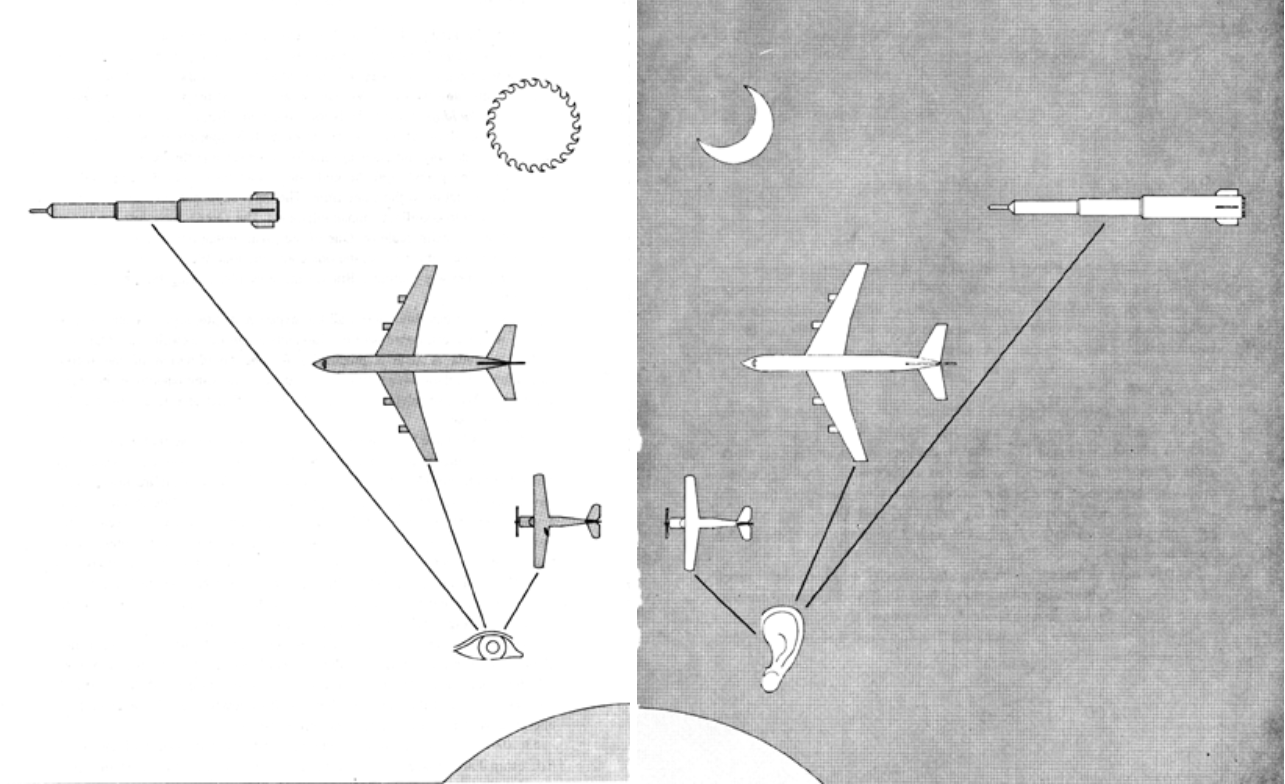
All Universe is in continual transformation. The geology of our Spaceship Earth makes it very clear how very severe have been the great transformations of history. The movement of topsoils around the surface of the Earth is very new, geologically speaking. As Einstein interpreted the speed-of-light information and the observation of the Brownian movement of the constant motion in water, he then posited a Universe in which we knew that light takes eight minutes to get to us from Sun and two and a half years to get to us from the nearest star; astronomical information shows that some of the stars we are looking at are live shows coming in from 100 years ago, others from 1,000 years ago, while the light from some of the stars we are looking at started on its way over a million years ago. With that kind of information, Einstein had to say physical Universe is quite obviously an aggregate of nonsimultaneous and only partially overlapping transformation events.
530.10 Nonsimultaneity of Scenario Universe
530.11
Any point can tune in any other point in Universe (Sec. 960.08). Between any two points in Universe there is a tetrahedral connection (see Sec. 961.30). Thus systematic connection of two points results in the interconnecting of four points. But none of the four event points of the tetrahedron are simultaneous. They are all overlappingly co- occurrent, each with different beginnings and endings. All of the atoms are independently introduced and terminaled; many are in gear—that is, synchronously tuned—but many are also way out of gear, untuned, or “noisy.”
530.12
Nouns can co-occur at the same time, but verbs cannot. Events can never be omnicongruently simultaneous, which would mean having all the component four events’ beginnings and endings always simultaneous. Events occur. Occur is a time word. The overlappingness of Scenario Universe (see Sec. 320) makes events appear simultaneous when they are not. Events are only overlappingly co-occurrent but never omnisimultaneous.
530.13
All the four unique electromagnetic frequencies of the 92 chemical elements are uniquely different, yet many are intersynchronizable in overlapping occurring alloys, whose unique sets of interattractive interrelationships produce the synergetically unique behaviors of those specific alloys.