536.01
As distinct from other mathematics, synergetics provides domains of interferences and domains of crossings. In the isotropic vector matrix, the domains of vertexes are spheres, and the domains of spheres are rhombic dodecahedra. These are all the symmetries around points. Where every vertex is the domain of a sphere we have closest-rhombic-dodecahedral-packing.
536.02
The coordinate system employed by nature uses 60 degrees instead of 90 degrees, and no lines go through points. There are 60-degree convergences even though the lines do not go through a point. The lines get into critical proximities, then twist-pass one another and there are domains of the convergences.
536.03
Fig. 536.03 Domains of Vertexes, Faces, and Edges of Systems
Fig. 536.03 Domains of Vertexes, Faces, and Edges of Systems:
Link to original
A. The domain of the vertex of a system: the domain of each vertex of the icosahedron is a pentagon whose edges connect the centers of gravity of five icosahedron face triangles. The resulting figure is the pentagonal dodecahedron.
B. The domain of the face of a system: The domain of each face of the icosahedron is the triangular face itself.
C. The domain of the edge of a system: The domain of each edge of the icosahedron is a diamond formed by connecting the vertexes of two adjacent icosahedron face triangles with their centers of gravity.
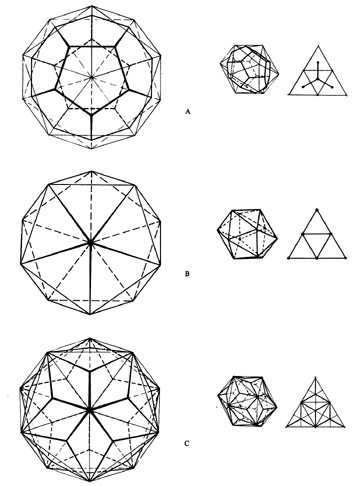
In a polyhedral system, critical-proximity-interference domains are defined by interconnecting the adjacent centers of area of all the separate superficial faces, i.e., “external areas” or “openings,” surrounding the vertex, or “crossing.” The surface domain of a surface vertex is a complex of its surrounding triangles: a hexagon, pentagon, or other triangulated polygon. (See Sec. 1006.20.)
536.10 Domains of Volumes
536.11
There are domains of the tetrahedron interfaced (triple-bonded) with domains of the octahedron. The domains of both are rationally subdivided into either A or B Modules. There is the center of volume (or gravity) of the tetrahedron and the center of volume (or gravity) of the octahedron, and the volumetric relationship around those centers of gravity is subdivisible rationally by A and B Quanta Modules⁵ in neat integer whole numbers. I can then speak of these domains quantitatively without consideration of now obsolete (superficial) face surfaces, i.e., polyhedra. Even though the cork is not in the bottle, I can speak quantitatively about the contents of the bottle. This is because it is a domain even though the edge-surrounded opening is uncorked. So we have no trouble topologically considering tensegrity mensuration. It is all open work, but its topological domains are clearly defined in terms of the centers of the systems involved having unique, centrally angled insideness and surface-angle-defined outsideness.
(Footnote 5: See Sec. 920.)
536.20 Domain of an Area
536.21
Areas do not have omnidirectional domains. The domain of an area is the area itself: it is the superficial one that man has looked at all these centuries. The domain of a face is a triangle in the simplest possible statement. Thus the domain of each face of the icosahedron is the triangular face itself.
536.30 Domain of a Line
536.31
The domains of the vector edges are defined by interconnecting the two centers of area of the two surface areas divided by the line with the ends of the line. The edge dominates an area on either side of it up to the centers of area of the areas it divides. Therefore, they become diamonds, or, omnidirectionally, octahedra. The domains of lines are two tetrahedra, not one octahedron.
536.32
The domains of lines must be two triple-bonded (face-bonded) tetrahedra or one octahedron. There could be two tetrahedra base-to-base, but they would no longer be omnisymmetrical. You can get two large spheres like Earth and Moon tangent to one another and they would seem superficially to yield to their mass attractiveness dimpling inward of themselves locally to have two cones base to base. But since spheres are really geodesics, and the simplest sphere is a tetrahedron, we would have two triangles base to base—ergo, two tetrahedra face-bonded and defined by their respective central angles around their two gravity centers.
536.33
The domain of each edge of the icosahedron is a diamond formed by connecting the vertexes of two adjacent icosahedron-face triangles with their centers of area.
536.40 Domain of a Point
536.41
Looking at a vector equilibrium as unity, it is all the domain of a point with a volume of 480.
536.42
The domains of points as vertexes of systems are tetrahedra, octahedra, or triangulated cubes. Or they could be the A and B Modules formed around the respective polyhedra.
536.43
The most complete description of the domain of a point is not a vector equilibrium but a rhombic dodecahedron, because it would have to be allspace filling and because it has the most omnidirectional symmetry. The nearest thing you could get to a sphere in relation to a point, and which would fill all space, is the rhombic dodecahedron.
536.44
A bubble is only a spherical bubble by itself. The minute you get two bubbles together, they develop a plane between them.
536.50 Domains of Actions
536.51
There are critical proximities tensionally and critical proximities compressionally—that is, there are attractive fields and repelling fields, as we learn from gravity and electromagnetics. There are domains or fields of actions. In gases under pressure, the individual molecules have unique atomic component behaviors that, when compressed, do not allow enough room for the accelerated speeds of their behavior; the crowded and accelerating force impinges upon the containing membrane to stretch that membrane into maximum volume commensurate with the restraints of its patterned dimensions.