… then, if we are not able to hunt the Good with one idea
only, with three we may catch our prey: Beauty, Symmetry,
Truth are the three…
— Plato, Philebus
542.01
This triadic concept is exclusively planar—ergo, nonexistent. What is inadvertently omitted is the observer of the planar triad, whose observer position marks the fourth corner of the tetrahedron, the minimum system.
542.02
Fig. 542.02 Tetrahedral Analysis of Plato's Triad
Fig. 542.02 Tetrahedral Analysis of Plato’s Triad: The triadic concept of Beauty, Symmetry, and Truth inadvenently omitted the function of the observer. The tetrahedron is the unique symmetrical set of minimum interrelationships.
Link to original
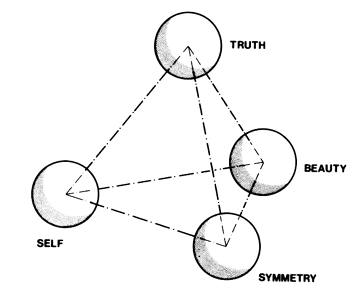
The observer-plus-the-observed, Beauty, Symmetry, and Truth are the four unique system-defining characteristics. It is possible that Plato might have approved a systematic reordering of his statement to read: The observer (as a truth) observing three other truths constitutes a system whose macro-micro-Universe-differentiating capability displays inherent symmetry and beauty—symmetry of four vertexes subtending four faces and symmetry of any two opposite pairs of its six edges precessionally subtending one another, together with the beauty of accomplishing such symmetry and Universe- differentiating with the minimum of structural system interrelationships. (See Fig. 542.02.)
542.03
The qualitative interrelationships of this beautiful and symmetrical system are expressed in the generalized formula
in which N = 4, the number of vertexes of the minimum system constituting the tetrahedron; wherefore
542.04
Beauty and symmetry are inherent and make superficially “good” the three additional interrelationships: thankfulness, maximum economy, and wisdom. They also make “good” all the remaining cases on balance—the 32 cases (Sec. 1044) of all the simplest cosmically conceptual and structurally realizable systems of Universe.
542.05
Is there a qualitative systems attribute? Can special case system events and characteristics be appraised qualitatively? My answer is that you and I are always off- center. All special case realizations of generalized principles are always aberrated realizations. Since there is no simultaneity, there is always realization lag. Consciousness is aberration. But the lags are always accompanied by experientially evolved inventions of more efficient operational means of decreasing the magnitude of tolerated errors—i.e., off-center aberrations.
542.06
Evolutingly we always acquire the means to come closer to the truth, but in all special-case temporality and its asymmetric resonance we can never reach statically concentric congruence with truth.
542.07
Quality describes the relative proximity—concentrically attained—of absolute congruence with convergently directioned, dimensionless truth.