610.01
By structure, we mean a self-stabilizing pattern. The triangle is the only self- stabilizing polygon.
610.02
By structure, we mean omnitriangulated. The triangle is the only structure. Unless it is self-regeneratively stabilized, it is not a structure.
610.03
Everything that you have ever recognized in Universe as a pattern is re- cognited as the same pattern you have seen before. Because only the triangle persists as a constant pattern, any recognized patterns are inherently recognizable only by virtue of their triangularly structured pattern integrities. Recognition is as dependent on triangulation as is original cognition. Only triangularly structured patterns are regenerative patterns. Triangular structuring is a pattern integrity itself. This is what we mean by structure.
610.10 Structural Functions
610.11
Triangulation is fundamental to structure, but it takes a plurality of positive and negative behaviors to make a structure. For example:
— always and only coexisting push and pull (compression and tension);
— always and only coexisting concave and convex;
— always and only coexisting angles and edges;
— always and only coexisting torque and countertorque;
— always and only coexisting insideness and outsideness;
— always and only coexisting axial rotation poles;
— always and only coexisting conceptuality and nonconceptuality;
— always and only coexisting temporal experience and eternal conceptuality.
610.12
If we want to have a structure, we have to have triangles. To have a structural system requires a minimum of four triangles. The tetrahedron is the simplest structure.
610.13
Every triangle has two faces: obverse and reverse. Every structural system has omni-intertriangulated division of Universe into insideness and outsideness.
610.20 Omnitriangular Symmetry: Three Prime Structural Systems
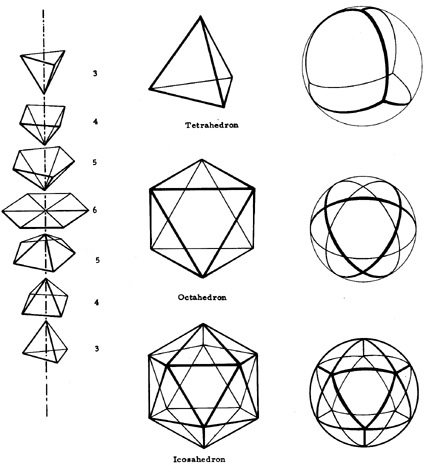
Fig. 610.20 The Three Basic Structural Systems in Nature with Three, Four or Five Triangles at Each Vertex
Fig. 610.20 The Three Basic Structural Systems in Nature with Three, Four or Five Triangles at Each Vertex: There are only three possible cases of fundamental omnisymmetrical, omnitriangulated, least-effort structural systems in nature: the tetrahedron with three triangles at each vertex, the octahedron with four triangles at each vertex, and the icosahedron with five triangles at each vertex. If there are six equilateral triangles around a vertex we cannot define a three-dimensional structural system, only a “plane.” The left column shows the minimum three triangles at a vertex forming the tetrahedron through to the six triangles at a vertex forming an “infinite plane.” The center column shows the planar polyhedra. The right column shows the same polyhedra in spherical form.
Link to original
610.21
There are three types of omnitriangular, symmetrical structural systems. We can have three triangles around each vertex; a tetrahedron. Or we can have four triangles around each vertex; the octahedron. Finally we can have five triangles around each vertex; the icosahedron. (See Secs. 532.40, 610.20, 724, 1010.20, 1011.30 and 1031.13.)
610.22
The tetrahedron, octahedron, and icosahedron are made up, respectively, of one, two, and five pairs of positively and negatively functioning open triangles.
610.23
We cannot have six symmetrical or equiangular triangles around each vertex because the angles add up to 360 degrees-thus forming an infinite edgeless plane. The system with six equiangular triangles “flat out” around each vertex never comes back upon itself. It can have no withinness or withoutness. It cannot be constructed with pairs of positively and negatively functioning open triangles. In order to have a system, it must return upon itself in all directions.
610.24
Limit Cases: Macro, Medio, and Micro: Considered geometrically, triangles are the only self-stabilizing polygonal patterns—ergo, only triangles are structurally stable. Since we cannot construct a polyhedral system of only two triangles around each corner (because a polyhedral system must by definition have an insideness and an outsideness in order definitively and closingly to separate the Universe into macrocosm and microcosm), and since we cannot have six equilateral triangles around each vertex of a polyhedral system (for each of the six would themselves separate out from the others to form flat planes and could not close back to join one another to separate Universe definitively into macrocosm and microcosm)— ergo, the tetrahedron, octahedron, and icosahedron constitute the minimum, middle, and maximum cases of omnitriangulated—ergo, stabilized—structural subdividings of Universe into macro, medio, and micro Universe divisions.
610.30 Structural Harmonics
610.31
The conceptual sequence in the left column of Fig. 610.20 illustrates the basic octave behavior of structural transformations. The first three figures—tetra, octa, icosa—represent the positive outside-out set of primitive structural systems. Three equiangular triangles around each corner add to tetra; four around each corner add to octa; five around each corner add to icosa; but six 60-degree angles around each corner add to 360 degrees; ergo, produce an infinitely extendible plane; ergo, fail to return upon themselves embracingly to produce a system’s insideness and outsideness; ergo, thus act as the zerophase of maximum evolution changing to the involution phase of maximum nothingness. As the transformation sequence changes from divergent evolution to convergent involution, from five, then four, then three equiangular triangles around each corner, it thereby produces successively the inside-out icosa, octa, and tetra, until the convergent involutional contraction attains the phase of maximum nothingness. At the minimum zero bottom of the sequence the inside-out tetra revolves outside-out to minimum somethingness of tetravolume I as the transformation diverges expansively to the maximum vector-equilibrium somethingness of tetravolume 20, thereafter attaining maximum nothingness and evolution-to-involution conversion. (See Sec. 1033.)
610.32
At six-vector hexagonality we have the vector equilibrium at maximum zero evolution-to-involution conversion.
610.33
The minimum zero tetrahedron with which the series commences repeats itself beneath the bottom figure to permit the accomplishment of octave harmony at minimum zero conversion whose terminal nothingnesses accommodate the overlapping interlinkages of the octave terminals: thus do-remi-fa-solla-ti do.
611.00 Structural Quanta
611.01
If the system’s openings are all triangulated, it is structured with minimum effort. There are only three possible omnisymmetrical, omnitriangulated, least-effort structural systems in nature. They are the tetrahedron, octahedron, and icosahedron. When their edges are all equal in length, the volumes of these three structures are, respectively, one, requiring one structural quantum; four, requiring two structural quanta; and 18.51, requiring five structural quanta. Six edge vectors equal one minimum-structural system: 6 edge vectors = 1 structural quantum.
611.02
Six edge vectors = one tetrahedron. One tetrahedron=one structural quantum.
1 Tetrahedron (volume 1) = 6 edge vectors = 1 structural quantum;
1 Octahedron (volume 4) = 12 edge vectors = 2 structural quanta;
1 Icosahedron (volume 18.51) =30 edge vectors =5 structural quanta.
Therefore:
with tetrahedron, 1 structural quantum provides 1 unit of volume;
with octahedron, 1 structural quantum provides 2 units of volume;
with icosahedron, 1 structural quantum provides 3.7 units of volume.
612.00 Subtriangulation: Icosahedron
612.01
Of the three fundamental structures, the tetrahedron contains the most surface and the most structural quanta per volume; it is therefore the strongest structure per unit of volume. On the other hand, the icosahedron provides the most volume with the least surface and least structural quanta per units of volume and, though least strong, it is structurally stable and gives therefore the most efficient volume per units of invested structural quanta.
612.10
Units of Environment Control: The tetrahedron gives one unit of environment control per structural quantum. The octahedron gives two units of environment control per structural quantum. The icosahedron gives 3.7 units of environment control per structural quantum.
612.11
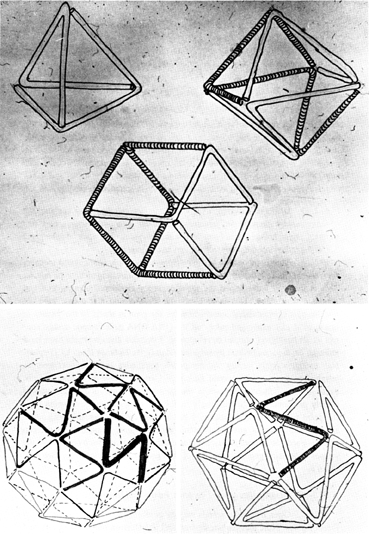
That is the reason for the employment of the triangulated icosahedron as the most efficient fundamental volume-controlling device of nature. This is the way I developed the multifrequency-modulated icosahedron and geodesic structuring. This is probably the same reason that nature used the multifrequency-modulated icosahedron for the protein shells of the viruses to house most efficiently and safely all the DNA-RNA genetic code design control of all biological species development. I decided also to obtain high local strength on the icosahedron by subtriangulating its 20 basic Icosa LCD spherical triangles with locally superimposed tetrahedra, i.e., an octahedron-tetrahedron truss, which would take highly concentrated local loads or impacts with minimum effort while the surrounding rings of triangles would swiftly distribute and diminishingly inhibit the outward waves of stress from the point of concentrated loading. I had also discovered the foregoing structural mathematics of structural quanta topology and reduced it to demonstrated geodesic dome practice before the virologists discovered that the viruses were using geodesic spheres for their protein shell structuring. (See Sec. 901.)
613.00 Triangular Spiral Events Form Polyhedra
613.01
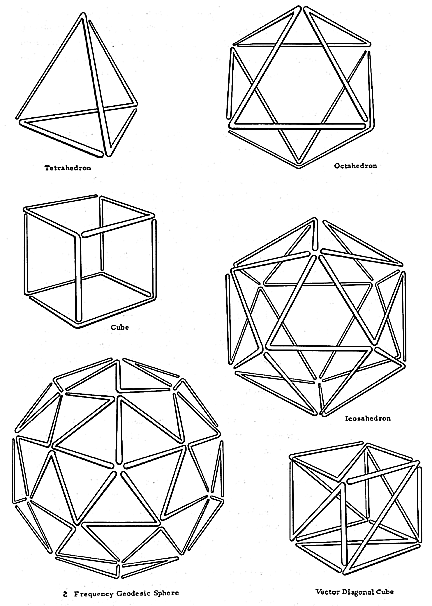
Open triangular spirals may be combined to make a variety of different figures. Note that the tetrahedron and icosahedron require both left- and right-handed (positive and negative) spirals in equal numbers, whereas the other polyhedra require spirals of only one-handedness. (See Sec. 452, Great Circle Railroad Tracks of Energy.) If the tetrahedron is considered to be one quantum, then the triangular spiral equals one-half quantum. It follows from this that the octahedron and cube are each two quanta, the icosahedron five quanta, and the two-frequency spherical geodesic is 15 quanta.
614.00 Triangle
614.01
A triangle’s three-vector parts constitute a basic event. Each triangle consists of three interlinked vectors. In the picture, we are going to add one triangle to the other. (See illustration 511.10) In conventional arithmetic, one triangle plus one triangle equals two triangles. The two triangles represent two basic events operating in Universe. But experientially triangles do not occur in planes. They are always omnidimensional positive or negative helixes. You may say that we do not have any right to break the triangles’ threesided rims open in order to add them together, but the answer is that the triangles were never closed, because no line can ever come completely back “into” or “through” itself. Two lines cannot be passed through a given point at the same time. One will be superimposed on the other. Therefore, the superimposition of one end of a triangular closure upon another end produces a spiral—a very flat spiral, indeed, but openly superimposed at each of its three corners, the opening magnitude being within the critical limit of mass attraction’s 180-degree “falling-in” effect. The triangle’s open-ended ends are within critical proximity and mass-attractively intercohered, as are each and all of the separate atoms in each of all the six separate structural members of the necklace-structure triangle. All coherent substances are “Milky Way” clouds of critically proximate atomic “stars.”
614.02
Triangles are inherently open. As one positive event and one negative event, the two triangles arrange themselves together as an interference of the two events. The actions and the resultants of each run into the actions and the resultants of the other. They always impinge at the ends of the action as two interfering events. As a tetrahedron, they are fundamental: a structural system. It is a tetrahedron. It is structural because it is omnitriangulated. It is a system because it divides Universe into an outsideness and an insideness—into a macrocosm and a microcosm.
614.03
A triangle is a triangle independent of its edge-sizing.
614.04
Each of the angles of a triangle is interstabilized. Each of the angles was originally amorphous—i.e., unstable—but they become stable because each edge of a triangle is a lever. With minimum effort, the ends of the levers control the opposite angles with a push-pull, opposite-edge vector. A triangle is the means by which each side stabilizes the opposite angle with minimum effort.
614.05
The stable structural behavior of a whole triangle, which consists of three edges and three individually and independently unstable angles (or a total of six components), is not predicted by any one or two of its angles or edges taken by themselves. A triangle (a structure) is synergetic: it is a behavior of a whole unpredicted by the behavior of any of its six parts considered only separately.
614.06
When a bright light shines on a complex of surface scratches on metal, we find the reflection of that bright light upon the scratched metal producing a complex of concentric scratch-chorded circles. In a multiplicity of omnidirectional actions in the close proximity of the viewable depth of the surfaces, structurally stable triangles are everywhere resultant to the similarly random events. That triangles are everywhere is implicit in the fact that wherever we move or view the concentric circles, they occur, and that there is always one triangle at the center of the circle. We could add the word approximately everywhere to make the everywhereness coincide with the modular- frequency characteristics of any set of random multiplicity. Because the triangles are structurally stable, each one imposes its structural rigidity upon its neighboring and otherwise unstable random events. With energy operative in the system, the dominant strength of the triangles will inherently average to equilateralness.
614.07
When we work with triangles in terms of total leverage, we find that their average, most comfortable condition is equilateral. They tend to become equilateral. Randomness of lines automatically works back to a set of interactions and a set of proximities that begin to triangulate themselves. This effect also goes on in depth and into the tetrahedra or octahedra.
615.00 Positive and Negative Triangulation of Cube and Vector Equilibrium
615.01
To be referred to as a rememberable entity, an object must be membered with structural integrity, whether maple leaf or crystal complex. To have structural integrity, it must consist entirely of triangles, which are the only complex of energy events that are self-interference-regenerating systems resulting in polygonal pattern stabilization.
615.02
A vectorial-edged cube collapses. The cube’s corner flexibility can be frustrated only by triangulation. Each of the four corners of the cube’s six faces could be structurally stabilized with small triangular gussets, of which there would be 24, with the long edge structurals acting as powerful levers against the small triangles. The complete standard stabilization of the cube can be accomplished with a minimum of six additional members in the form of six structural struts placed diagonally, corner to comer, in each of the six square faces, with four of the cube’s eight corner vertexes so interconnected. These six, end-interconnected diagonals are the six edges of a tetrahedron. The most efficiently stabilized cubical form is accomplished with the prime structural system of Universe: the tetrahedron.
615.03
Because of the structural integrity of the blackboard or paper on which they may be schematically pictured, the cubically profiled form can exist, but only as an experienceable, forms-suggesting picture, induced by lines deposited in chalk, or ink, or lead, accomplished by the sketching individual with only 12 of the compression- representing strut edge members interjoined by eight flexible vertex fastenings.
615.04
The accomplishment of experienceable, structurally stabilized cubes with a minimum of nonredundant structural components will always and only consist of one equiangled and equiedged “regular” tetrahedron on each of whose four faces are congruently superimposed asymmetrical tetrahedra, one of whose four triangular faces is equiangled and therefore congruently superimposable on each of the four faces of the regular tetrahedron; while the four asymmetrical superimposed tetrahedra’s other three triangular—and outwardly exposed—faces are all similar isosceles triangles, each with two 45-degree-angle corners and one corner of 90 degrees. Wherefore, around each of the outermost exposed corners of the asymmetrical tetrahedra, we also find three 90-degree angles which account for four of the cube’s eight corners; while the other four 90-degree surrounded corners of the cube consist of pairs of 45-degree corners of the four asymmetric tetrahedra that were superimposed upon the central regular tetrahedron to form the stabilized cube. More complex cubes that will stand structurally may be compounded by redundant strutting or tensioning triangles, but redundancies introduce microinvisible, high- and low-frequency, self-disintegrative accelerations, which will always affect structural enterprises that overlook or disregard these principles.
615.05
In short, structurally stabilized (and otherwise unstable) cubes are always and only the most simply compact aggregation of one symmetrical and four asymmetrical tetrahedra. Likewise considered, a dodecahedron may not be a cognizable entity-integrity, or be rememberable or recognizable as a regenerative entity, unless it is omnistabilized by omnitriangulation of its systematic subdivision of all Universe into either and both insideness and outsideness, with a small remainder of Universe to be discretely invested into the system-entity’s structural integrity. No energy action in Universe would bring about a blackboard-suggested pentagonal necklace, let alone 12 pentagons collected edge to edge to superficially outline a dodecahedron. The dodecahedron is a demonstrable entity only when its 12 pentagonal faces are subdivided into five triangles, each of which is formed by introducing into each pentagon five struts radiating unitedly from the pentagons’ centers to their five comer vertexes, of which vertexes the dodecahedron has 20 in all, to whose number when structurally stabilized must be added the 12 new pentagonal center vertexes. This gives the minimally, nonredundantly structural dodecahedron 32 vertexes, 60 faces, and 90 strut lines. In the same way, a structural cube has 12 triangular vertexes, 8 faces, and 18 linear struts.
615.06
The vector equilibrium may not be referred to as a stabilized structure except when six struts are inserted as diagonal triangulators in its six square faces, wherefore the topological description of the vector equilibrium always must be 12 vertexes, 20 (triangular) faces, and 30 linear struts, which is also the topological description of the icosahedron, which is exactly what the six triangulating diagonals that have hypotenusal diagonal vectors longer than the square edge vectors bring about when their greater force shrinks them to equilength with the other 24 edge struts. This interlinkage transforms the vector equilibrium’s complex symmetry of six squares and eight equiangled triangles into the simplex symmetry of the icosahedron.
615.07
Both the cube and the vector equilibrium’s flexible, necklacelike, six-square- face instabilities can be nonredundantly stabilized as structural integrity systems only by one or the other of two possible diagonals of each of their six square faces, which diagonals are not the same length as the unit vector length. The alternate diagonaling brings about positive or negative symmetry of structure. (See illustration 464.01 and 464.02 in color section.) Thus we have two alternate cubes or icosahedra, using either the red diagonal or the blue diagonal. These alternate structural symmetries constitute typical positive or negative, non-mirror-imaged intercomplementation and their systematic, alternating proclivity, which inherently propagate the gamut of frequencies uniquely characterizing the radiated entropy of all the self-regenerative chemical elements of Universe, including their inside-out, invisibly negative-Universe-provokable, split-second- observable imports of transuranium, non-self-regenerative chemical elements.
616.00 Surface Strength of Structures
616.01
The highest capability in strength of structures exists in the triangulation of the system’s enclosing structure, due to the greater action-reaction leverage distance that opposite sides of the system provide. This is what led men to hollow out their buildings.
616.02
The structural strength of the exterior triangles is not provided by the “solid” quality of the exterior shell, but by triangularly interstabilized lines of force operating within that shell. They perforate the shell with force lines. The minimum holes are triangular.
616.03
The piercing of the shells with triangular holes reduces the solid or continuous surface of second-power increase of the shells. This brings the rate of growth of structures into something nearer an overall first-power or linear rate of gain—for the force lines are only linear. (See also Sec. 412, Closest Packing of Rods: Surface Tension Capability, and Sec. 750, Unlimited Frequency of Geodesic Tensegrities.)
617.00 Cube
617.01
If the cubic form is stable, it has 18 structural lines. If a dodecahedron is stable, it has 32 vertexes, 60 faces, and 90 structural lines. (The primes 5 and, 3 show up here to produce our icosahedral friend 15.)
617.02
Whenever we refer to a stable entity, it has to be structurally valid; therefore, it has to be triangulated. This does not throw topology out.
617.03
A nonstructurally triangulated cube exists only by self-deceptive topological accounting: someone shows you a paper or sheet-metal cube and says, “Here is a structurally stable cube without any face diagonaling.” And you say, “What do you call that sheet metal or paper that is occupying the square faces without which the cube would not exist? The sheet metal or paper does diagonal the square but overdoes it redundantly.”
617.04
A blackboard drawing of a 12-line cube is only an imaginary, impossible structure that could not exist in this part of Universe. It could temporarily hold its shape in gravity-low regions of space or in another imaginary Universe. Because we are realistically interested only in this Universe, we find the cube to be theoretical only. If it is real, the linear strut cube has 12 isosceles, right-angle-apexed, triangular faces.
618.00 Dimpling Effect
618.01
Fig. 618.01
Fig. 618.01: The tetrahedron would have to turn itself completely inside out (A), and as this constitutes a complete change in the entire structure (with no localized effect in evidence) the tetrahedron clearly has the greatest resistance of any structure to externally applied concentrated load. The octahedron dimples in on itself (B), and the icosahedron (C), although dimpling locally, does reduce its volume considerably when doing so, implying that it still has good resistance to concentrated load. The geodesic spheres (D and E) exhibit “very local” dimpling as the frequency increases, suggesting much less resistance to concentrated loads but very high resistance to distributed loads
Link to original
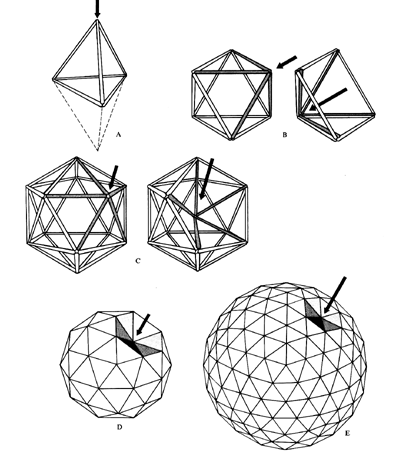
Definition: When a concentrated load is applied (toward the center) of any vertex of any triangulated system, it tends to cause a dimpling effect. As the frequency or complexity of successive structures increases, the dimpling becomes progressively more localized, and proportionately less force is required to bring it about.
618.02
To illustrate dimpling in various structures, we can visualize the tetrahedron, octahedron, and icosahedron made out of flexible steel rods with rubber joints. Being thin and flexible, they will bend and yield under pressure.
618.10
Tetrahedron: Beginning with the tetrahedron as the minimum system, it clearly will require proportionately greater force to create a “dent.” In order to dimple, the tetrahedron will have to turn itself completely inside out with no localized effect in evidence. Thus the dimpling forces a complete change in the entire structure. The tetrahedron has the greatest resistance of any structure to externally applied concentrated load. It is the only system that can turn itself inside out. Other systems can have very large dimples, but they are still local. Even a hemispherical dimple is still a dimple and still local.
618.20
Octahedron: If we apply pressure to any one of the six vertexes of the octahedron, we will find that one half will fit into the other half of the octahedron, each being the shape of a square-based Egyptian pyramid. It will nest inside itself like a football being deflated, with one half nested in the other. Although the octahedron dimples locally, it reduces its volume considerably in doing so, implying that it still has a good resistance to concentrated load.
618.30
Icosahedron: When we press on a vertex of the icosahedron, five legs out of the thirty yield in dimpling locally. There remains a major part of the space in the icosahedron that is not pushed in. If we go into higher and higher triangulation-into geodesics-the dimpling becomes more local; there will be a pentagon or hexagon of five or six vectors that will refuse to yield in tension and will pop inwardly in compression, and not necessarily at the point where the pressure is applied. (See Sec. 905.17.)