620.01
In the conceptual process of developing the disciplines for carrying on the process of consideration, the process of temporarily putting aside the irrelevancies and working more closely for the relationships between the components that are considered relevant, we find that a geometry of configuration emerges from our awareness of the minimum considered components. A minimum constellation emerges from our preoccupation with getting rid of the irrelevancies. The geometry appears out of pure conceptuality. We dismiss the irrelevancies in the search for understanding, and we finally come down to the minimum set that may form a system to divide Universe into macrocosm and microcosm, which is a set of four items of consideration. The minimum consideration is a four-star affair that is tetrahedral. Between the four stars that form the vertexes of the tetrahedron, which is the simplest system in Universe, there are six edges that constitute all the possible relationships between those four stars.
620.02
The tetrahedron occurs conceptually independent of events and independent of relative size.
620.03
By tetrahedron, we mean the minimum thinkable set that would subdivide Universe and have interconnectedness where it comes back upon itself. The four points have six interrelatednesses. There are two kinds of number systems involved: four being prime number two and six being prime number three. So there are two very important kinds of oscillating quantities numberwise, and they begin to generate all kinds of fundamentally useful mathematics. The basic structural unit of physical Universe quantation, tetrahedron has the fundamental prime number oneness.
620.04
Around any one vertex of the tetrahedron, there are three planes. Looking down on a tetrahedron from above, we see three faces and three edges. There are these three edges and three faces around any one vertex. That seems very symmetrical and nice. You say that is logical; how could it be anything else? But if we think about it some more, it may seem rather strange because we observe three faces and three edges from an inventory of four faces and six edges. They are not the same inventories. It is interesting that we come out with symmetry around each of the points out of a dissimilar inventory.
620.05
The tetrahedron is the first and simplest subdivision of Universe because it could not have an insideness and an outsideness unless it had four vertexes and six edges. There are four areal subdivisions and four interweaving vertexes or prime convergences in its six-trajectory isolation system. The vertexial set of four local-event foci coincides with the requirement of quantum mathematics for four unique quanta numbers for each uniquely considerable quantum.
620.06
Fig. 620.06 Tetrahedron as Vectorial Model of Quantum
Fig. 620.06 Tetrahedron as Vectorial Model of Quantum: The tetrahedron as a basic vectorial model is the fundamental structural system of the Universe. The open-ended triangular spiral as action, reaction, and resultant (proton, electron, and anti-neutrino; or neutron, positron, and neutrino) becomes half quantum. An association of positive and negative half-quantum units identifies the tetrahedron as one quantum.
Link to original
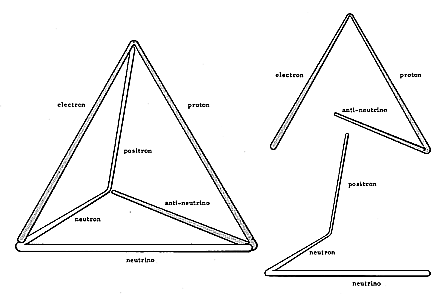
With three positive edges and three negative edges, the tetrahedron provides a vectorial quantum model in conceptual array in which the right helix corresponds to the proton set (with electron and antineutrino) and the left helix corresponds to the neutron set (with positron and neutrino). The neutron group has a fundamental leftness and the proton group has a fundamental rightness. They are not mirror images. In the tetrahedron, the two groups interact integrally. The tetrahedron is a form of energy package.
620.07
The tetrahedron is transformable, but its topological and quantum identity persists in whole units throughout all experiments with physical Universe. All of the definable structuring of Universe is tetrahedrally coordinate in rational number increments of the tetrahedron.
620.08
Organic chemistry and inorganic chemistry are both tetrahedrally coordinate. This relates to the thinking process where the fundamental configuration came out a tetrahedron. Nature’s formulations here are a very, very high frequency. Nature makes viruses in split seconds. Whatever she does has very high frequency. We come to tetrahedron as the first spontaneous aggregate of the experiences. We discover that nature is using tetrahedron in her fundamental formulation of the organic and inorganic chemistry. All structures are tetrahedrally based, and we find our thoughts resolving themselves spontaneously into the tetrahedron as it comes to the generalization of the special cases that are the physics or the chemistry.
620.09
We are at all times seeking how it can be that nature can develop viruses or billions of beautiful bubbles in the wake of a ship. How does she formulate these lovely geometries so rapidly? She must have some fundamentally pure and simple way of developing these extraordinary life cells at the rate she develops them. When we get to something as simple as finding that the tetrahedron is the minimum thinkable set that subdivides Universe and has relatedness, and that the chemist found all the structuring of nature to be tetrahedral, in some cases vertex to vertex, in others interlinked edge to edge, we find, as our thoughts go this way, that it is a very satisfying experience.
620.10
All polyhedra may be subdivided into component tetrahedra, but no tetrahedron may be subdivided into component polyhedra of less than the tetrahedron’s four faces.
620.11
The triangle is the minimum polygon and the tetrahedron is the minimum structural system, for we cannot find an enclosure of less than four sides, that is to say, of less than 720 degrees of interior- (or exterior-) angle interaction. The tetrahedron is a tetrahedron independent of its edge lengths or its relative volume. In tetrahedra of any size, the angles are always sumtotally 720 degrees.
620.12
Substituting the word tetrahedron for the number two completes my long attempt to convert all the previously unidentifiable integers of topology into geometrical conceptuality. Thus we see both the rational energy quantum of physics and the topological tetrahedron of the isotropic vector matrix rationally accounting all physical and metaphysical systems. (See Secs. 221.01 and 424.02.)
621.00 Constant Properties of the Tetrahedron
621.01
Fig. 621.01 Constant Properties of the Tetrahedron
Fig. 621.01 Constant Properties of the Tetrahedron:
Link to original
A. The area of a triangle is one-half the base times the altitude. Any arbitrary triangle will have the same area as any other triangle so long as they have a common base and altitude. Here is shown a system with two constants, A and B, and two variables_the edges of the triangle excepting A.
B. The volume of a tetrahedron is one-third the base area times the altitude. Any arbitrary tetrahedron will have a volume equal to any other tetrahedron so long as they have common base areas and common altitudes. Here is shown a system in which there are three constants, A, B, C, and five variables_all the tetrahedron edges excluding A.
C. As the tetrahedron is pulled out from the cube, the circumference around the tetrahedron remains equal when taken at the points where cube and tetrahedron edges cross; i.e. any rectangular plane taken through the regular tetrahedron will have a circumference equal to any other rectangular plane taken through the same tetrahedron, and this circumference will be twice the length of the tetrahedron edge.
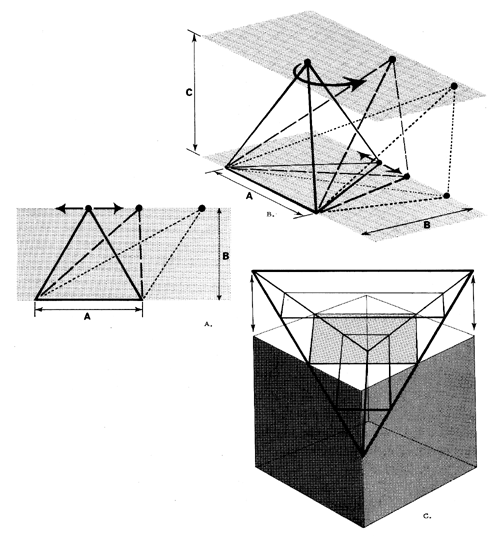
Evaluated in conventional terms of cubical unity, the volume of a tetrahedron is one-third the base area times the altitude; in synergetics, however, the volume of the tetrahedron is unity and the cube is threefold unity. Any asymmetric tetrahedron will have a volume equal to any other tetrahedron so long as they have common base areas and common altitudes. (See Sec. 923.20.)
621.02
Among geometrical systems, a tetrahedron encloses the minimum volume with the most surface, and a sphere encloses the most volume with the least surface.
621.03
A cone is simply a tetrahedron being rotated. Omnidirectional growth—which means all life—can be accommodated only by tetrahedron.
621.04
There is a minimum of four unique planes nonparallel to one another. The four planes of the tetrahedron can never be parallel to one another. So there are four unique perpendiculars to the tetrahedron’s four unique faces, and they make up a four- dimensional system.
621.05
Sixth-powering is all the perpendiculars to the 12 faces of the rhombic dodecahedron.
621.06
When we try to fill all space with regular tetrahedra, we are frustrated because the tetrahedra will not fill in the voids above the triangular-based grid pattern. But the regular tetrahedron is a complementary space filler with the octahedron. Sec. 951 describes irregular tetrahedral allspace fillers.
621.07
The tetrahedron and octahedron can be produced by multilayered closest packing of spheres. The surface shell of the icosahedron can be made of any one layer-but only one layer-of closest-packed spheres; the icosahedron refuses radial closest packing.
621.10
Fig. 621.10 Falling Sticks
Fig. 621.10 Falling Sticks: Six Vectors Provide Minimum Stability:
Link to original
A. Stick standing alone is free to fall in any direction.
B. Two sticks: free to fall in any direction.
C. Two sticks joined: free to fall in two directions and to slide apart at bases.
D. Three sticks: free to fall in any direction.
E. Three sticks joined: only free to slide apart at bases.
F. Four sticks: a propped-up triangle_the prop is free to slide out.
G. Five members: two triangles may collapse as with a hinge action.
H. Six members: complete multidimensional stability_the tetrahedron.
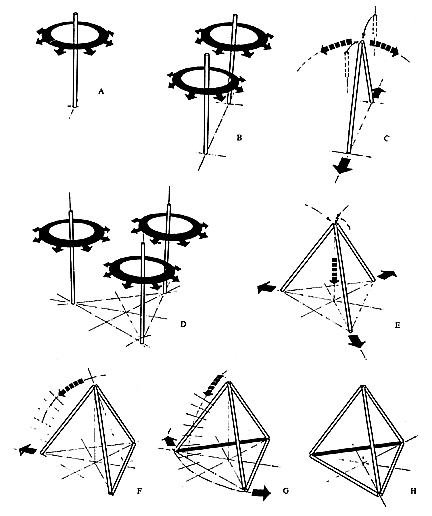
Six Vectors Provide Minimum Stability: If we have one stick standing alone on a table, it may be balanced to stand alone, but it is free to fall in any direction. The same is true of two or three such sticks. Even if the two or three sticks are connected at the top in an interference, they are only immobilized for the moment, as their feet can slide out from under them. Four or five sticks propped up as triangles are free to collapse as a hinge action. Six members are required to complete multidimensional stability—our friend tetrahedron and the six positive, six negative degrees of freedom showing up again.
621.20
Tepee-Tripod: The tepee-tripod affords the best picture of what happens locally to an assemblage of six vectors or less. The three sides of a tepee-tripod are composed first of three vertical triangles rising from a fourth ground triangle and subsequently rocking toward one another until their respective apexes and edges are congruent. The three triangles plus the one on the ground constitute a minimum system, for they have minimum “withinness.” Any one edge of our tepee acting alone, as a pole with a universal joint base, would fall over into a horizontal position. Two edges of the tepee acting alone form a triangle with the ground and act as a hinge, with no way to oppose rotation toward horizontal position except when prevented from falling by interference with a third edge pole, falling toward and into congruence with the other two poles’ common vertex. The three base feet of the three poles of the tepee-tripod would slide away outwardly from one another were it not for the ground, whose structural integrity coheres the three feet and produces three invisible chords preventing the three feet from spreading. This makes the six edges of the tetrahedron. (See Secs. 521.32 and 1012.37.)
621.30 Camera Tripod
621.31
A simple model of the effective conservation of regenerative Universe is to be had in a camera tripod which, when its legs are folded and parallel, finds the centers of gravity and mass of its three individual legs in close proximity to one another. As the legs are progressively hinged outward from one another, the respective centers of mass and gravity recede from one another. From Newton’s second law we know that as bodies increase their distance apart at an arithmetical rate, their interattractiveness decreases at a rate of the second power of the distance change—i.e., at double the distance the interattraction decreases to one-quarter intensity. Since the legs are fastened to one another at only one end (the top end), if the floor is slippery, the three bottom ends tend to slide apart at an accelerated rate.
621.32
We may think of the individual legs of the tripod as being energy vectors. The “length” of a vector equals the mass times the velocity of the force operative in given directions. We now open the equilengthed tripod legs until their bottom terminals are equidistant from one another, that distance being the same length as the uniform length of any one of the legs. Next we take three steel rods, each equal in length, mass, and structural strength to any one of the tripod legs, which renders them of equal force vector value to that of the tripod set. Next we weld the three rods together at three corner angles to form a triangle, against whose corners we will set the three bottom ends of the three downwardly and outwardly thrusting legs of the tripod. As gravity pulls the tripod Earthward, the tendency of these legs to disassociate further is powerfully arrested by the tensile integrity of the rod triangle on the ground, in which both ends of all three are joined together.
621.33
Assuming the three disassociative vectorial forces of the tripod legs to be equal to the associative vectorial force of the three-welded-together rods, we find the three-jointed closed system to be more effective than the one-jointed system. In this model the associative group in the closed triangle represents the gravity of Universe and the disassociative group—the tripod legs—represents the radiation of Universe. The whole model is the tetrahedron: the simplest structural system.
621.34
Think of the head of the camera tripod as an energy nucleus. We find that when nuclear energy becomes disassociated as radiation, it does so in a focused and limited direction unless it is intercepted and reflectively focused in a concave mirror. Radiation is inherently omnidirectional in its distribution from the nucleus outward, but it can be directionally focused. Gravity is totally embracing and convergently contractive toward all its system centers of Scenario Universe, and it cannot be focused. Like the circular waves made by an object dropped in the water, both gravitational and radiational growth-in-time patterns are concentrically arrayed; gravity convergently and contractively concentric, radiation divergently and expansively concentric. Frequency of concentricity occurrence is relative to the cyclic system considered.
622.00 Polarization of Tetrahedron
622.01
The notion that tetrahedra lack polarity is erroneous. There is a polarization of tetrahedra, but it derives only from considering a pair of tetrahedral edge vectors that do not intersect one another. The opposing vector mid-edges have a polar interrelationship.
622.10
Precessionally Polarized Symmetry: There is a polarization of tetrahedra, but only by taking a pair of opposite edges which are arrayed at 90 degrees (i.e., precessed) to one another in parallelly opposite planes; and only their midpoint edges are axially opposite and do provide a polar axis of spin symmetry of the tetrahedron. There is a fourfold symmetry aspect of the tetrahedron to be viewed as precessionally polarized symmetry. (See Sec. 416.01.)
622.20
Dynamic Equilibrium of Poles of Tetrahedron: There is a dynamic symmetry in the relationship between the mid-action, i.e., mid-edge, points of the opposing pair of polar edges of the tetrahedron. The one dot represents the positive pole of the tetrahedron at mid-action point, i.e., action center. The other dot represents the negative pole of the tetrahedron at mid-action point, i.e., at the center of negative energy of the dynamical equilibrium of the tetrahedron.
622.30
Spin Axis of Tetrahedron: The tetrahedron can be spun around its negative event axis or around its positive event axis.
623.00 Coordinate Symmetry
623.10
Cheese Tetrahedron: If we take a symmetrical polyhedron of cheese, such as a cube, and slice parallel to one of its faces, what is left over is no longer symmetrical; it is no longer a cube. Slice one face of a cheese octahedron, and what is left over is no longer symmetrical; it is no longer an octahedron. If you try slicing parallel to one of the faces of all the symmetrical geometries, i.e., all the Platonic and Archimedean “solids,” each made of cheese, what is left after the parallel slice is removed is no longer the same symmetrical polyhedron—but with one exception, the tetrahedron.
623.11
Let us take a foam rubber tetrahedron and compress on one of its four faces inward toward its opposite vertex instead of slicing it away. It remains symmetrical, but smaller. If we pull out on a second face at the same rate that we push in on the first face, the tetrahedron will remain the same size. It is still symmetrical, but the pushing of the first face made it get a little smaller, while the pulling of the second face made it get a little larger. By pushing and pulling at the same rate, it remains the same size, but its center of gravity has to move because the whole tetrahedron seems to move. As it moves, it receives one positive alteration and one negative alteration. But in moving it we have acted on only two of the tetrahedron’s four faces. We could push in on the third face at a rate different from the first couple, which is already operating; and we could pull out the fourth face at the same rate we are pushing in on the third face. We are introducing two completely different rates of change: one being very fast and the other slow; one being very hard and the other soft. We are introducing two completely different rates of change in physical energy or change in abstract metaphysical conceptuality. These completely different rates are coupled so that the tetrahedron as a medium of exchange remains both symmetrical and the same size, but it has to change its position to accommodate two alterations of the center of gravity positioning but not in the same plane or the same line. So it will be moving in a semihelix. This is another manifestation of precessional resultants.
623.12
The tetrahedron’s four faces may be identified as A, B, C, and D. Any two of these four faces can be coupled and can be paired with the other two to provide the dissimilar energy rate-of-exchange accommodation. (N² - N)/2 = the number of relationships. In this case, N = 4, therefore, (16 - 4) / 2 = 6. There are six possible couples: AB, AC, AD, BC, BD, CD, and these six couples may be interpaired in (N² - N)/2 ways; therefore, (36 - 6)/2=15; which 15 ways are:
(1) AB-AC (6) AC-AD (11) AD-BD
(2) AB-AD (7) AC-BC (12) AD-CD
(3) AB-BC (8) AC-BD (13) BC-BD
(4) AB-BD (9) AC-CD (14) BD-CD
(5) AB-CD (10) AD-BC (15) BD-CD
Thus any one tetrahedron can accommodate 15 different amplitude (A) and, or frequency (F) of interexchanging without altering the tetrahedron’s size while, however, always changing the tetrahedron’s apparent occurrence locale; therefore the number of possible alternative exchanges are three; i.e., AA, AF, FF; therefore, 3 × 15 = 45 different combinations of interface couplings and message contents can be accommodated by the same apparent unit-size tetrahedron, the only resultants of which are the 15 relocations of the tetrahedrons and the 45 different message accommodations.
623.13
Tetrahedron has the extraordinary capability of remaining symmetrically coordinate and entertaining 15 pairs of completely disparate rates of change of three different classes of energy behaviors in respect to the rest of Universe and not changing its size. As such, it becomes a universal joint to couple disparate actions in Universe. So we should not be surprised at all to find nature using such a facility and moving around Universe to accommodate all kinds of local transactions, such as coordination in the organic chemistry or in the metals. The symmetry, the fifteenness, the sixness, the foumess, and the threeness are all constants. This induced “motion,” or position displacement, may explain all apparent motion of Universe. The fifteenness is unique to the icosahedron and probably valves the 15 great circles of the icosahedron.
623.14
A tetrahedron has the strange property of coordinate symmetry, which permits local alteration without affecting the symmetrical coordination of the whole. This means it is possible to receive changes in respect to one part or direction of Universe and not in the direction of the others and still have the symmetry of the whole. In contradistinction to any other Platonic or Archimedean symmetrical “solid,” only the tetrahedron can accommodate local asymmetrical addition or subtraction without losing its cosmic symmetry. Thus the tetrahedron becomes the only exchange agent of Universe that is not itself altered by the exchange accommodation.
623.20
Size Comes to Zero: There are three different aspects of size—linear, areal, and volumetric—and each aspect has a different velocity. As you move one of the tetrahedron’s faces toward its opposite vertex, it gets smaller and smaller, with the three different velocities operative. But it always remains a tetrahedron with six edges, four vertexes, and four faces. So the symmetry is not lost and the fundamental topological aspect—its 60-degreeness—never changes. As the faces move in, they finally become congruent to the opposite vertex as all three velocities come to zero at the same time. The degreeness, the six edges, the four faces, and the symmetry were never altered because they were not variables. The only variable was size. Size alone can come to zero. The conceptuality of the other aspects never changes.
624.00 Inside-Outing of Tetrahedron
624.01
The tetrahedron is the only polyhedron, the only structural system that can be turned inside out and vice versa by one energy event.
624.02
You can make a model of a tetrahedron by taking a heavy-steel-rod triangle and running three rubber bands from the three vertexes into the center of gravity of the triangle, where they can be tied together. Hold the three rubber bands where they come together at the center of gravity. The inertia of the steel triangle will make the rubber bands stretch, and the triangle becomes a tetrahedron. Then as the rubber bands contract, the triangle will lift again. With such a triangle dangling in the air by the three stretched rubber bands, you can suddenly and swiftly plunge your hand forth and back through the relatively inert triangle … making first a positive and then a negative triangle. (In the example given in Sec. 623.20, the opposite face was pumped through the inert vertex. It can be done either way.) This kind of oscillating pump is typical of some of the atom behaviors. An atomic clock is just such an oscillation between a positive and a negative tetrahedron.
624.03
Both the positive and negative tetrahedra can locally accommodate the 45 different energy exchange couplings and message contents, making 90 such accommodations all told. These accommodations would produce 30 different “apparent” tetrahedron position shifts, whose successive movements would always involve an angular change of direction producing a helical trajectory.
624.04
The extensions of tetrahedral edges through any vertex form positive- negative tetrahedra and demonstrate the essential twoness of a system.
624.05
The tetrahedron is the minimum, convex-concave, omnitriangulated, compound curvature system, ergo, the minimum sphere. We discover that the additive twoness of the two polar (and a priori awareness) spheres at most economical minimum are two tetrahedra and that the insideness and outsideness complementary tetrahedra altogether represent the two invisible complementary twoness that balances the visible twoness of the polar pair.
624.06
When we move one of the tetrahedron’s faces beyond congruence with the opposite vertex, the tetrahedron turns inside out. An inside-out tetrahedron is conceptual and of no known size.
624.10
Inside Out by Moving One Vertex: The tetrahedron is the only polyhedron that can be turned inside out by moving one vertex within the prescribed linear restraints of the vector interconnecting that vertex with the other vertexes, i.e., without moving any of the other vertexes.
624.11
Moving one vertex of an octahedron within the vectorial-restraint limits connecting that vertex with its immediately adjacent vertexes (i.e., without moving any of the other vertexes), produces a congruence of one-half of the octahedron with the other half of the octahedron.
624.12
Moving one vertex of an icosahedron within the vectorial-constraint limits connecting that vertex with the five immediately adjacent vertexes (i.e., without moving any of the other vertexes), produces a local inward dimpling of the icosahedron. The higher the frequency of submodulating of the system, the more local the dimpling. (See Sec. 618.)
625.00 Invisible Tetrahedron
625.01
The Principle of Angular Topology (see Sec. 224) states that the sum of the angles around all the vertexes of a structural system, plus 720 degrees, equals the number of vertexes of the system multiplied by 360 degrees. The tetrahedron may be identified as the 720-degree differential between any definite local geometrical system and finite Universe. Descartes discovered the 720 degrees, but he did not call it the tetrahedron.
625.02
In the systematic accounting of synergetics angular topology, the sum of the angles around each geodesically interrelated vertex of every definite concave-convex local system is always two vertexial unities less than universal, nondefined, finite totality.
625.03
We can say that the difference between any conceptual system and total but nonsimultaneously conceptual—and therefore nonsimultaneously sensorial—scenario Universe, is always one exterior tetrahedron and one interior tetrahedron of whatever sizes may be necessary to account for the balance of all the finite quanta thus far accounted for in scenario Universe outside and inside the conceptual system considered. (See Secs. 345 and 620.12.)
625.04
Inasmuch as the difference between any conceptual system and total Universe is always two weightless, invisible tetrahedra, if our physical conceptual system is a regular equiedged tetrahedron, then its complementation may be a weightless, metaphysical tetrahedron of various edge lengths—ergo, non-mirror-imaged—yet with both the visible and the invisible tetrahedra’s corner angles each adding up to 720 degrees, respectively, though one be equiedged and the other variedged.
625.05
The two invisible and n-sized tetrahedra that complement all systems to aggregate sum totally as finite but nonsimultaneously conceptual scenario Universe are mathematically analogous to the “annihilated” left-hand phase of the rubber glove during the right hand’s occupation of the glove. The difference between the sensorial, special- case, conceptually measurable, finite, separately experienced system and the balance of nonconceptual scenario Universe is two finitely conceptual but nonsensorial tetrahedra. We can say that scenario Universe is finite because (though nonsimultaneously conceptual and considerable) it is the sum of the conceptually finite, after-image-furnished thoughts of our experience systems plus two finite but invisible, n-sized tetrahedra.
625.06
The tetrahedron can be turned inside out; it can become invisible. It can be considered as antitetrahedron. The exterior invisible complementary tetrahedron is only concave having only to embrace the convexity of the visible system and the interior invisible complementary tetrahedron is only convex to marry the concave inner surface of the system.
625.10 Macro-Micro Invisible Tetrahedra
625.11
In finite but nonunitarily conceptual Scenario Universe a minimum-system tetrahedron can be physically realized in local time-and-space Universe—i.e., as tune-in- able only within human-sense-frequency-range capabilities and only as an inherently two- in-one tetrahedron (one convex, one concave, in congruence) and only by concurrently producing two separate invisible tetrahedra, one externalized macro and one internalized micro—ergo, four tetrahedra.
625.12
The micro-tetra are congruent only in our Universe; in metaphysical Universe they are separate.
626.00 Operational Aspects of Tetrahedra
626.01
The world military forces use reinforced concrete tetrahedra for military tank impediments. This is because tetrahedra lock into available space by friction and not by fitting. They are used as the least disturbable barrier components in damming rivers temporarily shunted while constructing monolithic hydroelectric dams.
626.02
The tetrahedron’s inherent refusal to fit allows it to get ever a little closer; in not fitting additional space, it is always available to accommodate further forced intrusions. The tetrahedron’s edges and vertexes scratch and dig in and thus produce the powerfully locking-in-place frictions … while stacks of neatly fitting cubes just come apart.
626.03
This is why stone is crushed to make it less spherical and more tetrahedral. This is why beach sand is not used for cement; it is too round. Spheres disassociate; tetrahedra associate spontaneously. The limit conditions involved are the inherent geometrical limit conditions of the sphere enclosing the most volume with the least surface and the fewest angular protrusions, while the tetrahedron encloses the least volume with the most surface and does so with most extreme angular vertex protrusion of any regular geometric forms. The sphere has the least interfriction surface with other spheres and the greatest mass to restrain interfrictionally; while the tetrahedra have the most interfriction, interference surface with the least mass to restrain.