640.01
One cannot patent geometry per se nor any separately differentiated out, pure principle of nature’s operative processes. One can patent, however, the surprise complex behaviors of associated principles where the behavior of the whole is unpredicted by the behavior of the parts, i.e., synergetic phenomena. This is known as invention, a complex arrangement not found in, but permitted by, nature, though it is sometimes superficially akin to a priori natural systems, formulations, and processes. Though superficially similar in patternings to radiolaria and flies’ eyes, geodesic structuring is true invention. Radiolaria collapse when taken out of water. Flies’ eyes do not provide human- dwelling precedent or man-occupiable, environment-valving structures.
640.02
Until the introduction of geodesic structures, structural analysis and engineering-design strategies regarding clear-span structural enclosures in general, and domical structures in particular, were predicated upon the stress analysis of individual beams, columns, and cantilevers as separate components and thereafter as a solid compressional shell with no one local part receiving much, if any, aid from other parts. Their primarily compressional totality was aided here and there by tensional sinews, but tension was a discontinuous local aid and subordinate. As academically constituted in the middle of this 20th-century, engineering could in no way predict, let alone rely upon, the synergetic behaviors of geodesics in which any one, several, or many of the components could be interchangeably removed without in any way jeopardizing the structural-integrity cohering of the remaining structure. Engineering was, therefore, and as yet is, utterly unable to analyze effectively and correctly tensegrity geodesic structural spheres in which none of the compression members ever touch one another and only the tension is continuous.
640.03
It appeared and as yet appears to follow, in conventional, state-licensed structural engineering, that if tension is secondary and local in all men’s structural projections, that tension must also be secondary in man’s philosophic reasoning. As a consequence, the popular conception of airplane flight was, at first and for a long time, erroneously explained as a compressional push-up force operating under the plane’s wing. It “apparently” progressively compressed the air below it, as a ski compresses the snow into a grooved track of icy slidability. The scientific fact remains, as wind-tunnel experiments proved, that three-quarters of the airplane’s weight support is furnished by the negative lift of the partial vacuum created atop the airfoil. This is simply because, as Bernoulli showed, it is longer for the air to go around the top of the foil than under the foil, and so the same amount of air in the same amount of time had to be stretched thinner, ergo vacuously, over the top. This stretching thinner of the air, and its concomitant greater effectiveness of interpositioning of bodies (that is, the airplane in respect to Earth), is our same friend, the astro- and nucleic-tensional integrity of dynamic interpatterning causality.
640.10
Slenderness Ratio: Compression members have a limit ratio of length to section: we call it the slenderness ratio. The compression member may very readily break if it is too long. But there is no limit of cross section to length in a tension member; there is no inherent ratio.
640.11
The Greeks, who built entirely in compression, discovered that a stone column’s slenderness ratio was approximately 18 to 1, length to diameter. Modern structural-steel columns, with an integral tensional fibering unpossessed by these stone columns, have a limit slenderness ratio of approximately 33 to 1. If we have better metallurgical alloys, we can make longer and longer tension members with less and less section—apparently ad infinitum. But we cannot make longer compression columns ad infinitum.
640.12
If we try to load a slender column axially—for instance, a 36-inch-long by 1/8-inch-diameter steel rod—it tends to bend in any direction away from its neutral axis. If, however, we take a six-inch-diameter bundle of 36-inch-long by 1/8-inch-diameter rods compacted parallel to one another into a closest-packed, hexagonally cross-sectioned bundle, bind them tensionally with circumferential straps in planes at 90 degrees to the axis of the rods, around the bundle’s six-inch girth, and then cap both ends of the tightly compacted, hexagonally cross-sectioned bundle with tightly fitting, forged-steel, hexagonal caps, we will have a bundle that will act together as a column. If we now load this 36-inch-high column axially under an hydraulic press, we discover that because each rod could by itself be easily bent, but they cannot bend toward one another because closest packed, they therefore bend away from one another as well as twisting circumferentially into an ever-fattening, twisting cigar that ultimately bursts its girth-tensed bonds. So we discover that our purposeful compressing axially of the bundle column is resulting in tension being created at 90 degrees to our purposeful compressing.
640.20
Fig. 640.20 Compression Members Under Stress
Fig. 640.20 Compression Members Under Stress: A cigar shape (A) (with radials short and compact) under pressure in its long axes goes to squash shape (B) (radials long and separating) or to banana shape (C) (radials longer and collecting). Note that on the squash the stretching edge gets thinner and breaks. The cigar (D) has only one neutral axis: axial or polar exaggerated asymmetry. The sphere (E) has an infinity of equi-neutral axes: symmetry. The disc (F) has only one neutral axis: equatorially exaggerated asymmetry. Compression columns (G) tend toward axes of ever lesser radius. As columns become longer in respect to their cross section (slenderness ratio) they tend to flex and break into two shorter columns in an attempt to restore a desirable slenderness ratio.
Link to original
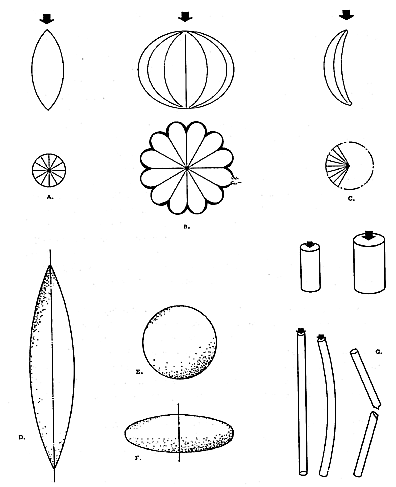
Sphere: An Island of Compression: Aiming of the compressional loading of a short column into the neutral or central-most axis of the column provides the greatest columnar resistance to the compressing because, being the neutral axis, it brings in the most mass coherence to oppose the force. To make a local and symmetrical island of compression from a short column that axial loading has progressively twisted and expanded at girth into a cigar shape, you have to load it additionally along its neutral axis until the ever-fattening cigar shape squashes into a sphere. In the spherical condition, for the first and only time, any axis of the structure is neutral—or in its most effective resistant-to-compression attitude. It is everywhere at highest compression and tension- resisting capability to withstand any forces acting upon it.
640.21
It is not surprising, in view of these properties, that ball bearings prove to be the most efficient compression members known to and ever designedly produced by man. Nor are we surprised to find all the planets and stars to be approximately spherical mass aggregations, as also are the atoms, all of which spherical islands of the macrocosmic and microcosmic aspects of scenario Universe provide the comprehensive, invisible, tensional, gravitational, electromagnetic, and amorphous integrity of Universe with complementarily balancing internality of compressionally most effective, locally and temporarily visible, islanded compressional entities. It is also not surprising, therefore, that Universe islands its spherical compression aggregates and coheres the whole exclusively with tension; discontinuous compression and continuous tension: I call this tensional integrity of Universe tensegrity.
640.30
Precession and Critical Proximity: Compressions are always local and, when axially increased beyond the column-into-cigar-into-sphere stage of optimum compression-resisting effectiveness, they tend toward edge-sinused, lozenge shapes, then into edge-fractionated discs, and thereafter into a plurality of separately and visibly identifiable entities separating inwardly in a plane at 90 degrees to the compressional forces as the previously neighboring atoms became precessionally separated from one another beyond the critical threshold between the falling-inward, massive integrity coherence proclivities of islanded “matter”—beyond that proclivity threshold of critical proximity, now to yield precessionally at 90 degrees to participate in the remotely orbiting patterns characterizing 99.99 percent of all the celestially accountable time-distance void of known Universe.
640.40
Wire Wheel: In the high- and low-tide cooperative precessional functionings of tension versus compression, I saw that there are times when each are at half tide, or equally prominent in their system relationships. I saw that the exterior of the equatorial compressional island rim-atoll of the wire wheel must be cross-sectionally in tension as also must be its hub-island’s girth. I also saw that all these tension-vs- compression patterning relationships are completely reversible, and are entirely reversed, as when we consider the compressively spoked artillery wheel vs. the tensionally spoked wire wheel. I followed through with the consideration of these differentiable, yet complementarily reversible, functions of structural systems as possibly disclosing the minimum or fundamental set of differentiability of nonredundant, precessionally regenerative structural systems. (See Sec. 537.04.)
640.41
Fig. 640.41A Stabilization of tension
Fig. 640.41A Stabilization of tension: Minimum of 12 Spokes:
Link to original
A. A solid mast without stays stands erect by itself in “solid” earth. Tension stays may be added at end of the lever arm helping against hurricane “uprooting.” Men have until now employed a compression continuity as the primary load-carrying structural system with tension employed secondarily to stabilize angular relationships.
B. The old artillery wheel provides a series of vaulting poles.
C. Pole vaulting along, a “pushing-up” load.
D. Hanging in tension like the wire wheel.
E. The wire wheel provides a series of tension clings. The axle load of the wire wheel is hung from the top of the wheel, which tries to belly out, so spokes as additional tension members are added horizontally to keep it from bellying.
F. It takes a minimum of 12 spokes to fix the hub position in relation to the rim: six positive diaphragm and six negative diaphragm, of which respectively three each are positively and negatively opposed turbining torque members.
G. Many spokes keep rim from bending outwardly any further while load is suspended by central vertical spokes successively leading from top of wheel to hub and its load.
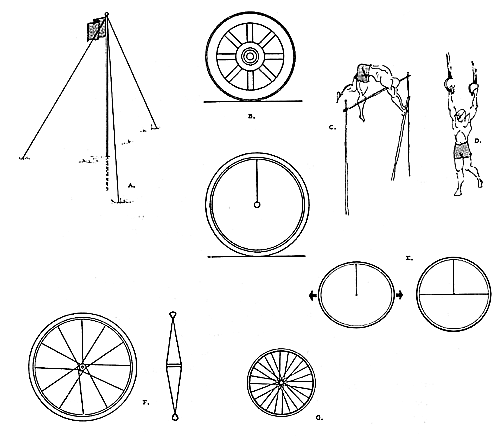
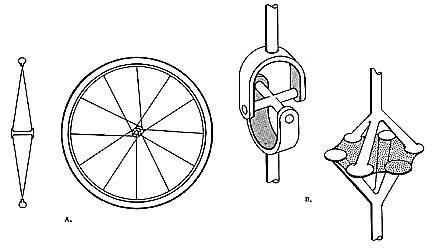
Fig. 640.41B Minimum of Twelve Spokes Oppose Torque
Fig. 640.41B Minimum of Twelve Spokes Oppose Torque: Universal Joint:
Link to original
A. It takes a minimum of 12 spokes to overcome the turbining evident with the minimum four vectors of restraint. This is demonstrated with the 12-spoke wire wheel with its six positive diaphragm and six negative diaphragm of which respectively three each are positively and negatively opposed turbining or torque members.
B. Two-axis and three-axis “universal joints,” analogous to the wire wheel as a basic system relying on the differentiation of tension and compression for its effectiveness. These all may be considered basic tensegrity systems.
As I considered the 12 unique vectors of freedom constantly and nonredundantly operative between the two poles of the wire wheel—its islanded hub and its islanded equatorial rim-atoll, in effect a Milky Way-like ring of a myriad of star islands encircling the hub in a plane perpendicular to the hub axis—I discerned that this most economic arrangement of forces might also be that minimum possible system of nature capable of displaying a stable constellar compressional discontinuity and tensional continuity. A one-island system of compression would be an inherently continuous compression system, with tension playing only a redundant and secondary part. Therefore, a one-island system may be considered only as an optically illusory “unitary” system, for, of course, at the invisible level of atomic structuring, the coherence of the myriad atomic archipelagos of the “single” pebble’s compression-island’s mass is sum-totally and only provided by comprehensively continuous tension. This fact was invisible to, and unthought of by, historical man up to yesterday. Before the discovery of this fact in mid-20th- century, there was naught to disturb, challenge, or dissolve his “solid-rock” and other “solid-things” thinking. “Solid thinking” is as yet comprehensively popular and is even dominant over the practical considerations of scientists in general, and even over the everyday logic of many otherwise elegantly self-disciplined nuclear physicists.
640.42
As I wondered whether it was now possible for man to inaugurate an era of thinking and conscious designing in terms of comprehensive tension and discontinuous compression, I saw that his structural conceptioning of the wire wheel documented his intellectual designing breakthrough into such thinking and structuring. The compressional hub of the wire wheel is clearly islanded or isolated from the compressional “atoll” comprising the rim of the wheel. The compressional islands are interpositioned in structural stability only by the tensional spokes. This is clearly a tensional integrity, where tension is primary and comprehensive and compression is secondary and local. This reverses the historical structural strategy of man. His first wire wheel had many and varied numbers of spokes. From mathematical probing of generalized principles and experimentally proven knowledge governing the tensional integrity of the wire wheel, we discover that 12 is the minimum number of spokes necessary for wire wheel stability. (See Sec. 537, Twelve Universal Degrees of Freedom.)
640.50
Mast in the Earth: In his primary regard for compressional structuring, man inserts a solid mast into a hole in the “solid” Earth and rams it in as a solid continuity of the unitary solid Earth. In order to keep the wind from getting hold of the top of the mast and breaking it when the hurricane rages, he puts tension members in the directions of the various winds acting at the ends of the levers to keep it from being pulled over. The set of tension stays is triangulated from the top of the masthead to the ground, thus taking hold of the extreme ends of the potential mast-lever at the point of highest advantage against motion. (See illustration 640.41A.) In this way, tension becomes the helper. But these tensions are secondary structuring actions. They are also secondary adjuncts in man’s solidly built, compressional-continuity ships. He puts in a solid mast and then adds tension helpers as shrouds. To man, building, Earth, and ship seemed alike, compressionally continuous. Tension has been secondary in all man’s building and compression has been primary, for he has always thought of compression as solid. Compression is that “realistic hard core” that men love to refer to, and its reality was universal, ergo comprehensive. Man must now break out of that habit and learn to play at nature’s game where tension is primary and where tension explains the coherence of the whole. Compression is convenient, very convenient, but always secondary and discontinuous.
640.60
Tensed Rope: There is a unique difference in the behaviors of tension and compression. When we take a coil of rope of twisted hemp and pull its ends away from one another, it both uncoils along its whole length and untwists locally in its body. This is to say that a tensed rope or tensed object tends to open its arcs of local curvation into arcs of ever greater radius. But we find that the rope never attains complete straightness either of its whole length or of its separate local fibers or threads. Ropes are complexes of spirals. Tensed mediums tend to a decreasing plurality of arcs, each of the remainder continually tending to greater radius but never attaining absolute straightness, being always affected in their overall length by other forces operating upon them. We see that tension members keep doing bigger and bigger arc tasks. The big patterns of Universe are large-radius patterns, and the small patterns are small-radius patterns. Compressed columns tend to spiral-arc complexes of ever-increasing radius. So we find the compression complexes tend to do the small local structural tasks in Universe, and the tension complexes tend to do the large structural tasks in Universe. As tension accounts for the large patternings and pattern integrities, compression trends into locally small pattern integrities.
641.00 High Tide and Low Tide
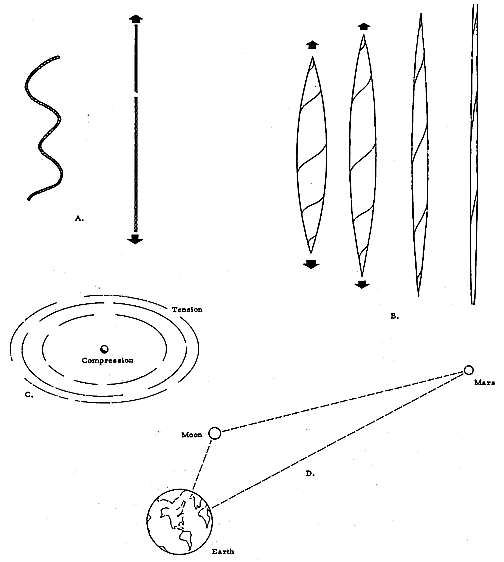
Fig. 641.01 Tension Members Tend Toward Arcs of Ever Greater Radius
Fig. 641.01 Tension Members Tend Toward Arcs of Ever Greater Radius:
Link to original
A. Slack rope and tensed rope: tensed rope tends toward “straight,” i.e. toward arcs of ever greater radius, but never attains complete “straightness.”
B. As tension increases: neutral axis lengthens and girth contracts (becomes more compact). Therefore, the long-dimension profile arcs increase in radius and spiral arcs’ “radii” increase in dimensions but never attain “straightness” of relation between two “fixed” points, as there are no experiences of fixed points and straight points.
C. Tension goes toward arcing of larger and fewer different radii all ultimately spirally closing back on self. Tension: inherently comprehensive and finite. Compression goes toward relatively smaller radius and toward more of smaller and multiplying microcosmic differentiation. Compression: inherently local and infinite.
D. Tension as gravity: a tension structure is nature’s fundamental pattern-cohering principle.
641.01
No tension member is innocent of compression, and no compression member is innocent of tension. That is, when we are tensing a rope visibly and axially, its girth contracts as it goes untwistingly into compression, precessionally, compressing in planes at 90 degrees to the axis of our purposeful tensing. We learn experimentally that tension and compression always and only coexist and operate precessionally at right angles to one another, covarying in such a way that one is ebbing toward low tide while the other is flowing toward high tide, or vice versa, in respect to relative human apprehendability, as they fluctuate between visibly obvious and human subvisibility.
641.02
Tension and compression are inseparable and coordinate functions of structural systems, but one may be at its “high tide” aspect, i.e., most prominent phase, while the other is at low tide, or least prominent aspect. The visibly tensioned rope is compressively contracted in almost invisible increments of its girth dimensions everywhere along its length. This low-tide aspect of compression occurs in planes perpendicular to its tensed axis. Columns visibly loaded by weights applied only to their top ends are easily seen to have their vertical axes in compression, but invisibly the horizontal girths of these columns are also in tension as the result of a cigar-shaped, swelling pattern of forces acting in the column at right angles to its loaded axis, which tends, invisibly, to transform toward the shape of a squash or a banana. As a result of the visible, or high-tide, vertical compressioning aspect of such axial loading of the column’s system, this swelling force imperceptibly stretches, or tenses, the column’s girth as a low-tide reciprocal function of the overall structural-integrity reciprocity.
642.00 Functions
642.01
Functions are never independent of one another. There is a plurality of coexistent behaviors in nature; these are the complementary behaviors. Functions occur only as inherently cooperative and accommodatively varying subaspects of synergetically transforming wholes. Functions are covariants. Wave magnitude and frequency are experimentally interlocked as covarying cofunctions, and both are experimentally gear- locked with energy quanta. The meaning of a function is that it is part of a complementary pattern. No function exists by itself: X only in respect to Y. Tension and compression are always and only interfunctioning covariables whose seeming relative importance is a consequence of local pattern inspection. Multiplication is accomplished only by division. Universe expands through progressively differentiating out or multiplying discrete considerations.
642.10 Tetrahedral Models of Functions
642.11
Covarying functions are tetrahedrally modelable. A series of covarying tetrahedral models is presented in Secs. 961.10-48.
643.00 Tension and Compression: Summary
| Compression is IN. | Tension is OUT. |
| Compression is dispersive both laterally and circumferentially, inherently electrostatic because differentiative, divisive, temporary, and local. | Tension is omniradially conversive and is both electromagnetically and gravitationally tensive because eternally and integrally comprehensive. |
| Compression tends to local dichotomy and multiplication by separation. | Tension is unit: universally cohering and comprehensively finite. |
| Compression is locally expressive in discrete tones and frequencies internal to the octave. | Tension is both internal and external to the octave and is harmonic with either the unit octave or octave pluralities. |
| Compression accumulates potential. As demonstrated in the arch, compression is limited to absolute, local, and within-law relationships of one fixed system. | Tension is comprehensive, attractive, and gravitational. Tension is inherently integral and eternally, invisibly, infinitely comprehensive. Tension is comprehensively without law. |
| Compression tends toward arcs of decreasing radius. | Tension tends toward arcs of increasing radius. |
| Compressions are plural. | Tension is singular. |
| Compression is time. | Tension is eternity. |
| Compression is specifically directional. | Tension is both omni- and supra- directional. |
| Compression is inherently partial. | Tension is inherently total. |
644.00 Limitless Ratios of Tension
644.01
I adopted as a working hypothesis that there is a limit to slenderness ratio of the girth diameter of a compression member in respect to its longitudinal axis and that there is no limit to the slenderness ratio of structures dominated by tensional components. Astronomical magnitudes of structural-system coherence are accomplished by tensionally dominated structural functions of zero slenderness ratio, i.e., by gravitational functioning. Compressionally dominated structural components tend toward contour transformation in which the radius of curvature steadily decreases under axial loading, that is, the cigar- shaped column forces tend toward squash- or bananalike bending of their contours. This tending of compressionally loaded systems toward arcs of lessening radius is in direct contrast to the contour transformation tending of tensionally dominated structural components, which always tend toward arcs of ever-increasing radius of axial profile. For instance, the coil of rope tends toward straightening out when terminally tensed, but it never attains absolute straightness; instead, it progresses toward ever-greater radius of locally spiraling but overall orbital arcing, which must eventually cycle back upon itself. Tensionally dominated patterning is inevitably self-closing and finite.
644.02
Compressionally dominated functions of structural systems are inherently self-diminutive in overall aspect. Tensionally dominated functions of structural systems are inherently self-enlarging in overall involvement. The sum of all the interactive-force relationships of Universe must continually accelerate their intertransforming in such a manner as to result in ever more remotely and locally multiplied, islanded, compressional functions—comprehensively cohered by ever-enlarging finite patternings of the tensional functions. Universe must be a comprehensively finite integrity, permitting only a locally islanded infinitude of observer-considered and regenerated-differentialing discovery. We have herein discovered a workable man-awareness of a complete reversal of presently accepted cosmology and of general a priori conceptioning regarding the general patterning scheme of Universe, which has heretofore always conceived only of locally finite experiences as omnidirectionally surrounded by seemingly unthinkable infinity.
645.00 Gravity
645.01
The ratio of length to section in tension appears to be limitless. I once wondered whether it was a nonsensical question that we might be trending toward bridges that have infinite length with no section dimension at all. As a sailor, I looked spontaneously into the sky for indicated clues. I observed that the solar system, which is the most reliable structure that we know of, is so constituted that Earth does not roll around Mars as would ball bearings, which is to say that the compressional components of celestial structures are astro-islands, spatially remote from one another, each shaped in the most ideal conformation for highest compressional-structure effectiveness, which is the approximately spherical shape. All other spheroidal shapes (cigar, turnip, egg, potato, spider) have only one most neutral axis. This is why spherical ball bearings are the ideal compressional-system structures of man’s devising, as they continually shift their loads while distributing the energetic effects to the most parts in equal, ergo relatively minuscule, shares in the shortest time. I saw that the astro-islands of compression of the solar system are continuously controlled in their progressive repositioning in respect to one another by comprehensive tension of the system. This is what Newton called gravity. The effective coherence between island-components varies in respect to their relative proximities and masses, in ratio gains and losses of the second power in respect to the dimensional distance as stated in terms of the radius of one of the component bodies involved.
645.02
Throughout the Universe, we find that tension and compression are energetically and complementarily interactive. A steel wire of ever stronger metallic alloys can span ever greater distances. In this kind of patterning, we find that the nonsimultaneous structural integrities of Universe are arranged by the tensional coherences. As thinner and thinner wire can span ever greater and greater distances, visible cross section of the tension members trends toward ever lesser and lesser diameters.
645.03
Finally, because there is no limit ratio in tension, may we not get to where we have very great lengths and no section at all? We find this is just the way Universe is playing the game. This is demonstrated astronomically because it is just the way the Earth and the Moon are invisibly cohered … remotely cohered and coordinated, noncontiguous, nontangent, physical entities with their respective coherence decreasing at a second-power rate of their relative remoteness multiplied by their combined masses. It is the way the solar system coheres.
645.04
The gravitational, mass-attractive cohering is noncontiguous, and so there is no cross-sectional diameter or identifiable local entity. This is why tension and coherence are able to approach larger and larger magnitudes while working toward no cross section at all: for there never was any cross section in the adjacent atoms. You have enormous tension with no section at all. This is also true in the atoms: true in the macrocosm and true in the microcosm. The same relative distance intervenes as between the Earth and the Moon in respect to their relative masses. The only surprise here is that man has been so superficially misled into ever having thought that there could be solids or continuous compressional or tensional structural members. Only man’s mentality has been wrong in trying to organize the idea of structure.
645.05
The trends are to increasing amplification of tension to infinite length with no section. Every use of gravity is a use of such sectionless tensioning. The electric tension first employed by man to pull energy through the nonferrous conductors and later to close the wireless circuit was none other than such universally available sectionless tension. In the phenomenon tension, man is in principle given access to unlimited performance. It seems fantastic, but there it is!
645.10
Tension is shown experientially to be nondimensional, omnipresent, finitely accountable, continuous, comprehensive, ergo timeless, ergo eternal. Comprehensive Universe is amorphous and only locally finite as it transformingly differentiates into serially conceptual pattern integrities, some much larger than humanly apprehendable, some much smaller than humanly apprehendable, ever occurring in nonsimultaneous sets of human observings, most of whose time-canceling, harmonically integrative synchronizations are supra- or subhuman sensibility and longevity experienceability and whose periodicities are therefore so preponderantly unexpected as to induce human reaction of overwhelming disorder, so that … suddenly, around comes the comet again, for the first known time in humanly recorded experience, periodically closing the gap and periodically pulsing through eternally normal zero.
645.11
In our old ways of thinking, infinity was expressible numerically as N + 1. We tried to get a static picture of a sphere, but we could not understand one more layer beyond it and what was beyond that—in order for it to be something.
645.12
In the nonsimultaneous experiencing of Universe, there is no simultaneous “one frame.” We are not faced with that at all. We get to the finite physical world of the physicist and then to the local compressionals and we find that the local is continually subdivisible. We started with a whole that was finite and then began to subdivide it. So there is, in a sense, an infinity of subdivisions locally. This is very much the way the intellectual pattern goes, so that the only thing you might call infinity here is the further subdivision of finity. So it is really never infinite because you are not looking at one part. It is never just Plus One. It is always plus the rest of Universe when you separate that One out. You can separate unity up further and further. You can multiply the subdivisions of unity.
646.00 Chemical Bonds
646.01
While tension and compression always and only coexist, their respective structural behaviors differ greatly. Structural columns function most predominantly in compression of inherent limit of length to cross section, whereas tension cables or rods have no cross section diameter-to-length ratio.
646.02
Mass attraction is always involved in bonding. There may not be atomic bonding without either electromagnetic or mass attraction: either will suffice.
646.03
As man’s knowledge of chemical-element interalloying improves, it becomes apparent that critically effective, mass-attractive atomic proximities are intensified by symmetrical congruence. The mass attractions increase as of the second power with each halving of the distance of atomic interstices—the length of structural tensile members, such as those of suspension bridge cables, relative to a given cross section of cable diameter or of any given stress. The overall lengths trend to amplify in every-multiplying degree, thus approaching infinite lengths with no cross section at all. Incredible? No! Look at the Moon and Earth flying coheringly around the Sun. Every use of gravity is a use of such sectionless tensioning. The electrical tensioning first employed by man to pull energy through the nonferrous conductors, and later to close the wireless circuit, was none other than such universally available sectionless tension.
646.04
Electromagnetic energy is produced by accelerating the inexhaustible mass attraction into other permitted patterns, as we may stir water in a bathtub to develop cyclic rotation.
646.10 Spherical Behavior of Gravity and Bonding
[646.10-646.22 Spherical Gravity Scenario]
646.11
Gravitational behavior is an operational concept embracing the following discoveries:
- Spheres contain the most volume with the least surface.
- Nature always employs only the most economical intertransformative and omnicosmically interrelated behavioral stratagems.
- With each event in Universe there are always 12 unique degrees of freedom (see Sec. 537.06).
- Falling bodies manifest a mathematically uniform, second-power, exponential rate of acceleration (discovered by Galileo).
- Hidden within the superficial disorder of individual omnidifferences—differences of size; differences in distance from the Sun; and differences in Sun-orbiting rates—there nonetheless exists an elegantly exact, one-to-one mathematical correspondence in the Sun’s planets’ intercoordinate behaviors manifest by the equiareas of the radii- and arc- bounded, piece-of-apple-pie-shaped, areal sweepouts, within an identical time span, of all the Sun’s planets as they orbit elliptically around the Sun at vast distances from one another, all accomplished without any visible mechanical interlinkage such as gears, yet whose orbiting around the Sun (rather than flying off tangentially from those orbits by centrifugal force, as do the round iron balls released by hammer-throwing athletes) altogether suggests that some incredibly powerful interattractiveness is operative. (All of the foregoing planetary behavior was discovered by Kepler. Compare Sec. 791.01.)
- The above discoveries (1-5) were correlated by Newton to reveal:
First, that the prime interattractiveness magnitude existing between two mutually remote bodies, as compared to the prime interattractiveness existing between any other two mutually remote bodies, is arrived at by multiplying each of the respective couples’ separate masses by one another; and
Second, as a cosmic generalization of the second-power, time-distance acceleration rate of Galileo’s Earthward-falling bodies, Newton discovered the second-power mathematical rate of interattractiveness gain occurring with each halving of the intervening distance of any two given celestial bodies; whereby it was thereafter shown by other astronomers that there are interrelationship behaviors manifest in physical Universe that are in no wise indicated to be interoperative between those bodies by any or all of the unique and integral geometrical, chemical, or physical characteristics of any one of the mass-interattracted bodies when either one is only separately considered. - Synergy means behavior of whole systems unpredicted by the integral characteristics of any of the systems’ separate parts; thus it has come to pass that it has been synergetically proven that Copernicus was right, for the exponentially ever-increasing interattractiveness of bodies freed of other external restraints must induce their ultimate huddling together in the most economical volume-to-enclosing-surface manner, which, as the number of converging bodies increases, is that of the spherical conformation.
646.12
The spherical behavior of gravity is illustrated in the trending series of intertransforming events that would take place as two large, independent spherical masses, such as two asteroids, fell into one another and their multitudinous individual atoms began to sort themselves into most economical interarray. Interestingly enough, this is the opposite of what transpires with biological cell dichotomy.
646.13
Electromagnetic radiant energy is entropic; gravitational energy is syntropic (see Sec. 1052.80).
646.14
Speaking mathematically, the surface area growth is always at a second- power rate of increase in respect to the linear dimension’s rate of increase. As Newton’s linear distance apart was measured arithmetically, we can understand systematically why the relative interattraction of the bodies varies as the second power, which represents their relative surface rates of change, but this does not explain why there is any interattraction. Interattraction is eternally mysterious.
646.15
Circumferential Behavior of Gravity: Hammer Men and Closest Packing: Sheet-metal workers never seem to think of what they are doing in terms of what their work does to the atoms, of the ways the atoms accommodate to their work. The hammer men have learned that they can gather the metal together in a way that hammers it thicker. It is easy to conceive of hammering metals thinner, but few of us would think spontaneously of hammering metals thicker. But the hammer men are quite able to do this, to hammer the metal in such a way as to increase its bulk. They can start with a flat sheet of metal and hammer it thicker, as you would knead dough together after it has been rolled out thin with a rolling pin. But you push the dough together horizontally with your hands; you do not pummel it vertically from above. The skilled sheet-metal workers can do just that with the metal, though amateurs might assume it to be illogical, if not impossible. (See Secs. 1024.13 —15 and 1024.21).
646.16
We can conceive of heating metal until it becomes liquid and flows together. Thus the blacksmith’s heating of his horseshoes to a bright red, to a condition just short of melting; this makes it easy for us to think of the cherry-red metal as being in a plastic or semimolten condition that permits the smith to smite it into any preferred shapes—thicker or thinner. But the sheet-metal men hammer cold, hard sheet metal into any shape without preheating.
646.17
What the hammer men do intuitively without sensing it consciously is to hit the indestructible atoms tangentially, as a billiards player might “kiss” the object ball with his cue ball. Thus does the hammer inadvertently impel atoms sidewise, often to roll atop the next-nearest “spherical” aggregate of atoms. The aggregate of atoms is spherical because of the electrons’ orbiting combined with the atoms’ spinning at so high a rate as usually to present a dynamically spherical surface. Hammer men do not think about their work as bounce-impelling the spherical atoms around as if they were a bunch of indestructible ball bearings stuck together magnetically, as a consequence of which the accelerated ball bearings would cleave-roll to relodge themselves progressively in certain most-economically-traveled-to, closest-packed, internested rearrangements.
646.18
Atoms dislodged from the outer layer of the omniintermagnetized ball bearings would always roll around on one another to relocate themselves in some closest- packing array, with any two mass-interattracted atoms being at least in tangency. When another dynamic-spherical-domain atom comes into closest-packing tangency with the first two, the mutual interattractiveness interrolls the three to form a triangle. Three in a triangle produce a “planar” pattern of closest packing. When a fourth ball bearing lodges in the nest formed between and atop the first three, each of the four balls then touches three others simultaneously and produces a tetrahedron having a concave-faceted void within it. In this tetrahedral position, with four-dimensional symmetry of association, they are in circumferential closest packing. Having no mutual sphere, they are only intercircumferentially mass-interattracted and cohered: i.e., gravity alone coheres them, but gravity is hereby seen experimentally to be exclusively circumferential in interbonding.
646.19
With further spherical atom additions to the initial tetrahedral aggregate, the outermost balls tend to roll coherently around into asymmetrical closest-packing collections, until they are once more symmetrically stabilized with 12 closest packing around one and as yet exercising their exclusively intercircumferential interattractiveness, bound circumferentially together by four symmetrically interacting circular bands, whereby each of the 12 surrounding spheres has four immediately adjacent circumferential shell spheres interattracting them circumferentially, while there is only one central nuclear ball inwardly—i.e., radially attracting each of them. In this configuration they form the vector equilibrium.
646.20
In the vector-equilibrium configuration of closest-packed, “spherical” atoms we have clarification of the Copernican nostalgia, or synergetic proclivity, of the circumferentially arrayed spheres to associate symmetrically around the nucleus sphere or the nucleus void, which, as either configuration—the vector equilibrium or the icosahedron—rotates dynamically, producing a spherical surface. But the modus operandi of four symmetrically intertriangulated gravitational hoops (in the case of the vector equilibrium) and the six hoops (in the case of the icosahedron) is lucidly manifest. If we take out the central ball, or if it shrinks in diameter, we will discover synergetics’ jitterbug model (see Sec. 460), showing that the 12 circumferential spheres will closest pack circumferentially until each of the 12 circumferentially arrayed balls is tangent to five surrounding balls, and thus they altogether form the icosahedron.
646.21
Gravity has been described by Arthur Koestler as the nostalgia of things to become spheres. The nostalgia is poetic, but the phenomenon is really more of a necessity than it is a nostalgia. Spheres contain the most volume with the least surface: Gravity is circumferential: Nature is always most economical. Gravity is the most effective embracement. Gravity behaves spherically of necessity, because nature is always most economical.
646.22
The hammer man probably does not think about these properties of atoms. The fact is that the spheres do not actually touch each other. They are held together only mass-interattractively, and their electron paths are of course at distances from their atomic nuclei equivalent relatively to that of the distance of the Earth from the Sun, as proportioned to the respective radii of these vastly different-sized spheres. Thus the hammer man can push the atoms only as the physical laws allow them to be moved. Nature accommodates his only-superficially contrived hammering strategies, while all the time all those atoms are intercohered by gravity—which the hammer associates only with falling objects. Almost nothing of the reality of our present life meets the human eye; wherefore our most important problems are invisible.
647.00 Absolute Velocity: Shunting
647.01
Synergetics discloses that the apparently different velocities, or rates of acceleration, ascribed by humans to environmental events are optical aberrations. The seemingly different velocities are a plurality of angularly precessed—or shunted—energy- action systems regeneratively operated in respect to other systems. Velocity is always 186,000 miles per second. All other relative motion patterns are the result of remotely observed, angularly precessed, 186,000 m.p.s., energy-action shunting. Angularly precessed shunting may divert omnidirectional energy into focused (angularly shunted) actions and reactions of either radial or circumferential patterns, or both.
647.02
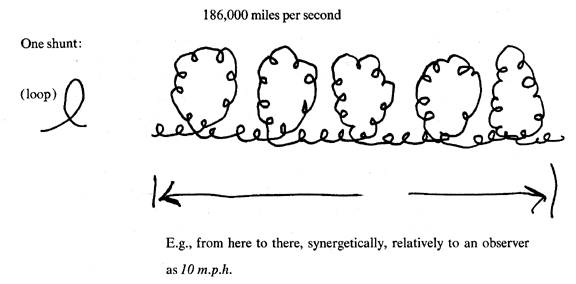
Frequency modulation is accomplished through precession-shunted circuit synchronizations. “Valving” is angular shunting. Competent design is predicated upon frequency modulation by application of the precessional-shunting principle.
647.03
Because tension is ever a spiraling arc, it must close back upon itself; it is, therefore, finite and cohesive. Universe is inherently finite and a comprehensive integrity. Compression systems tend, when compression-loaded, to yield to arcs of lesser radius and also, by precessional axial despiraling, tend to unravel and to separate into a plurality of subsystems. Tension systems tend, when axially loaded, to arcs of greater radius. Tension systems tend to greater cohesiveness of precessional inspiraling.
647.04
Discontinuous-compression, continuous-tension structures are finite islands of microcosmic, inwardly precessing, zonal wave-sequence displacements of radial-to- circumferential-to-radial energy knotting regenerations as nuclear phenomena—and the whole, which is enclosed in infinite, macrocosmically trending, precessional unravelings, regenerates precessionally as radial-to-circumferential-to-radial nebular phenomena— circumferential micro- or macro- being finite, and radial being infinite. Compression is micro and tension is macro.
647.10
In topological systems, vertexes are finite relationships; turbo-systems are in convergence tendencies; and faces are finite sections of infinite open-angle divergent tendencies.
647.20
The equilibriously regenerative octet truss is regenerated as fast and as extensively as man explores and experiences it. As I define Universe as the sum-total aggregate of men’s experiences, then we may say that the octet truss-vector equilibrium is universally extensive. Universally extensive is a term quite other than to infinity, a term the semantic integrity of synergetic geometry may not employ.
647.30
The open end of an angle is infinite, but so too is its convergent end, in that the two actions cannot pass either instantaneously or simultaneously through the same point.
648.00 Macrocosmic and Microcosmic
648.01
If we switch our observation from the macrocosmic to the microcosmic, we witness man’s probing within the atom, which discloses the same kind of discontinuous- compression, continuous-tension apparently governing the structure of the atom. That is, the islands of energy concentration of the atom and its nucleus are extraordinarily remote from one another in respect to their measurable local-energy-concentration diameters, and all are bounded together by a comprehensive but invisible tensional integrity.
648.02
In the new awareness of synergetics, the remote patternings of Universe are inherently finite, and only the local islands of compression are subdivisible to the degree of infinity projected by the existence of local life and its differential dichotomies of progressive probing. We discover that the more visible, i.e., the more sensorially tunable, the structural functions are, then the more infinitely subdivisible do their potential treatments become. The more invisible the structural functions of Universe, the more comprehensively and comprehendably finite they become.
648.03
As a consequence of these macro-micro structural observations, I also wondered whether man was congenitally limited to his solid structural conceptioning. Man obviously tended to think only of a “solid,” brick-on-brick, pile-up law as governing all fundamental forms of structural modifications, i.e., formal local alterations of the “solid” compressional Earth’s crust. Could he therefore never participate in the far more efficient structural strategies evidenced in his (only instrumentally harvested) infra- and ultrasensorial data of universal patterning? I saw that man had long known of tensional structures and had experienced and developed tensional capabilities, but apparently only as a secondary accessory of primary compressional structuring.