710.01
When a photograph is made of a plurality of lines crossing through approximately one point, it is seen that there is a blurring or a running together of the lines near the point, creating a weblike shadow between the converging lines—even though the individual lines may have been clearly drawn. This is caused by a refractive bending of the light waves. When the masses of the physically constituted lines converge to critical proximity, the relative impedance of light-wave passage in the neighborhood of the point increases as the second power of the relative proximities as multiplied by a factor of the relative mass density.
710.02
Tensegrity geodesic spherical structures eliminate the heavy sections of compression members in direct contact at their terminals and thus keep the heavy mass of respective compressions beyond critical proximities. As the vertexial connections are entirely tensional, the section mass is reduced to a minimum, and system “frequency” increase provides a cube-root rate of reduction of section in respect to each doubling frequency. In this manner, very large or very small tensegrity geodesic spheroids may be designed with approximate elimination of all microwave interferences without in any way impairing the structural dimensional stability.
710.03
The turbining, tensionally interlaced joints of the tensegrity-geodesic spheroids decrease the starlike vertexial interference patterns.
711.00 Gravity as a Circumferential Force
711.01
Circumference: Circumference = πD = C. Wherefore, we can take a rope of a given D length and lay it out circumferentially to make it a circle with its ends almost together, but with a tiny gap between them.
711.02
Then we can open out the same rope to form only a half-circle in which the diameter doubles that of the first circle and the gap is wide open.
711.03
Halfway between the two, the gap is partially open.
711.04
As we open gaps, we make the sphere bigger. The comprehensive tension wants to make it smaller. Struts in the gap prevent it from becoming smaller. Struts make big. Tension makes small. The force of the struts is only outward. The force of the tension network is only inward.
711.10
Circumferential Advantage over Radial: Gravity is a spherically circumferential, omniembracingly contractive force. The resultant is radially inward, attempting to make the system get smaller. The circumferential mass-interattraction effectiveness has a constant coherent advantage ratio of 12 to 1 over the only radially effective mass attraction; ergo, the further inward within the embraced sphere, the greater the leverage advantage of the circumferential network over the internal compaction; ergo, the greater the radial depth within, the greater the pressure.
711.20
Ratio of Tensors: Locally on a circle, each particle has two sideways tensors for each inward tensor. One great-circle plane section through a circle shows two sideways tensors for one inward vector. But, on the surface of a sphere, each particle has six circumferential tensors for each single inward radial vector. When you double the radius, you double the chord.
711.30
Struts as Chords in a Spherical Network: When inserting a strut into a tensegrity sphere, we have to pull the tension lines outward from the system’s center, in order to insert the strut between the vertexes of those lines. As we pull outward, the chordal distance of the gap between the spheric tension lines increases.
711.31
If we wish to open the slot in the basketball or football’s skin through which its pneumatic bladder is to be inserted, we pull it outwardly and apart to make room inside.
711.32
The most outward chord of any given central angle of a circle is the longest. The omnicircumferential, triangularly stabilized, interconnecting tension lines of the spherical-network system cannot get bigger than its discretely designed dimensions and the ultimate tensile strength of the network’s tensors, without bursting its integrity. The comprehensive spherical-tensor network can only relax inwardly. When all in place, the tensegrity-compression struts can only prevent the tension network from closing inward toward the sphere’s center, which is its comprehensive proclivity.
711.33
The synergetic force of the struts (that is, their total interrelationship tendency) is not predicted by any one strut taken singly. It is entirely omniradially outward. The force of the strut is not a chordal two-way thrust.
711.34
A fully relaxed spherical tensegrity structure may be crumpled together in a tight bundle without hurting it, just as a net shopping bag can be stuffed into a small space. Thereafter, its drooped, untaut tension members can only yield outward radially to the dimensionally predesigned and prefabricated limits of the omniclosed spheric system, which must be progressively opened to accommodate the progressive interconstruction of the predesigned, prefabricated chordal lengths of the only circumferentially arrayed compression struts.
711.35
The compression struts are islanded from one another, that is, in each case, neither of the separate compression strut’s ends touches any part of any other compression strut in the spheric system. As struts are inserted into the spheric-tension network, the whole spheric system is seen to be expanding omnioutwardly, as do pneumatic balloons when air is progressively introduced into their previously crumpled skins.
711.36
The comprehensive, finitely closed tension network’s integrity is always pulling the islanded compression struts inward; it is never pushing them, nor are they pushing it, any more than a rock lying on Earth’s crust thrusts horizontally sidewise. The rock is held where it is by the comprehensively contractive Earth’s inter-mass-attraction (gravitational) field, or network. But the more rocks we add, the bigger the sphere held comprehensively together by the omnitensively cohering, gravitational consequences of the omni-interattractive mass aggregate.
712.00 Clothesline
712.01
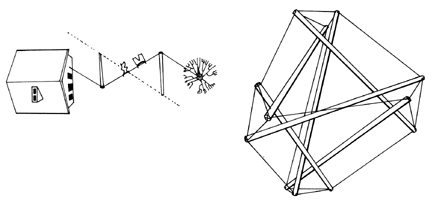
Surprising behaviors are found in tensegrity structures. The illustration shows a house and a tree and a clothesline. The line hangs low between the house and the tree. To raise the line so that the clothes to be dried will not sweep the ground, the line is elevated by a pole that has one end thrust against the ground and the other end pushed outwardly against the line. The line tightens with the pole’s outer end at the vertex of an angle stretched into the line. The line’s angle shows that the line is yielding in the direction away from the thrusting pole.
712.02
As the clothesline tightens and bends, it always yields away from the pushing strut. In spherical tensegrity structures the islanded compression struts pull the tension lines to angle toward the strut ends.
712.03
When we release a compression member from a tensegrity sphere, one end does not thrust by the tension member to which it was fastened in a circumferential direction. It was not fastened in thrust or sheer. It was not pushing circumferentially. It was resisting being compressed, and like a cork in a bottle, it was employing its frictional contact with the tension net at both its ends to resist its only tendency, which was to exit radially outward from the system’s center.
713.00 Discontinuous Compression
713.01
Subvisible Discontinuity: In the Babylonian, Egyptian, and Ionian eras of ways of looking at, thinking about, and formulating, there evolved a concept of a “first family” of geometrical “solids,” in which each member was characterized by all of its faces being identical and all of its edges being one length only. Humans were then unaware of what physics was only much later to discover experimentally: that nature discloses no evidence of a continuum. Experiment discloses only aggregates of separate, finitely closed events. Ergo, there are no solids.
713.02
Their optical illusion and stubbornly conditioned reflexes have since motivated one generation after another to go on teaching and accepting the misconception of geometric “solids,” “planes,” and “straight lines,” where physics has discovered only wavilinear trajectories of high-frequency, yes-no event pulsations. With the misconception of straight lines came the misconception of the many lines going through the same point at the same time. Wherefore the 12 edges that define the cube were assumed to be absolute straight lines, and therefore sets of them ran simultaneously into the thus absolutely determined eight corner “points” of the cube.
713.03
Humans were accustomed to the idea that edges come together at one certain point. But we now know operationally that if we look at any of the edges of any item microscopically, there is no such absolute line, and instead there is seen to be an aggregate of atomic events whose appearance as an aggregate is analogous to the roughly rounding, wavilinear profiled, shoulder “edge” of a rock cliff, sand, or earth bluff standing high above the beach of the shore lying below, whose bluff and beach disclose the gradual erosion of the higher land by the sea.
713.04
The corners of the solids are also just like the corners of an ocean-side bluff that happens to have its coastwise direction changed at 90 degrees by large geological events of nature such as an earthquake fault. Such an easterly coastline’s bluff casts dark shadows as the Earth rotates; seen from airplanes at great altitudes, long sections of that black coastal shadow may appear illusionarily as “straight.”
713.05
We can make Platonic figures in nonsolid tensegrity where none of the lines go through any of the same points at the same time, and we realize that the only seemingly continuous, only mass-interattractively cohered, atomic “Milky Way” tensor strands spanning the gaps between the only seemingly “solid,” omni-islanded, vectorially compressioned struts, do altogether permit a systematic, visually informed, and realistically comprehended differentiation between the flexible tensor and inflexible vector energy-event behaviors, all of which are consistent with all the experimental information accruing to the most rigorous scientific discipline.
713.06
The eye can resolve intervals of about 1/100th of an inch or larger. Below that, we do not see the aggregates as points. Thereafter, we see only “solid”-color surfaces. But our color receptivity, which means our only-human-optics-tunable range of electromagnetic radiation frequencies, cannot “bring in,” i.e., resonatingly respond to, more than about one-millionth of the now known and only instrumentally tune-in-able overall electromagnetic-wave-frequency range of physical Universe. This is to say that humans can tune in directly to less than one-millionth of physical reality—ergo, cannot “see” basic atomic and molecular-structuring events and behaviors, but our synergetic tensegrity principles of structuring are found instrumentally to be operative to the known limits of both micro- and macro-Universe system relationships as the discontinuous, entropic, radiational, and omnicohering, collecting gravitational syntropics. (See Sec. 302..)
713.07
Convergence: While we cannot see the intervals between atomic-event waves, the tensegrity structuring principles inform our consideration of the invisible events. Every time we instrumentally magnify the illusionarily converging geometrical “lines” defining the edges of “solids,” we see them only wavilinearly converging toward critical proximity but never coming completely together; instead, twisting around each other, then slivering again, never having gone through the same “points.”
713.08
When we first try to differentiate tension and compression in consciously attempting to think about the behavior of structures in various locals of Universe, it becomes apparent that both macro-Universe and micro Universe are only tensionally cohered phenomena. They both obviously manifest discontinuous compression islands. It is evidenced, in cosmically structured systems, both macro and micro, that compression members never touch one another. Earth does not roll “ball bearing” around on the surface of Mars; nor does the Moon roll on Earth, and so forth. This structural scheme of islanded spheres of compression, which are only mass-attractively cohered, also characterizes the atomic nucleus’s structural integrities. Tensegrity discoveries introduce new and very different kinds of structural principles which seem to be those governing all structuring of Universe, both macrocosmic and microcosmic.
713.20 Compression Members
713.21
Behavior of Compression Members in Spherical Tensegrity Structures: In spherical tensegrity constructions, whenever a tension line interacts with a compression strut, the line does not yield in a circumferential direction away from the strut. The islanded compression member, combining its two ends’ oppositely outward thrust, pulls on the omni-integrated tension network only acting as a radially outward force in respect to the sphere’s center.
713.22
When we remove a compression member from a tensegrity sphere of more than three struts, the compression member of the original triangular group, when released on one end, does not shove by the tension member to which it was fastened. It is not fastened in shove or sheer. It pulls outwardly of the spherical system, away from the tension members at both of its ends simultaneously; when released, it pops only outwardly from the sphere’s center.
713.23
When inserting a strut into a tensegrity sphere, you are pulling the tensional network only outwardly of the system in order to allow the strut to get into the system, that is, toward the structure’s center. The strut pulls only outward on the two adjacent tension members to which it is fixed, trying to escape only radially outwardly from the system’s center.
714.00 Interstabilization of Local Stiffeners
714.01
Local, Discontinuous, Compressional Strut Waves Interstabilizing Two Concentric, Differentially Radiused Tensegrity Spheres: Highly stable, nonredundant, rigidly trussed, differently radiused, concentric spherical tensegrity structures of hexagonal-pentagonal, inner or outer (but not both) surface dimples, symmetrically interspersing their omnitriangularly interlinked, spherically closed systems, may be constructed with swaged crossings of high-tensile-steel-cabled, spherical nets and locally islanded compressional struts occurring discontinuously as inbound-outbound, triangularly intertrussing, locally islanded compressional struts. The struts may then be either hydraulically actuated to elongate them to designed dimensions, or may be locally jacked in between the comprehensively prefabricated, spherical-system tensional network.
714.02
The local struts are so oriented that they always and only angle inwardly and outwardly between the concentric, differently radiused, comprehensively finite, exterior and interior, tensional spherical nets. The result is an interstabilized dynamic equilibrium of positive and negative waves of action. Such tensegrity sphere structures are limited in size only by the day-to-day limits of industrial production and service-logistics techniques. Large tensegrity spheres can have their lower portions buried in reinforced-concrete as tie- down bases to secure them against hurricane-drag displacement.
715.00 Locked Kiss
715.01
As we increase the frequency of triangular-module subdivisions of a tensegrity geodesic sphere, we thus also increase the number of compression struts, which get progressively halved in length, while their volumes and weights shrink eightfold. At the same time, the arc altitude between the smaller arcs and chords of the sphere decreases, while the compression members get closer and closer to the adjacent compression members they cross. Finally, we reach the condition where the space between the struts is the same dimension as the girth radius of the struts. At this point, we can let them kiss- touch; i.e., with the ends of two converging struts contacting the top middle of the strut running diagonally to those two struts and immediately below their ends. We may then lock the three kissing members tensionally together in their kiss, but when we do so, we must remember that they were not pushing one another when they “kissed” and we locked them in that equilibrious, “most comfortable” position of contact coincidence. Tensegrity spheres are not fastened in shear, even though their locked kiss gives a superficially “solid” continuity appearance that is only subvisibly discontinuous at the atomic level.
716.00 Complex Continuity and Discontinuity in Tensegrity Structures
716.01
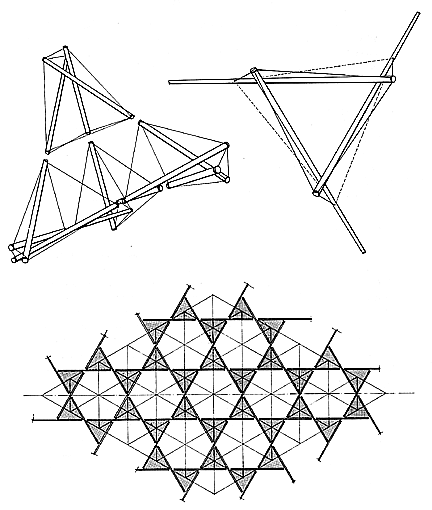
The terminal junctures of four three-strut tensegrity octahedra are all 180- degree junctures. They appear to be compressionally continuous, while the central coherence of the three struts appears visibly discontinuous. The complex tensegrity presents a visibly deceptive appearance to the unwary observer. The two joined legs of the basic units appear as single units; as such, they appear to be primary elements of the complex tensegrity, whereas we learn from construction that our elements are the three- strut octahedra and that the cohering principle of the simplest elements is tensegrity.
716.02
The fundamental, repeatable unit used to form the spherical tensegrity structures is a flattened form of the basic three-strut tensegrity octahedron.
716.03
The basic 12-frequency tensegrity matrix employs collections of the basic three-strut units joined at dead center between single- and double-bonded discontinuity. The shaded triangles in the illustration represent the sites for each of the three-strut units. This matrix is applied to the spherical triacontrahedron—consequently, the large 12- frequency rhombus (illustration 716.01C) is one-thirtieth of the entire sphere.
716.10 Convergence
716.11
Whereas man seems to be blind in employing tensegrity at his level of everyday consciousness, we find that tensegrity structures satisfy our conceptual requirement that we may not have two events passing through the same point at the same time. Vectors converge in tensegrity, but they never actually get together; they only get into critical proximities and twist by each other.
717.0 Single- and Double-Bonding in Tensegrity Spheres
717.01
Fig. 717.01 Single and Double Bonding of Members in Tensegrity Spheres
Fig. 717.01 Single and Double Bonding of Members in Tensegrity Spheres:
Link to original
A. Negatively rotating triangles on a 270-strut tensegrity geodesic sphere with double-bonded triangles.
B. A 270-strut isotropic tensegrity geodesic sphere: single bonded turbo triangles forming a complex six-frequency triacontahedron tensegrity.
C. Complex of basic three-strut tensegrities, with axial alignment whose exterior terminals are to be joined in single bond as 90-strut tensegrity.
D. Complex of basic three-strut tensegrity units with exterior terminals now joined.
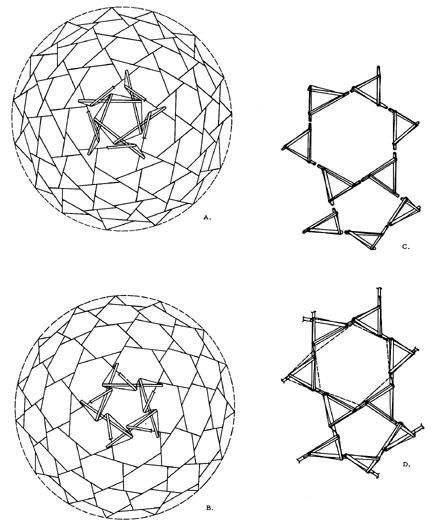
Basic three-strut tensegrities may be joined in single-bonding or double- bonding to form a complex, 270-strut, isotropic tensegrity geodesic sphere. It can be composited to rotate negatively or positively. A six-frequency triacontrahedron tensegrity is shown in illustration 717.01.
717.02
Complexes of basic three-strut tensegrities are shown with axial alignment of exterior terminals to be joined in single bond as a 90-strut tensegrity.