730.10 Symmetric Juxtaposition of Tetrahedra
730.11
Fig. 730.11 Functions of Positive and Negative Tetrahedra in Tensegrity Stacked Cubes
Fig. 730.11 Functions of Positive and Negative Tetrahedra in Tensegrity Stacked Cubes: Every cube has six faces (A). Every tetrahedron has six edges (B). Every cube has eight corners and every tetrahedron has four corners. Every cube contains two tetrahedra (ABCD and WXYZ) because each of its six faces has two diagonals, the positive and negative set. These may be called the symmetrically juxtaposed positive and negative tetrahedra whose centers of gravity are congruent with one another as well as congruent with the center of gravity of the cube (C). It is possible to stack cubes (D) into two columns. One column contains the positive tetrahedra (E) and the other contains the negative tetrahedra (F).
Link to original
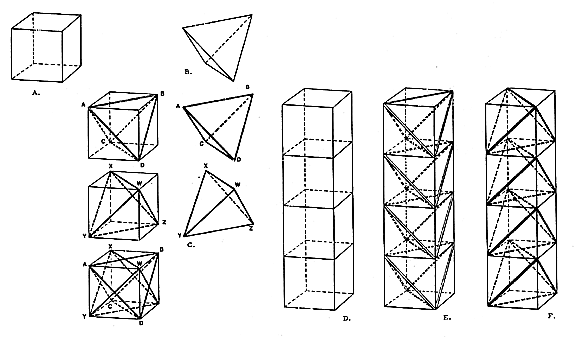
All polyhedra may be subdivided into component tetrahedra. Every tetrahedron has four vertexes, and every cube has eight vertexes. Every cube contains two tetrahedra (ABCD and WXYZ). Each of its faces has two diagonals, the positive set and the negative set. These may be called the symmetrically juxtaposed positive and negative tetrahedra, whose centers of volume are congruent with one another as well as congruent with the center of volume of the cube. It is possible to stack cubes into two columns. One column can demonstrate the set of positive tetrahedra, and the other column can demonstrate the set of negative tetrahedra.
730.12
Fig. 730.12 Stabilization of Tension in Tensegrity Column
Fig. 730.12 Stabilization of Tension in Tensegrity Column: We put a steel sphere at the center of gravity of a cube which is also the center of gravity of tetrahedron and then run steel tubes from the center of gravity to four corners, W,X,Y, and Z, of negative tetrahedron (A). Every tetrahedron’s center of gravity has four radials from the center of gravity to the four vertexes of the tetrahedron (B). In the juncture between the two tetrahedra (D), ball joints at the center of gravity are pulled toward one another by a vertical tension stay, thus thrusting universally jointed legs outwardly, and their outward thrust is stably restrained by finite sling closure WXYZ. This system is nonredundant: a basic discontinuous-compression continuous-tension or “tensegrity” structure. It is possible to have a stack (column) of center-of-gravity radial tube tetrahedra struts (C) with horizontal (approximate) tension slings and vertical tension guys and diagonal tension edges of the four superimposed tetrahedra, which, because of the (approximate) horizontal slings, cannot come any closer to one another, and, because of their vertical guys, cannot get any further away from one another, and therefore compose a stable relationship: a structure.
Link to original
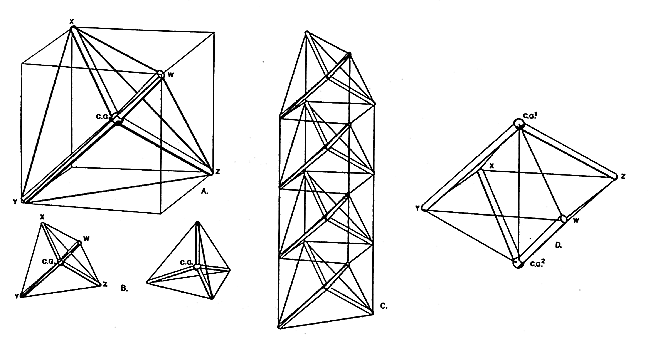
In every tetrahedron, there are four radials from the center of volume to the four vertexes. These radials provide a model for the behavior of compression members in a column of tensegrity-stacked cubes. Vertical tension stays connect the ends of the tetrahedral compression members, and they also connect the successive centers of volume of the stacked spheres—the centers of volume being also the junction of the tetrahedral radials. As the two centers of volume are pulled toward one another by the vertical tension stays, the universally jointed radials are thrust outwardly but are finitely restrained by the sliding closure XYZW interlinking the tetrahedral integrities of the successive cubes.
730.13
This system is inherently nonredundant, as are all discontinuous- compression, continuous-tension tensegrity structures. The approximately horizontal slings cannot come any closer to one another, and the approximately vertical stays cannot get any farther from one another; thus they comprise a discrete-pattern, interstabilizing relationship, which is the essential characteristic of a structure.