761.00 Net
761.01
People think spontaneously of a balloon as a continuous skin or solidly impervious unitary and spherically enclosed membrane holding the gas. They say that because the gas cannot get out and because it is under pressure, the pressure makes the balloon spheroidal. This means that the gas is pushing the skin outwardly in all directions. People think of a solid mass of air jammed into a pneumatic bag. But if we look at this skin with a microscope, we find that it is not a continuous film at all; it is full of holes. It is made up of molecules that are fairly remote from one another. It is in reality a great energy aggregate of Milky Way-like atomic constellations cohering only gravitationally to act as the invisible, tensional integrities of the fibers with which the webbing of the pneumatic balloon’s net is woven.
761.02
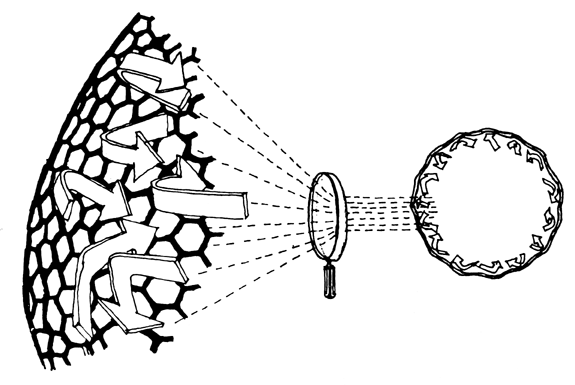
In a gas balloon, we do not have a continuous membrane of film. There is no such thing as a continuous “solid” skin or a “solid” or a “continuous” anything in Universe. What we do have is a network pattern, a network of energy actions interspersed with vast spaces or lack of energy events. The mass-interattracted atomic components not only are not touching each other, but they are as remote from one another as are Sun and its planets in the relative terms of respective diameters of each of the phenomena involved.
761.03
The spaces between the energy-action-net components are smaller, however, than are the internally captivated and mutually interrepelled gas molecules; wherefore the gas molecules, which are complex low-frequency energy events, interfere with the higher- frequency, omnienclosing net-webbing energy events. The pattern is similar to that of fish crowded in a spherical net and therefore running tangentially outward into the net in approximately all directions. Fish caught in nets produce an enclosure-frustrated, would- be escape pattern. In the tensegrities, you have gravity or electromagnetism producing the ultimate tension forces, but you don’t have any strings or ultimately smallest solid threads. The more we think about it and the more we experiment, the less reliable becomes our concept “solid.” The balloon is indeed not only full of holes, but it is in fact utterly discontinuous. It is a net and not a bag. In fact, it is a spherical galaxy of critically neighboring energy events.
761.04
The balloon is a net in which the holes are so small that the molecules are larger than the holes and therefore cannot get out. The molecules are gas, but they have a minimum dimension, and they cannot get out of the holes. The next thing that we discover is the pressure of the gases explained by their kinetics. That is, the molecules are in motion; they are not rigid. There is nothing static at all pushing against the net. They are hitting it like projectiles. All of the molecules of gas are trying to get out of the system: this is what gives it the high pressure. The middle of the chord of an arc is always nearer to the center of the sphere than the ends of the chord. Chord ends are always pushing the net outwardly from the system’s spherical center. The molecules are stretching the net outwardly until the skin acts to resist the outward motion and relaxes inwardly. The skin is finite and closes back upon itself in apparently all circumferential directions. The net represents a tensional force with the arrows bound inwardly, balancing all the molecules, hitting them, caroming around, with every molecular action having its chordal reaction. But the molecules do not huddle together at the center and then simultaneously explode outward to hit the balloon skin in one omnidirectionally outbound wave. Not only are there critical proximities that show up physically, but there are critical proximities tensionally and critical proximities compressionally—that is, there are repellings.
761.05
What makes the net take the shape that it does is simply the molecules that happen to hit it. The molecules that are not hitting it have nothing to do with its shape. There is potential that other molecules might hit the network, but that is not what we are talking about. The shape it has is by virtue of the ones that happen to hit it.
761.06
When we crowd the gassy molecules into a container, they manifest action, reaction, and resultant. When one molecule goes out to hit the net, it is also pushing another molecule inwardly or in some other direction. We discover mathematically that it would be impossible to get all of them to go to an absolute common center because that would require a lot more pressure. It would have to be a smaller space so the patterns are not all from the center outwardly against the bag. Each one of the patterns is ricocheting around the bag; some are hitting the net and some are only interfering with and precessing each other and changing angles without hitting the net.
762.00 Paired Swimmers
762.01
Fig. 762.01 Chordal Ricochet Pattern in Stretch Action of a Balloon Net
Fig. 762.01 Chordal Ricochet Pattern in Stretch Action of a Balloon Net: A gas balloon’s exterior tension “net” has the shape that it has because some of the molecules are too large to escape and, crowed by the other molecules, are hitting the balloon. But the molecules do not huddle together at the center and then simultaneously explode outwardly to hit the balloon skin in one omnidirectionally outbound wave. The molecules near the surface are coursing in chordally ricocheting patterns all around the inner net’s surface. I therefore saw that—because every action has its reaction—it would be possible to pair all the molecules so that they would behave as can two swimmers who dive into a swimming tank from opposite ends, meet in the middle and then, employing each other’s inertia, shove off from each other’s feet in opposite directions.
Link to original
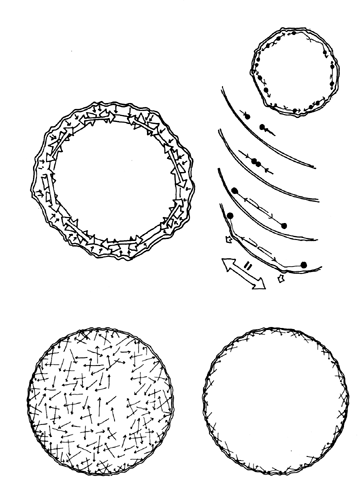
The molecules near the surface of the net are coursing in chordally ricocheting great-circle patterns around the net’s inner surface. Because every action has its reaction, it would be possible to pair all the molecules so that they would behave as, for instance, two swimmers who dive into a swimming tank from opposite ends, meet in the middle, and then, employing each other’s inertia, shove off from each other’s feet in opposite directions. We have an acceleration effectiveness equal to what they experience when shoving off from the tank’s “solid” wall. When you are swimming, you dive from one end of the tank, which gives you a little acceleration into the water. When you get to the end of the tank, you can put up your feet, double up your body, and shove off from the wall again. Likewise, two swimmers can meet in the middle of the tank, double up their bodies, put the soles of their feet together, and thrust out in opposite directions. The phenomenon is similar to the discontinuous compression and continuous tension of geodesics. The molecules are in motion and have to have some kind of a reaction set; each molecule caroming around, great-circularly hitting glancing blows, then making a chord and then another glancing blow, has to have another molecule to shove off from. They are the ones that are accounting for all the work. Each one would have to be balanced as a balanced pair of forces. We discover that all we are accounting for can be paired. So there is a net of arrows outwardly in the middle of the chord pulling against the net of arrows pointing inwardly.
762.02
The pattern indicates that we could have each and all of the paired molecules bounce off their partners and dart away in opposite directions, with each finally hitting the balloon net and pushing it outwardly as they each angled in glancing blows in new directions, but always toward the net at another point where, in critical repelling proximities, they would all pair off nonsimultaneously but at high frequency of re- repellment shove-offs to ricochet off the net at such a high frequency of events as to keep the net stretched outwardly in all directions. This represents what the molecules of balloon confined gases are doing. With discontinuous compression and continuous tension, we can make geodesic structures function in the same way.
763.00 Speed and Concentration of Airplanes
763.01
As we find out in electromagnetics where there are repellings and domains of actions, the kinetic actions of these gas molecules seem to require certain turning-radius magnitudes. When you pressure too many of these patterns into the same area, there is not enough room to avoid interferences, and they develop a very high speed. Increased speed decreases interference probability caused by increased crowding.
763.02
Airplanes in the sky seem to be great distances apart. But the minute they come in for a landing, they are slowed down and are very much closer to each other. If you have phenomena at very high speeds, their amount of time at any one point is a very short time: the amount of time there would be at a given point for something to hit it would be very much lessened by the speed. The higher the velocity, the lesser the possibility of interference at any one point. So we have the motion patterns of the molecules making themselves more comfortable inside the balloon by increasing their velocity, thereby reducing the interferences that are developing. The velocity then gives us what we call pressure or heat: it can be read either way. If you feel the pneumatic bag, you may find it getting hotter. You can feel an automobile tire getting hotter as it is pumped full.
764.00 Escape from Compression Structuring
764.01
Geodesics introduces tension as the integrity of structure. Geodesics is in fundamental contradistinction to the compressional arches where men made lesser rings of stone and bricks and so forth, like Santa Sophia, fitting them together beautifully and shaping them very mathematically to prevent their slipping or falling inwardly from one another to break the integrity of the compressional rings. In Santa Sophia, they put a chain around the bottom of the dome to take care of the outward thrust of the enormous weights of the aggregate trying to come apart. They could not build an exclusively compressionally composed dome that would not thrust outwardly at the base, so they put the chains around the bases to prevent their collapsing.
764.02
We have seen that in tensional structures there is no limit of length to cross section: you can make as big a pneumatic bag as you want. In the comprehensive, geodesically omnitriangulated, tensegrity structures, we are able to reach unlimited spans because our only limitation is tension, where there is no inherent limit to cross section due to length. We get to where there is no cross section visible at all, as in the pull between the Earth and the Moon. With such structural insights we can comprehend the structure of an apple in terms of noncompressible hydraulic compression and critical proximity cellular wall tensioning. Synergetics identifies tensegrity with high-tensile alloys, pneumatics, hydraulics, and load distribution.
765.00 Snow Mound
765.01
A child playing in sticky snow may make a big mound of snow and hollow it out with his hands or a shovel to make a cave. The snow is fascinating because you can push it together and it will take on shapes. It has coherence. Almost every child with mittens on has built himself a mound and then started chipping away to make a cave. Looking at the hollowed mound from the outside, he may discover that he has made a rough dome. He might then conclude that whatever makes the structure stand up has to do with the circumferential interactions of the snow crystals and their molecules and the latter’s atoms. He finds that he can get in it and that the structural integrity has nothing to do with the snow that used to be at the middle. So we may develop a strong intuition about this when we are very young: that it is the circumferential set of molecules that are accounting for the structural integrity of the dome.
765.02
Fig. 765.02 Stabilization of Three-Way-Grid Tensegrity Sphere
Fig. 765.02 Stabilization of Three-Way-Grid Tensegrity Sphere: What happens with the snow mound is also exactly what happens in a three-way-grid tensegrity-geodesic spherical grid. In the balloon we get paths of these positively and negatively paired, kinetic molecules reacting from one another in a random set of directions. If they went into one path only, they would make a single circle which would push the balloon outwardly only at its equator making a disc and allowing the poles to collapse. If they made a two-way stack of parallel lesser circles as a cylinder, the cylinder would contract axially into a disc. A two-way grid would make only unstable squares and diamonds, which would elongate into a tubular snake. But once we have three or more sets of angularly independent circularly continued push-pull paths, they must inherently triangulate by push-pull stabilization of opposite angles. Triangulation means self-stabilizing, which creates omnidirectional symmetry, which makes an inherent three-way spherical symmetry grid, which is the geodesic structure.
Link to original
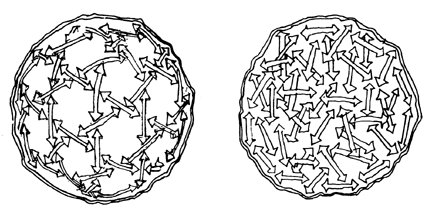
The child may then find by experiment that he might hollow out the pneumatic network and put not only one hole, but many holes, in the snowdome shell, and it continues to stand up. It becomes apparent that it would be possible to take a pneumatic balloon, pair the molecules doing the work, and get rid of all the molecules at the center that were not hitting the balloon—for it is only the molecules that hit the balloon at high frequency of successive bounce-offs that give the balloon its shape.
766.00 Tensegrity Geodesic Three-Way Grid
766.01
What happens in the snow mound is also what happens in the three-way tensegrity geodesic spherical grid. In the balloon, we get paths of these positively and negatively paired kinetic molecules reacting from one another in a random set of directions. If they went into one path only, they would make a single circle, which would push the balloon outwardly only at its equator, making a disc and allowing the poles to collapse. If they made a two-way stack of parallel lesser circles as a cylinder, the cylinder would contract axially into a disc.
766.02
A gas-filled balloon is not stratified. If it were, it would collapse like a Japanese lantern.
766.03
A two-way grid would make only unstable squares and diamonds, which would elongate into a tubular snake.
766.04
Once we have three or more sets of angularly independent, great-circularly continued, push-pull paths, they must inherently triangulate by push-pull into stabilization of opposite angles. Triangulation means selfstabilizing; which creates omnidirectional symmetry; which makes an inherent three-way spherical symmetry grid; which is the geodesic structure.