811.00 Bias on One Side of the Line
811.01
We have all been brought up with a plane geometry in which a triangle was conceived and defined as an area bound by a closed line of three edges and three angles. A circle was an area bound by a closed line of unit radius. The area outside the closed boundary line was not only undefinable but was inconceivable and unconsidered.
811.02
In the abstract, ghostly geometry of the Greeks, the triangle and circle were inscribed in a plane that extended laterally to infinity. So tiny is man and so limited was man’s experience that at the time of the Greeks, he had no notion that he was living on a planet. Man seemed obviously to be living on an intuitively expansive planar world around and above which passed the Sun and stars, after which they plunged into the sea and arose again in the morning. This cosmological concept of an eternally extended, planar-based Earth sandwiched between heaven above and hell below made infinity obvious, ergo axiomatic, to the Greeks.
811.03
The Greek geometers could not therefore define the planar extensibility that lay outside and beyond the line of known content. Since the surface outside of the line went to infinity, you could not include it in your computation. The Greeks’ concept of the geometrical, bound-area of their triangle — or their circle — lay demonstrably on only one bound-area side of the line. As a consequence of such fundamental schooling, world society became historically biased about everything. Continually facing survival strategy choices, society assumed that it must always choose between two or more political or religious “sides.” Thus developed the seeming nobility of loyalties. Society has been educated to look for logic and reliability only on one side of a line, hoping that the side chosen, on one hand or the other of indeterminately large lines, may be on the inside of the line. This logic is at the head of our reflexively conditioned biases. We are continually being pressed to validate one side of the line or the other.
811.04
You can “draw a line” only on the surface of some system. All systems divide Universe into insideness and outsideness. Systems are finite. Validity favors neither one side of the line nor the other. Every time we draw a line operationally upon a system, it returns upon itself. The line always divides a whole system’s unit area surface into two areas, each equally valid as unit areas. Operational geometry invalidates all bias.
812.00 Spherical Triangle
812.01
The shortest distance between any two points on the surface of a sphere is always described by an arc of a great circle. A triangle drawn most economically on the Earth’s surface or on the surface of any other sphere is actually always a spherical triangle described by great-circle arcs. The sum of the three angles of a spherical triangle is never 180 degrees. Spherical trigonometry is different from plane trigonometry; in the latter, the sum of any triangle’s angles is always 180 degrees. There is no plane flat surface on Earth, wherefore no plane triangles can be demonstrated on its surface. Operationally speaking, we always deal in systems, and all systems are characterized projectionally by spherical triangles, which control all our experimental transformations.
812.02
Drawing or scribing is an operational term. It is impossible to draw without an object upon which to draw. The drawing may be by depositing on or by carving away — that is, by creating a trajectory or tracery of the operational event. All the objects upon which drawing may be operationally accomplished are structural systems having insideness and outsideness. The drawn-upon object may be either symmetrical or asymmetrical. A piece of paper or a blackboard is a system having insideness and outsideness.
812.03
Fig. 812.03
Fig. 812.03: The Greeks defined a triangle as an area bound by a closed line of three edges and three angles. A triangle drawn on the Earth’s surface is actually a spherical triangle described by three great- circle arcs. It is evident that the arcs divide the surface of the sphere into two areas, each of which is bound by a closed line consisting of three edges and three angles, ergo dividing the total area of the sphere into two complementary triangles. The area apparently “outside” one triangle is seen to be “inside” the other. Because every spherical surface has two aspects_convex if viewed from outside, concave if viewed from within_each of these triangles is, in itself, two triangles. Thus one triangle becomes four when the total complex is understood. “Drawing” or “scribing” is an operational term. It is impossible to draw without an object upon which to draw. The drawing may be by depositing on or by carving away, that is, by creating a trajectory or tracery of the operational event. All the objects upon which drawing may be operationally accomplished are structural systems having insideness and outsideness. The drawn-upon object may be symmetrical or asymmetrical, a piece of paper or a blackboard system having insideness and outsideness.
Link to original
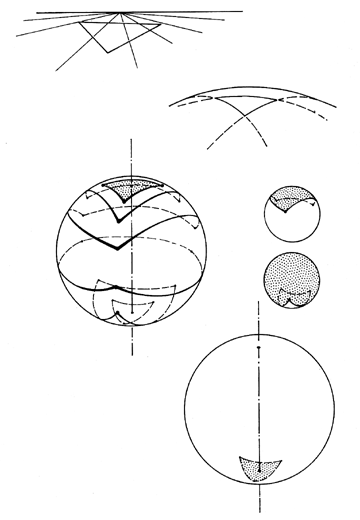
When we draw a triangle on the surface of Earth (which previously unscribed area was unit before the scribing or drawing), we divide Earth’s surface into two areas on either side of the line. One may be a little local triangle whose three angles seem to add up to 180 degrees, while the other big spherical triangle complementing the small one to account together for all the Earth’s surface has angles adding up to 900 degrees or less. This means that each corner of the big triangle complementing the small local one, with corners seeming to be only 60 degrees each, must be 300 degrees each, for there are approximately 360 degrees around each point on the surface of a sphere. Therefore the sum of all the three angles of the big Earth triangles, which inherently complement the little local 60-degree-per-corner equilateral triangles, must be 900 degrees. The big 900-degree triangle is also an area bounded by three lines and three angles. Our schooled-in bias renders it typical of us to miss the big triangle while being preoccupied only locally with the negligibly sized triangular area.
812.04
If you inscribe one triangle on a spherical system, you inevitably describe four triangles. There is a concave small triangle and a concave big triangle, as viewed from inside, and a convex small triangle and a convex big triangle, as viewed from outside. Concave and convex are not the same, so at minimum there always are inherently four triangles.
812.05
Background Nothingness: One spherical triangle ABC drawn on the Earth’s surface inadvertently produces four triangles as the corners of the surface triangle are inherently related to the center of the Earth D, and their lines of interrelatedness together with the three edge lines of the surface triangle describe a tetrahedron. (See Fig. 812.03) Drawing a triangle on the surface of the Earth (as described at Sec. 810) also divides the surface of the Earth into two areas — one large, one small — both of which are bound by a closed line with three edges and three angles. The large triangle and the small triangle have both concave and convex aspects — ergo, four triangles in all. Euler did not recognize the background nothingness of the outside triangles. (See Sec. 505.81)
812.06
Under the most primitive pre-time-size conditions the surface of a sphere may be exactly subdivided into the four spherical triangles of the spherical tetrahedron, each of whose surface corners are 120-degree angles, and whose “edges” have central angles of 109 28’. The area of a surface of a sphere is also exactly equal to the area of four great circles of the sphere. Ergo, the area of a sphere’s great circle equals the area of a spherical triangle of that sphere’s spherical tetrahedron: wherefore we have a circular area exactly equaling a triangular area, and we have avoided use of pi (π).
813.00 Square or Triangle Becomes Great Circle at Equator
813.01
If we draw a closed line such as a circle around Earth, it must divide its total unit surface into two areas, as does the equator divide Earth into southern and northern hemispheres. If we draw a lesser-sized circle on Earth, such as the circle of North latitude 70°, it divides Earth’s total surface into a very large southern area and a relatively small northern area. If we go outdoors and draw a circle on the ground, it will divide the whole area of our planet Earth into two areas — one will be very small, the other very large.
813.02
If our little circle has an area of one square foot, the big circle has an area of approximately five quadrillion square feet, because our 8,000-mile-diameter Earth has an approximately 200-million-square-mile surface. Each square mile has approximately 25 million square feet, which, multiplied, gives a five followed by fifteen zeros: 5,000,000,000,000,000 square feet. This is written by the scientists as 5×10¹⁵ square feet; while compact, this tends to disconnect from our senses. Scientists have been forced to disconnect from our senses due to the errors of our senses, which we are now able to rectify. As we reconnect our senses with the reality of Universe, we begin to regain competent thinking by humans, and thereby possibly their continuance in Universe as competently functioning team members — members of the varsity or University team of Universe.
813.03
If, instead of drawing a one-square-foot circle on the ground — which means on the surface of the spherical Earth — we were to draw a square that is one foot on each side, we would have the same size local area as before: one square foot. A square as defined by Euclid is an area bound by a closed line of four equal-length edges and four equal and identical angles. By this definition, our little square, one foot to a side, that we have drawn on the ground is a closed line of four equal edges and equal angles. But this divides all Earth’s surface into two areas, both of which are equally bound by four equal- length edges and four equal angles. Therefore, we have two squares: one little local one and one enormous one. And the little one’s corners are approximately 90 degrees each, which makes the big square’s corners approximately 270 degrees each. While you may not be familiar with such thinking, you are confronted with the results of a physical experiment, which inform you that you have been laboring under many debilitating illusions.
813.04
If you make your small square a little bigger and your bigger one a little smaller by increasing the little one’s edges to one mile each, you will have a local one square mile — a customary unit of western United States ranches — and the big square will be approximately 199,999,999 square miles. As you further increase the size of the square, using great-circle lines, which are the shortest distances on a sphere between any two points, to draw the square’s edges, you will find the small square’s corner angles increasing while the big one’s corner angles are decreasing. If you now make your square so that its area is one half that of the Earth, 100 million square miles, in order to have all your edges the same and all your angles the same, you will find that each of the corners of both squares is 180 degrees. That is to say, the edges of both squares lie along Earth’s equator so that the areas of both are approximately 10 million square miles.
814.00 Complementarity of System Surfaces
814.01
The progressive enlargement of a triangle, a pentagon, an octagon, or any other equiedged, closed-line figure drawn on any system’s surface produces similar results to that of the enlarging square with 180 degrees to each corner at the equator. The closed- line surface figure will always and only divide the whole area into two complementary areas. Each human making this discovery experimentally says spontaneously, “But I didn’t mean to make the big triangle,” or “the big square,” or indeed, the big mess of pollution. This lack of intention in no way alters these truths of Universe. We are all equally responsible. We are responsible not only for the big complementary surface areas we develop on systems by our every act, but also for the finite, complementary outward tetrahedron automatically complementing and enclosing each system we devise. We are inherently responsible for the complementary transformation of Universe, inwardly, outwardly, and all around every system we alter.