980.01 Relative Superficial and Volumetric Magnitudes
980.02
Starting With Just Twoness: Granted a beyond-touch-reach apartness between two initially inter-self-identifying cosmic events of the basic otherness generating the awareness called “life,” the approximate distance between the volumetric centers of the respective event complexes can only be guessed at as observingly informed by a sequence of angular-differentialing of any two fixed-distance-apart, “range-finder” optics, integral to the observer in respect to which some feature of the remote pattern characteristics of the otherness correspond with some self-sensible features integral to the observing selfness.
980.03
Self has no clue to what the overall size of the away-from-self otherness may be until the otherness is in tactile contact with integral self, whereby component parts of both self and otherness are contactingly compared, e.g., “palm-to-palm.” Lacking such tactile comparing, self has no clue to the distance the other may be away from self. The principle is manifest by the Moon, whose diameter is approximately one-million times the height of the average human. The Moon often appears to humans as a disc no bigger than their fingernails.
980.04
Without direct contact knowledge, curiosity-provoked assumptions regarding the approximate distance T can be only schematically guessed at relativistically from a series of observationally measured angular relationship changes in the appearance of the observed otherness’s features in respect to experienced time-measured intervals of evolutionary transformation stages of self; such as, for instance, self-contained rhythmic frequencies or self-conceptualizability of angular-integrity relationships independent of size. Relative macro-micro system differentialing of direct-experience-stimulated cosmic conceptuality initiates progressive self-informing effectiveness relative to covarying values integral to any and all self-evolutionarily developing observational history.
980.05
For instance, it is discoverable that with linear size increase of the tetrahedral structural systems (see Sec. 623.10), the tetrahedral surface enclosure increases as the second power of the linear growth rate, while the volumetric content coincreases at a third-power rate of the linear rate of size increase. Ergo, with a given tensile strength of cross section of material (itself consisting of nebular aggregates of critically proximate, mass-interattracted, behavioral-event integrities), which material is completely invested in the tetrahedral envelope stretched around four events, with one of the events not being in the plane of the other three. The envelope of a given amount of material must be stretched thinner and thinner as the tetrahedron’s four vertexes recede from one another linearly, the rate of the skin material thinning being a second power of the rate of linear retreat from one another of the four vertexial events. All the while the interior volume of the tetrahedron is increasing at a third-power rate and is being fed through one of its vertexes with an aggregate of fluid matter whose atomic population is also increasing at a third- power volumetric rate in respect to the rate of linear gain by symmetrical recession from one another of the four vertexial points.
980.06
A child of eight years jumping barefootedly from rock to rock feels no pain, whereas a grownup experiences not only pain but often punctures the skin of the bottom of the feet because the weight per square inch of skin has been increased three- or fourfold. If humans have not learned by experience that the surface-to-volume relationships are not constant, they may conclude erroneously that they have just grown softer and weaker than they were in childhood, or that they have lost some mystical faculty of childhood. Realizing intuitively or subconsciously with self-evolution-gained information and without direct knowledge regarding the internal kinetics of atoms and molecules in the combined fluid-gaseous aggregate of organisms, we can intuit cogently that naturally interrepellent action-reaction forces are causing the interior gaseous molecules to accelerate only outwardly from one another because the closest-packed limits will not accommodate inwardly, while expansion is ever less opposed and approaches entirely unlimited, entirely unpacked condition. Sensing such relationships without knowing the names of the principles involved, humans can comprehend in principle that being confined only by the ever-thinning films of matter stretched about them on, for instance, a tetrahedron’s surface, the third-power rate of increase of the bursting force of the contained volume of gases against the second-power growth rate of the ever more thinly stretched film, in respect to the first-power growth rate of the system, swiftly approaches parting of the enclosing film without knowing that the subvisible energy events have receded beyond the critical proximity limits of their mutual mass-interattractiveness and its inter-fall-in-ness proclivities, instead of which they interprecess to operate as individually remote cosmic orbitings. All of these principles are comprehensible in effective degree by individuals informed only by repeated self-observation of human saliva’s surface tension behaviors of their lung-expelled, tongue-formed, mouth-blowable air bubbles as they swiftly approach the critical proximity surface-tension conditions and burst.
980.07
Such information explains to self that the critical dimensional interrelationships are to be expected regarding which their own and others’ experimental measurements may lead them to comprehend in useful degree the complex subvisible organisms existing between the energy states of electromagnetics, crystals, hydraulics, pneumatics, and plasmics. Thus they might learn that the smaller the system, the higher the surface-tension effectiveness in respect to total volumetric-force enclosure and interimpact effects of locally separate system events; if so, they will understand why a grasshopper can spring outward against a system’s gravity to distances many times the greatest height of the grasshopper standing on the system and do so without damaging either its mechanical or structural members; on the other hand, humans are unable to jump or spring outwardly from Earth’s surface more than one module of their own height, and if they were dropped toward the system from many times that height, it would result in the volumetric-content- mass-concentration acceleration bursting their mass intertensioning’s critical limits.
980.08
Thus locally informed of relative magnitude-event behaviors, the individual could make working assumptions regarding the approximate distances as though, informed of the observed presence of enough event details of the otherness corresponding with those of the within-self-complex, as provided by the relative electromagnetic- frequency color effects that identify substances and their arrangement in the otherness corresponding to the observer’s integral-event complex, the individual has never heard of or thought of the fact that he is not “seeing things” but is tuning in electromagnetic wave programs. The foregoing embraces all the parameters of the generalized principles governing always and only self-inaugurated education and its only secondary augmentability by others.
980.09
Flying-boat aviators landing in barren-rock- and ice-rimmed waters within whose horizons no living organism may be observed are completely unable to judge the heights of cliffs or valleys and must come in for a landing at a highly controllable glide angle and speed suitable for safe touch-in landing.
980.10
Once there has been contact of the observer with the otherness, then the approximate T distance estimation can be improved by modular approximations, the modules being predicated on heartbeat intervals, linear pacings, or whatever. These do, however, require time intervals. No otherness: No time: No distance. The specific within- self rhythm criterion spontaneously employed for time-distance-interval measurements is inconsequential. Any cycle tunable with the specific-event frequencies will do.
981.00 Self and Otherness Sequence
981.01
Coincidentally synchronized with the discovery of self through the discovery of otherness and otherness’s and self’s mutual inter-rolling-around (see Sec. 411), we have self-discovery of the outside me and the inside me, and the self-discovery of the insideness and outsideness of the otherness. The inside me in my tummy is directionally approachable when I stick my finger in my mouth.
981.02
Now we have the complete coordinate system of self-polarizing in-out-and- aroundness apprehending and comprehending of self experience, which initiates life awareness and regeneratively processes the evoluting agglomeration of individual experiences. Individual experiences are always and only special-case physical manifestations of utterly abstract, cosmically eternal, generalized principles observable at remotely large and small as well as at everyday local middling time ranges, all of which accumulate progressively to provide potential convertibility of the experience inventory from energetic apprehensions into synergetically discovered comprehensions of a slowly increasing inventory of recognized, inherently and eternally a priori generalized principles from which gradually derive the inventory of human advantages gainable through the useful employment of the generalized principles in special-case artifacts and inventions, which are realized and accumulate only through mutually acknowledged self-and-other individual’s omnidirectional observations of the multioverlapped relay of only discontinuously living consciousness’s apprehension-comprehension-awareness evolution of the totally communicated and ever-increasing special-case information and synergetically generalized knowledge environment, all of which integrally evolving overlapped and nonsimultaneously interspliced finite experience awareness aggregate is experientially identified as nonunitarily conceptual, but finitely equatable, Universe.
981.03
Going beyond the original formulation of the four-sphere-vertexed minimum structural system (Sec. 411), we observe that the addition of a fifth spherical otherness to the four-ball structural system’s symmetry brings about a polarized-system condition. The fifth ball cannot repeat the total mutually intertouching experienced by each of the first four as they joined successively together. The fifth sphere is an oddball, triangularly nested diametrically opposite one of the other four and forming the apex of a second structural- system tetrahedron commonly based by the same three equatorially triangulated spheres. This brings about a condition of two polar-apex spheres and an equatorial set of three. Each of the three at the middle touches not only each other but each of the two poles. While each of the equatorial three touches four others of the fivefold system, each of the two polar spheres touches only three others. Due to this inherent individual differentiability, the fivefoldedness constitutes a self-exciting, pulsation-propagating system. (Compare the atomic time clock, which is just such a fivefolded, atomic- structured, mutually based tetrahedral configuration.)
981.04
This is a second-degree polarization. The first polarization was subsystem when the selfness discovered the otherness and the interrelatedness became an axis of cospinnability, only unobservably accomplished and only intuitively theorized during the initial consciousness of inter-rolling-around anywhere upon one another of the mutually interattracted tangency of self and first otherness, which simultaneous and only theoretically conceivable axial-rotation potential of the self and one other tangential pairing could only be witnessingly apprehended by a secondly-to-be-discovered otherness, as it is mass-attractively drawn toward the first two from the unthinkable nowhere into the somewhere.
981.05
The whole associated self-and-otherness discloses both in-outing (A) and arounding (B), which are of two subclasses, respectively: (1) the individually coordinate, and (2) the mutually coordinate.
A.
1. is individually considered, radial or diametric, inward and outward exploration of self by self;
2. is comprehensive expansion or contraction only mutually and systematically accomplishable;
B.
3. is individual spinnability;
4. is orbiting of one by another, which is only mutually accomplishable.
981.06
The couple may rotate axially, but it has no surrounding environment otherness in respect to which it can observe that it is rotating axially (or be mistaken and egotistically persuaded that the entire Universe is revolving axially around “self”).
981.07
Not until a sixth otherness appears remotely, approaches, and associates with the fivefold system can the latter learn from the newcomer of its remote witnessing that the fivefold system had indeed been rotating axially. Before that sixth otherness appears, the two polar balls of the fivefold polarized system symmetry attract each other through the hole in their common base—the triangular three-ball equator—and their approach-accelerated, second-power rate of interattraction increases momentum, which wedge-spreads open the equatorial triangle with the three equatorial spheres centrifugally separated by the axial spin, precessionally arranged by dynamic symmetry into a three-ball equatorial array, with the three spheres spaced 120 degrees apart and forming the outer apexes of three mutually edged triangles with the two axially tangent polar spheres constituting the common edge of the three longitudinally arrayed triangles.
981.08
Then along comes a sixth ball, and once more momentum-produced dynamic symmetry rearranges all six with three uniradius spheres in the northern hemisphere and three in the southern hemisphere: i.e., they form the octahedron, spinning on an axis between the face centers of two of its eight triangular faces, with the other six triangles symmetrically arrayed around its equator. Dynamic symmetry nests the next ball to arrive at the axial and volumetric center occurring between the north and south polar triangular groups, making two tetrahedra joined together with their respective apexes congruent in the center ball and their respective triangular base centers congruent with the north and south poles. Now the mass-interattracted, dynamically symmetried group of seven spheres is centered by their common mid-tetra apex; since the sevenness is greater than the combined mass of the next six arriving spheres, the latter are dynamically arranged around the system equator and thus complete the vector equilibrium’s 12-around-one, isotropic, closest-packed, omnicontiguous-embracing, nuclear containment.
981.09
As awareness begins only with awareness of otherness, the mass- interattracted accelerating acceleration—at a second-power rate of gain as proximity is progressively halved by the self and otherness interapproach—both generates and locally impounds the peak energy combining at tangency, now articulated only as round-and- about one another’s surfaces rolling.
981.10
Self has been attracted by the other as much as the other has been attracted by self. This initial manifest of interacceleration force must be continually satisfied. This accumulative force is implicit and is continually accountable either as motion or as structural-system coherence. Four balls manifest structural interstabilization, which combiningly multiplied energy is locked up as potential energy, cohering and stabilizing the structural system, as is manifest in the explosive release of the enormous potential energy locked into the structural binding together of atoms.
981.11
With all the 12 spherical othernesses around the initial self-oneness sphericity apparently uniformly diametered with self, the positive-negative vectorial relativity of nuclear equilibrium is operationally established. The pattern of this nuclear equilibrium discloses four hexagonal planes symmetrically interacting and symmetrically arrayed (see Sec. 415) around the nuclear center.
981.12
Awareness of otherness involves mutually intertuned event frequencies. The 12 othernesses around the initially conceiving self-oneness establish both an inward and an outward synchroresonance. Circuit frequency involves a minimum twoness. This initial frequency’s inherent twoness is totally invested as one inward plus one outward wave—two waves appearing superficially as one, or none.
981.13
The self extension of the central sphere reproduces itself outwardly around itself until it is completely embraced by self-reproduced otherness, of which there are exactly 12, exact-replica, exactly spherical domains symmetrically filling all the encompassing space outside of the initial sphere’s unique closest-packed cosmic domain, which includes each sphere’s exact portion of space occurring outside and around their 12 points of intertangency. The portion of the intervening space belonging to each closest- packed sphere is that portion of the space nearest to each of the spheres as defined by planes halfway between any two most closely adjacent spheres. There are 12 of these tangent planes symmetrically surrounding each sphere whose 12 similar planes are the 12 diamond-shaped facets of the rhombic dodecahedron. The rhombic dodecahedra are allspace filling. Their allspace-filling centers are exactly congruent with the vertexes of the isotropic vector matrix—ergo, with the centers of all closest-packed unit radius sphere complexes.
981.14
This is the self-defining evolution of the sphere and spherical domain as omnisymmetrically surrounded by identical othernesses, with the self-regenerative surroundment radially continuous.
981.15
We now reencounter the self-frequency-multipliable vector equilibrium regeneratively defined by the volumetric centers of the 12 closest-packed rhombic dodecahedral spheric domains exactly and completely surrounding one such initial and nuclear spheric domain.
981.16
What seemed to humans to constitute initiation and evolution of dimensional connection seemed to start with his scratching a line on a plane of a flat Earth, in which two sets of parallel lines crossed each other perpendicularly to produce squares on the seemingly flat Earth, from the corners of which, four perpendiculars arose to intersect with a plane parallel to the base plane on flat Earth occurring at a perpendicular distance above Earth equal to the perpendicular distance between the original parallel lines intersecting to form the base square. This defined the cube, which seemed to satisfy humanity’s common conception of dimensional coordination defined by width, breadth, and height. Not knowing that we are on a sphere—the sphere, even a round pebble, seems too foreign to the obvious planar simplicity seemingly accommodated by the environment to deserve consideration. But we have learned that Universe consists primarily of spherically generated events. Universe is a priori spherically islanded. The star-energy aggregates are all spherical.
981.17
If we insist (as humans have) on initiating mensuration of reality with a cube, yet recognize that we are not living on an infinite plane, and that reality requires recognition of the a priori sphericity of our planet, we must commence mensuration with consideration of Earth as a spherical cube. We observe that where three great-circle lines come together at each of the eight corners of the spherical cube, the angles so produced are all 120 degrees—and not 90 degrees. If we make concentric squares within squares on each of the six spherical-surface squares symmetrically subdividing our planet, we find by spherical trigonometry that the four comer angles of each of the successively smaller squares are progressively diminishing. When we finally come to the little local square on Earth within which you stand, we find the corner angles reduced from 120 degrees almost to 90 degrees, but never quite reaching true 90-degree corners.
981.18
Because man is so tiny, he has for all of history deceived himself into popular thinking that all square corners of any size are exactly 90 degrees.
981.19
Instead of initiating universal mensuration with assumedly straight-lined, square-based cubes firmly packed together on a world plane, we should initiate with operationally verified reality; for instance, the first geometrical forms known to humans, the hemispherical breasts of mother against which the small human spheroidal observatory is nestled. The synergetic initiation of mensuration must start with a sphere directly representing the inherent omnidirectionality of observed experiences. Thus we also start synergetically with wholes instead of parts. Remembering that we have verified the Greek definition of a sphere as experimentally invalidated, we start with a spheric array of events. And the “sphere” has definable insideness and seemingly undefinable outsideness volume. But going on operationally, we find that the sphere becomes operationally omni- intercontiguously embraced by other spheres of the same diameter, and that ever more sphere layers may symmetrically surround each layer by everywhere closest packings of spheres, which altogether always and only produces the isotropic vector matrix. This demonstrates not only the uniformly diametered domains of closest-packed spheres, but also that the domains’ vertexially identified points of the system are the centers of closest- packed spheres, and that the universal symmetric domain of each of the points and spheres of all uniformly frequencied systems is always and only the rhombic dodecahedron. (See Sec. 1022.11.)
981.20
All the well-known Platonic polyhedra, as well as all the symmetrically referenced crystallographic aberrations, are symmetrically generated in respect to the centers of the spheric domains of the isotropic vector matrix and its inherently nucleating radiational and gravitational behavior accommodating by concentrically regenerative, omnirational, frequency and quanta coordination of vector equilibria, which may operate propagatively and coheringly in respect to any special-case event fix in energetically identifiable Universe.
981.21
The vector equilibrium always and only represents the first omnisymmetric embracement and nucleation of the first-self-discovered-by-otherness sphere by the completely self-embracing, twelvefold, isotropic, continuous otherness.
981.22
Sphere is prime awareness.
981.23
Spheric domain is prime volume.
981.24
Only self-discoverable spheric-system awareness generates all inwardness, outwardness, and aroundness dimensionality.
982.00 Cubes, Tetrahedra, and Sphere Centers
982.01
Spheric Domain: As the domain hierarchy chart shows (see “Concentric Domain Growth Rates,” Sec. 955.40), the inherent volume of one prime spheric domain, in relation to the other rational low order number geometric volumes, is exactly sixfold the smallest omnisymmetrical structural system polyhedron: the tetrahedron.
982.02
The spheric domain consists of 144 modules, while the tetrahedron consists of 24 modules. 24/l44 = 1/6.
982.03
The vector equilibrium consists of 480 modules. 24/480 = 1/20.
982.04
Within the geometries thus defined, the volume of the cube = 3. The cube consists of 72 modules. 72/24 = 3/1. The initial cube could not contain one sphere because the minimum spheric domain has a volume of six.
982.05
The initial generated minimum cube is defined by four 1/8th spheres occurring close-packingly and symmetrically only at four of the cube’s eight corners; these four corners are congruent with the four corners of the prime tetrahedron, which is also the prime structural system of Universe.
982.06
We thus discover that the tetrahedron’s six edges are congruent with the six lines connecting the four fractional spheres occurring at four of the eight alternate corners of the cube.
982.10
Noncongruence of Cube and Sphere Centers: The centers of cubes are not congruent with the sphere centers of the isotropic vector matrix. All the vectors of the isotropic vector matrix define all the centers of the omni-interconnections of self and otherness of omnicontiguously embracing othernesses around the concentrically regenerating, observing self sphere.
982.11
The vector equilibrium represents self’s initial realization of self both outwardly and inwardly from the beginning of being between-ness.
982.12
The cube does occur regularly in the isotropic vector matrix, but none of the cubes has more than four of their eight corners occurring in the centers of spheres. The other four comers always occur at the volumetric centers of octahedra, while only the octahedra’s and tetrahedra’s vertexes always occur at the volumetric centers of spheres, which centers are all congruent with all the vertexes of the isotropic vector matrix. None of the always co-occurring cube’s edges is congruent with the vectorial lines (edges) of the isotropic vector matrix. Thus we witness that while the cubes always and only co- occur in the eternal cosmic vector field and are symmetrically oriented within the field, none of the cubes’ edge lines is ever congruent or rationally equatable with the most economical energetic vector formulating, which is always rational of low number or simplicity as manifest in chemistry. Wherefore humanity’s adoption of the cube’s edges as its dimensional coordinate frame of scientific-event reference gave it need to employ a family of irrational constants with which to translate its findings into its unrecognized isotropic-vector-matrix relationships, where all nature’s events are most economically and rationally intercoordinated with omni-sixty-degree, one-, two-, three-, four-, and five- dimensional omnirational frequency modulatability.
982.13
The most economical force lines (geodesics) in Universe are those connecting the centers of closest-packed unit radius spheres. These geodesics interconnecting the closest-packed unit radius sphere centers constitute the vectors of the isotropic (everywhere the same) vector matrix. The instant cosmic Universe insinuatability of the isotropic vector matrix, with all its lines and angles identical, all and everywhere equiangularly triangulated—ergo, with omnistructural integrity but always everywhere structurally double- or hinge-bonded, ergo, everywhere nonredundant and force-fluid—is obviously the idealized eternal coordinate economy of nature that operates with such a human-mind-transcending elegance and bounty of omnirational, eternal, optional, freedom-producing resources as to accomplish the eternal regenerative integrity of comprehensively synergetic, nonsimultaneous Universe.
982.14
The edges of the tetrahedra and octahedra of the isotropic vector matrix are always congruent with one another and with all the vectors of the system’s network of closest-packed unit radius spheres.
982.15
The whole hierarchy of rationally relative omnisymmetrical geometries’ interdimensional definability is topologically oriented exactly in conformance with the ever cosmically idealizable isotropic vector matrix.
982.16
Though symmetrically coordinate with the isotropic vector matrix, none of the co-occurring cube’s edges is congruent with the most economical energy-event lines of the isotropic vector matrix; that is, the cube is constantly askew to the most economic energy-control lines of the cosmic-event matrix.
982.20
Starting With Parts: The Nonradial Line: Since humanity started with parallel lines, planes, and cubes, it also adopted the edge line of the square and cube as the prime unit of mensuration. This inaugurated geomathematical exploration and analysis with a part of the whole, in contradistinction to synergetics’ inauguration of exploration and analysis with total Universe, within which it discovers whole conceptual systems, within which it identifies subentities always dealing with experimentally discovered and experimentally verifiable information. Though life started with whole Universe, humans happened to pick one part—the line, which was so short a section of Earth arc (and the Earth’s diameter so relatively great) that they assumed the Earth-scratched-surface line to be straight. The particular line of geometrical reference humans picked happened not to be the line of most economical interattractive integrity. It was neither the radial line of radiation nor the radial line of gravity of spherical Earth. From this nonradial line of nature’s event field, humans developed their formulas for calculating areas and volumes of the circle and the sphere only in relation to the cube-edge lines, developing empirically the “transcendentally irrational,” ergo incommensurable, number pi (π), 3.14159 … ad infinitum, which provided practically tolerable approximations of the dimensions of circles and spheres.
982.21
Synergetics has discovered that the vectorially most economical control line of nature is in the diagonal of the cube’s face and not in its edge; that this diagonal connects two spheres of the isotropic-vector-matrix field; and that those spherical centers are congruent with the two only-diagonally-interconnected corners of the cube. Recognizing that those cube-diagonal-connected spheres are members of the closest packed, allspace-coordinating, unit radius spheres field, whose radii = 1 (unity), we see that the isotropic-vector-matrix’s field-occurring-cube’s diagonal edge has the value. of 2, being the line interconnecting the centers of the two spheres, with each half of the line being the radius of one sphere, and each of the whole radii perpendicular to the same points of intersphere tangency.
982.30
Diagonal of Cube as Control Length: We have learned elsewhere that the sum of the second powers of the two edges of a right triangle equals the second power of the right triangle’s hypotenuse; and since the hypotenuse of the two similar equiedged right triangles formed on the square face of the cube by the sphere-center-connecting diagonal has a value of two, its second power is four; therefore, half of that four is the second power of each of the equi-edges of the right triangle of the cube’s diagonaled face: half of four is two.
982.31
The square root of 2 = 1.414214, ergo, the length of each of the cube’s edges is 1.414214. The sqrt(2)happens to be one of those extraordinary relationships of Universe discovered by mathematics. The relationship is: the number one is to the second root of two as the second root of two is to two: 1:sqrt(2) = sqrt(2):2, which, solved, reads out as 1 : 1.414214 = 1.414214 : 2.
982.32
The cube formed by a uniform width, breadth, and height of sqrt(2) is sqrt(2³), which = 2.828428. Therefore, the cube occurring in nature with the isotropic vector matrix, when conventionally calculated, has a volume of 2.828428.
982.33
This is exploratorily noteworthy because this cube, when calculated in terms of man’s conventional mensuration techniques, would have had a volume of one, being the first cube to appear in the omni-geometry-coordinate isotropic vector matrix; its edge length would have been identified as the prime dimensional input with an obvious length value of one—ergo, its volume would be one: 1 × 1 × 1 = 1. Conventionally calculated, this cube with a volume of one, and an edge length of one, would have had a face diagonal length of sqrt(2), which equals 1.414214. Obviously, the use of the diagonal of the cube’s face as the control length results in a much higher volume than when conventionally evaluated.
982.40
Tetrahedron and Synergetics Constant: And now comes the big surprise, for we find that the cube as coordinately reoccurring in the isotropic vector matrix—as most economically structured by nature—has a volume of three in synergetics’ vector- edged, structural-system-evaluated geometry, wherein the basic structural system of Universe, the tetrahedron, has a volume of one.
982.41
A necklace-edged cube has no structural integrity. A tension-linked, edge- strutted cube collapses.
982.42
To have its cubical conformation structurally (triangulated) guaranteed (see Secs. 615 and 740), the regular equiangled tetrahedron must be inserted into the cube, with the tetrahedron’s six edges congruent with each of the six vacant but omnitriangulatable diagonals of the cube’s six square faces.
982.43
As we learn elsewhere (Secs. 415.22 and 990), the tetrahedron is not only the basic structural system of Universe, ergo, of synergetic geometry, but it is also the quantum of nuclear physics and is, ipso facto, exclusively identifiable as the unit of volume; ergo, tetrahedron volume equals one. We also learned in the sections referred to above that the volume of the octahedron is exactly four when the volume of the tetrahedron of the unit-vector edges of the isotropic-vector-matrix edge is one, and that four Eighth-Octahedra are asymmetrical tetrahedra with an equiangular triangular base, three apex angles of 90 degrees, and six lower-comer angles of 45 degrees each; each of the 1/8th octahedron’s asymmetric tetrahedra has a volumetric value of one-half unity (the regular tetrahedron). When four of the Eighth-Octahedrons are equiangle-face added to the equiangled, equiedged faces of the tetrahedra, they produce the minimum cube, which, having the tetrahedron at its heart with a volume of one, has in addition four one-half unity volumed Eighth-Octahedra, which add two volumetric units on its corners. Therefore, 2 + 1 = 3 = the volume of the cube. The cube is volume three where the tetrahedron’s volume is one, and the octahedron’s volume is four, and the cube’s diagonally structured faces have a diagonal length of one basic system vector of the isotropic vector matrix. (See Illus. 463.01.)
982.44
Therefore the edge of the cube = sqrt(1/2).
982.45
Humanity’s conventional mensuration cube with a volume of one turns out in energetic reality to have a conventionally calculated volume of 2.828428, but this same cube in the relative-energy volume hierarchy of synergetics has a volume of 3.
982.46
To correct 2.828428 to read 3, we multiply 2.828428 by the synergetics conversion constant 1.06066. (See Chart 963.10.)
982.47
Next we discover, as the charts at Secs. 963.10 and 223.64 show, that of the inventory of well-known symmetrical polyhedra of geometry, all but the cube have irrational values as calculated in the XYZ rectilinear-coordinate system—“cubism” is a convenient term—in which the cube’s edge and volume are both given the prime mensuration initiating value of one. When, however, we multiply all these irrational values of the Platonic polyhedra by the synergetic conversion constant, 1.06066, all these values become unitarily or combinedly rational, and their low first-four-prime-number- accommodation values correspond exactly with those of the synergetic hierarchy of geometric polyhedra, based on the tetrahedron as constituting volumetric unity.
982.48
All but the icosahedron and its “wife,” the pentagonal dodecahedron, prove to be volumetrically rational. However, as the tables show, the icosahedron and the vector-edged cube are combiningly rational and together have the rational value of three to the third power, i.e., 27. We speak of the pentagonal dodecahedron as the icosahedron’s wife because it simply outlines the surface-area domains of the 12 vertexes of the icosahedron by joining together the centers of area of the icosahedron’s 20 faces. When the pentagonal dodecahedron is vectorially constructed with flexible tendon joints connecting its 30 edge struts, it collapses, for, having no triangles, it has no structural integrity. This is the same behavior as that of a cube constructed in the same flexible- tendon-vertex manner. Neither the cube nor the pentagonal dodecahedron is scientifically classifiable as a structure or as a structural system (see Sec. 604).
982.50
Initial Four-Dimensional Modelability: The modelability of the XYZ coordinate system is limited to rectilinear-frame-of-reference definition of all special-case experience patternings, and it is dimensionally sized by arbitrary, e.g., c.gt.s.-system, subdivisioning increments. The initial increments are taken locally along infinitely extensible lines always parallel to the three sets of rectilinearly interrelated edges of the cube. Any one of the cube’s edges may become the one-dimensional module starting reference for initiating the mensuration of experience in the conventional, elementary, energetical⁷ school curriculum.
(Footnote 7: Energetical is in contradistinction to synergetical. Energetics employs isolation of special cases of our total experience, the better to discern unique behaviors of parts undiscernible and unmeasurable in total experience.)
982.51
The XYZ cube has no initially moduled, vertex-defined nucleus; nor has it any inherent, common, most-economically-distanced, uniform, in-out-and- circumferentially-around, corner-cutting operational interlinkage, uniformly moduled coordinatability. Nor has it any initial, ergo inherent, time-weight-energy-(as mass charge or EMF) expressibility. Nor has it any omni-intertransformability other than that of vari- sized cubism. The XYZ exploratory coordination inherently commences differentially, i.e., with partial system consideration. Consider the three-dimensional, weightless, timeless, temperatureless volume often manifest in irrational fraction increments, the general reality impoverishments of which required the marriage of the XYZ system with the c.gt.s. system in what resembles more of an added partnership than an integration of the two.
982.52
The synergetics coordinate system’s initial modelability accommodates four dimensions and is operationally developable by frequency modulation to accommodate fifth- and sixth-dimensional conceptual-model accountability. Synergetics is initially nuclear-vertexed by the vector equilibrium and has initial in-out-and-around, diagonaling, and diametrically opposite, omni-shortest-distance interconnections that accommodate commonly uniform wavilinear vectors. The synergetics system expresses divergent radiational and convergent gravitational, omnidirectional wavelength and frequency propagation in one operational field. As an initial operational vector system, its (mass x velocity) vectors possess all the unique, special-case, time, weight, energy (as mass charge or EMF) expressibilities. Synergetics’ isotropic vector matrix inherently accommodates maximally economic, omniuniform intertransformability.
982.53
In the synergetics’ four-, five-, and six-dimensionally coordinate system’s operational field the linear increment modulatability and modelability is the isotropic vector matrix’s vector, with which the edges of the co-occurring tetrahedra and octahedra are omnicongruent; while only the face diagonals—and not the edges—of the inherently co-occurring cubes are congruent with the matrix vectors. Synergetics’ exploratory coordination inherently commences integrally, i.e., with whole-systems consideration. Consider the one-dimensional linear values derived from the initially stated whole system, six-dimensional, omnirational unity; any linear value therefrom derived can be holistically attuned by unlimited frequency and one-to-one, coordinated, wavelength modulatability. To convert the XYZ system’s cubical values to the synergetics’ values, the mathematical constants are linearly derived from the mathematical ratios existing between the tetrahedron’s edges and the cube’s corner-to-opposite-corner distance relationships; while the planar area relationships are derived from the mathematical ratios existing between cubical-edged square areas and cubical-face-diagonaled-edged triangular areas; and the volumetric value mathematical relationships are derived from ratios existing between (a) the cube-edge-referenced third power of the-often odd-fractioned-edge measurements (metric or inches) of cubically shaped volumes and (b) the cube-face-diagonal-vector- referenced third power of exclusively whole number vector, frequency modulated, tetrahedrally shaped volumes. (See Sec. 463 and 464 for exposition of the diagonal of the cube as a wave-propagation model.)
982.54
The mathematical constants for conversion of the linear, areal, and volumetric values of the XYZ system to those of the synergetics system derive from the synergetics constant (1.060660). (See Sec. 963.10 and Chart 963.12.) The conversion constants are as follows:
a. First Dimension: The first dimensional cube-edge-to-cube-face-diagonal vector conversion constant from XYZ to synergetics is as 1:1.060660.
b. Second Dimension: The two-dimensional linear input of vector vs. cube-edged referenced, triangular vs. square area product identity is 1.060660² = 1.125 = 1 1/8th = 9/8ths. The second-power value of the vector, 9/8, is in one-to-one correspondence with “congruence in modulo nine” arithmetic (see Secs. 1221.18 and 1221.20); ergo is congruent with wave-quanta modulation (see Secs. 1222 and 1223).
c. Third Dimension: The three-dimensional of the cube-edge vs. vector-edged tetrahedron vs. cube volumetric identity is 1.060660³ = 1.192.
982.55
To establish a numerical value for the sphere, we must employ the synergetics constant for cubical third-power volumetric value conversion of the vector equilibrium with the sphere of radius 1. Taking the vector equilibrium at the initial phase (zero frequency, which is unity-two diameter: ergo unity-one radius) with the sphere of radius l; i.e., with the external vertexes of the vector equilibrium congruent with the surface of the sphere = 4/3 pi (π) multiplied by the third power of the radius. Radius = 1. 1³ = 1. l × 1.333 × 3.14159 = 4.188. 4.188 times synergetics third-power constant 1.192 = 5 = volume of the sphere. The volume of the radius 1 vector equilibrium = 2.5. VE sphere = 2 VE.
982.56
We can assume that when the sphere radius is 1 (the same as the nuclear vector equilibrium) the Basic Disequilibrium 120 LCD tetrahedral components of mild off- sizing are also truly of the same volumetric quanta value as the A and B Quanta Modules; they would be shortened in overall greatest length while being fractionally fattened at their smallest-triangular-face end, i.e., at the outer spherical surface end of the 120 LCD asymmetric tetrahedra. This uniform volume can be maintained (as we have seen in Sec. 961.40).
982.57
Because of the fundamental 120-module identity of the nuclear sphere of radius 1 (F = 0), we may now identify the spherical icosahedron of radius 1 as five; or as 40 when frequency is 2F². Since 40 is also the volume of the F² vector-equilibrium- vertexes-congruent sphere, the unaberrated vector equilibrium F² = 20 (i.e., 8 × 2 1/2 nuclear-sphere’s inscribed vector equilibrium). We may thus assume that the spherical icosahedron also subsides by loss of half its volume to a size at which its volume is also 20, as has been manifested by its prime number five, indistinguishable from the vector equilibrium in all of its topological hierarchies characteristics.
982.58
Fig. 982.58
Fig. 982.58 Nuclear Sphere of Volume 5 Enclosing the Vector Equilibrium of Volume 2 1/2 with the Vector Equilibrium’s Vertexes Congruent with the Nuclear Sphere: Shown are 15 of the Basic Disequilibrium 120 LCD triangles per sphere which transform as A Quanta Module tetrahedra. In the 25-great-circle subdividing of the vector equilibrium’s sphere, the three great-circles produce the spherical octahedron, one of whose eight spherical triangles is shown here. As was shown on the icosahedron, the 120 triangles of the 15 great circles divide the sphere in such a way that the spherical octahedron’s triangle can be identified exactly with 15 Basic Disequilibrium 120 LCD Triangles. Here we show the 15 disequilibrium triangles on the spherical octahedron of the vector equilibrium: 8&215;15=120 spherical right triangles which tangentially accommodate-closely but not exactly-the 120 A Quanta Modules folded into tetrahedra and inserted, acute corners inward to the sphere’s center, which could not be exactly accommodated in the shallower icosahedral phase because of nuclear collapse and radius shortening in the icosahedron.
Link to original
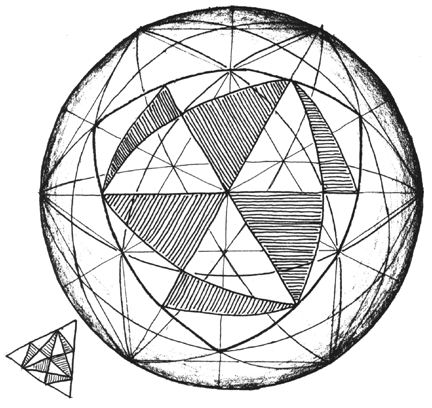
Neither the planar-faceted exterior edges of the icosahedron nor its radius remain the same as that of the vector equilibrium, which, in transforming from the vector equilibrium conformation to the icosahedral state—as witnessed in the jitterbugging (see Sec. 465) — did so by transforming its outer edge lengths as well as its radius. This phenomenon could be analagous the disappearance of the nuclear sphere, which is apparently permitted by the export of its volume equally to the 12 surrounding spheres whose increased diameters would occasion the increased sizing of the icosahedron to maintain the volume 20-ness of the vector equilibrium. This supports the working assumption that the 120 LCD asymmetric tetrahedral volumes are quantitatively equal to the A or B Quanta Modules, being only a mild variation of shape. This effect is confirmed by the discovery that 15 of the 120 LCD Spherical Triangles equally and interiorly subdivide each of the eight spherical octahedron’s triangular surfaces, which spherical octahedron is described by the three-great-circle set of the 25 great circles of the spherical vector equilibrium.
982.59
We may also assume that the pentagonal-faced dodecahedron, which is developed on exactly the same spherical icosahedron, is also another transformation of the same module quantation as that of the icosahedron’s and the vector equilibrium’s prime number five topological identity.
982.60
Without any further developmental use of pi (π) we may now state in relation to the isotropic vector matrix synergetic system, that:
The volume of the sphere is a priori always quantitatively:
— 5F³ as volumetrically referenced to the regular tetrahedron (as volume = 1); or
— 120F³ as referenced to the A and B Quanta Modules.
982.61
Fig. 982.61 Synergetics Isometric of the Isotropic Vector Matrix
Fig. 982.61 Synergetics Isometric of the Isotropic Vector Matrix: See text for full legend. Note the twelve-around-one, closest-packed spheres.
Link to original
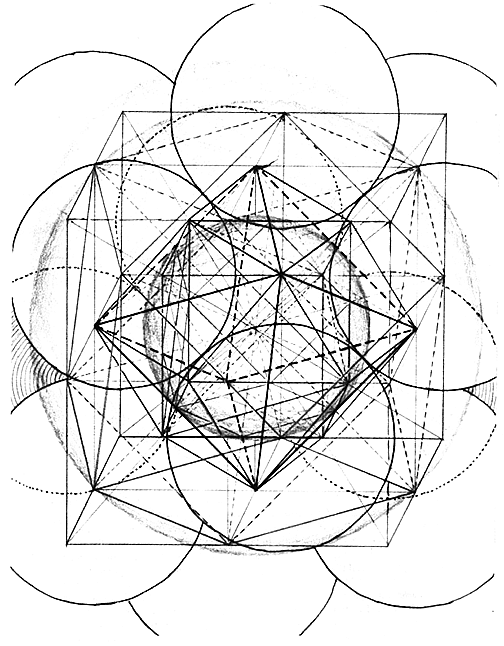
There is realized herewith a succession of concentric, 12-around-one, closest-packed spheres, each of a tetra volume of five; i.e., of 120 A and B Quanta Modules omniembracing our hierarchy of nuclear event patternings. See Illus. 982.61 in the color section, which depicts the synergetics isometric of the isotropic vector matrix and its omnirational, low-order whole number, equilibrious state of the micro-macro cosmic limits of nuclearly unique, symmetrical morphological relativity in their interquantation, intertransformative, intertransactive, expansive-contractive, axially- rotative, operational field. This may come to be identified as the unified field, which, as an operationally transformable complex, is conceptualizable only in its equilibrious state.
982.61A
Cosmic Hierarchy of Omnidirectionally-phased Nuclear-centered, Convergently-divergently Intertransformable Systems: There is realized herewith a succession of concentric, 12-around-one, closest-packed spheres omniembracing our hierarchy of nuclear event patternings. The synergetics poster in color plate 9 depicts the synergetics isometric of the isotropic vector matrix and its omnirational, low-order-whole- number, equilibrious state of the macro-micro cosmic limits of nuclearly unique, symmetrical morphological relativity in their interquantation, intertransformative, intertransactive, expansive-contractive, axially rotative, operational field. This may come to be identified as the unified field, which, as an operationally transformable complex, is conceptualized only in its equilibrious state.
982.62
Table of Concentric, 12-Around-One, Closest-Packed Spheres, Each of a Tetra Volume of Five, i.e., 120 A and B Quanta Modules, Omniembracing Our Hierarchy of Nuclear Event Patternings. (See also Illus. 982.61 in drawings section.)
| Symmetrical Form | Tetra Volumes | A and B Quanta Modules |
|---|---|---|
| F² Sphere | 40 | 960 |
| F² Cube | 24 | 576 |
| F² Vector equilibrium | 20 | 480 |
| F⁰ Rhombic dodecahedron | 6 | 144 |
| F⁰ Sphere (nuclear) | 5 | 120 |
| F⁰ Octahedron | 4 | 96 |
| F⁰ Cube | 3 | 72 |
| F⁰ Vector equilibrium | 2½ | 60 |
| F⁰ Tetrahedron | 1 | 24 |
| F⁰ Skew-aberrated, disequilibrious icosahedron | 5 | 120 |
| F² Skew-aberrated, disequilibrious icosahedron | 40 | 960 |
982.62A
Table of Concentric, 12-around-one, Closest-packed Spheres Omniembracing Our Hierarchy of Nuclear Event Patternings (Revised):
| Symmetrical Form | Tetravolumes | A and B Quanta Modules |
|---|---|---|
| F⁰ Tetrahedron | 1 | 24 |
| F⁰ Vector equilibrium | 2.5 | 60 |
| F⁰ Double-Tet cube | 3 | 72 |
| F⁰ Octahedron | 4 | 96 |
| F⁰ Rhombic triacontahedron* | 5+ | 120+ |
| F⁰ Rhombic dodecahedron | 6 | 144 |
| F² Vector equilibrium | 20 | 480 |
| F² Double-Tet cube | 24 | 576 |
| *The spheric spin domain of the rhombic triacontahedron “sphere.” |
982.63
Sphere and Vector Equilibrium: Sphere = vector equilibrium in combined four-dimensional orbit and axial spin. Its 12 vertexes describing six great circles and six axes. All 25 great circles circling while spinning on one axis produce a spin-profiling of a superficially perfect sphere.
982.64
The vector equilibrium also has 25 great circles (see Sec. 450.10), of which 12 circles have 12 axes of spin, four great circles have four axes of spin, six great circles have six axes of spin, and three great circles have three axes of spin. (12 + 4 + 6 + 3 = 25)
982.65
Vector equilibrium = sphere at equilibrious, ergo zero energized, ergo unorbited and unspun state.
982.70
Hierarchy of Concentric Symmetrical Geometries: It being experimentally demonstrable that the number of A and B Quanta Modules per tetrahedron is 24 (see Sec. 942.10); that the number of quanta modules of all the symmetric polyhedra congruently co-occurring within the isotropic vector matrix is always 24 times their whole regular-tetrahedral-volume values; that we find the volume of the nuclear sphere to be five (it has a volumetric equivalence of 120 A and B Quanta Modules); that the common prime number five topological and quanta-module value identifies both the vector equilibrium and icosahedron (despite their exclusively unique morphologies—see Sec. 905, especially 905.55; that the icosahedron is one of the three-and-only prime structural systems of Universe (see Secs. 610.20 and 1011.30) while the vector equilibrium is unstable—because equilibrious—and is not a structure; that their quanta modules are of equal value though dissimilar in shape; and that though the vector equilibrium may be allspace-fillingly associated with tetrahedra and octahedra, the icosahedron can never be allspace-fillingly compounded either with itself nor with any other polyhedron: these considerations all suggest the relationship of the neutron and the proton for, as with the latter, the icosahedron and vector equilibrium are interexchangingly transformable through their common spherical-state omnicongruence, quantitatively as well as morphologically.
982.71
The significance of this unified field as defining and embracing the minimum- maximum limits of the inherent nuclear domain limits is demonstrated by the nucleus- concentric, symmetrical, geometrical hierarchy wherein the rhombic dodecahedron represents the smallest, omnisymmetrical, selfpacking, allspace-filling, six-tetra-volume, uniquely exclusive, cosmic domain of each and every closest-packed, unit-radius sphere. Any of the closest-packed, unit-radius spheres, when surrounded in closest packing by 12 other such spheres, becomes the nuclear sphere, to become uniquely embraced by four successive layers of surrounding, closest-packed, unit-radius spheres—each of which four layers is uniquely related to that nucleus—with each additional layer beyond four becoming duplicatingly repetitive of the pattern of unique surroundment of the originally unique, first four, concentric-layered, nuclear set. It is impressive that the unique nuclear domain of the rhombic dodecahedron with a volume of six contains within itself and in nuclear concentric array:
— the unity-one-radiused sphere of volume five;
— the octahedron of volume four;
— the cube of volume three;
— the prime vector equilibrium of volume 2 1/2; and
— the two regular (positive and negative) tetrahedra of volume one each.
This succession of 1, 2, 3, 4, 5, 6 rational volume relationships embraces the first four prime numbers 1, 2, 3, and 5. (See Illus. 982.61 in color section.) The volume-24 (tetra) cube is the largest omnisymmetrical self-packing, allspace-filling polyhedron that exactly identifies the unique domain of the original 12-around-one, nuclear-initiating, closest packing of unit-radius spheres. The unit quantum leap of 1—going to 2—going to 3—going to 4—going to 5—going to 6, with no step greater than 1, suggests a unique relationship of this set of six with the sixness of degrees of freedom.⁸
(Footnote 8: For further suggestions of the relationship between the rhombic dodecahedron and the degrees of freedom see Sec. 426 537.10 954.47.)
982.72
The domain limits of the hierarchy of concentric, symmetrical geometries also suggests the synergetic surprise of two balls having only one interrelationship; while three balls have three—easily predictable—relationships; whereas the simplest, ergo prime, structural system of Universe defined exclusively by four balls has an unpredictable (based on previous experience) sixness of fundamental interrelationships represented by the six edge vectors of the tetrahedron.
982.73
The one-quantum “leap” is also manifest when one vector edge of the volume 4 octahedron is rotated 90 degrees by disconnecting two of its ends and reconnecting them with the next set of vertexes occurring at 90 degrees from the previously interconnected-with vertexes, transforming the same unit-length, 12-vector structuring from the octahedron to the first three-triple-bonded-together (face-to-face) tetrahedra of the tetrahelix of the DNA-RNA formulation. One 90-degree vector reorientation in the complex alters the volume from exactly 4 to exactly 3. This relationship of one quantum disappearance coincident to the transformation of the nuclear symmetrical octahedron into the asymmetrical initiation of the DNA-RNA helix is a reminder of the disappearing-quanta behavior of the always integrally end-cohered jitterbugging transformational stages from the 20 tetrahedral volumes of the vector equilibrium to the octahedron’s 4 and thence to the tetrahedron’s 1 volume. All of these stages are rationally concentric in our unified operational field of 12-around-one closest- packed spheres that is only conceptual as equilibrious. We note also that per each sphere space between closest-packed spheres is a volume of exactly one tetrahedron: 6 - 5 = 1.
982.80
Closest Packing of Circles: Because we may now give the dimensions of any sphere as 5Fⁿ, we have no need for pi in developing spheres holistically. According to our exploratory strategy, however, we may devise one great circle of one sphere of unit rational value, and, assuming our circle also to be rational and a whole number, we may learn what the mathematical relationship to pi may be—lengthwise—of our a priori circle as a whole part of a whole sphere. We know that pi is the length of a circle as expressed in the diameters of the circle, a relationship that holds always to the transcendentally irrational number 3.14159. But the relationship of volume 5 to the radius of one of our spheres is not altered by the circumference-to-diameter relationship because we commence with the omnidimensional wholeness of reality.
982.81
We recall also that both Newton and Leibnitz in evolving the calculus thought in terms of a circle as consisting of an infinite number of short chords. We are therefore only modifying their thinking to accommodate the manifest discontinuity of all physical phenomena as described by modern physics when we explore the concept of a circle as an aggregate of short event-vectors—tangents (instead of Newtonian short chords) whose tangential overall length must be greater than that of the circumference of the theoretical circle inscribed within those tangent event-vectors—just as Newton’s chords were shorter than the circle encompassing them.
982.82
If this is logical, experimentally informed thinking, we can also consider the closest-tangential-packing of circles on a plane that produces a non-all-area-filling pattern with concave triangles occurring between the circles. Supposing we allowed the perimeters of the circles to yield bendingly outward from the circular centers and we crowded the circles together while keeping themselves as omni-integrally, symmetrically, and aggregatedly together, interpatterned on the plane with their areal centers always equidistantly apart; we would find then—as floor-tile makers learned long ago—that when closest packed with perimeters congruent, they would take on any one of three and only three possible polygonal shapes: the hexagon, the square, or the triangle—closest-packed hexagons, whose perimeters are exactly three times their diameters. Hexagons are, of course, cross sections through the vector equilibrium. The hexagon’s six radial vectors exactly equal the six chordal sections of its perimeter.
982.83
Assuming the vector equilibrium hexagon to be the relaxed, cosmic, neutral, zero energy-events state, we will have the flexible but not stretchable hexagonal perimeter spun rapidly so that all of its chords are centrifugally expelled into arcs and the whole perimeter becomes a circle with its radius necessarily contracted to allow for the bending of the chords. It is this circle with its perimeter equalling six that we will now convert, first into a square of perimeter six and then into a triangle of perimeter six with the following results:
| Radius | Perimeter | |
|---|---|---|
| Circle | 0.954930 | 6 |
| Hexagon | 1.000000 | 6 (neutral) |
| Square | 1.060660 | 6 |
| Triangle | 1.1546 | 6 |
(In the case of the square, the radius is taken from the center to the comer, not the edge. In the triangle the radius is taken to the comer, not the edge.) We take particular note that the radius of the square phase of the closest-packed circle is 1.060660, the synergetics constant.
982.84
In accomplishing these transformations of the uniformly-perimetered symmetrical shapes, it is also of significance that the area of six equiangular, uniform- edged triangles is reduced to four such triangles. Therefore, it would take more equiperimeter triangular tiles or squares to pave a given large floor area than it would using equiperimetered hexagons. We thus discover that the hexagon becomes in fact the densest-packed patterning of the circles; as did the rhombic dodecahedron become the minimal limit case of self-packing allspace-filling in isometric domain form in the synergetical from-whole-to-particular strategy of discovery; while the rhombic dodecahedron is the six-dimensional state of omni-densest-packed, nuclear field domains; as did the two-frequency cube become the maximum subfrequency self-packing, allspace- filling symmetrical domain, nuclear-uniqueness, expandability and omni- intertransformable, intersymmetrical, polyhedral evolvement field; as did the limit-of- nuclear-uniqueness, minimally at three-frequency complexity, self-packing, allspace-filling, semi-asymmetric octahedron of Critchlow; and maximally by the three-frequency, four- dimensional, self-packing, allspace-filling tetrakaidecahedron: these two, together with the cube and the rhombic dodecahedron constitute the only-four-is-the-limit-system set of self-packing, allspace-filling, symmetrical polyhedra. These symmetrical realizations approach a neatness of cosmic order.
983.00 Spheres and Interstitial Spaces
983.01
Frequency: In synergetics, F =
either, frequency of modular subdivision of one radius;
or, frequency of modular subdivision of one outer chord of a hexagonal equator plane of the vector equilibrium. Thus, F = r, radius; or F = Ch, Chord.
983.02
Sphere Layers: The numbers of separate spheres in each outer layer of concentric spherical layers of the vector equilibrium grows at a rate:
983.03
Whereas the space between any two concentrically parallel vector equilibria whose concentric outer planar surfaces are defined by the spheric centers of any two concentric sphere layers, is always
or
983.04
The difference is the nonsphere interstitial space occurring uniformly between the closest-packed spheres, which is always 6 - 5 = 1 tetrahedron.
984.00 Rhombic Dodecahedron
984.10
The rhombic dodecahedron is symmetrically at the heart of the vector equilibrium. The vector equilibrium is the ever-regenerative, palpitatable heart of all the omniresonant physical-energy hearts of Universe.
985.00 Synergetics Rational Constant Formulas for Area of a Circle and Area and Volume of a Sphere
985.01
We employ the synergetics constant “S,” for correcting the cubical XYZ coordinate inputs to the tetrahedral inputs of synergetics:
S¹ = 1.060660
S² = 1.12487
S³ = 1.1931750
We learn that the sphere of radius 1 has a “cubical” volume of 4.188; corrected for tetrahedral value we have 4.188 × 1.193 = 4.996 = 5 tetrahedra = 1 sphere. Applying the S² to the area of a circle of radius 1, (pi = 3.14159) 3.14159 × 1.125 = 3.534 for the corrected “square” area.
985.02
We may also employ the XYZ to synergetics conversion factors between commonly based squares and equiangled triangles: from a square to a triangle the factor is 2.3094; from a triangle to a square the factor is 0.433. The constant pi 3.14159 × 2.3094 = 7.254 = 7 1/4; thus 7 1/4 triangles equal the area of a circle of radius 1. Since the circle of a sphere equals exactly four circular areas of the same radius, 7 1/4 × 4 = 29 = area of the surface of a sphere of radius 1.
985.03
The area of a hexagon of radius 1 shows the hexagon with its vertexes lying equidistantly from one another in the circle of radius 1 and since the radii and chords of a hexagon are equal, then the six equilateral triangles in the hexagon plus 1 1/4 such triangles in the arc-chord zones equal the area of the circle: 1.25/6 = 0.208 zone arc-chord area. Wherefore the area of a circle of frequency 2 = 29 triangles and the surface of a sphere of radius 2 = 116 equilateral triangles.
985.04
For the 120 LCD spherical triangles S = 4; S = 4 for four greatcircle areas of the surface of a sphere; therefore S for one great-circle area equals exactly one spherical triangle, since 120/4 = 30 spherical triangles vs. 116/4 = 29 equilateral triangles. The S disparity of 1 is between a right spherical triangle and a planar equiangular triangle. Each of the 120 spherical LCD triangles has exactly six degrees of spherical excess, their three corners being 90 degrees, 60 degrees and 36 degrees vs. 90 degrees, 60 degrees, 30 degrees of their corresponding planar triangle. Therefore, 6 degrees per each spherical triangle times 120 spherical triangles amounts to a total of 720 degrees spherical excess, which equals exactly one tetrahedron, which exact excessiveness elucidates and elegantly agrees with previous discoveries (see Secs. 224.07, 224.10, and 224.20).
985.05
The synergetical definition of an operational sphere (vs. that of the Greeks) finds the spheric experience to be operationally always a star-point-vertexed polyhedron, and there is always a 720 degree (one tetrahedron) excess of the Greek’s sphere’s assumption of 360 degrees around each vertex vs. the operational sum of the external angles of any system, whether it be the very highest frequency (seemingly “pure” spherical) regular polyhedral system experience of the high-frequency geodesic spheres, or irregular giraffe’s or crocodile’s chordally-interconnected, outermost-skin-points-defined, polyhedral, surface facets’ corner-angle summation.
985.06
Thus it becomes clear that S = 1 is the difference between the infinite frequency series’ perfect nuclear sphere of volume S and 120 quanta modules, and the four-whole-great-circle surface area of 116 equilateral triangles, which has an exact spherical excess of 720 degrees = one tetrahedron, the difference between the 120 spherical triangles and the 120 equilateral triangles of the 120-equiplanar-faceted polyhedron.
985.07
This is one more case of the one tetrahedron: one quantum jump involved between various stages of nuclear domain intertransformations, all the way from the difference between integral-finite, nonsimultaneous, scenario Universe, which is inherently nonunitarily conceptual, and the maximum-minimum, conceptually thinkable, systemic subdivision of Universe into an omnirelevantly frequenced, tunable set which is always one positive tetrahedron (macro) and one negative tetrahedron (micro) less than Universe: the definitive conceptual vs. finite nonunitarily conceptual Universe (see Secs. 501.10 and 620.01).
985.08
The difference of one between the spheric domain of the rhombic dodecahedron’s six and the nuclear sphere’s five—or between the tetra volume of the octahedron and the three-tetra sections of the tetrahelix—these are the prime wave pulsation propagating quanta phenomena that account for local aberrations, twinkle angles, and unzipping angles manifest elsewhere and frequently in this book.
985.10
Table: Triangular Area of a Circle of Radius 1 F¹ = Zero-one frequency = 7 1/4.
Table of whole triangles only with F = Even N, which is because Even N = closed wave circuit.
| Fᴺ | F² | Triangular Areas of Circle of Radius 1 | ||||
|---|---|---|---|---|---|---|
| Open | 1 | 1 | × 7¼ | 7¼ | ||
| Close | 2 | 4 | × 7¼ | 29 | ||
| Open | 3 | 9 | × 7¼ | (63 + 2¼) | 65¼ | |
| Close | 4 | 16 | × 7¼ | (112 + 4) | 116 | also surface of one sphere |
| Open | 5 | 25 | × 7¼ | (175 + 6¼) | 181¼ | |
| Close | 6 | 36 | × 7¼ | (252 + 9) | 261 |
985.20
Spheric Experience: Experientially defined, the spheric experience, i.e., a sphere, is an aggregate of critical-proximity event “points.” Points are a multidimensional set of crossings of orbits: traceries, foci, fixes, vertexes coming cometlike almost within intertouchability and vertexing within cosmically remote regions. Each point consists of three or more vectorially convergent events approximately equidistant from one approximately locatable and as yet nondifferentially resolved, point; i.e., three or more visualizable, four-dimensional vectors’ most critical proximity, convergently-divergently interpassing region, local, locus, terminal and macrocosmically the most complex of such point events are the celestial stars; i.e., the highest-speed, high-frequency energy event, importing-exporting exchange centers. Microcosmically the atoms are the inbound terminals of such omniorderly exchange systems.
985.21
Spheres are further cognizable as vertexial, star-point-defined, polyhedral, constellar systems structurally and locally subdividing Universe into insideness and outsideness, microcosm-macrocosm.
985.22
Physically, spheres are high-frequency event arrays whose spheric complexity and polyhedral system unity consist structurally of discontinuously islanded, critical-proximity-event huddles, compressionally convergent events, only tensionally and omni-interattractively cohered. The pattern integrities of all spheres are the high- frequency, traffic-described subdivisionings of either tetrahedral, octahedral, or icosahedral angular interference, intertriangulating structures profiling one, many, or all of their respective great-circle orbiting and spinning event characteristics. A11 spheres are highfrequency geodesic spheres, i.e., triangular-faceted polyhedra, most frequently icosahedral because the icosasphere is the structurally most economical.