986.00 T and E Quanta Modules: Structural Model of E=mc²: The Discovery that the E Quanta Module Is the True, Experimentally Evidenceable Model of E=mc²
[986.00-986.874 Demass Model Scenario]
986.010 Narrative Recapitulation
986.011
The exposition herein recounts and recapitulates the original surprise and excitement of the progressive, empirically verified conceptionings; the family of relevant experimental-evidence recalls; the modus operandi; the successive, only-evolutionarily- discovered inputs; and the synergetic comprehension of the omniinterresultant cosmic significance of these strategically employable, synergetically critical additions to human knowledge and their technologically realizable insights.
986.020 Elementary School Definitions
986.021
My first mathematics and geometry teachers taught me games that I learned to play well enough to obtain swiftly the answers for which their (only-axiomatically- argued) assumptions called. Webster’s dictionary states tersely the definitions of the games they taught me. Webster’s definitions are carefully formulated by leading academic authorities and represent the up-to-the-minute concensus of what the educational system assumes geometry, mathematics, and science to consist.
986.022
Webster defines geometry as “the mathematics of the properties, measurements, and relationships of points, lines, angles, surfaces, and solids”— none of which we ourselves observe can exist experientially (ergo, science-verifiably), independently of the others; ergo, they cannot be isolatable “properties” or separate characteristics.
986.023
Physics has found no surfaces and no solids: only localized regions of high- frequency, self-interfering, deflecting, and consequently self-knotting energy events. These self-interference patterns occur in pure principle of ultra-high-frequency intervals and on so minuscule a scale as to prohibit intrusion by anything so dimensionally gross and slow as our fingers. We cannot put our fingers between any two of all the numbers occurring serially between the integer 1 and the integer 2,000,000,000,000—two trillion—as aggregated linearly in one inch. This is the approximate number of atomic domains (the x- illion-per-second, electron-orbited atoms’ individual spinout domains) tangentially arrayable in a row within an experience inch.
986.024
Within each of the electron-orbited spheric domains the respective atomic nuclei are centered as remotely distant from their orbiting electrons as is our Sun from its orbiting planets. Within each of these nuclei complex, high-frequency events are occurring in pure principle of interrelationship.
986.025
How do you see through a solid-glass window? Light passes through glass. Light is high-frequency radiation passing unobstructedly at 700 million miles per hour with lots of time and room “to spare” between the set of energy events that constitute the atomic-event constellation known as “glass.” (In lenses the light caroms off atoms to have its course deliberately and angularly altered.)
986.026
Webster’s definition of mathematics is “the science of dealing with quanitites, forms, etc., and their relationships by the use of numbers and symbols.”
986.027
Webster defines science as “systematized knowledge derived from observation and study.”
986.028
In respect to those definitions I was taught, between 1905 and 1913 at the private preparatory school then most highly regarded by Harvard, that “the properties of a point” are nonexistent—that a point is nondimensional or infradimensional, weightless, and timeless. The teacher had opened the day’s lesson by making a white chalk mark on the cleanly washed-off blackboard and saying, “This is a point.” I was next taught that a line is one dimensional and consists of a “straight” row of nondimensional points—and I am informed that today, in 1978, all schoolchildren around the world are as yet being so taught. Since such a line lacks three-dimensionality, it too is nonexistent to the second power or to “the square root of nonexistence.” We were told by our mathematics teacher that the plane is a raft of tangentially parallel rows of nonexistent lines—ergo, either a third power or a “cube root of nonexistence”—while the supposedly “real” cube of three dimensions is a rectilinear stack of those nonexistent planes and therefore must be either a fourth power or a fourth root of nonexistence. Since the cube lacked weight, temperature, or duration in time, and since its empty 12-edged frame of nonexistent lines would not hold its shape, it was preposterously nondemonstrable—ergo, a treacherous device for students and useful only in playing the game of deliberate self-deception. Since it was arbitrarily compounded of avowedly nonexistent points, the socially accepted three- dimensional reality of the academic system was not “derived from observation and study”— ergo, was to me utterly unscientific.
986.030 Abstraction
986.031
The scientific generalized eternal principle of leverage can be experientially demonstrated, and its rate of lifting-advantage-gain per each additional modular increment of lifting-arm length can be mathematically expressed to cover any and all special case temporal realizations of the leverage principle. Biological species can be likewise generalizingly defined. So in many ways humanity has been able to sort out its experiences and identify various prominent sets and subsets of interrelationship principles. The special- case “oriole on the branch of that tree over there,” the set of all the orioles, the class of all birds, the class of all somethings, the class of all anythings—any one of which anythings is known as X … that life’s experiences lead to the common discovery of readily recognized, differentiated, and remembered generalizable sets of constantly manifest residual interrelationship principles—swiftly persuaded mathematical thinkers to adopt the symbolism of algebra, whose known and unknown components and their relationships could be identified by conveniently chosen empty-set symbols. The intellectuals call this abstraction.
986.032
Abstraction led to the discovery of a generalized family of plus-and-minus interrelationship phenomena, and these generalized interrelationships came to be expressed as ratios and equations whose intermultiplicative, divisible, additive, or subtractive results could—or might—be experimentally (objectively) or experientially (subjectively) verified in substantive special case interquantation relationships.
986.040 Greek Geometry
986.041
It was a very different matter, however, when in supposed scientific integrity mathematicians undertook to abstract the geometry of structural phenomena. They began their geometrical science by employing only three independent systems: one supposedly “straight”-edged ruler, one scribing tool, and one pair of adjustable-angle dividers.
986.042
Realistically unaware that they were on a spherical planet, the Greek geometers were first preoccupied with only plane geometry. These Greek plane geometers failed to recognize and identify the equally important individual integrity of the system upon whose invisibly structured surface they were scribing. The Euclidean mathematicians had a geocentric fixation and were oblivious to any concept of our planet as an includable item in their tool inventory. They were also either ignorant of—or deliberately overlooked—the systematically associative minimal complex of inter-self-stabilizing forces (vectors) operative in structuring any system (let alone our planet) and of the corresponding cosmic forces (vectors) acting locally upon a structural system. These forces must be locally coped with to insure the local system’s structural integrity, which experientially demonstrable force-interaction requirements are accomplishable only by scientific intertriangulations of the force vectors. Their assumption that a square or a cube could hold its own structural shape proves their oblivousness to the force (vector) interpatternings of all structurally stable systems in Universe. To them, structures were made only of stone walls—and stone held its own shape.
986.043
The Ionian Greeks seem to have been self-deceived into accepting as an absolute continuum the surface of what also seemed to them to be absolutely solid items of their experience—whether as randomly fractured, eroded, or ground-apart solids or as humanly carved or molded symmetrical shapes. The Ionian Greeks did not challenge the self-evident axiomatic solid integrity of their superficial-continuum, surface-face-area assumptions by such thoughts as those of the somewhat later, brilliantly intuitive, scientific speculation of Democritus, which held that matter might consist of a vast number of invisible minimum somethings—to which he gave the name “atoms.” All of the Euclidean geometry was based upon axioms rather than upon experimentally redemonstrable principles of physical behavior.
986.044
Webster’s dictionary defines axiom (etymologically from the Greek “to think worthy”) as (1) a maxim widely accepted on its intrinsic merit, and (2) a proposition regarded as self-evident truth. The dictionary defines maxim as (1) a general truth, fundamental principle, or rule of conduct, and (2) a saying of a proverbial nature. Maxim and maximum possibly integratingly evolved as “the most important axiom.” Max + axiom = maxim. The assumption of commonly honored, customarily accredited axioms as the fundamental “building-blocks” of Greek geometry circumvented the ever- experimentally-redemonstrable qualifying requirement of all serious scientific considerations.
986.045
The Ionian Greeks assumed as fundamental geometric components their line- surrounded areas. These areas’ surfaces could be rough, smooth, or polished—just as the smooth surface of the water of the sea could be roughened without losing its identity to them as “the surface.” Looking upon plane geometry as the progenitor of subsequently-to- be-developed solid geometry, it seemed never to have occurred to the Euclideans that the surface on which they scribed had shape integrity only as a consequence of its being a component of a complex polyhedral system, the system itself consisting of myriads of subvisible structural systems, whose a priori structural integrity complex held constant the shape of the geometrical figures they scribed upon—the polyhedral system, for instance, the system planet Earth upon whose ground they scratched their figures, or the stone block, or the piece of bark on which they drew. Even Democritus’s brilliant speculative thought of a minimum thing smaller than our subdimensional but point-to-able speck was speculative exploration a priori to any experimentally induced thinking of complex dynamic interactions of a plurality of forces that constituted structuring in its most primitive sense. Democritus did not think of the atom as a kinetic complex of structural shaping interactions of energy events operating at ultra-high-frequency in pure principle.
986.046
Cubical forms of wood and stone with approximately flat faces and corner angles seemed to the Euclidean-led Ionians to correspond satisfactorily with what was apparently a flat plane world to which trees and humanly erected solid wooden posts and stone columns were obviously perpendicular—ergo, logically parallel to one another. From these only-axiomatically-based conclusions the Ionians developed their arbitrarily shaped, nonstructural, geometrical abstractions and their therefrom-assumed generalizations.
986.047
The Greeks’ generalized geometry commenced with the planar relationships and developed therefrom a “solid” geometry by in effect standing their planes on edge on each of the four sides of a square base and capping this vertical assembly with a square plane. This structure was then subdivided by three interperpendicularly coordinate lines—X, Y, and Z—each with its corresponding sets of modularly interspaced and interparalleled planes. Each of these three sets of interparallel and interperpendicular planes was further subdivisible into modularly interspaced and interparallel lines. Their sets of interparallel and interperpendicular planar and linear modulations also inherently produced areal squares and volumetric cubes as the fundamental, seemingly simplest possible area-and-volume standards of uniform mensuration whose dimensioning increments were based exclusively on the uniform linear module of the coordinate system—whose comprehensive interrelationship values remained constant—ergo, were seemingly generalizable mathematically quite independently of any special case experiential selection of special case lengths to be identified with the linear modules.
986.048
The Euclidean Greeks assumed not only that the millions of points and instant planes existed independently of one another, but that the complex was always the product of endlessly multipliable simplexes—to be furnished by an infinite resource of additional components. The persistence of the Greeks’ original misconceptioning of geometry has also so distorted the conditioning of the human brain-reflexing as to render it a complete 20th-century surprise that we have a finite Universe: a finite but nonunitarily- and-nonsimultaneously accomplished, eternally regenerative Scenario Universe. In respect to such a scenario Universe multiplication is always accomplished only by progressively complex, but always rational, subdivisioning of the initially simplest structural system of Universe: the sizeless, timeless, generalized tetrahedron. Universe, being finite, with energy being neither created nor lost but only being nonsimultaneously intertransformed, cannot itself be multiplied. Multiplication is cosmically accommodated only by further subdivisioning.
986.049
If the Greeks had tried to do so, they would soon have discovered that they could not join tetrahedra face-to-face to fill allspace; whereas they could join cubes face- to-face to fill allspace. Like all humans they were innately intent upon finding the “Building-Block” of Universe. The cube seemed to the Greeks, the Mesopotamians, and the Egyptians to be just what they needed to account their experiences volumetrically. But if they had tried to do so, they would have found that unit-dimensioned tetrahedra could be joined corner-to-corner only within the most compact omnidirectional confine permitted by the corner-to-corner rule, which would have disclosed the constant interspace form of the octahedron, which complements the tetrahedron to fill allspace; had they done so, the Ionians would have anticipated the physicists’ 1922 discovery of “fundamental complementarity” as well as the 1956 Nobel-winning physics discovery that the complementarity does not consist of the mirror image of that which it complements. But the Greeks did not do so, and they tied up humanity’s accounting with the cube which now, two thousand years later, has humanity in a lethal bind of 99 percent scientific illiteracy.
986.050 Unfamiliarity with Tetrahedra
986.051
The distorted conditioning of human reflexing and reasoning persisted in overwhelming the academic point of view—and still does so up to this moment in history. This is nowhere more apparent than in the official reaction to the data and photographs taken on planet Mars by the planet Earth’s scientists from their multistage-rocket- despatched Mariner 9 and Viking orbiters:
But even at the present limits of resolution, some surprising formations have been seen, the most inexplicable of which are the three-sided pyramids found on the plateau of Elysium. Scientists have tried to find a natural geological process that would account for the formation of these pyramids, some of which are two miles across at the base, but as yet their origin is far from being explained. Such tantalizing mysteries may not be fully solved until astronauts are able to make direct observations on the Martian surface.¹
(Footnote 1: David L. Chandler, “Life on Mars,” Atlantic, June 1977.)
986.052
Fig. 986.052 Robot Camera Photograph of Tetrahedra on Mars
Fig. 986.052 Robot Camera Photograph of Tetrahedra on Mars: On their correct but awkward description of these gigantic polyhedra as “three-sided pyramids” the NASA scientists revealed their unfamiliarity with tetrahedra
Link to original
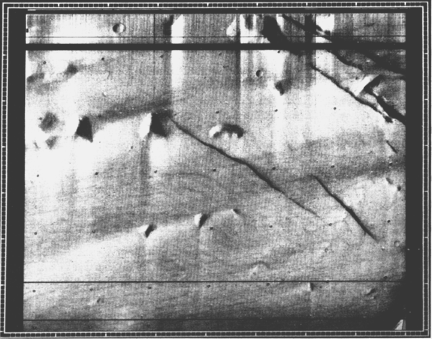
In 1977 the NASA scientists scrutinized the robot-photographed pictures of the close-in Martian scene and reported the—to them—surprise presence on Mars of two (two-mile-base-edged) three-sided pyramids the size of Mount Fuji. The NASA scientists were unfamiliar with the tetrahedron. They remarked that these forms, with whose simplest, primitive character they were unacquainted, must have been produced by wind- blown sand erosion, whereas we have discovered that tetrahedra are always and only a priori to nature’s processes of alteration of her simplest and most primitive polyhedral systems.
986.053
Also suggestive of the same blindness to nature’s reality suffered by the academic world and the scientists who lead it, was van’t Hoff’s late 19th-century identification of the primitive significance of the tetrahedron in the structuring of organic chemistry. (See Sec. 931.60.) His hypothesis was at first scoffed at by scientists. Fortunately, through the use of optical instruments he was able to present visual proof of the tetrahedral configuration of carbon bonds-which experimentally reproduced evidence won him the first Nobel prize awarded a chemist. The Greeks of three millennia ago and today’s “educated” society are prone to assume that nature is primitively disorderly and that symmetrical shapes are accomplished only by human contriving.
986.060 Characteristics of Tetrahedra
986.061
Fig. 986.061 Truncation of Tetrahedra
Fig. 986.061 Truncation of Tetrahedra: Only vertexes and edges may be truncated. (Compare Figs. 987.241 and 1041.11.)
Link to original
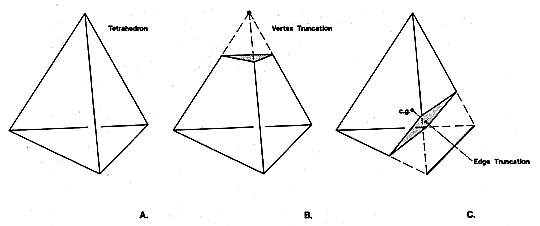
The tetrahedron is at once both the simplest system and the simplest structural system in Universe (see Secs. 402 and 620). All systems have a minimum set of topological characteristics of vertexes, faces, and edges (see Secs. 1007.22 and 1041.10). Alteration of the minimum structural system, the tetrahedron, or any of its structural- system companions in the primitive hierarchy (Sec. 982.61), may be accomplished by either external or internal contact with other systems—which other systems may cleave, smash, break, or erode the simplest primitive systems. Other such polyhedral systems may be transformingly developed by wind-driven sandstorms or wave-driven pebble beach actions. Those other contacting systems can alter the simplest primitive systems in only two topological-system ways:
1. by truncating a vertex or a plurality of vertexes, and
2. by truncating an edge or a plurality of edges.
Faces cannot be truncated. (See Fig. 986.061.)
986.062
Fig. 986.062 Truncated Tetrahedron within Five-frequency Tetra Grid
Fig. 986.062 Truncated Tetrahedron within Five-frequency Tetra Grid: Truncating the vertexes of the tetrahedron results in a polyhedron with four triangular faces and four hexagonal faces. (Compare Figs. 1041.11 and 1074.13.)
Link to original
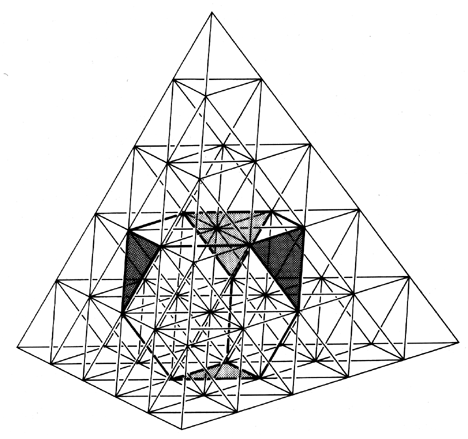
As we have learned regarding the “Platonic solids” carvable from cheese (Sec. 623.10), slicing a polyhedron parallel to one of its faces only replaces the original face with a new face parallel to the replaced face. Whereas truncating a vertex or an edge eliminates those vertexes and edges and replaces them with faces—which become additional faces effecting a different topological abundance inventory of the numbers of vertexes and edges as well. For every edge eliminated by truncation we gain two new edges and one new face. For every corner vertex eliminated by truncation our truncated polyhedron gains three new vertexes, three new edges, and one new face.
986.063
The cheese tetrahedron (Sec. 623.13) is the only one of the primitive hierarchy of symmetrical polyhedral systems that, when sliced parallel to only one of its four faces, maintains its symmetrical integrity. It also maintains both its primitive topological and structural component inventories when asymmetrically sliced off parallel to only one of its four disparately oriented faces. When the tetrahedron has one of its vertexes truncated or one of its edges truncated, however, then it loses its overall system symmetry as well as both its topological and structural identification as the structurally and topologically simplest of cosmic systems.
986.064
We may now make a generalized statement that the simplest system in Universe, the tetrahedron, can be design-altered and lose its symmetry only by truncation of one or more of its corners or edges. If all the tetrahedron’s four vertexes and six edges were to be similarly truncated (as in Fig. 1041.11) there would result a symmetrical polyhedron consisting of the original four faces with an addition of 10 more, producing a 14-faceted symmetrical polyhedron known as the tetrakaidecahedron, or Kelvin’s “solid,” which (as shown in Sec. 950.12 and Table 954.10) is an allspace filler—as are also the cube, the rhombic dodecahedron, and the tetrahedral Mites, Sytes, and Couplers. All that further external alteration can do is produce more vertex and edge truncations which make the individual system consist of a greater number of smaller-dimension topological aspects of the system. With enough truncations—or knocking off of corners or edges—the system tends to become less angular and smoother (smoother in that its facets are multiplying in number and becoming progressively smaller and thus approaching subvisible identification). Further erosion can only “polish off” more of the only-microscopically- visible edges and vertexes. A polished beach pebble, like a shiny glass marble or like a high-frequency geodesic polyhedral “spheric” structure, is just an enormously high- frequency topological inventory-event system.
986.065
Joints, Windows, and Struts: As we have partially noted elsewhere (Secs. 536 and 604), Euler’s three primitive topological characteristics—texes, faces, and *lines—*are structurally identifiable as joints, windows, and push-pull struts, respectively. When you cannot see through the windows (faces), it is because the window consists of vast numbers of subvisible windows, each subvisible-magnitude window being strut- mullion-framed by a complex of substructural systems, each with its own primitive topological and structural components.
986.066
Further clarifying those structural and topological primitive componentation characteristics, we identify the structural congruences of two or more joined-together- systems’ components as two congruent single vertexes (or joints) producing one single, univalent, universal-joint intersystem bonding. (See Secs. 704, 931.20, and Fig. 640.41B.) Between two congruent pairs of interconnected vertexes (or joints) there apparently runs only one apparent (because congruent) line, or interrelationship, or push-pull strut, or hinge.
986.067
Returning to our early-Greek geometry initiative and to the as-yet-persistent academic misconditioning by the Greeks’ oversights and misinterpretations of their visual experiences, we recall how another non-Ionian Greek, Pythagoras, demonstrated and “proved” that the number of square areas of the unit-module-edged squares and the number of cubical module volumes of the unit-module-edged cubes correspond exactly with arithmetic’s second-powerings and third-powerings. The Greeks, and all mathematicians and all scientists, have ever since misassumed these square and cube results to be the only possible products of such successive intermultiplying of geometry’s unit-edge-length modular components. One of my early mathematical discoveries was the fact that all triangles—regular, isosceles, or scalene—may be modularly subdivided to express second-powering. Any triangle whose three edges are each evenly divided into the same number of intervals, and whose edge-interval marks are cross-connected with lines that are inherently parallel to the triangle’s respective three outer edges—any triangle so treated will be subdivided by little triangles all exactly similar to the big triangle thus subdivided, and the number of small similar triangles subdividing the large master triangle will always be the second power of the number of edge modules of the big triangle. In other words, we can say “triangling” instead of “squaring,” and since all squares are subdivisible into two triangles, and since each of those triangles can demonstrate areal second-powering, and since nature is always most economical, and since nature requires structural integrity of her forms of reference, she must be using “triangling” instead of “squaring” when any integer is multiplied by itself. (See Sec. 990.)
986.068
This seemed to be doubly confirmed when I discovered that any nonequiedged quadrangle, with each of its four edges uniformly subdivided into the same number of intervals and with those interval marks interconnected, produced a pattern of dissimilar quadrangles. (See Fig. 990.01.) In the same manner I soon discovered experimentally that all tetrahedra, octahedra, cubes, and rhombic dodecahedra—regular or skew—could be unitarily subdivided into tetrahedra with the cube consisting of three tetra, the octahedron of four tetra, and the rhombic dodecahedron of six similar tetra; and that when any of these regular or skew polyhedras’ similar or dissimilar edges and faces were uniformly subdivided and interconnected, their volumes would always be uniformly subdivided into regular or skew tetrahedra, and that N³ could and should be written and spoken of as N and not as N.
986.069
Nature would use the tetrahedron as the module of subdivision because nature has proven to the physicists and the other physical scientists that she always chooses the most economic realization. Cubes require three times as much Universe as do tetrahedra to demonstrate volumetric content of systems because cubic identification with third-powering used up three times as much volume as is available in Universe. As a result of cubic mensuration science has had to invent such devices as “probability” and “imaginary numbers.” Thus “squaring” and “cubing,” instead of nature’s “triangling” and “tetrahedroning,” account for science’s using mathematical tools that have no physical- model demonstrability—ergo, are inherently “unscientific.”
986.070 Buildings on Earth’s Surface
986.071
In the practical fortress and temple building of the earliest known Mesopotamians, Egyptians, and Greeks their cubes and omnirectilinear blocks seemed readily to fill allspace as they were assembled into fortress or temple walls with plumb bobs, water-and-bubble levels, straightedges, and right-triangle tools. No other form they knew—other than the cube—seemed to fill allspace as demonstrated in practical masonry; wherefore they assumed this to be scientifically demonstrated proof of the generalizability of their mathematically abstracted plane- and solid-geometry system and its XYZ coordination.
986.072
Because of the relatively diminutive size of humans in respect to the size of our planet, world-around society as yet spontaneously cerebrates only in terms of our immediate world’s seeming to demonstrate itself to be a flat plane base, all of the perpendiculars of which—such as trees and humans and human-built local structures- appear to be rising from the Earth parallel to one another—ergo, their ends point in only two possible directions, “up” or “down.” … It’s “a wide, wide world,” and “the four corners of the Earth.”
986.073
It was easy and probably unavoidable for humanity to make the self- deceptive blunders of assuming that a cube held its shape naturally, and not because the stone-cutters or wood-cutters had chosen quite arbitrarily to make it in this relatively simple form. Human’s thought readily accepted—and as yet does—the contradictory abstract state “solid.” The human eye gave no hint of the energetic structuring of the atomic microcosm nor of the omnidynamic, celestial-interpositioning transformations of both macro- and micro-Universe.
986.074
Prior to steel-framed or steel-reinforced-concrete construction methods, humans’ buildings that were constructed only of masonry could not be safely built to a height of over 20 stories—approximately 200 feet high. Such a masonry building was Chicago’s turn-of-the-20th-century world-record Monadnock Building, whose base covered a small but whole city block. It is not until we reach a height of 100 stories—approximately 1000 feet high—that two exactly vertical square columns, each with base edges of 250 feet, built with exactly vertical walls, and touching one another only along one of each of their base edges, will show a one-inch space between them. The rate their vertical walls part from one another is only 1/1000th of an inch for each foot of height.
986.075
Masons’ and carpenters’ linear measuring devices are usually graduated only to 1/16th of an inch, and never finer than 1/32nd of an inch. Thus differentials of a thousandth of an inch are undetectable and are altogether inadvertently overlooked; ergo, they get inadvertently filled-in, or cross-joined, never to have been known to exist even on the part of the most skilled and conscientious of building craftsmen, whose human eyes cannot see intervals of less than 1/100th of an inch.
986.076
Fig. 986.076 Diagram of Verrazano Bridge
Fig. 986.076 Diagram of Verrazano Bridge: The two towers are not parallel to each other.
Link to original
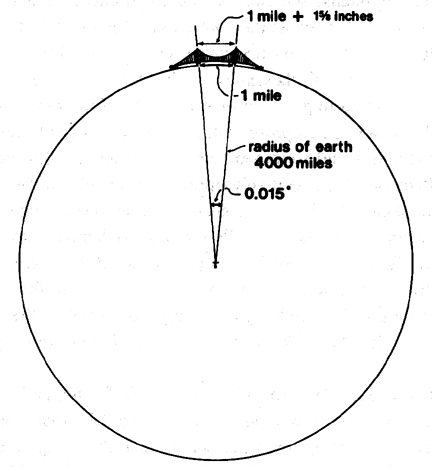
If two exactly-vertical-walled city skyscrapers are built side by side, not until they are two and one-half miles high (the height of Mount Fuji) will there be a space of one foot between the tops of their two adjacent walls. (See Fig. 986.076.) Of course, the farther apart the centers of their adjacent bases, the more rapidly will the tops of such high towers veer away from one another:
The twin towers of New York’s Verrazano Bridge are 693 feet high … soaring as high as a 70-story skyscraper … set almost a mile from each other, the two towers, though seemingly parallel, are an inch and five-eighths farther apart at their summits than at their bases because of the Earth’s curvature.²
(Footnote 2: The Engineer (New York: Time-Life Books, 1967.) If the towers are 12,000 miles apart-that is, halfway around the world from one another-their tops will be built in exactly opposite directions ergo, at a rate of two feet farther apart for each foot of their respective heights.)
986.077
It is easy to understand how humans happened to think it “illogical” to have to consider that all the perpendiculars to a sphere are radii of that sphere—ergo, never parallel to one another. Our humans-in-Universe scale is inherently self-deceptive—ergo, difficult to cope with rigorously.
986.080 Naive Perception of Childhood
986.081
The inventory of experimentally demonstrated discoveries of science which had accrued by the time of my childhood gave me reason to question many of the “abstractions” of geometry as I was being instructed in that subject. Axioms were based on what only seemed “self-evident,” such as the stone block or the “cubical” wooden play blocks of my nursery. To society they “obviously held their shape.” I do not think that I was precocious or in any way a unique genius. I had one brother; he was three years younger than I. His eyesight was excellent; mine was atrocious. I did not get my first eyeglasses until my younger brother was running around and talking volubly. He could see things clearly; I could not. Our older sister could also see things clearly. I literally had to feel my way along—tactilely—in order to recognize the “things” of my encountered environment-ergo, my deductions were slow in materializing. My father called my younger brother “stickly-prickly” and he called me “slow-and-solid”-terms he adopted from “The Jaguar and the Armadillo” in Kipling’s Just So Stories.
986.082
I was born cross-eyed on 12 July 1895. Not until I was four-and-a-half years old was it discovered that I was also abnormally farsighted. My vision was thereafter fully corrected with lenses. Until four-and-a-half I could see only large patterns—houses, trees, outlines of people—with blurred coloring. While I saw two dark areas on human faces, I did not see a human eye or a teardrop or a human hair until I was four. Despite my newly gained ability—in 1899—to apprehend details with glasses, my childhood’s spontaneous dependence upon only big-pattern clues has persisted. All that I have to do today to reexperience what I saw when I was a child is to take off my glasses, which, with some added magnification for age, have exactly the same lens corrections as those of my first five-year-old pair of spectacles. This helps me to recall vividly my earliest sensations, impressions, and tactical assumptions.
986.083
I was sent to kindergarten before I received my first eyeglasses. The teacher, Miss Parker, had a large supply of wooden toothpicks and semidried peas into which you could easily stick the sharp ends of the toothpicks. The peas served as joints between the toothpicks. She told our kindergarten class to make structures. Because all of the other children had good eyesight, their vision and imagination had been interconditioned to make the children think immediately of copying the rectilinearly framed structures of the houses they saw built or building along the road. To the other children, horizontally or perpendicularly parallel rectilinear forms were structure. So they used their toothpicks and peas to make cubic and other rectilinear models. The semidried peas were strong enough to hold the angles between the stuck-in toothpicks and therefore to make the rectilinear forms hold their shapes—despite the fact that a rectangle has no inherent self-structuring capability.
986.084
In my poor-sighted, feeling-my-way-along manner I found that the triangle—I did not know its name-was the only polygon—I did not know that word either-that would hold its shape strongly and rigidly. So I naturally made structural systems having interiors and exteriors that consisted entirely of triangles. Feeling my way along I made a continuous assembly of octahedra and tetrahedra, a structured complex to which I was much later to give the contracted name “octet truss.” (See Sec. 410.06). The teacher was startled and called the other teachers to look at my strange contriving. I did not see Miss Parker again after leaving kindergarten, but three-quarters of a century later, just before she died, she sent word to me by one of her granddaughters that she as yet remembered this event quite vividly.
986.085
Three-quarters of a century later, in 1977, the National Aeronautics and Space Administration (NASA), which eight years earlier had put the first humans on the Moon and returned them safely to our planet Earth, put out bids for a major space-island platform, a controlled-environment structure. NASA’s structural specifications called for an “octet truss” —my invented and patented structural name had become common language, although sometimes engineers refer to it as “space framing.” NASA’s scientific search for the structure that had to provide the most structural advantages with the least pounds of material—ergo, least energy and seconds of invested time-in order to be compatible and light enough to be economically rocket-lifted and self-erected in space—had resolved itself into selection of my 1899 octet truss. (See Sec. 422.)
986.086
It was probable also that my only-insectlike, always-slow, cross-referencing strategy of touching, tasting, smelling, listening, and structurally testing by twisting and pounding and so forth—to which I spontaneously resorted—made me think a great deal about the fact that- when I broke a piece of glass or a stone or a wooden cube apart, it did not separate naturally into little cubes but usually into sharp pointed shapes. In the earliest of my memories I was always suspicious of the integrity of cubes, which only humans seemed to be introducing into the world. There were no cubical roses, eggs, trees, clouds, fruits, nuts, stones, or anything else. Cubes to me were unnatural: I observed humans deliberately sawing ice into large rectilinear cakes, but window glass always broke itself into predominantly triangular pieces; and snowflakes formed themselves naturally into a myriad of differently detailed, six-triangled, hexagonal patterns.
986.087
I was reacting normally in combining those spontaneous feelings of my childhood with the newly discovered knowledge of the time: that light has speed (it is not instantaneous, and comes in smallest packages called photons); that there is something invisible called electricity (consisting of “invisible behaviors” called electrons, which do real work); and that communication can be wireless, which Marconi had discovered the year I was born—and it is evident that I was reacting normally and was logically unable to accept the customarily honored axioms that were no longer “self-evident.”
986.088
My contemporaries and I were taught that in order to design a complete and exact sphere and have no materials left over, we must employ the constant known as pi (pi), which I was also taught was a “transcendentally irrational number,” meaning it could never be resolved. I was also informed that a singly existent bubble was a sphere; and I asked, To how many places does nature carry out pi when she makes each successive bubble in the white-cresting surf of each successive wave before nature finds out that pi can never be resolved? … And at what moment in the making of each separate bubble in Universe does nature decide to terminate her eternally frustrated calculating and instead turn out a fake sphere? I answered myself that I don’t think nature is using pi or any of the other irrational fraction constants of physics. Chemistry demonstrates that nature always associates or disassociates in whole rational increments… Those broken window shards not only tended to be triangular in shape, but also tended to sprinkle some very fine polyhedral pieces. There were wide ranges of sizes of pieces, but there were no pieces that could not “make up their minds” or resolve which share of the original whole was theirs. Quite the contrary, they exploded simultaneously and unequivocally apart.
986.089
At first vaguely, then ever more excitedly, precisely, and inclusively, I began to think and dream about the optimum grand strategy to be employed in discovering nature’s own obviously elegant and exquisitely exact mathematical coordinate system for conducting the energetic transactions of eternally regenerative Universe. How does nature formulate and mass-produce all the botanical and zoological phenomena and all the crystals with such elegant ease and expedition?
986.090 The Search for Nature’s Coordinate System
986.091
Several things were certain: nature is capable of both omnidirectional disorderly, dispersive, and destructive expansion and omnidirectional collective, selective sorting and constructive contraction; and rays of candlelight are not parallel to one another. I decided to initiate my search for nature’s coordinate system by assuming that the coordinate system must be convergently and divergently interaccommodative. That the seasons of my New England childhood brought forth spectacular transformations in nature’s total interpatterning; that the transformations were not simultaneous nor everywhere the same; that there were shaded and Sun-shined-upon area variables; and that they were all embraced by a comprehensive coordination—altogether made me dream of comprehending the comprehensively accommodating coordinate system that had no separate departments of chemistry, physics, biology, mathematics, art, history, or languages. I said nature has only one department and only one language.
986.092
These thoughts kept stimulating my explorations for the totally accommodative coordinate system. Einstein’s conclusion-that the definitive, maximum possible speed of light rendered astronomical phenomena an aggregate of nonsimultaneous and only partially overlapping, differently enduring energy events—greatly affected the increasing inventory of my tentative formulations of the interaccommodative requirements of the cosmic coordination system which I sought. I was driven by both consciously and subconsciously sustained intuition and excitement. This was very private, however. I talked to no one about it. It was all very remote from that which seemed to characterize popular interest.
986.093
The youthful accruals of these long-sustained private observations, cogitations, and speculations were enormously helpful when I decided at the age of 32, in my crisis year of 1927, to abandon the game of competitive survival (a game I had been taught to believe in as thought-out, managed, and evolved entirely by others) and instead to rely completely upon my own thinking and experience-suggested inclinations … to find out how Universe is organized and what it is doing unbeknownst to humans. Why are humans here in Universe? What should we be doing to fulfill our designed functioning in Universe? Surely all those stars and galaxies were not designed only to be romantic scenery for human moods. What am I designed to be able to comprehend about Universe? What are we humans designed to be able to do for one another and for our Universe?
986.094
Expanding Universe: My determination to commit myself completely to the search for nature’s raison d’ˆtre and for its comprehensive coordinate system’s mathematics was greatly reinforced by the major discovery of the astronomer E. P. Hubble in 1924. He discovered an expanding macrocosmic system with all the myriads of galaxies and their respective stellar components at all times maintaining the same interangular orientations and relative interdistancings from one another while sum-totally and omnisymmetrically expanding and moving individually away from one another, and doing so at astronomical speeds. This discovery of Hubble’s became known as Expanding Universe.
986.095
The only way humans can expand their houses is by constructing lopsided additions to their rectilinearly calculated contriving. People found that they could “blow up” rubber-balloon spheres to increase their radii, but they couldn’t blow up their buildings except by dynamite. They called their wooden “2 × 4,” and “2 × 6,” and “2 × 8- inch” cross-section, wooden-timber nail-ups “balloon framing,” but why they selected that name was difficult to explain.
986.096
Fig. 986.096 4-D Symbol
Fig. 986.096 4-D Symbol: Adopted by the author in 1928 to characterize his fourth-dimensional mathematical explorings.
Link to original
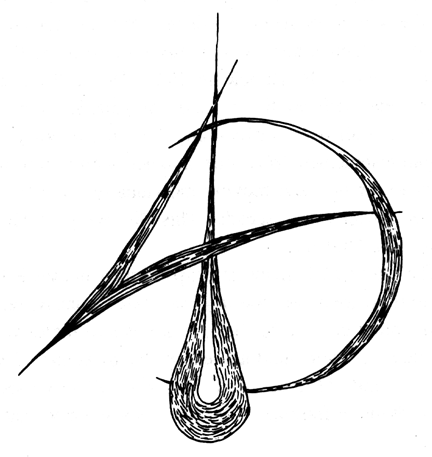
My insights regarding nature’s coordinate system were greatly enhanced by two of Milton Academy’s greatest teachers: Homer LeSourd in physics and William Lusk Webster Field (“Biology Bill”) in biology. During the summer vacation of 1906, at 11 years of age I designed and built my first small but exciting experimental dwelling on our family’s small mid-Penobscot Bay island. Living all my youthful summers on that island, with its essential boat-building, boat-modifying, boat-upkeep, and boat-sailing, followed by five years as a line officer in the regular U.S. Navy with some of my own smaller-craft commands, some deck-officering on large craft of the new era’s advanced technology ships, together with service involving airplanes, submarines, celestial navigation, ballistics, radio, and radiotelephone; then resignation from the Navy followed by five more private- enterprise years developing a new building system, inventing and installing its production tools, managing the production of the materials, and erecting therewith 240 residences and small commercial buildings—altogether finally transformed my sustained activity into full preoccupation with my early-boyhood determination some day to comprehend and codify nature’s omniintertransformative, omnidirectional, cosmic coordination system and its holistic, only-experientially-proven mathematics. In 1928, inspired and fortified by Hubble’s Expanding Universe discovery, I gave the name and its symbol 4-D to my mathematical preoccupations and their progressively discovered system codifying. In 1936 I renamed my discipline “Energetic Vectorial Geometry.” In 1938 I again renamed it “Energetic-synergetic Geometry,” and in 1970 for verbal economy contracted that title to “Synergetics.” (See Fig. 986.096.)
986.100 Sequence of Considerations
986.101
At the outset of my lifelong search for nature’s omnirational coordination system of mathematical interaccounting and intertransformability I proceeded through a sequence of considerations which may be enumerated as follows:
986.110 Consideration 1: Energetic Vectors
986.111
I first determined to employ only vectors for lines. I realized that operationally all lines are always trajectories of energy events, either as the energy invested by humans in the work of carving or depositing linearly—which we call “drawing” a line—or as the inanimately articulated energy of force lines.
986.112
Vectors always represent energy forces of given magnitude operating at given angles upon given entities at given loci, and vectors may always be demonstrated by lines representing given mass moving at given velocity in unique angular direction in respect to a given axis of observation. Vectors do not occur singly: They occur only as the total family of forces interacting in any given physical circumstance.
986.113
Vectors always have unique length, that length being the product of the mass and the velocity as expressed in a given modular system of measurement. Vectors do not have inherent extendibility to infinity—as did the lines of my boyhood’s schoolteachers. Vectors are inherently terminal. Vectors bring into geometry all the qualities of energetic reality lacking in Euclidean geometry: time and energy-energy differentially divergent as radiation (velocity) and energy integratively convergent as matter (mass). Velocity and mass could be resolved into numerically described time and temperature components.
986.120 Consideration 2: Avogadro’s Constant Energy Accounting
986.121
Avogadro discovered that under identical conditions of pressure and heat all elements in their gaseous state always consist of the same number of molecules per given volume. Since the chemical elements are fundamentally different in electron-proton componentation, this concept seemed to me to be the “Grand Central Station” of nature’s numerical coordinate system’s geometric volume-that numerically exact volumes contain constant, exact numbers of fundamental energy entities. This was the numerical and geometrical constancy for which I was looking. I determined to generalize Avogadro’s experimentally proven hypothesis that “under identical conditions of heat and pressure all gases disclose the same number of molecules per given volume.” (See Secs. 410.03-04.)
986.122
Here were Physical Universe’s natural number quantations being constantly related to given volumes. Volumes are geometrical entities. Geometrically defined and calculated volumes are polyhedral systems. Polyhedra are defined by edge lines, each of which must be a vector.
986.123
Within any given volumetrically contained gaseous state the energy kinetics of molecules are everywhere the same. The outward pressure of air against the enclosing tube wall and casing of any one automobile tire is everywhere the same. Pressure and heat differentials involve isolated conditions—isolated by containers; ergo, special cases. To me this meant that we could further generalize Avogadro by saying that “under identical, uncontained, freely self-interarranging conditions of energy all chemical elements will disclose the same number of fundamental somethings per given volume.” This constant- volume-population-and-omniequilibrious-energy relationship would require physically demonstrable, substantive, geometrical combining of a given number of unique energetic- event entities per unit volume with constant-angularly-defined positional orientation integrities. This meant that the vectorially structured shapes of the volumes accommodating given numbers of most primitive energy events must be experientially demonstrable.
986.130 Consideration 3: Angular Constancy
986.131
I said that since vectors are physically modelable structural components, they produce conceptual structural models of energy events, and since my hypothetical generalization of Avogadro’s law requires that “all the conditions of energy be everywhere the same,” what does this condition look like as structured in vectorial geometry? Obviously all the vectors must be the same length and all of them must interact at the same angles. I said: It will make no difference what length is employed so long as they are all the same length. Linear size is special case. Special case occurs only in time. Angles are cosmically constant independently of time-size considerations.
986.140 Consideration 4: Isotropic Vector Model
986.141
I said, Can you make a vector model of this generalization of Avogadro? And I found that I had already done so in that kindergarten event in 1899 when I was almost inoperative visually and was exploring tactilely for a structural form that would hold its shape. This I could clearly feel was the triangle—with which I could make systems having insides and outsides. This was when I first made the octet truss out of toothpicks and semidried peas, which interstructuring pattern scientists decades later called the “isotropic vector matrix,” meaning that the vectorial lengths and interanglings are everywhere the same. (See Sec. 410.06.)
986.142
This matrix was vectorially modelable since its lines, being vectors, did not lead to infinity. This isotropic vector matrix consists of six-edged tetrahedra plus 12-edged octahedra—multiples of six. Here is an uncontained omniequilibrious condition that not only could be, but spontaneously would be, reverted to anywhen and anywhere as a six- dimensional frame of transformative-evolution reference, and its vector lengths could be discretely tuned by uniform modular subdivisioning to accommodate any desired special case wavelength time-size, most economically interrelated, transmission or reception of physically describable information. (Compare Secs. 639.02 and 1075.10.)
986.143
Since the vectors are all identical in length, their intersection vertexes become the nuclear centers of unit-radius spheres in closest-packed aggregation—which closest packing is manifest by atoms in their crystal growth. All the foregoing brought the adoption of my vectorial geometry’s everywhere-the-same (isotropic) vector matrix as the unified field capable of accommodating all of Physical Universe’s intertransformative requirements.
986.150 Consideration 5: Closest Packing of Spheres
986.151
I had thus identified the isotropic vector matrix with the uniform linear distances between the centers of unit radius spheres, which aggregates became known later—in 1922—as “closest-packed” unit-radius spheres (Sec. 410.07 ), a condition within which we always have the same optimum number of the same “somethings”—spheres or maybe atoms—per given volume, and an optimally most stable and efficient aggregating arrangement known for past centuries by stackers of unit-radius coconuts or cannonballs and used by nature for all time in the closest packing of unit-radius atoms in crystals.
986.160 Consideration 6: Diametric Unity
986.161
Fig. 986.161 Diametric Unity
Fig. 986.161 Diametric Unity: The vectors of the isotropic vector matrix interconnect the spheric centers of any two tangentially adjacent spheres. The radii of the two spheres meet at the kissing point and are each one-half of the system vector. Unity is plural and at minimum two.
Link to original
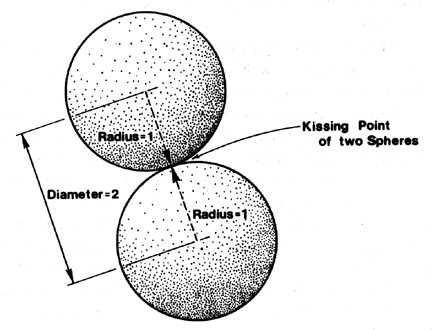
The installation of the closest-packed unit-radius spheres into their geometrical congruence with the isotropic vector matrix showed that each of the vectors always reaches between the spheric centers of any two tangentially adjacent spheres. This meant that the radius of each of the kissing spheres consists of one-half of the interconnecting vectors. Wherefore, the radius of our closest-packed spheres being half of the system vector, it became obvious that if we wished to consider the radius of the unit sphere as unity, we must assume that the value of the vector inherently interconnecting two unit spheres is two. Unity is plural and at minimum two. Diameter means dia- meter — unit of system measurement is two.
986.162
Fig. 986.161 shows one vector D whose primitive value is two. Vectors are energy relationships. The phenomenon relationship exists at minimum between two entities, and the word unity means union, which is inherently at minimum two. “Unity is plural and at minimum two” also at the outset became a prime concept of synergetics vectorial geometry. (See Sec. 540.10.)
986.163
1 R + 1 R = 2 R
2 R = Diameter
Diameter is the relative-conceptual-size determinant of a system. A diameter is the prime characteristic of the symmetrical system. The separate single system = unity. Diameter describes unity. Unity = 2. (See Secs. 905.10 and 1013.10.)
986.164
One by itself is nonexistent. Existence begins with awareness. Awareness begins with observable otherness. (See Secs. 264 and 981.)
986.165
Understanding means comprehending the interrelationship of the observer and the observed. Definitive understanding of interrelationships is expressed by ratios.
986.166
At the outset of my explorations I made the working assumption that unity is two, as combined with the experimentally demonstrable fact that every system and every systemic special case sphere is at once both a concave and a convex sphere—ergo, always inherently two spheres. Reflective concave surfaces convergently concentrate all impinging radiation, and reflective convex surfaces divergently diffuse all impinging radiation. Though concave and convex are inherently congruent as they are always-and- only coexisting, they are also diametrically opposed physical behavior phenomena—ergo, absolutely different because the one diffuses the energies of Universe, producing macrocosmic dispersion, and the other concentrates the energies of Universe, producing microcosmic convergence. Concave and convex are explicitly two opposites cosituate (congruent) geometrically as one. This led me to the working assumption at the outset of my—thus far—60-year exploration for nature’s own coordinate system, that unity is inherently plural and at minimum is to be dealt with as the value two, which twoness might well coexist with other numbers of inherent properties of primary-existence systems.
986.170 Consideration 7: Vector Equilibrium
986.171
I then identified this closest-packed-spheres isotropic vector matrix as a generalized field condition of the everywhere-and-everywhen most economically interaccommodating of any plurality of nuclearly convergent-divergent, importively organizing, and exportingly info-dispensing energy events—while also providing for any number of individually discrete, overlappingly co-occurrent, frequency differentiated info- interexchangings—ergo, to be always accommodative of any number of co-occurrent, individual-pattern-integrity evolutionary scenarios.
986.172
Thus the eternally regenerative Universe, embracing the minimum complex of intercomplementary transformations necessary to effect total regeneration, becomes comprehensively accommodated by the only generalizably definable Scenario Universe as the condition of the vector equilibrium, an everywhere-everywhen condition at which nature refuses to pause, but through which most economically accommodating field of operational reference she pulsates her complex myriads of overlapping, concurrent, local intertransformings and aberrative structurings. I then invented the symbol to identify vector equilibrium.
986.180 Consideration 8: Concentric Polyhedral Hierarchy
986.181
Thereafter I set about sorting out the relative numbers and volumes of the most primitive hierarchy of symmetrically structured polyhedral-event “somethings”—all of which are always concentrically congruent and each and all of which are to be discovered as vertexially defined and structurally coexistent within the pre-time-size, pre- frequency-modulated isotropic vector matrix. (See Sec. and Fig. 982.61.)
986.190 Consideration 9: Synergetics
986.191
This book Synergetics (volumes 1 and 2) embraces the record of the lifetime search, research, sorting-outs, and structural-intertransforming experiments based upon the foregoing eight considerations, all of which I had adopted by 1927. This 1927 inventory has been progressively amplified by subsequent experience-induced considerations.