986.301 Consideration 11: Maximum-limit Case
986.302
The explorer gains assurance by discovering the relevant minimum-maximum limit cases—the min-max limits of the variables—of the system under consideration.
986.303
For instance, we have learned through experimental evidence, the cosmic hierarchy of primitive polyhedra has a limit set of seven axes of great-circle symmetries and spinnabilities. They are the 3, 4, 6 (VE), 12, 10, 15, 6 (icosa) great-circle-spinnable systems. (See Table 986.304 and Sec. 1040.) Within that inherently limited hierarchy of seven symmetries, the triacontahedron, with its 15 different great circles’ self- hemispherings and 120 triangular interconfigurings, produces the maximum-limit number of identical polyhedral surface self-facetings of all great-circle systems in Universe (Sec. 400).
Table 986.304: Limit Set of Seven Axes of Spinnability
Generalized Set of All Symmetrical Systems
| Spinnable System | Great Circles |
|---|---|
| #1 | 3 |
| #2 | 4 |
| #3 | 6 (VE) |
| #4 | 12 |
| #5 | 10 |
| #6 | 15 |
| #7 | 6 (icosa) |
(Compare Secs. 1041.01 and 1042.05.)
986.310 Strategic Use of Min-max Cosmic System Limits
986.311
The maximum limit set of identical facets into which any system can be divided consists of 120 similar spherical right triangles ACB whose three corners are 60 degrees at A, 90 degrees at C, and 36 degrees at B. Sixty of these right spherical triangles are positive (active), and 60 are negative (passive). (See Sec. 901.)
986.312
These 120 right spherical surface triangles are described by three different central angles of 37.37736814 degrees for arc AB, 31.71747441 degrees for arc BC, and 20.90515745 degrees for arc AC—which three central-angle arcs total exactly 90 degrees. These 120 spherical right triangles are self-patterned into producing 30 identical spherical diamond groups bounded by the same central angles and having corresponding flat-faceted diamond groups consisting of four of the 120 angularly identical (60 positive, 60 negative) triangles. Their three surface corners are 90 degrees at C, 31.71747441 degrees at B, and 58.2825256 degrees at A. (See Fig. 986.502.)
986.313
These diamonds, like all diamonds, are rhombic forms. The 30-symmetrical- diamond system is called the rhombic triacontahedron: its 30 mid-diamond faces (right- angle cross points) are approximately tangent to the unit-vector-radius sphere when the volume of the rhombic triacontahedron is exactly tetravolume-5. (See Fig. 986.314.)
986.314
Fig. 986.314
Fig. 986.314 Polyhedral Profiles of Selected Polyhedra of Tetravolume-5 and Approximately Tetravolume-5: A graphic display of the radial proximity to one another of exact and neighboring tetravolume-5 polyhedra, showing central angles and ratios to prime vector.
Link to original
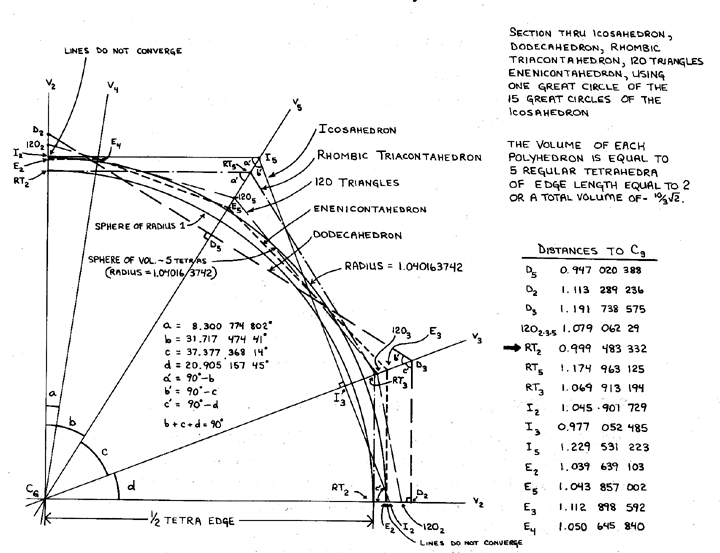
I therefore asked Robert Grip and Chris Kitrick to prepare a graphic comparison of the various radii and their respective polyhedral profiles of all the symmetric polyhedra of tetravolume 5 (or close to 5) existing within the primitive cosmic hierarchy (Sec. 982.62) —i.e. other than those of tetravolumes 1, 2, 3, 4, and 6—which carefully drafted drawing of the tetravolume-5 polyhedra (and those polyhedra “approximately” tetravolume S) my colleagues did prepare (see Fig. 986.314). These exactly tetravolume-5 polyhedra are, for example—
a. the icosahedron with outer edges of unit vector length;
b. the icosahedron of outer vertex radius of unit vector length;
c. the regular dodecahedron of unit vector edge; and
d. the regular dodecahedron of unit vector radius
—all of which show that they have only a slightly greater radius length than that of the prime vector.
986.315
The chart of the polyhedral profiles (Fig. 986.314) shows the triacontahedron of tetravolume 5 having its mid-diamond-face point C at a distance outward radially from the volumetric center that approximately equals the relative length of the prime vector. I say “approximately” because the trigonometrically calculated value is .999483332 instead of 1, a 0.0005166676 radial difference, which—though possibly caused in some very meager degree by the lack of absolute resolvability of trigonometric calculations themselves—is on careful mathematical review so close to correct as to be unalterable by any known conventional trigonometric error allowance. It is also so correct as to hold historical significance, as we shall soon discover. Such a discrepancy is so meager in relation, for instance, to planet Earth’s spheric diameter of approximately 8,000 miles that the spherical surface aberration would be approximately the same as that existing between sea level and the height of Mount Fuji, which is only half the altitude of Mount Everest. And even Mount Everest is invisible on the Earth’s profile when the Earth is photographed from outer space. The mathematical detection of such meager relative proportioning differences has time and again proven to be of inestimable value to science in first detecting and then discovering cosmically profound phenomena. In such a context my “spherical energy content” of 4.99, instead of exactly 5, became a thought-provoking difference to be importantly remembered.
986.316
By careful study of the Grip-Kitrick drawings of tetravolume-5 polyhedra it is discovered that the graphically displayed zones of radial proximity to one another of all the tetravolume-5 symmetric polyhedra (Fig. 986.314) describe such meager radial differences at their respective systems’ outermost points as to suggest that their circumferential zone enclosed between the most extremely varied and the most inwardly radiused of all their axially spun vertexes of the exact tetravolume-5 polyhedra may altogether be assumed to constitute the zone of limit cases of radiantly swept-out and pulsating tetravolume-5 kinetic systems.
986.317
Recognizing that polyhedra are closed systems and that there are only seven cases of symmetrical subdivisioning of systems by the most economical great-circle spinnings (and most economically by the chords of the great-circle arcs), we discover and prove structurally that the maximum-limit abundance of a unit-symmetrical-polyhedral- system’s identical facetings is the rhombic triacontahedron, each of whose 30 symmetrical diamond planar faces may be symmetrically subdivided into four identical right triangles (30 × 4=120), and we find that the triacontahedron’s 120-spherical-right-triangled frame of system reference is the maximum-limit case of identical faceting of any and all symmetrical polyhedral systems in Universe. This maximum-limit-system structuring proof is accomplished by the physically permitted, great-circle-spun, hemispherical self-halvings, as permitted by any and all of the seven cosmic limit cases of symmetric systems’ being spun-defined around all the respective system’s geometrically definitive (ergo, inherent) axes of symmetrical spinnability. It is thus that we learn experimentally how all the symmetric systems of Universe self-fractionate their initial system unities into the maximum number of omniangularly identical surface triangles outwardly defining their respective internal-structure tetrahedra whose angles-central or surface-are always independent of a system’s time-size considerations. And because they are independent of time-size considerations, such minimum-maximum limit-case ranges embrace all the symmetrical polyhedral systems’ generalized-primitive-conceptuality phenomena.