986.401 Consideration 12: Dynamic Spinning of Rhombic Triacontahedron
986.402
I then speculated that the only-by-spinning-produced, only superficially apparent “sphericity” could be roundly aspected by spinning the rhombic triacontahedron of tetravolume 5. This rational volumetric value of exactly 5 tetravolumes placed the rhombic triacontahedron neatly into membership in the primitive hierarchy family of symmetric polyhedra, filling the only remaining vacancy in the holistic rational-number hierarchy of primitive polyhedral volumes from 1 through 6, as presented in Table 1053.51A.
986.403
In the isotropic vector matrix system, where R = radius and PV = prime vector, PV = 1 = R—ergo, PVR = prime vector radius, which is always the unity of VE. In the 30-diamond-faceted triacontahedron of tetravolume 5 and the 12-diamond-faceted dodecahedron of tetravolume 6, the radius distances from their respective symmetric polyhedra’s volumetric centers O to their respective mid-diamond faces C (i.e., their short- and-long-diamond-axes’ crossing points) are in the rhombic triacontahedral case almost exactly PVR—i.e., 0.9994833324 PVR—and in the rhombic dodecahedral case exactly PVR, 1.0000 (alpha) PVR.
986.404
In the case of the rhombic dodecahedron the mid-diamond-face point C is exactly PVR distance from the polyhedral system’s volumetric (nucleic) center, while in the case of the rhombic triacontahedron the point C is at approximately PVR distance from the system’s volumetric (nucleic) center. The distance outward to C from the nucleic center of the rhombic dodecahedron is that same PVR length as the prime unit vector of the isotropic vector matrix. This aspect of the rhombic triacontahedron is shown at Fig. 986.314.
986.405
Fig. 986.405
Fig. 986.405 Respective Subdivision of Rhombic Dodecahedron (A) and Rhombic Triacontahedron (B) into Diamond-faced Pentahedra: O is at the respective volumetric centers of the two polyhedra, with the short axes A-A and the long axes B-B (diagrams on the right). The central surface angles of the two pentahedra differ as shown.
Link to original
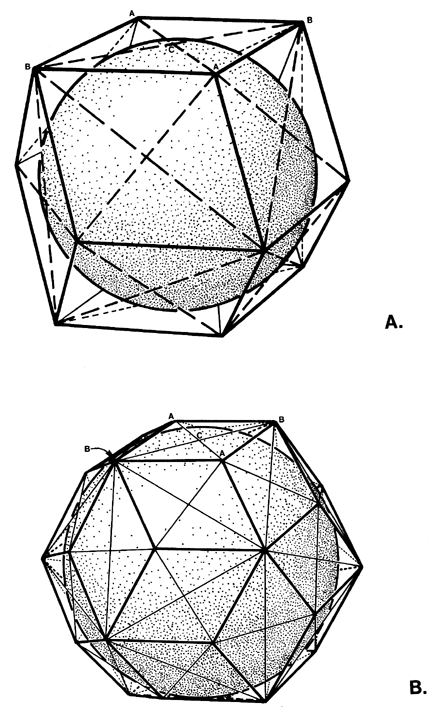
The symmetric polyhedral centers of both the rhombic dodecahedron and the rhombic triacontahedron may be identified as 0, and both of their respective external diamond faces’ short axes may be identified as A-A and their respective long axes as B-B. Both the rhombic dodecahedron’s and the triacontahedron’s external diamond faces ABAB and their respective volumetric centers O describe semiasymmetric pentahedra conventionally labeled as OABAB. The diamond surface faces ABA of both OABAB pentahedra are external to their respective rhombic-hedra symmetrical systems, while their triangular sides OAB (four each) are internal to their respective rhombichedra systems. The angles describing the short A-A axis and the long B-B axis, as well as the surface and central angles of the rhombic dodecahedron’s OABAB pentahedron, all differ from those of the triacontahedron’s OABAB pentahedron.
986.410 T Quanta Module
986.411
Fig. 986.411A T and E Quanta Modules Lengths
Fig. 986.411A T and E Quanta Modules: Edge Lengths: This plane net for the T Quanta Module and the E Quanta Module shows their edge lengths as ratioed to the octa edge. Octa edge = tetra edge = unity.
Link to original
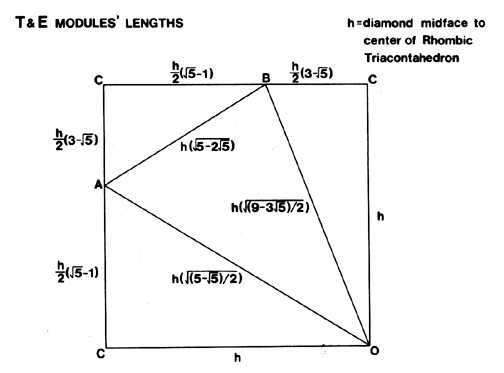
Fig. 986.411B T and E Quanta Module Angles
Fig. 986.411B T and E Quanta Module Angles: This plane net shows the angles and the foldability of the T Quanta Module and the E Quanta Module.
Link to original
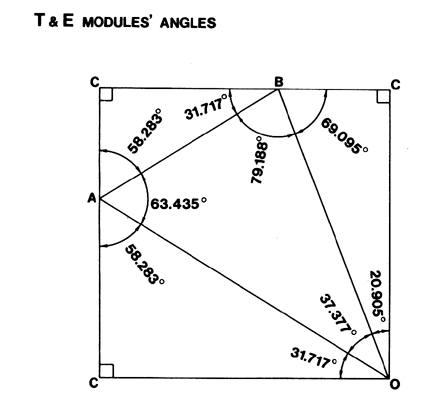
Fig. 986.411C
Fig. 986.411C T and E Quanta Modules in Context of Rhombic Triacontahedron
Link to original
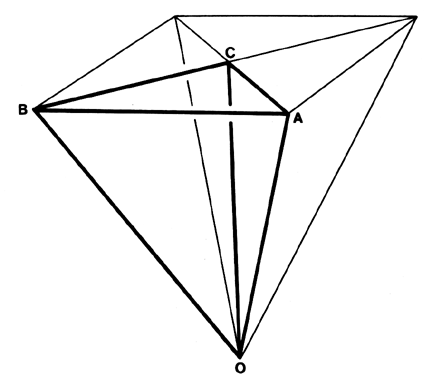
The respective 12 and 30 pentahedra OABAB of the rhombic dodecahedron and the triacontahedron may be symmetrically subdivided into four right-angled tetrahedra ABCO, the point C being surrounded by three right angles ABC, BCO, and ACO. Right- angle ACB is on the surface of the rhombic-hedra system and forms the face of the tetrahedron ABCO, while right angles BCO and ACO are internal to the rhombic-hedra system and from two of the three internal sides of the tetrahedron ABCO. The rhombic dodecahedron consists of 48 identical tetrahedral modules designated ABCO. The triacontahedron consists of 120 (60 positive and 60 negative) identical tetrahedral modules designated ABCO, for which tetrahedron ABCO we also introduce the name T Quanta Module.
986.412
The primitive tetrahedron of volume 1 is subdivisible into 24 A Quanta Modules. The triacontahedron of exactly tetravolume 5, has the maximum-limit case of identical tetrahedral subdivisibility—i.e., 120 subtetra. Thus we may divide the 120 subtetra population of the symmetric triacontahedron by the number 24, which is the identical subtetra population of the primitive omnisymmetrical tetrahedron: 120/24=5. Ergo, volume of the A Quanta Module = volume of the T Quanta Module.
986.413
Fig. 986.413
Fig. 986.413 Regular Tetrahedron Composed of 24 Quanta Modules: Compare Fig. 923.10.
Link to original
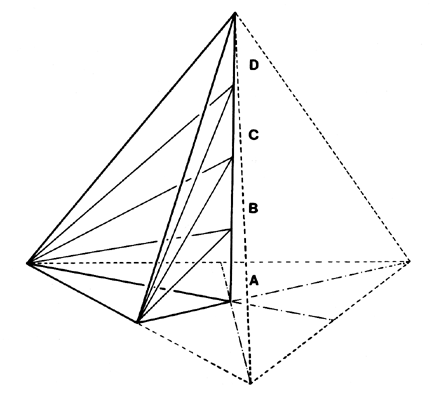
The rhombic dodecahedron has a tetravolume of 6, wherefore each of its 48 identical, internal, asymmetric, component tetrahedra ABCO has a regular tetravolume of 6/48 = 1/8 The regular tetrahedron consists of 24 quanta modules (be they A, B, C, D,⁵ * or T Quanta Modules; therefore ABCO, having l/8-tetravolume, also equals three quanta modules. (See Fig. 986.413.)
(Footnote 5: C Quanta Modules and D Quanta Modules are added to the A and B Quanta Modules to compose the regular tetrahedron as shown in drawing B of Fig. 923.10.)
986.414
The vertical central-altitude line of the regular, primitive, symmetrical tetrahedron may be uniformly subdivided into four vertical sections, each of which we may speak of as quarter-prime-tetra altitude units-each of which altitude division points represent the convergence of the upper apexes of the A, B, C, D, A’, B’, C’, D’, A”, B”, C”, D” … equivolume modules (as illustrated in Fig. 923.10B where—prior to the discovery of the E “Einstein” Module—additional modules were designated E through H, and will henceforth be designated as successive ABCD, A’B’C’D’, A”B”C”D” … groups). The vertical continuance of these unit-altitude differentials produces an infinite series of equivolume modules, which we identify in vertical series continuance by groups of four repetitive ABCD groups, as noted parenthetically above. Their combined group-of- four, externally protracted, altitude increase is always equal to the total internal altitude of the prime tetrahedron.
986.415
The rhombic triacontahedron has a tetravolume of 5, wherefore each of its 120 identical, internal, asymmetric, component tetrahedra ABCO, the T Quanta Module, has a tetravolume of 5/120 = 1/24 tetravolume—ergo, the volume of the T Quanta Module is identical to that of the A and B Quanta Modules. The rhombic dodecahedron’s 48 ABCO asymmetric tetrahedra equal three of the rhombic triacontahedron’s 120 ABCO , T Quanta Module asymmetric tetrahedra. The rhombic triacontahedron’s ABCO T Quanta Module tetrahedra are each 1/24 of the volume of the primitive “regular” tetrahedron—ergo, of identical volume to the A Quanta Module. The A Mod, like the T Mod, is structurally modeled with one of its four corners omnisurrounded by three right angles.
986.416
1 A Module = 1 B Module = 1 C Module = 1 D Module = 1 T Module = any one of the unit quanta modules of which all the hierarchy of concentric, symmetrical polyhedra of the VE family are rationally comprised. (See Sec. 910).
986.417
I find that it is important in exploratory effectiveness to remember—as we find an increasingly larger family of equivolume but angularly differently conformed quanta modules—that our initial exploration strategy was predicated upon our generalization of Avogadro’s special-case (gaseous) discovery of identical numbers of molecules per unit volume for all the different chemical-element gases when individually considered or physically isolated, but only under identical conditions of pressure and heat. The fact that we have found a set of unit-volume, all-tetrahedral modules—the minimum-limit structural systems—from which may be aggregated the whole hierarchy of omnisymmetric, primitive, concentric polyhedra totally occupying the spherically spun and interspheric accommodation limits of closest-packable nuclear domains, means that we have not only incorporated all the min-max limit-case conditions, but we have found within them one unique volumetric unit common to all their primitive conformational uniqueness, and that the volumetric module was developed by vectorial—i.e., energetic—polyhedral-system definitions.
986.418
None of the tetrahedral quanta modules are by themselves allspace-filling, but they are all groupable in units of three (two A’s and one B—which is called the Mite) to fill allspace progressively and to combine these units of three in nine different ways—all of which account for the structurings of all but one of the hierarchy of primitive, omniconcentric, omnisymmetrical polyhedra. There is one exception, the rhombic triacontahedron of tetravolume 5—i.e., of 120 quanta modules of the T class, which T Quanta Modules as we have learned are of equivolume to the A and B Modules.
986.419
Fig. 986.419
Fig. 986.419 T Quanta Modules within Rhombic Triacontahedron: The 120 T Quanta Modules can be grouped two different ways within the rhombic triacontahedron to produce two different sets of 60 tetrahedra each: 60 BAAO and 60 BBAO.
Link to original
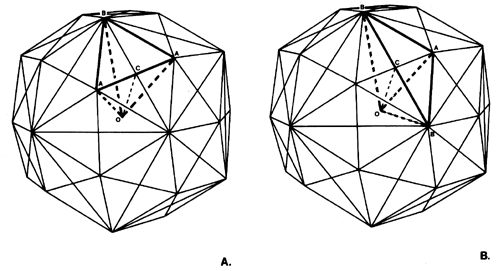
The 120 T Quanta Modules of the rhombic triacontahedron can be grouped in two different ways to produce two different sets of 60 tetrahedra each: the 60 BAAO tetrahedra and the 60 BBAO tetrahedra. But rhombic triacontahedra are not allspace-filling polyhedra. (See Fig. 986.419.)
986.420 Min-max Limit Hierarchy of Pre-time-size Allspace-fillers
986.421
Fig. 986.421
Fig. 986.421 A and B Quanta Modules. The top drawings present plane nets for the modules with edge lengths of the A Modules ratioed to the tetra edge and edge lengths of the B Modules ratioed to the octa edge. The middle drawings illustrate the angles and foldability. The bottom drawings show the folded assembly and their relation to each other. Tetra edge=octa edge. (Compare Figs. 913.01 and 916.01.)
Link to original
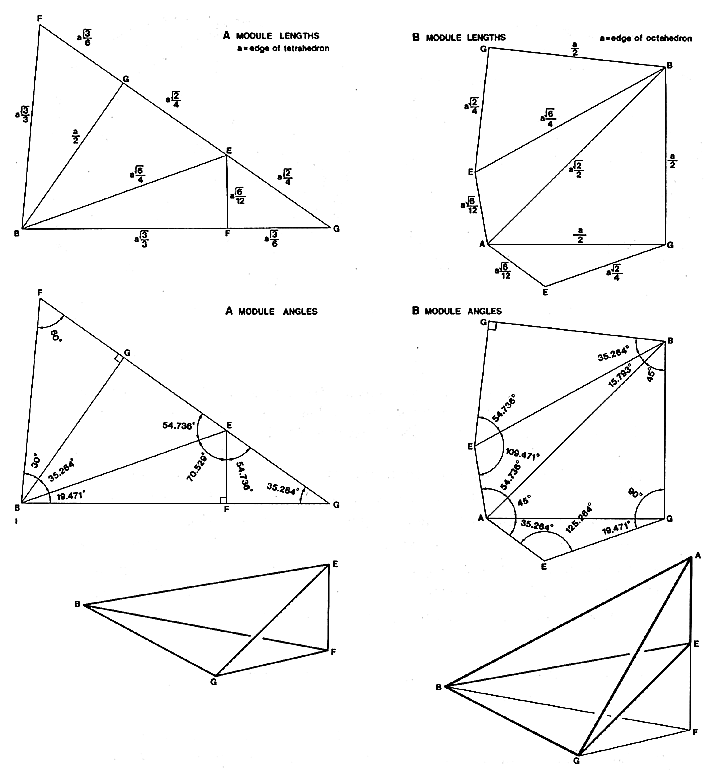
Of all the allspace-filling module components, the simplest are the three- quanta-module Mites, consisting of two A Quanta Modules (one A positive and one A negative) and of one B Quanta Module (which may be either positive or negative). Thus a Mite can be positive or negative, depending on the sign of its B Quanta Module. The Mites are not only themselves tetrahedra (the minimum-sided polyhedra), but they are also the simplest minimum-limit case of allspace-filling polyhedra of Universe, since they consist of two energy-conserving A Quanta Modules and one equivolume energy- dispersing B Quanta Module. The energy conservation of the A Quanta Module is provided geometrically by its tetrahedral form: four different right-triangled facets being all foldable from one unique flat-out whole triangle (Fig. 913.01), which triangle’s boundary edges have reflective properties that bounce around internally to those triangles to produce similar smaller triangles: Ergo, the A Quanta Module acts as a local energy holder. The B Quanta Module is not foldable out of one whole triangle, and energies bouncing around within it tend to escape. The B Quanta Module acts as a local energy dispenser. (See Fig. 986.421.)
986.422
Fig. 986.422 MITE
MITE (See color plate 17.)
Link to original
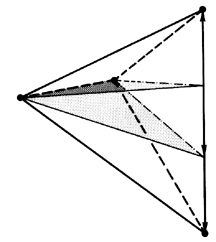
Mite: The simplest allspace-filler is the Mite (see Secs. 953 and 986.418). The positive Mite consists of 1 A + mod, 1 A - mod, and B + mod; the negative Mite consists of 1 A + mod, 1A - mod, and B-mod. Sum-total number of modules…3.
986.423
Around the four corners of the tetrahedral Mites are three right triangles. Two of them are similar right triangles with differently angled acute corners, and the third right triangle around that omni-right-angled corner is an isosceles.
986.424
The tetrahedral Mites may be inter-edge-bonded to fill allspace, but only because the spaces between them are inadvertent capturings of Mite-shaped vacancies. Positive Mite inter-edge assemblies produce negative Mite vacancies, and vice versa. The minimum-limit case always provides inadvertent entry into the Negative Universe. Sum- total number of modules is…1½
986.425
Mites can also fill allspace by inter-face-bonding one positive and one negative Mite to produce the Syte. This trivalent inter-face-bonding requires twice as many Mites as are needed for bivalent inter-edge-bonding. Total number of modules is…3
986.426
Syte: The next simplest allspace-filler is the Syte. (See Sec. 953.40.) Each Syte consists of one of only three alternate ways of face-bonding two Mites to form an allspace-filling polyhedron, consisting of 2 A + mods, 2 A - mods, 1 B + mod, and 1 B - mod. Sum-total number of modules…6
986.427
Fig. 986.427 Bite, Rite, Lite
Fig. 986.427 Bite, Rite, Lite
Link to original
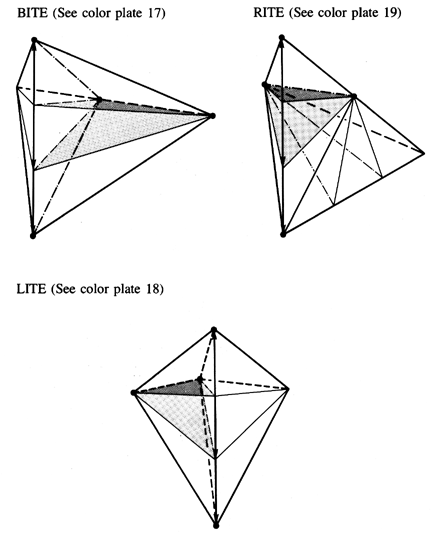
Two of the three alternate ways of combining two Mites produce tetrahedral Sytes of one kind:
BITE (See color plate 17), RITE (See color plate 19)
while the third alternate method of combining will produce a hexahedral Syte.
LITE (See color plate 18)
986.428
Kite: The next simplest allspace-filler is the Kite. Kites are pentahedra or half-octahedra or half-Couplers, each consisting of one of the only two alternate ways of combining two Sytes to produce two differently shaped pentahedra, the Kate and the Kat, each of 4 A + mods, 4 A - mods, 2 B + mods, and 2 B-mods. Sum-total number of modules…12
986.429
Fig. 986.429 Kate, Kat
Fig. 986.429 Kate, Kat.
Link to original
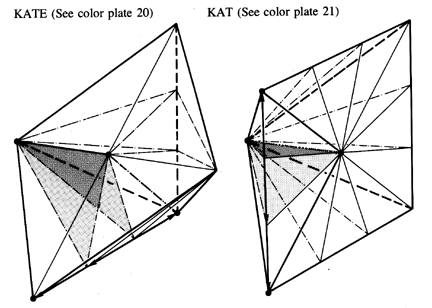
Two Sytes combine to produce two Kites as KATE (See color plate 20) KAT (See color plate 21)
986.430
Fig. 986.430 OCTET
OCTET (See color plate 22)
Link to original
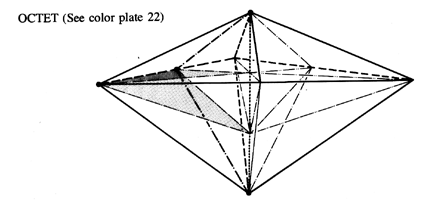
Octet: The next simplest allspace-filler is the Octet, a hexahedron consisting of three Sytes—ergo, 6 A + mods, 6 A - mods, 3 B + mods, and 3 B-mods. Sum-total number of modules…18
986.431
Fig. 986.431 COUPLER
COUPLER (See color plate 23)
Link to original
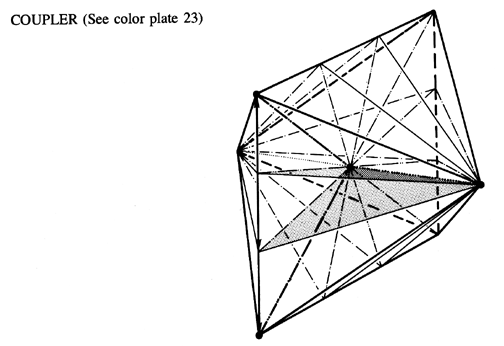
Coupler: The next simplest allspace-filler is the Coupler, the asymmetric octahedron. (See Secs. 954.20-.70.) The Coupler consists of two Kites—ergo, 8 A + mods, 8 A - mods, 4 B + mods, and 4 B - mods. Sum-total number of modules…24
986.432
Fig. 986.432 CUBE
CUBE (See color plate 24)
Link to original
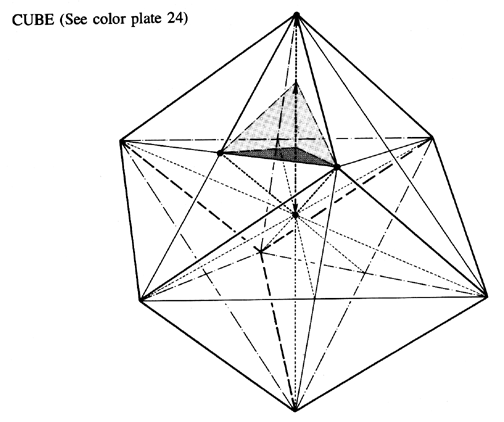
Cube: The next simplest allspace-filler is the Cube, consisting of four Octets—ergo, 24 A + mods, 24 A - mods, 12 B + mods, and 12 B - mods. Sum-total number of modules…72
986.433
Fig. 986.433 RHOMBIC DODECAHEDRON
RHOMBIC DODECAHEDRON (See color plate 25)
Link to original
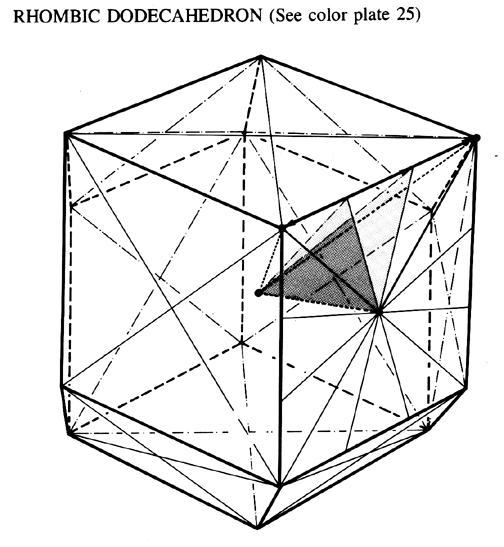
Rhombic Dodecahedron: The next and last of the hierarchy of primitive allspace-fillers is the rhombic dodecahedron. The rhombic dodecahedron is the domain of a sphere (see Sec. 981.13). The rhombic dodecahedron consists of 12 Kites—ergo, 48 A + mods, 48 A - mods, 24 B + mods, and 24 B - mods. Sum-total number of modules…144
986.434
This is the limit set of simplest allspace-fillers associable within one nuclear domain of closest-packed spheres and their respective interstitial spaces. There are other allspace-fillers that occur in time-size multiplications of nuclear domains, as for instance the tetrakaidecahedron. (Compare Sec. 950.12.)
986.440 Table: Set of Simple Allspace-fillers
This completes one spheric domain (i.e., sphere plus interstitial space) of one unit-radius sphere in closest packing, each sphere being centered at every other vertex of the isotropic vector matrix.
| Name | Face Triangles | Type Hedra | A Quanta Modules | B Quanta Modules | Sum- Total Modules |
|---|---|---|---|---|---|
| MITE | 4 | tetrahedron | 2 | 1 | 3 |
| SYTE | |||||
| BITE | 4 | tetrahedron | 4 | 2 | 6 |
| RITE | 4 | tetrahedron | 4 | 2 | 6 |
| LITE | 6 | hexahedron | 4 | 2 | 6 |
| KITE | |||||
| KATE | 5 | pentahedron | 8 | 4 | 12 |
| KAT | 5 | pentahedron | 8 | 4 | 12 |
| OCTET | 6 | hexahedron | 12 | 6 | 18 |
| COUPLER | 8 | octahedron | 16 | 8 | 24 |
| CUBE | 6 | hexahedron | 48 | 24 | 72 |
| RHOMBIC DODECAHEDRON | 12 | dodecahedron | 96 | 48 | 144 |
(For the minimum time-size special case realizations of the two-frequency systems. multiply each of the above Quanta Module numbers by eight.)
986.450 Energy Aspects of Spherical Modular Arrays
986.451
The rhombic dodecahedron has an allspace-filling function as the domain of any one sphere in an aggregate of unit-radius, closest-packed spheres; its 12 mid-diamond- face points C are the points of intertangency of all unit-radius, closest-packed sphere aggregates; wherefore that point C is the midpoint of every vector of the isotropic vector matrix, whose every vertex is the center of one of the unit-radius, closest-packed spheres.
986.452
These 12 inter-closest-packed-sphere-tangency points—the C points—are the 12 exclusive contacts of the “Grand Central Station” through which must pass all the great-circle railway tracks of most economically interdistanced travel of energy around any one nuclear center, and therefrom—through the C points—to other spheres in Universe. These C points of the rhombic dodecahedron’s mid-diamond faces are also the energetic centers-of-volume of the Couplers, within which there are 56 possible unique interarrangements of the A and B Quanta Modules.
986.453
We next discover that two ABABO pentahedra of any two tangentially adjacent, closest-packed rhombic dodecahedra will produce an asymmetric octahedron OABABO’ with O and O’ being the volumetric centers (nuclear centers) of any two tangentially adjacent, closest-packed, unit-radius spheres. We call this nucleus-to-nucleus, asymmetric octahedron the Coupler, and we found that the volume of the Coupler is exactly equal to the volume of one regular tetrahedron—i.e., 24 A Quanta Modules. We also note that the Coupler always consists of eight asymmetric and identical tetrahedral Mites, the minimum simplex allspace-filling of Universe, which Mites are also identifiable with the quarks (Sec. 1052.360).
986.454
We then discover that the Mite, with its two energy-conserving A Quanta Modules and its one energy-dispersing B Quanta Module (for a total combined volume of three quanta modules), serves as the cosmic minimum allspace-filler, corresponding elegantly (in all ways) with the minimum-limit case behaviors of the nuclear physics’ quarks. The quarks are the smallest discovered “particles”; they always occur in groups of three, two of which hold their energy and one of which disperses energy. This quite clearly identifies the quarks with the quanta module of which all the synergetics hierarchy of nuclear concentric symmetric polyhedra are co-occurrent.
986.455
In both the rhombic triacontahedron of tetravolume 5 and the rhombic dodecahedron of tetravolume 6 the distance from system center O at AO is always greater than CO, and BO is always greater than AO.
986.456
With this information we could reasonably hypothesize that the triacontahedron of tetravolume 5 is that static polyhedral progenitor of the only- dynamically-realizable sphere of tetravolume 5, the radius of which (see Fig. 986.314) is only 0.04 of unity greater in length than is the prime vector radius OC, which governs the dimensioning of the triacontahedron’s 30 midface cases of 12 right-angled corner junctions around mid-diamond-vertex C, which provides the 12 right angles around C-the four right-angled corners of the T Quanta Module’s ABC faces of their 120 radially arrayed tetrahedra, each of which T Quanta Module has a volume identical to that of the A and B Quanta Modules.
986.457
We also note that the radius OC is the same unitary prime vector with which the isotropic vector matrix is constructed, and it is also the VE unit-vector-radius distance outwardly from O, which O is always the common system center of all the members of the entire cosmic hierarchy of omniconcentric, symmetric, primitive polyhedra. In the case of the rhombic triacontahedron the 20 OA lines’ distances outwardly from O are greater than OC, and the 12 OB lines’ distances are even greater in length outwardly from O than OA. Wherefore I realized that, when dynamically spun, the greatcircle chord lines AB and CB are centrifugally transformed into arcs and thus sprung apart at B, which is the outermost vertex—ergo, most swiftly and forcefully outwardly impelled. This centrifugal spinning introduces the spherical excess of 6 degrees at the spherical system vertex B. (See Fig. 986.405) Such yielding increases the spheric appearance of the spun triacontahedron, as seen in contradistinction to the diamond-faceted, static, planar-bound, polyhedral state aspect.
986.458
The corners of the spherical triacontahedron’s 120 spherical arc-cornered triangles are 36 degrees, 60 degrees and 90 degrees, having been sprung apart from their planar-phase, chorded corners of 31.71747441 degrees, 58.28252559 degrees, and 90 degrees, respectively. Both the triacontahedron’s chorded and arced triangles are in notable proximity to the well-known 30-, 60-, and 90-degree-cornered draftsman’s flat, planar triangle. I realized that it could be that the three sets of three differently-distanced- outwardly vertexes might average their outward-distance appearances at a radius of only four percent greater distance from O-thus producing a moving-picture-illusioned “dynamic” sphere of tetravolume 5, having very mildly greater radius than its static, timeless, equilibrious, rhombic triacontahedron state of tetravolume 5 with unit-vector- radius integrity terminaled at vertex C.
986.459
In the case of the spherical triacontahedron the total spherical excess of exactly 6 degrees, which is one-sixtieth of unity = 360 degrees, is all lodged in one corner. In the planar case 1.71747441 degrees have been added to 30 degrees at corner B and subtracted from 60 degrees at corner A. In both the spherical and planar triangles—as well as in the draftsman’s triangle—the 90-degree corners remain unchanged.
986.460
The 120 T Quanta Modules radiantly arrayed around the center of volume of the rhombic triacontahedron manifest the most spherical appearance of all the hierarchy of symmetric polyhedra as defined by any one of the seven axially rotated, great circle system polyhedra of the seven primitive types of great-circle symmetries.
986.461
What is the significance of the spherical excess of exactly 6 degrees? In the transformation from the spherical rhombic triacontahedron to the planar triacontahedron each of the 120 triangles releases 6 degrees. 6 × 120 = 720. 720 degrees = the sum of the structural angles of one tetrahedron = 1 quantum of energy. The difference between a high-frequency polyhedron and its spherical counterpart is always 720 degrees, which is one unit of quantum—ergo, it is evidenced that spinning a polyhedron into its spherical state captures one quantum of energy—and releases it when subsiding into its pre-time- size primitive polyhedral state.
986.470 Geodesic Modular Subdivisioning
986.471
Fig. 986.471
Fig. 986.471 Modular Subdivisioning of Icosahedron as Maximum Limit Case: The 120 outer surface right spherical triangles of the icosahedron’s 6, 10, and 15 great circles generate a total of 242 external vertexes, 480 external triangles, and 480 internal face-congruent tetrahedra, constituting the maximum limit of regular spherical system surface omnitriangular self-subdivisioning into centrally collected tetrahedral components.
Link to original
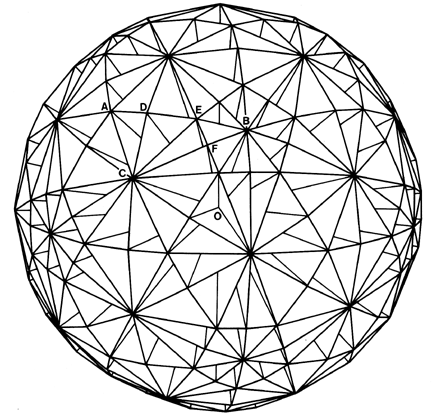
A series of considerations leads to the definition of the most spherical- appearing limit of triangular subdivisioning:
1. recalling that the experimentally demonstrable “most spherically-appearing” structure is always in primitive reality a polyhedron;
2. recalling that the higher the modular frequency of a system the more spheric it appears, though it is always polyhedral and approaching not a “true sphere” limit but an unlimited multiplication of its polyhedral facetings;
3. recalling that the 120 outer surface triangles of the icosahedron’s 15 great circles constitute the cosmic maximum limit of system-surface omni-triangular- self-subdivisioning into centrally collected tetrahedron components; and
4. recalling that the icosahedron’s 10- and 6-great-circle equators of spin further subdivide the 15 great circles’ outer 120 LCD triangles into four different right triangles, ADC, CDE, CFE, and EFB (see Fig. 901.03),
then it becomes evident that the icosahedron’s three sets of symmetrical greatcircle spinnabilities—i.e., 6 + 10 + 15 (which totals 31 great circle self-halvings)—generate a total of 242 unit-radius, external vertexes, 480 external triangles, and 720 internal triangles (which may be considered as two congruent internal triangles, each being one of the internal triangular faces of the 480 tetrahedra whose 480 external triangular faces are showing-in which case there are 1440 internal triangles). The 480 tetrahedra consist of 120 OCAD, 120 OCDE, 120 OCEF, and 120 OFEB tetrahedra. (See Fig. 986.471.) The 480 internal face-congruent tetrahedra therefore constitute the “most spheric-appearing” of all the hemispheric equators’ self-spun, surface-subdividing entirely into triangles of all the great circles of all the primitive hierarchy of symmetric polyhedra.
986.472
In case one thinks that the four symmetrical sets of the great circles of the spherical VE (which total 25 great circles in all) might omnisubdivide the system surface exclusively into a greater number of triangles, we note that some of the subdivision areas of the 25 great circles are not triangles (see quadrant BCEF in Fig. 453.01 —third printing of Synergetics 1—of which quadrangles there are a total of 48 in the system); and note that the total number of triangles in the 25-great-circle system is 288—ergo, far less than the 31 great circles’ 480 spherical right triangles; ergo, we become satisfied that the icosahedron’s set of 480 is indeed the cosmic maximum-limit case of system-self-spun subdivisioning of its self into tetrahedra, which 480 consist of four sets of 120 similar tetrahedra each.
986.473
It then became evident (as structurally demonstrated in reality by my mathematically close-toleranced geodesic domes) that the spherical trigonometry calculations’ multifrequenced modular subdividing of only one of the icosahedron’s 120 spherical right triangles would suffice to provide all the basic trigonometric data for any one and all of the unit-radius vertex locations and their uniform interspacings and interangulations for any and all frequencies of modular subdividings of the most symmetrical and most economically chorded systems’ structuring of Universe, the only variable of which is the special case, time-sized radius of the special-case system being considered.
986.474
This surmise regarding nature’s most-economical, least-effort design strategy has been further verified by nature’s own use of the same geodesics mathematics as that which I discovered and employed in my domes. Nature has been using these mathematical principles for eternity. Humans were unaware of that fact. I discovered these design strategies only as heretofore related, as an inadvertent by-product of my deliberately undertaking to find nature’s coordination system. That nature was manifesting icosahedral and VE coordinate patterning was only discovered by other scientists after I had found and demonstrated geodesic structuring, which employed the synergetics’ coordinate-system strategies. This discovery by others that my discovery of geodesic mathematics was also the coordinate system being manifest by nature occurred after I had built hundreds of geodesic structures around the world and their pictures were widely published. Scientists studying X-ray diffraction patterns of protein shells of viruses in 1959 found that those shells disclosed the same patterns as those of my widely publicized geodesic domes. When Dr. Aaron Klug of the University of London—who was the one who made this discovery—communicated with me, I was able to send him the mathematical formulae for describing them. Klug explained to me that my geodesic structures are being used by nature in providing the “spherical” enclosures of her own most critical design-controlling programming devices for realizing all the unique biochemical structurings of all biology—which device is the DNA helix.
986.475
The structuring of biochemistry is epitomized in the structuring of the protein shells of all the viruses. They are indeed all icosahedral geodesic structures. They embracingly guard all the DNA-RNA codified programming of all the angle-and-frequency designing of all the biological, life-accommodating, life-articulating structures. We find nature employing synergetics geometry, and in particular the high-frequency geodesic “spheres,” in many marine organisms such as the radiolaria and diatoms, and in structuring such vital organs as the male testes, the human brain, and the eyeball. All of these are among many manifests of nature’s employment on her most critically strategic occasions of the most cosmically economical, structurally effective and efficient enclosures, which we find are always mathematically based on multifrequency and three-way-triangular gridding of the “spherical”—because high-frequenced—icosahedron, octahedron, or tetrahedron.
986.476
Comparing the icosahedron, octahedron, and tetrahedron-the icosahedron gives the most volume per unit weight of material investment in its structuring; the high- frequency tetrahedron gives the greatest strength per unit weight of material invested; and the octahedron affords a happy—but not as stable-mix of the two extremes, for the octahedron consists of the prime number 2, 2² = 4; whereas the tetrahedron is the odd prime number 1 and the icosahedron is the odd prime number 5. Gear trains of even number reciprocate, whereas gear trains of an odd number of gears always lock; ergo, the tetrahedral and icosahedral geodesic systems lock-fasten all their structural systems, and the octahedron’s compromise, middle-position structuring tends to yield transformingly toward either the tetra or the icosa locked-limit capabilities—either of which tendencies is pulsatively propagative.
986.480 Consideration 13: Correspondence of Surface Angles and Central Angles
986.481
It was next to be noted that spherical trigonometry shows that nature’s smallest common denominator of system-surface subdivisioning by any one type of the seven great-circle-symmetry systems is optimally accomplished by the previously described 120 spherical-surface triangles formed by the 15 great circles, whose central angles are approximately
whereas their surface angles are 36 degrees at A, 60 degrees at B, and 90 degrees at C.
986.482
We recall that the further self-subdividing of the 120 triangles, as already defined by the 15 great circles and as subdividingly accomplished by the icosahedron’s additional 6- and 10-great-circle spinnabilities, partitions the 120 LCD triangles into 480 right triangles of four types: ADC, CDE, CFE, and EFB-with 60 positive and 60 negative pairs of each. (See Figs. 901.03 and 986.314.) We also recall that the 6- and 10-great- circle-spun hemispherical gridding further subdivided the 120 right triangles—ACB—formed by the 15 great circles, which produced a total of 12 types of surface angles, four of them of 90 degrees, and three whose most acute angles subdivided the 90-degree angle at C into three surface angles: ACD—31.7 degrees; DCE—37.4 degrees; and ECB—20.9 degrees, which three surface angles, we remember, correspond exactly to the three central angles COB, BOA, and COA, respectively, of the triacontahedron’s tetrahedral T Quanta Module ABCO.