986.501 Consideration 14: Great-circle Foldable Discs
986.502
Fig. 986.502
Fig. 986.502 Thirty Great-circle Discs Foldable into Rhombic Triacontahedron System: Each of the four degree quadrants, when folded as indicated at A and B, form separate T Quanta Module tetrahedra. Orientations are indicated by letter on the great-circle assembly at D.
Link to original
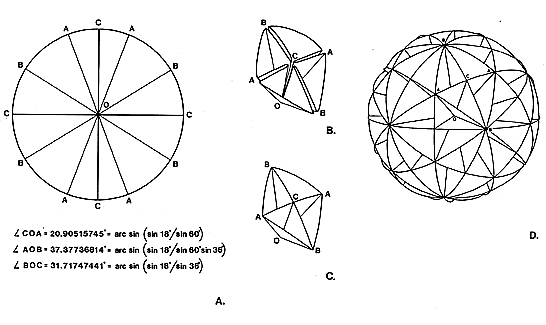
With all the foregoing events, data, and speculative hypotheses in mind, I said I think it would be worthwhile to take 30 cardboard great circles, to divide them into four 90-degree quadrants, then to divide each of the quadrants into three angles—COA, 20.9 degrees; AOB, 37.4 degrees; and BOC, 31.7 degrees—and then to score the cardboard discs with fold lines in such a manner that the four lines CO will be negatively outfolded, while the lines AO and BO will be positively infolded, so that when they are altogether folded they will form four similar-arc-edged tetrahedra ABCO with all of their four CO radii edges centrally congruent. And when 30 of these folded great-circle sets of four T Quanta Module tetrahedra are each triple-bonded together, they will altogether constitute a sphere. This spherical assemblage involves pairings of the three intercongruent interface triangles AOC, COB, and BOA; that is, each folded great-circle set of four tetra has each of its four internal triangular faces congruent with their adjacent neighbor’s corresponding AOC, COB, and BOC interior triangular faces. (See Fig. 986.502.)
986.503
I proceeded to make 30 of these 360-degree-folding assemblies and used bobby pins to lock the four CO edges together at the C centers of the diamond-shaped outer faces. Then I used bobby pins again to lock the 30 assemblies together at the 20 convergent A vertexes and the 12 convergent B sphere-surface vertexes. Altogether they made a bigger sphere than the calculated radius, because of the accumulated thickness of the foldings of the construction paper’s double-walled (trivalent) interfacing of the 30 internal tetrahedral components. (See Fig. 986.502D.)
986.504
Fig. 986.504
Fig. 986.504 Profile of Quadrants of Sphere and Rhombic Triacontahedron: Central angles and ratios of radii are indicated at A. Orientation of modules in spherical assembly is indicated by letters at B.
Link to original
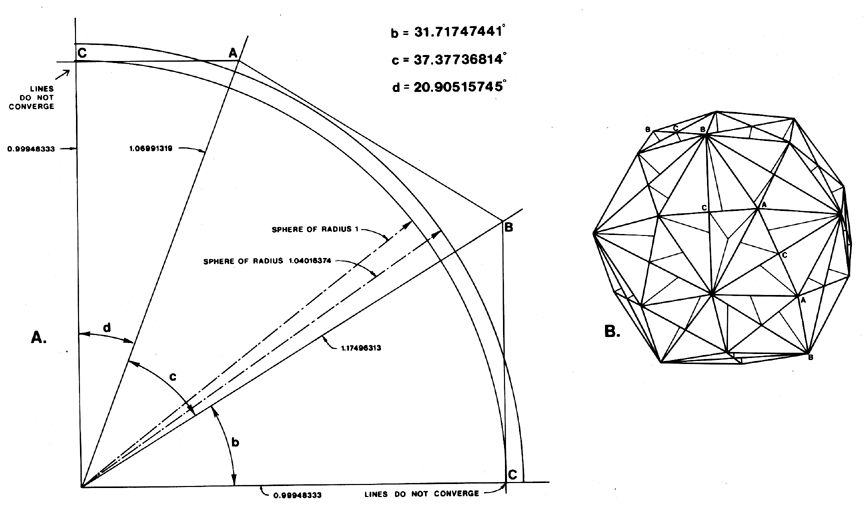
Instead of the just previously described 30 assemblies of four identical spherically central tetrahedra, each with all of their 62 vertexes in the unit-radius spheres, I next decided to make separately the 120 correspondingly convergent (non-arc-edged but chorded) tetrahedra of the tetravolume-5 rhombic triacontahedron, with its 30 flat ABAB diamond faces, the center C of which outer diamond faces is criss-crossed at right angles at C by the short axis A-A of the diamond and by its long axis B-B, all of which diamond bounding and criss-crossing is accomplished by the same 15 greatcircle planes that also described the 30 diamonds’ outer boundaries. As noted, the criss-crossed centers of the diamond faces occur at C, and all the C points are at the prime-vector-radius distance outwardly from the volumetric center O of the rhombic triacontahedron, while OA is 1.07 of vector unity and OB is 1.17 of vector unity outward, respectively, from the rhombic triacontahedron’s symmetrical system’s center of volume O. (See Figs. 986.504A and 986.504B.)
986.505
Fig. 986.505
Fig. 986.505 Six Intertangent Great-circle Discs in 12-inch Module Grid: The four 90 degree quadrants are folded at the central angles indicated for the T Quanta Module.
Link to original
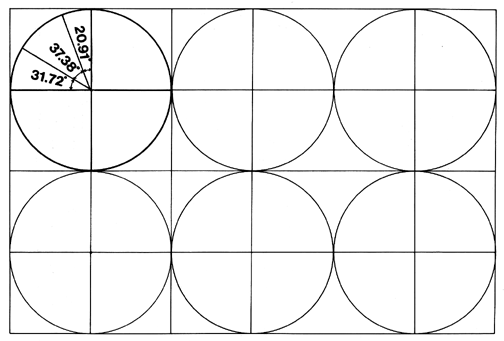
To make my 120 OABC tetrahedra I happened to be using the same construction paperboard I had used before in making the 30 arc-edged great-circle components. The construction paperboard happened to come in sheets 24 by 36 inches, i.e., two feet by three feet. In making the previously described spherical triacontahedron out of these 24-by-36-inch sheets, I had decided to get the most out of my material by using a 12-inch-diameter circle, so that I could lay out six of them tangentially within the six 12-inch-square modules of the paperboard to produce the 30 foldable great circles. This allowed me to cut out six intertangent great circles from each 24-by-36-inch construction paper sheet. Thirty great circles required only five sheets, each sheet producing six circles. To make the 12 separate T Quanta Module tetrahedra, I again spontaneously divided each of the same-size sheets into six squares with each of the six circles tangent to four edges of each square (Fig. 986.505).
986.506
In starting to make the 120 separate tetrahedra (60 positive, 60 negative—known as T Quanta Modules) with which to assemble the triacontahedron- which is a chord-edged polyhedron vs the previous “spherical” form produced by the folded 15-great-circle patterning—I drew the same 12-inch-edge squares and, tangentially within the latter, drew the same six 12-inch-diameter circles on the five 24-by-36-inch sheets, dividing each circle into four quadrants and each quadrant into three subsections of 20.9 degrees, 37.4 degrees, and 31.7 degrees, as in the T Quanta Modules.
986.507
I planned that each of the quadrants would subsequently be cut from the others to be folded into one each of the 120 T Quanta Module tetrahedra of the triacontahedron. This time, however, I reminded myself not only to produce the rhombic triacontahedron with the same central angles as in the previous spheric experiment’s model, but also to provide this time for surfacing their clusters of four tetrahedra ABCO around their surface point C at the mid-crossing point of their 30 flat diamond faces. Flat diamond faces meant that where the sets of four tetra came together at C, there would not only have to be four 90-degree angles on the flat surface, but there would be eight internal right angles at each of the internal flange angles. This meant that around each vertex C corner of each of the four T Quanta Modules OABC coming together at the diamond face center C there would have to be three 90-degree angles.
986.508
Fig. 986.508 Six Intertangent Great-circle Discs
Fig. 986.508 Six Intertangent Great-circle Discs: Twelve-inch module grids divided into 24 quadrant blanks at A Profile of rhombic triacontahedron superimposed on quadrant at B.
Link to original
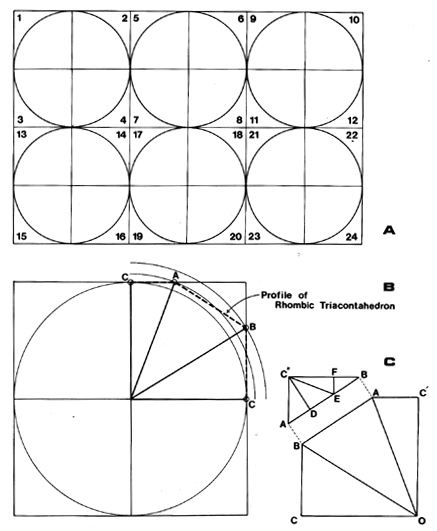
Looking at my “one-circle-per-each-of-six-squares” drawing, I saw that each sheet was divided into 24 quadrant blanks, as in Fig. 986.508A. Next I marked the centers of each of the six circles as point O, O being the volumetric center of the triacontahedral system. Then I realized that, as trigonometrically calculated, the flat, diamond-centered, right-angled, centrally criss-crossed point C of the triacontahedron’s outer faces had to be at our primitive unit-vector-length distance outwardly from the system center O, whereas in the previous arc-edged 30-great-circle-folded model the outer vertex C had been at full- spherical-system-radius distance outwardly from O. In the spherical 15-great-circle-model, therefore, the triacontahedron’s mid-flat-diamond-face C would be at 0.07 lesser radial distance outwardly from O than would the diamond corner vertexes A and vertex A itself at a lesser radial distance outwardly from O than diamond corner vertex B. (See Fig. 986.504A.)
986.509
Thinking about the C corner of the described tetrahedron consisting entirely of 90-degree angles as noted above, I realized that the line C to A must produce a 90- degree-angle as projected upon the line OC”, which latter ran vertically outward from O to C”, with O being the volumetric center of the symmetrical system (in this case the rhombic triacontahedron) and with C” positioned on the perimeter exactly where vertex C had occurred on each of the previous arc-described models of the great circles as I had laid them out for my previous 15 great-circle spherical models. I saw that angle ACO must be 90 degrees. I also knew by spherical trigonometry that the angle AOC would have to be 20.9 degrees, so I projected line OA outwardly from O at 20.9 degrees from the vertical square edge OC.
986.510
At the time of calculating the initial layout I made two mistaken assumptions: first, that the 0.9995 figure was critically approximate to 1 and could be read as 1; and second (despite Chris Kitrick’s skepticism born of his confidence in the reliability of his calculations), that the 0.0005 difference must be due to the residual incommensurability error of the inherent irrationality of the mathematicians’ method of calculating trigonometric functions. (See the Scheherazade Numbers discussed at Sec. 1230.) At any rate I could not lay out with drafting tools a difference of 0.0005 of six inches, which is 0.0030 of an inch. No draftsman can prick off a distance even ten times that size. (I continue to belabor these mistaken assumptions and the subsequent acknowledgments of the errors because it is always upon the occasion of my enlightened admission of error that I make my greatest discoveries, and I am thus eager to convey this truth to those seeking the truth by following closely each step of this development, which leads to one of the most exciting of known discoveries.)
986.511
In order to produce the biggest model possible out of the same 24-by-36- inch construction paper blanks, I saw that vertex A of this new T Quanta Module model would have to lie on the same 12-inch circle, projecting horizontally from A perpendicularly (i.e., at right angles), upon OX at C. I found that the point of 90-degree impingement of AC on OX occurred slightly inward (0.041, as we learned later by/trigonometry), vertically inward, from X. The symbol X now occurs on my layout at the point where the previous spherical model’s central diamond vertex C had been positioned—-on the great-circle perimeter. Trigonometric calculation showed this distance between C and X to be 0.041 of the length of our unit vector radius. Because (1) the distance CO is established by the right-angled projection of A upon OX; and because (2) the length CO is also the prime vector of synergetics’ isotropic vector matrix itself, we found by trigonometric calculation that when the distance from O to C is 0.9995 of the prime vector’s length, that the tetravolume of the rhombic triacontahedron is exactly 5.
986.512
When the distance from O to C is 0.9995, then the tetravolume of the rhombic triacontahedron is exactly 5. OC in our model layout is now exactly the same as the vector radius of the isotropic vector matrix of our “generalized energy field.” OC rises vertically (as the right-hand edge of our cut-out model of our eventually-to-be-folded T Quanta Module’s model designing layout) from the eventual triacontahedron’s center O to what will be the mid-diamond face point C. Because by spherical trigonometry we know that the central angles of our model must read successively from the right-hand edge of the layout at 20.9 degrees, 37.4 degrees, and 31.7 degrees and that they add up to 90 degrees, therefore line OC’ runs horizontally leftward, outward from O to make angle COC’ 90 degrees. This is because all the angles around the mid-diamond criss-cross point C are (both externally and internally) 90 degrees. We also know that horizontal OC’ is the same prime vector length as vertical OC. We also know that in subsequent folding into the T Quanta Module tetrahedron, it is a mathematical requirement that vertical OC be congruent with horizontal OC’ in order to be able to have these edges fold together to be closed in the interior tetrahedral form of the T Quanta Module. We also know that in order to produce the required three 90-degree angles (one surface and two interior) around congruent C and C’ of the finished T Quanta Module, the line C’B of our layout must rise at 90 degrees vertically from C’ at the leftward end of the horizontal unit vector radius OC’. (See Fig. 986.508C.)
986.513
This layout now demonstrates three 90-degree comers with lines OC vertical and OC’ horizontal and of the same exact length, which means that the rectangle COC’C” must be a square with unit-vector-radius edge length OC. The vertical line C’C” rises from C’ of horizontal OC’ until it encounters line OB, which—to conform with the triacontahedron’s interior angles as already trigonometrically established—must by angular construction layout run outwardly from O at an angle of 31.7 degrees above the horizontal from OC’ until it engages vertical C’C” at B. Because by deliberate construction requirement the angle between vertical OC and OA has been laid out as 20.9 degrees, the angle AOB must be 37.4 degrees-being the remainder after deducting both 20.9 degrees and 31.7 degrees from the 90-degree angle Lying between vertical OC and horizontal OC’. All of this construction layout with OC’ horizontally equaling OC vertically, and with the thus-far-constructed layout’s corner angles each being 90 degrees, makes it evident that the extensions of lines CA and C’B will intersect at 90 degrees at point C”, thus completing the square OC `C”C of edge length OC, which length is exactly 0.999483332 of the prime vector of the isotropic vector matrix’s primitive cosmic- hierarchy system.
986.514
Since ACO, COC’, and OC’B are all 90-degree angles, and since vertical CO = horizontal C’O in length, the area COC’C” must be a square. This means that two edges of each of three of the four triangular faces of the T Quanta Module tetrahedron, and six of its nine prefolded edges (it has only six edges after folding), are congruent with an exactly square paperboard blank. The three triangles OCA, OAB, and OBC’ will be folded inwardly along AO and BO to bring the two CO and CO’ edges together to produce the three systemically interior faces of the T Quanta Module.
986.515
Fig. 986.515
Fig. 986.515 T Quanta Module Foldable from Square: One of the triangular corners may be hinged and reoriented to close the open end of the folded tetrahedron.
Link to original
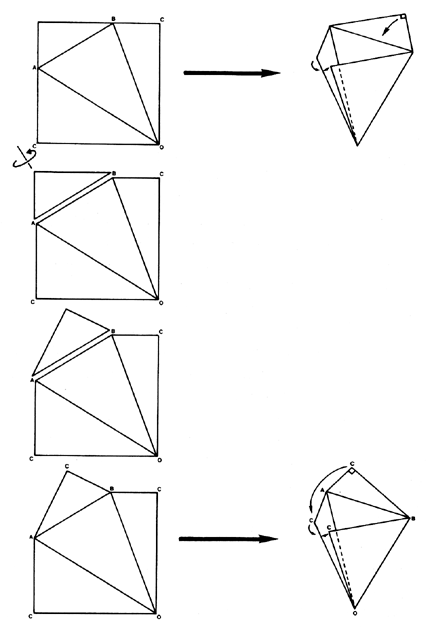
This construction method leaves a fourth right-triangular corner piece AC”B, which the dividers indicated-and subsequent trigonometry confirmed—to be the triangle exactly fitting the outer ABC-triangular-shaped open end of the folded-together T Quanta Module OABC. O” marks the fourth corner of the square blank, and trigonometry showed that C”A = C’B and C”B = AC, while AB of triangle OBA by construction is congruent with AB of triangle AC”B of the original layout. So it is proven that the vector- edged square COC’C” exactly equals the surface of the T Quanta Module tetrahedron CABO. (See Fig. 986.515.)
986.516
The triangle AC”B is hinged to the T Quanta Module along the mutual edge AB, which is the hypotenuse of the small AC”B right triangle. But as constructed the small right triangle AC”B cannot be hinged (folded) to close the T Quanta Module tetrahedron’s open-end triangular area ABC—despite the fact that the hinged-on triangle AC”B and the open triangle ABC are dimensionally identical. AC”B is exactly the right shape and size and area and can be used to exactly close the outer face of the T Quanta Module tetrahedron, if—but only if—it is cut off along line BA and is then turned over so that its faces are reversed and its B corner is now where its A corner had been. This is to say that if the square COC’C” is made of a cardboard sheet with a red top side and a gray underside, when we complete the tetrahedron folding as previously described, cut off the small corner triangle AC”B along line BA, reverse its face and its acute ends, and then address it to the small triangular ABC open end of the tetrahedron CABO, it will fit exactly into place, but with the completed tetrahedron having three gray faces around vertex O and one red outer face CAB. (See Fig. 986.508C.)
986.517
Following this closure procedure, when the AC”B triangles of each of the squares are cut off from COC’C” along line AB, and right triangle AC”B is reversed in face and its right-angle corner C” is made congruent with the right-angle corner C of the T Quanta Module’s open-end triangle, then the B corner of the small triangle goes into congruence with the A corner of the open-end triangle, and the A corner of the small triangle goes into congruence with the B corner of the open-end triangle—with the 90- degree corner C becoming congruent with the small triangle’s right-angle corner C”. When all 120 of these T Quanta Module tetrahedra are closed and assembled to produce the triacontahedron, we will have all of the 360 gray faces inside and all of the 120 red faces outside, altogether producing an externally red and an internally gray rhombic triacontahedron.
986.518
In developing the paper-folding pattern with which to construct any one of these 120 identical T Quanta Module tetrahedra, we inadvertently discovered it to be foldable out of an exact square of construction paper, the edge of which square is almost (0.9995 of the prime vector 1) identical in length to that of the prime vector radius of synergetics’ closest-packed unit-radius spheres, and of the isotropic vector matrix, and therefore of the radii and chords of the vector equilibrium—which synergetics’ vector (as with all vectors) is the product of mass and velocity. While the unit-vector length of our everywhere-the-same energy condition conceptually idealizes cosmic equilibrium, as prime vector (Sec. 540.10) it also inherently represents everywhere-the-same maximum cosmic velocity unfettered in vacuo—ergo, its linear velocity (symbolized in physics as lower-case c) is that of all radiation—whether beamed or piped or linearly focused—the velocity of whose unbeamed, omnidirectionally outward, surface growth rate always amounts to the second-powering of the linear speed. Ergo, omniradiance’s wave surface growth rate is c².
986.519
Since the edge length of the exactly 5.0000 (alpha) volumed T Quanta Module surface square is 0.9995 of the prime vector 1.0000 (alpha), the surface-field energy of the T Quanta Module of minimum energy containment is 0.9995 V² , where 1.0000 (alpha) V is the prime vector of our isotropic vector matrix. The difference—0.0005—is minimal but not insignificant; for instance, the mass of the electron happens also to be 0.0005 of the mass of the proton.
986.520 Einstein’s Equation
986.521
Remembering that in any given dimensional system of reference the vector’s length represents a given mass multiplied by a given velocity, we have in the present instance the physical evidence that the surface area of the T Quanta Module tetrahedron exactly equals the area of the edge length—0.9995—“squared.” In this case of the T Quanta Module the edge length of 0.9995 of the foldable square (the visibly undetectable) is 0.0005 less than the length of the prime vector of 1.000.
986.522
The generalized isotropic vector matrix’s prime vector to the second power—“squared”— becomes physically visible in the folded-square T tetra modules. (Try making one of them yourself.) This visible “squaring” of the surface area of the exactly one-energy-quantum module tetrahedron corresponds geometrically to what is symbolically called for in Einstein’s equation, which language physics uses as a nonengineering-language symbolism (as with conventional mathematics), and which does not preintermultiply mass and velocity to produce a vector of given length and angular direction-ergo, does not employ the integrated vectorial component VE—ergo, must express V² in separate components as M (mass) times the velocity of energy unfettered in vacuo to the second power, c². However, we can say Mc² = V², the engineering expression V² being more economical. When T = the T Quanta Module, and when the T Quanta Module = one energy quantum module, we can say:
986}.523
In the Einstein equation the velocity—lower-case c—of all radiation taken to the second power is omnidirectional-ergo, its quasispheric surface-growth rate is at the second power of its radial-linear-arithmetic growth rate—ergo, c². (Compare Secs. 1052.21 and 1052.30.) Thus Einstein’s equation reads E = Mc², where E is the basic one quantum or one photon energy component of Universe.
986.524
With all the foregoing holding true and being physically demonstrable, we find the vector minus 0.0005 of its full length producing an exactly square area that folds into a tetrahedron of exactly one quantum module, but, we must remember, with a unit- integral-square-surface area whose edge length is 0.0005 less than the true V² vector, i.e., less than Mc². But don’t get discouraged; as with the French Vive la Différence, we find that difference of 0.0005 to be of the greatest possible significance … as we shall immediately learn.
986.540 Volume-surface Ratios of E Quanta Module and Other Modules
986.541
Now, reviewing and consolidating our physically exploratory gains, we note that in addition to the 0.9995 V²-edged “square”-surfaced T Quanta Module tetrahedron of exactly the same volume as the A, B, C, or D Quanta Modules, we also have the E Quanta Module—or the “Einstein Module” —whose square edge is exactly vector V = 1.0000 (alpha), but whose volume is 1.001551606 when the A Quanta Module’s volume is exactly 1.0000 (alpha), which volume we have also learned is uncontainable by chemical structuring, bonding, and the mass-attraction law.
986.542
When the prime-unit vector constitutes the radial distance outward from the triacontahedron’s volumetric center O to the mid-points C of each of its mid-diamond faces, the volume of the rhombic triacontahedron is then slightly greater than tetravolume 5, being actually tetravolume 5.007758031. Each of the rhombic triacontahedron’s 120 internally structured tetrahedra is called an E Quanta Module, the “E” for Einstein, being the transformation threshold between energy convergently self-interfering as matter = M, and energy divergently dispersed as radiation = c². Let us consider two rhombic triacontahedra: (1) one of radius 0.9995 V of exact tetravolume 5; and (2) one of radius 1.0000 (alpha) of tetravolume 5.007758031. The exact prime-vector radius 1.0000 (alpha) rhombic triacontahedron volume is 0.007758031 (1/129th) greater than the tetravolume 5—i.e., tetravolume 5.007758031. This means that each E Quanta Module is 1.001551606 when the A Quanta Module is 1.0000.
986.543
The 0.000517 radius difference between the 0.999483-radiused rhombic triacontahedron of exactly tetravolume 5 and its exquisitely minute greater radius-1.0000 (alpha) prime vector, is the exquisite difference between a local-in-Universe energy-containing module and that same energy being released to become energy radiant. Each of the 120 right-angle-cornered T Quanta Modules embraced by the tetravolume-5 rhombic triacontahedron is volumetrically identical to the A and B Quanta Modules, of which the A Modules hold their energy and the B Modules release their energy (Sec. 920). Each quanta module volume is 0.04166—i.e., 1/24 of one regular primitive tetrahedron, the latter we recall being the minimum symmetric structural system of Universe. To avoid decimal fractions that are not conceptually simple, we multiply all the primitive hierarchy of symmetric, concentric, polyhedral volumes by 24—after which we can discuss and consider energetic-synergetic geometry in always-whole-rational-integer terms.
986.544
We have not forgotten that radius I is only half of the prime-unit vector of the isotropic vector matrix, which equals unity 2 (Sec. 986.160). Nor have we forgotten that every square is two triangles (Sec. 420.08); nor that the second-powering of integers is most economically readable as “triangling”; nor that nature always employs the most economical alternatives—but we know that it is momentarily too distracting to bring in these adjustments of the Einstein formula at this point.
986.545
To discover the significance of the “difference” all we have to do is make another square with edge length of exactly 1.000 (alpha) (a difference completely invisible at our one-foot-to-the-edge modeling scale), and now our tetrahedron folded out of the model is an exact geometrical model of Einstein’s E = Mc², which, expressed in vectorial engineering terms, reads E = V² ; however, its volume is now 0.000060953 greater than that of one exact energy quanta module. We call this tetrahedron model folded from one square whose four edge lengths are each exactly one vector long the E Module, naming it for Einstein. It is an exact vector model of his equation.
986.546
The volumetric difference between the T Module and the E Module is the difference between energy-as-matter and energy-as-radiation. The linear growth of 0.0005 transforms the basic energy-conserving quanta module (the physicists’ particle) from matter into one minimum-limit “photon” of radiant energy as light or any other radiation (the physicists’ wave).
986.547
Einstein’s equation was conceived and calculated by him to identify the energy characteristics derived from physical experiment, which defined the minimum radiation unit—the photon—E = Mc². The relative linear difference of 0.000518 multiplied by the atoms’ electrons’ nucleus-orbiting diameter of one angstrom (a unit on only l/40-millionth of an inch) is the difference between it is matter or it is radiation… Vastly enlarged, it is the same kind of difference existing between a soap bubble existing and no longer existing—“bursting,” we call it—because it reached the critical limit of spontaneously coexistent, cohesive energy as-atoms-arrayed-in-liquid molecules and of atoms rearranged in dispersive behavior as gases. This is the generalized critical threshold between it is and it isn’t… It is the same volume-to-tensional-surface-enclosing-capability condition displayed by the soap bubble, with its volume increasing at a velocity of the third power while its surface increases only as velocity to the second power. Its tension- embracement of molecules and their atoms gets thinned out to a one-molecule layer, after which the atoms, behaving according to Newton’s mass-interattraction law, become circumferentially parted, with their interattractiveness decreasing acceleratingly at a second-power rate of the progressive arithmetical distance apart attained—an increase that suddenly attains critical demass point, and there is no longer a bubble. The same principle obtains in respect to the T Quanta Module → E Quanta Module—i.e., matter transforming into radiation.
986.548
The difference between the edge length of the square from which we fold the E Quanta Module and the edge length of the square from which we fold the T Quanta Module is exquisitely minute: it is the difference between the inside surface and the outside surface of the material employed to fabricate the model. In a 20-inch-square model employing aluminum foil
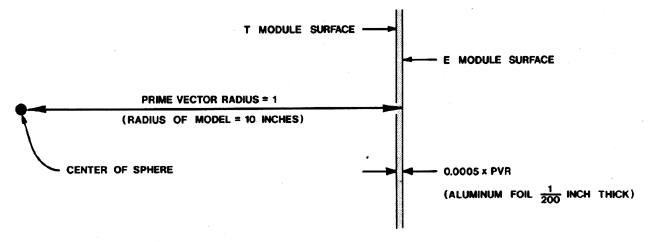
1/200th of an inch thick, the E Module would be congruent with the outside surface and the T Module would be congruent with the inside surface, and the ratio of the edge lengths of the two squares is as 1 is to 0.0005, or 0.0005 of prime vector radius of our spherical transformation. This minuscule modelable difference is the difference between it is and it isn’t—which is to say that the dimensional difference between matter and radiation is probably the most minute of all nature’s dimensioning: it is the difference between inside-out and outside-out of positive and negative Universe.
986.549
Because we have obtained an intimate glimpse of matter becoming radiation, or vice versa, as caused by a minimum-structural-system tetrahedron’s edge-length growth of only 129 quadrillionths of an inch, and because we have been paying faithful attention to the most minute fractions of difference, we have been introduced to a whole new frontier of synergetics exploration. We have discovered the conceptual means by which the 99 percent of humanity who do not understand science may become much more intimate with nature’s energetic behaviors, transformations, capabilities, and structural and de-structural strategies.
986.550
Table: Relative Surface Areas Embracing the Hierarchy of Energetic Quanta Modules: Volumes are unit. All Module Volumes are 1, except the radiant E Module, whose Surface Area is experimentally evidenced Unity:
1 Unit vector of isotropic vector matrix
Vector × Vector = Surface (Energy as local energy system-containment capability)
= Outer array of energy packages.⁶
Mass = F = Relative frequency of primitive-system-subdivision energy-event occupation.
| Module | SURFACE | AREA VOLUME |
|---|---|---|
| A Quanta Module | 0.9957819158 | 1 HOLD |
| T Quanta Module | 0.9989669317 | 1 ENERGY |
| ”Einstein” E Module | 1.0000000000 | 1.00155 |
| B Quanta Module | 1.207106781 | |
| C Quanta Module | 1.530556591 | |
| D Quanta Module | 1.896581995 | |
| A’ Module | 2.280238966 | |
| B’ Module | 2.672519302 | 1 RELEASE |
| C’ Module | 3.069597104 | 1 ENERGY |
| D’ Module | 3.469603759 | |
| A” Module | 3.871525253 | 1 |
| B” Module | 4.27476567 | 1 |
| C” Module | 4.678952488 | 1 |
| D” Module | 5.083841106 | 1 |
(For a discussion of C and D Modules see Sec. 986.413.)
(Footnote 6: The VE surface displays the number of closest-packed spheres of the outer layer. That surface = f²; ergo, the number of energy-package spheres in outer layer shell = surface, there being no continuum or solids.)
986.560 Surprise Nestability of Minimod T into Maximod T
986.561
Fig. 986.561 T and E Modules - Minimod Nestabilities
Fig. 986.561 T and E Modules: Minimod Nestabilities: Ratios of Angles and Edges: The top face remains open: the triangular lid will not close, but may be broken off and folded into smaller successive minimod tetra without limit.
Link to original
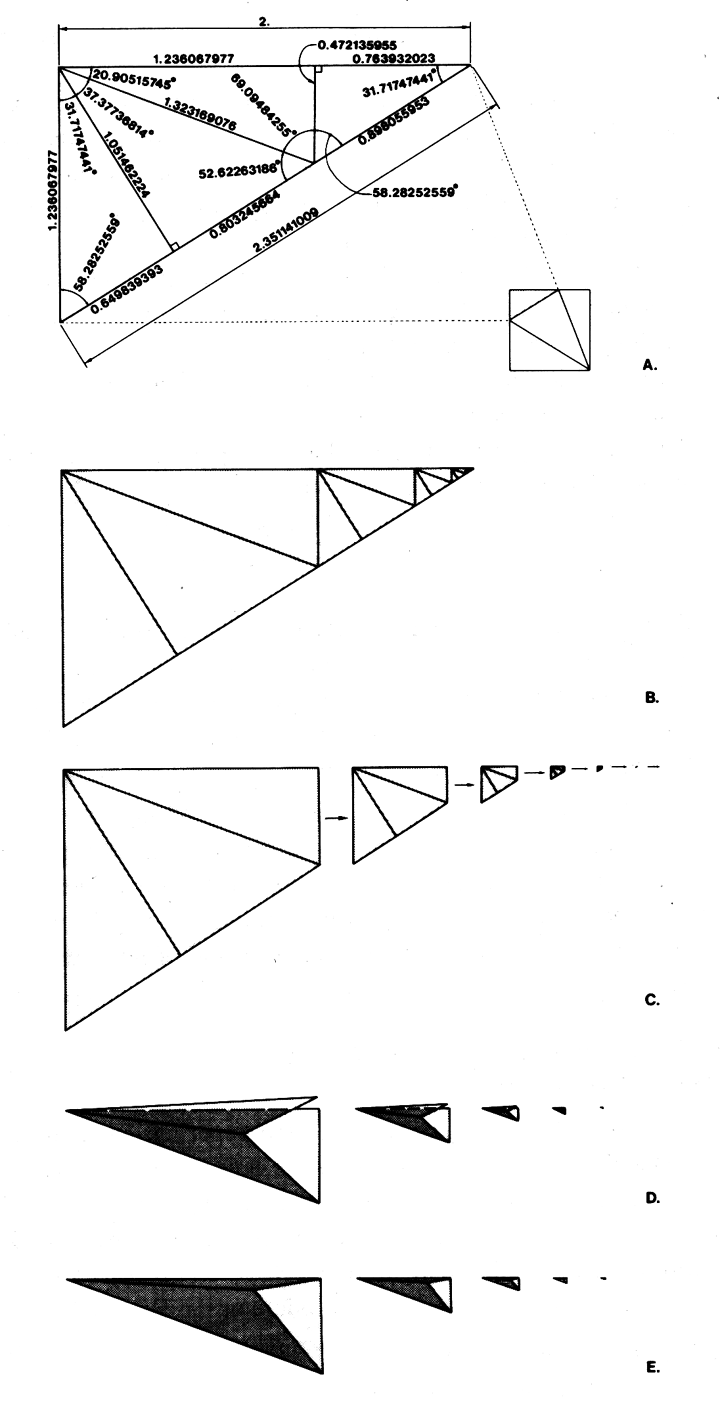
The 6 + 10 + 15 = 31 great circles of icosahedral symmetries (Fig. 901.03) produce the spherical-surface right triangle AC”B; CAB is subdivisible into four spherical right triangles CDA, CDE, DFE, and EFB. Since there are 120 CAB triangles, there are 480 subdivision-right-surface triangles. Among these subdivision-right triangles there are two back-to-back 90-degree surface angles at D—CDA and CDE—and two back-to-back degree surface angles at F—CFE and EFB. The surface chord DE of the central angle DOE is identical in magnitude to the surface chord EB of the central angle EOB, both being 13.28 degrees of circular azimuth. Surface chord FB of central angle FOB and surface chord AD of central angle AOD are identical in magnitude, both being 10.8 degrees azimuth. In the same manner we find that surface chord EF of central angle EOF constitutes the mutual edge of the two surface right triangles CFE and BFE, the central- angle magnitude of EOF being 7.77 degrees azimuth. Likewise, the central angles COA and COF of the surface chords CA and CF are of the same magnitude, 20.9 degrees. All the above data suggest a surprising possibility: that the small corner triangle AC”B itself can be folded on its three internal chord lines CD, CE, and EF, while joining its two edges AC and CF, which are of equal magnitude, having central angles of 20.9 degrees. This folding and joining of F to A and of B to D cancels out the congruent-letter identities F and D to produce the tetrahedron ABEC. (See Fig. 986.561.)
986.562
We find to our surprise that this little flange-foldable tetrahedron is an identically angled miniature of the T Quanta Module OABCt and that it can fit elegantly into the identically angled space terminating at O within the inner reaches of vacant OABC, with the miniature tetrahedron’s corner C becoming congruent with the system’s center O. The volume of the Minimod T is approximately 1/18 that of the Maximod T Quanta Module or of the A or B Modules.
986.570 Range of Modular Orientations
986.571
Now we return to Consideration 13 of this discussion and its discovery of the surface-to-central-angle interexchanging wave succession manifest in the cosmic hierarchy of ever-more-complex, primary structured polyhedra—an interchanging of inside-out characteristics that inherently produces positive-negative world conditions; ergo, it propagates—inside-to-outside-to-in—pulsed frequencies. With this kind of self- propagative regenerative function in view, we now consider exploring some of the implications of the fact that the triangle C’AB is foldable into the E Quanta Module and is also nestable into the T Quanta Module, which produces many possibilities:
- The triangle AC’B will disconnect and reverse its faces and complete the enclosure of the T Quanta Module tetrahedron.
- The 120 T Quanta Modules, by additional tension-induced twist, take the AC”B triangles AB ends end-for-end to produce the additional radius outwardly from O to convert the T Quanta Modules into “Einstein” E Quanta Modules, thus radiantly exporting all 120 modules as photons of light or other radiation.
- The triangle AC”B might disconnect altogether, fold itself into the miniature T Quanta Module, and plunge inwardly to fill its angularly matching central tetrahedral vacancy.
- The outer triangle may just stay mishinged and flapping, to leave the tetrahedron’s outer end open.
- The outer triangle might come loose, fold itself into a miniature T Quanta Module, and leave the system.
- The 120 miniature T Quanta Modules might fly away independently__as, for instance, cosmic rays, i.e., as minimum modular fractions of primitive systems.
- All 120 of these escaping miniature T Quanta Modules could reassemble themselves into a miniature 1/120 triacontahedron, each of whose miniature T Module’s outer faces could fold into mini-mini T Modules and plunge inwardly in ever-more-concentrating demonstration of implosion, ad infinitum.
There are 229,920 other possibilities that any one of any other number of the 120 individual T Module tetrahedra could behave in any of the foregoing seven alternate ways in that vast variety of combinations and frequencies. At this borderline of ultrahigh frequency of intertransformability between matter and electromagnetic radiation we gain comprehension of how stars and fleas may be designed and be born.
986.580 Consideration 15: Surface Constancy and Mass Discrepancy
986.581
Those AC”B triangles appear in the upper left-hand corner of either the T Module’s or the E Module’s square areas COC’C”, one of which has the edge length 0.994 V and the other the edge length of 1.0000 (alpha) V. Regardless of what those AC”B triangles may or may not do, their AC”B areas, together with the areas of the triangles ACO, ABO, and BCO, exactly constitute the total surface area of either the T Module or the E Module.
Surface of T Module =.994 V²
Surface of E Module = 1.00000 (alpha) V²
986.582
The outer triangle AC”B of the T Quanta Module is an inherent energy conserver because of its foldability into one (minimum-something) tetrahedron. When it folds itself into a miniature T Module with the other 119 T Modules as a surface-closed rhombic triacontahedron, the latter will be a powerful energy conserver—perhaps reminiscent of the giant-to-dwarf-Star behavior. The miniature T Module behavior is also similar to behaviors of the electron’s self-conservation. This self-conserving and self- contracting property of the T Quanta Modules, whose volume energy (ergo, energy quantum) is identical to that of the A and B Modules, provides speculative consideration as to why and how electron mass happens to be only 1/1836 the mass of the proton.
986.583
Certain it is that the T Quanta Module → E Quanta Module threshold transformation makes it clear how energy goes from matter to radiation, and it may be that our little corner triangle AC”B is telling us how radiation retransforms into matter.
986.584
The volume of the T Quanta Module is identical with the volumes of the A and B Quanta Modules, which latter we have been able to identify with the quarks because of their clustering in the cosmically minimum, allspace-filling three-module Mites as A +, A -, and B, with both A’s holding their energy charges and B discharging its energy in exact correspondence with the quark grouping and energy-holding-and-releasing properties, with the A Modules’ energy-holding capabilities being based on their foldability from only one triangle, within which triangle the reflection patterning guarantees the energy conserving. (See Secs. 921 and 986.414)
986.585
As we study the hierarchy of the surface areas of constant volume 1 and their respective shapes, we start with the least-surface A Quanta Module which is folded out of one whole triangle, and we find that no other triangle is enclosed by one triangle except at the top of the hierarchy, where in the upper left-hand corner we find our Minimod T or Minimod E tetrahedron foldable out of our little triangle AC”B, whose fold-line patterning is similar to that of the triangle from which the A Quanta Module is folded. In between the whole foldable triangular blank of the A Quanta Module and the whole foldable triangular blank of the Minimod T or Minimod E, we have a series of only asymmetrical folding blanks-until we come to the beautiful squares of the T and E Quanta Modules, which occur just before we come to the triangles of the minimod tetrahedra, which suggests that we go from radiation to matter with the foldable triangle and from matter to radiation when we get to the squares (which are, of course, two triangles).