986.610 Considerations, Recalls, and Discoveries
986.611
Our inventory of considerations, recalls, and discoveries is now burgeoning but remains omniinterrelevant. Wherefore we continue recalling and reconsidering with a high probability factor that we will make further discovery based on our past experience.
986.620 Demass Breakpoint Model of Macrotude-microtude Difference Between Matter and Radiation
986.621
Let me here introduce a physical experiment that will give us a personal feeling of appreciation of the importance to all humanity of all humanity’s being able to see with its own eyes what Einstein’s equation represents—the breakpoint between matter and radiation (critical mass and atomic-energy release)—and above all to give all humanity experienceable, knowable access to all that science has ever discovered regarding Universe, plus much more than science has ever discovered. With all this experienceability of most advanced scientific discovery all humanity will come to appreciate the otherwise utterly incredible exquisiteness of mathematical exactitude with which Universe (which is nature) functions.
986.622
What we employ for such self-instruction at a human-sense-detectable level to appreciate the meager difference between the “T” square’s 0.9995 edge length and the “E” square’s 1.00000 (alpha) edge length is to perform the physical task of producing two squares, which the human eyes can see and fingers can feel are of different sizes. Unaided by a lens, only the most skilled human eyes can see something that is one one-hundredth of an inch (expressed as 0.01 inch). A carpenter works at no finer than 1/32nd of an inch. To make a difference of 0.0005 undeniably visible to any average human we would have to use the popularly adopted 1/16th of an inch, which is that of the common school ruler. This 1/16th of an inch is expressed decimally as 0.0625. To make 0.005 of an inch visible we multiply it by 100, which makes it 0.05. One hundred inches is eight and a half feet—the average room-ceiling height. If we make two squares with 100-inch edges (8 l/2 feet “square”) out of wooden planks and timber, we cannot hold their dimensions to such a close tolerance of error because the humidity and temperature variations will be greater than 0.05 inch. Even if we make the 8 l/2-foot squares of steel and aluminum plate, the expansion and contraction under common weather temperature changes will be greater than 0.05 inch.
986.623
Using machine tools machinists can “dress” their products to tolerances as fine as 0.0001 inch.
986.624
Fiberglass-and-epoxy resin is the substance that has the minimum presently known temperature-and-humidity-caused expansion and contraction rates of all practically producible materials. Wherefore: two square plates two inches thick with edge lengths of 8 l/2 feet could be machine-tool “dressed” and placed vertically face to face in a temperature-controlled slot with one of each of both of their bottom innermost 90-degree corners jammed tightly into a “machined” corner slot, which would then make it possible to “see” with human eyes the difference in square size between the “T” and the “E” squares.
986.625
Even if we “machined” two steel cubes with an edge-length difference of .0005 inch, they would stack one on top of the other with their two vertical surfaces appearing as a polished continuum—the space between them being also subvisible.
986.626
But nature’s energy-as-matter transformed into energy-as-radiation are operations conducted at a size scale far different from our experientially imagined experiments. Nature operates her matter-to-radiation energy exchanging at the atomic level. The nucleus of the atom is where energy-as-matter is self-interferingly knotted together in most primitive polyhedral-patterning event systems. The atomic nucleus diameter is 1/100,000 the diameter of its electron-orbited domain—which domain is spoken of by scientists as “the atom.” One atomic diameter is called the angstrom and is the prime measurement unit of the physicists—macrophysicists or microphysicists, astro or nuclear, as they might well be designated.
986.627
Referring to those two 8 l/2-foot (the size of Barnum’s circus human giant) in height and 2-inches-thick square plates of machine-dressed fiberglass-epoxy resin and their minimum-human-sense-detectability difference of dimension, we find that the angstrom-atomic theater of energy-exchanging performance is only 1/126,500,000,000 the size of the minimum average human sense detectability. This figure, put into human- experience-sensing terms, is the distance that a photon of light expanding radially at 186,000 miles per second will travel-reach between the time humans are born and the time they reach their nineteenth birthday.
986.628
What is important for us to realize here is that synergetics mathematics, beginning with the most primitive hierarchy of min-max geometrical relationships, expresses relationships that exist independently of time-size. So we humans can think intimately about structural principles of any size. These primitive structural principles disclose inherent geometrical nuclei in respect to which all of Universe’s convergent- divergent, gravitational and radiational, contracting into matter and expanding into electromagnetics, and vice versa, together with their terminal angular and frequency knotting and unknotting events comprehensively and comprehendingly occur. And since the sum-total of both macro- and micro-physical science evidences 100-percent conservation of the energy of eternally regenerative Scenario Universe, each smallest differential fraction is of infinite importance to the integrity of Universe.
986.629
And since Physical Universe demonstrates the principle of least effort, i.e., maximum efficiency to be infallibly operative, Universe does the most important tasks in the most exquisite manner; ergo, it is in the most exquisitely minute fractions that she hides her most important secrets. For all the foregoing synergetics’ disclosure of a means of comprehending and operating independently of size provides human mind with not only a cosmic advantage but with all the responsibility such a cosmic decision to invest such an advantage in us implies. With these thoughts we address ourselves now to considering not only the critical cosmic surface-volume relationships but also their unique behavior differentials.
986.630 Interkinetic Limits
986.631
In a structural system’s interbalancing of compression and tension forces the tensed components will always embrace the compression components—as does gravity always comprehensively embrace all radiation—ergo, tension is always outermost of all systems, macrocosmic or microcosmic.
986.632
Take any bendable substance and bend it. As you do so, the outer part of the bend stretches and the inner part compresses. Tension always has the greater radius-ergo, leverage advantage—ergo, gravity is always comprehensive of radiation (Compare Sec. 1051.50)
986.633
In experiential structural reality the so-called sphere is always and only an ultra-high-frequency geodesic polyhedron; ergo, it is always chord-circumferenced and chord-convergent-vertexed rather than arc-circumferenced and arc-vertexed; ergo, it is always and only quasispherical, which quasispherical structural form is experimentally demonstrable as enclosing the most volume with the least surface of any and all symmetrical, equiangular, structural systems. Because of the foregoing we find it desirable to rename the spheric experience, using from now on the word spheric in lieu of the nonexistent, experimentally nondemonstrable “sphere.”
986.634
As an asymmetrical or polarized structural system, the hemispheric-ended cylinder has the same surface-to-volume ratio as that of a sphere with an identical diameter—the latter cylinders as well as their hemispherical terminals consist structurally only of high-frequency, triangularly chorded structures. The spheric and the hemispheric- terminalled cylinders alike contain the most volume with the least surface of all symmetrical polyhedra. At the other extreme of the surface-to-volume ratio, the equiangular tetrahedron encloses the least volume with the most surface of any and all omnisymmetrical structural systems. The more asymmetrical the tetrahedron, the more surface is required to envelop a given volume. It may be assumed, therefore, that with a given quantity of the same energy invested as molecularly structured, system-containing capability, it is less tensionally stressful to enclose a regular equiangular tetrahedron than it is to enclose any asymmetrical tetrahedron.
986.635
In respect to total surface areas of asymmetrical tetrahedra of unit (i.e., identical volume) enclosure, it is experimentally demonstrable that the greater the difference between the most acute angle and the most obtuse of its 12 surface angles, the greater the surface-to-volume ratio will be, and therefore the greater the tensional stressing of its outermost cohering components—ergo, the greater the challenge to the containment of its structural-system integrity. (See Sec. 923 and Fig. 923.10.) According to Newton’s law the mass interattraction of two separate bodies deteriorates exponentially as the distance apart decreases arithmetically; ergo, the relative interproximity of the atoms within any molecule, and the relative interproximity of the molecules as structurally interarrayed within any and all volume-containment systems—and the resultant structural- integrity coherences of those systems—trend acceleratingly toward their theoretical atom- and-molecule-interattractive-proximity limits. These chemical-structure-integrity limits are visibly demonstrated to the human eyes by the bursting of bubbles or of children’s overfilled balloons or of any other internally overpressured fluid-pneumatic, molecular- membraned containers when the membrane impinging and ricocheting interkinetic acceleration of an increasingly introduced population of contained gas molecules separates the molecules of the container membrane beyond their critical-proximity limits. These critical-atomic-and-molecular-proximity limits are mathematically and gravitationally similar to the proximity limits governing the velocity and distance outward from planet Earth’s surface at which a rocket-launched vehicle can maintain its orbit and not fall back into the Earth.
986.700 Spheric Nature of Electromagnetic Waves
986.701 Consideration 16: and Realization of Synergetic Significance
986.702
Since we have learned that nature’s second-powering is triangling and not squaring (Sec. 990), and since each square is always two similar triangles, we must express Einstein’s equation, where E is the product of M and c², as:
986.710 Recapitulation of Geometry-and-energy Recalls
986.711
I must add to the inventory of only-synergetically-interrevealing significant discoveries of this chronicle a recapitulation of additional “recalls ”:
- The absolute constancy of cheese polyhedra;
- that the tetrahedron is the quantum of energy;
- that the nonpolar vertexes of the polar-edge-”tuned” tetrahedron can connect any other two points in Universe;
- that the unit-volume progression of quanta modules accounts for electromagnetic intertuning;
- that the tetrahedron in turning itself inside-out accounts for electromagnetic- wave propagation;
- that polyhedra should be reidentified as polyvertexia, the simplest of which is the tetravertex;
- that the tetravertex is the simplest spheric system;
- that the vector equilibrium provides a field for universal energy accommodation; and
- that the vector equilibrium shell growth rate predicts the proton and neutron population of the elements.
986.720 Absolute Constancy: Cheese Polyhedra
986.721
My first observation of the polyhedral hierarchy was introduced in Sec. 223.64, Table 224.20, and Fig. 400.30. That hierarchy may be considered as cheese polyhedra in which there is an experimental redemonstrability of absolute constancy of areal, volumetric, topological, and symmetry characteristics, which constancy is exclusively unique to triangles and tetrahedra and is maintained despite any and all asymmetrical aberrations of those triangles and tetrahedra, as caused
— by perspective distortion;
— by interproportional variations of relative lengths and angles as manifest in isosceles, scalene, acute, or obtuse system aspects (see quadrangular versus triangular accounting in Figs. 990.01 and 100.301.);
— by truncatings parallel to triangle edges or parallel to tetrahedron faces; or
— by frequency modulations,
in contradistinction to complete loss of symmetry and topological constancy of all polygons other than the triangle and of all polyhedra other than the tetrahedron as caused by any special-case, time-size alterations or changes of the perspective point from which the observations of those systems are taken.
986.722
In connection with this same cheese tetrahedron recall we remember (1) that we could push in on the face A of the tetrahedron at a given rate of radial contraction of the system, while pulling out face B at a matching rate of radial expansion of the system, which “couple” of local alterations of the system left the tetrahedron unaltered in shape or size throughout the transformation (Sec. 623) and just as it was both before and after the “coupled” transformings took place, the only altered consequence of which was that the tetrahedron’s center of volume had migrated; and we remember (2) that we could also push in on the same tetrahedron’s face C and pull out on face D at a coupled rate other than the coupled rate of radial expansion and contraction of the A-B face-coupling’s intercomplementary transformings; by all of which we learn that the tetrahedron can accommodate two disparate rates of change without in any way altering its own size and only altering its center-of-volume positioning in respect to any other system components of the local Universe consideration. (See color plate 26.)
986.723
It must be noted, however, that because of the generalized nonsimultaneity of cosmic events, there exists an inherent lag between the pushing in of face A and the pulling out of face B, which induces an inherent interim wave-depression or a wave- breaking pulsating of the coupling functionings of the tetrahedron’s accommodation of transmission of two disparately frequenced energetic communications.
986.724
Second, I recall—as in Secs. 920.01 and 921.10 and Fig. 923.10 —that the tetrahedron is the quantum of energy.
986.725
Third, I recall that the single-tuned-length axis of the edge-axis-rotatable tetrahedron’s two nonaxis polar vertexes may be deployed to connect up with any two other points in Universe without altering the tetrahedron’s unit volume or its tuned-axis length. (See Sec. 961.30.)
986.726
Fig. 986.726
Constant-unit-volume Progressions of Asymmetric Tetrahedra: In this progression of ever- more-asymmetric tetrahedra, only the sixth edge remains constant. Tetrahedral wavelength and tuning permits any two point in Universe.
Link to original
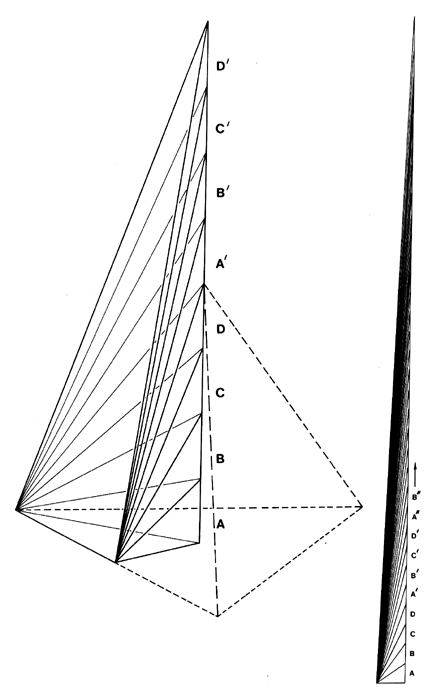
Fourth, I recall that the tetrahedron’s 24 A Modules and the latter’s B, C, D; A, B, C’, D’; A”, B”, C”, D”…(alpha) (see Fig. 986.726, which is a detail and relabeling of Fig. 923.10B) together with the T and E Modules provide transformative significance of being the constant-unit-volume progression of ever-more-asymmetrically-transforming stages of the constant-unit-volume tetrahedra, with the uniform-stage transforming being provided by five of the six edges of each of the constant-volume tetrahedra being covaryingly and ever-progressively-disparately altered—with the sixth edge alone of each and all stages of the transformation remaining unaltered in frequency and wavelength magnitude. The concurrent
— constant-volume-and-wavelength transformings, and
— system rotating around and angular tilting of the constant, unaltered-in-length, sixth edge’s axial altitude in respect to the all-other-in-Universe experiences’ omniinterangular orientations, altogether both permit and accommodate any two other points X and Y in Universe being interconnected not only with one another, but also with the two points A and B that define the unaltered sixth edge AB of the constant-volume and constant-AB-edge-length, omni- Universe-interconnecting tetrahedron ABXY; all of which permits the constant sixth edge AB length to serve as the anywhere and anywhen in Universe to be established transceiver’s wavelength-defining and frequency-selecting and tuning interconnecting any given two points in Universe with any two other points in Universe; ergo, with all other points in Universe, granted only sufficient elapsed time for rotational realization of the frequency of repetition of the wavelength vector’s velocity factor to reach any given loci in Universe with a given volumetric-unit quantum of energy. (This is the significance of Fig. 923.10.)
986.727
Fifth, I recall as recounted in Sec. 961.40 that the more elongated the unit- volume tetrahedron of only one-edge-length-constancy (the sixth edge), the less becomes the unit-volume tetrahedron’s least-altitude aspect as related to its other interdimensional aspects, wherefore there is attained a condition wherein the controlling sixth edge’s wavelength is greater than half the tetrahedron’s least-altitude aspect—at which condition the tetrahedron spontaneously turns itself inside-out, ergo, turns itself out—not out of Universe, but out of tune-in-able range. Prior to this spontaneous tuning-out range we have a vast range of now-partially-tuned-in-and-now-tuned-out, which altogether propagates finitely packaged, tuned-in energy information occurring in packages yet recurring in constant, contained wavelength intervals that introduce what has hitherto been considered to be the paradoxical aspect of electromagnetic phenomena, of which it has been misassumed that as of any one moment we can consider our electromagnetic phenomena as being continuous-wave phenomena or as discontinuous-particle phenomena—both simultaneous. We thus learn that no such paradox exists. (Compare Secs. 541.30, 961.46-48, 973.30, and 1072.32.)
986.728
Sixth, we recall that there are no solids or absolute continuums; ergo, there are no physically demonstrable faces or sides of hedra; ergo, we reidentify the system- conceptioning experiences heretofore spoken of as polyhedra, by the name polyvertexia, the simplest of which is the tetravertex, or “four-fix” system.
986.729
Seventh, we recall that the tetravertex is not only the simplest limit case—i.e., the topologically most economically definable polyvertex system case—but also the simplest spheric-system experience case. (See Secs. 1024.10-25, 1053.40-62, 1054.00, 1054.30, and Fig. 1054.40.)
986.730
The Spheric Experience: We now scientifically redefine the spheric experience as an aggregate of vertex-direction-pointed-to (fixed) sub-tune-in-able microevent centers surrounding a system center at equal-radius distances from the system center. Four such surrounding, vertex-convergence-indicated, microevent fixes are redemonstrably proven to be the minimum number of such a microcenter- surrounding aggregate geometrically adequate to constitute systemic subdivision of Universe into macrocosm and microcosm by convergent envelopment, which inherently excludes the thus-constituted system’s macrocosm and inherently includes the thus- constituted system’s microcosm, in which spheric experiencing the greater the population of equi-radiused-from-system-center microevent fixes, the more spheric the experience, and the earliest and simplest beyond the tetrahedron being the hierarchy of concentric, symmetric, primitive polyhedra.
986.740 Microenergy Transformations of Octet Truss
986.741
These last nine major recalls (Sec. 986.711) are directly related to the matter-to-radiation transitional events that occur as we transit between the T and the E Quanta Modules. First, we note that bubbles are spherics, that bubble envelopes are liquid membranes, and that liquids are bivalent. Bivalent tetrahedral aggregates produce at minimum the octet truss. (See Sec. 986.835 et seq.) The octet truss’s double-bonded vertexes also require two layers of closest-packed, unit-radius spheres, whose two layers of closest-packed spheres produce an octet truss whose interior intermembranes are planar while both the exterior and interior membranes are domical.
986.742
Sufficient interior pressure will stretch out the bivalent two-sphere layer into univalent one-sphere layering, which means transforming from the liquid into the gaseous state, which also means transforming from interattractive proximity to inadequate interattractive proximity—ergo, to self-diffusing, atoms-dispersing gaseous molecules. This is to say that the surface-to-volume relationship as we transform from T Quanta Module to E Quanta Module is a transformative, double-to-single-bond, liquid-to-gas transition. Nothing “bursts.” … Bursting is a neat structural-to-destructural atomic rearrangement, not an undefinable random mess.
986.743
Small-moleculed, gaseous-state, atomic-element, monovalent integrities, wherein the atoms are within mass-interattractive critical-proximity range of one another, interconstitute a cloud that may entrap individual molecules too large for escape through the small-molecule interstices of the cloud. A cloud is a monovalent atomic crowd. Water is a bivalent crowd of atoms. Clouds of gasses, having no external membrane, tend to dissipate their molecule and atom populations expansively, except, for instance, within critical proximity of planet Earth, whose Van Allen belts and ionosphere are overwhelmingly capable of retaining the atmospheric aggregates—whose minienergy events such as electrons otherwise become so cosmically dispersed as to be encountered only as seemingly “random” rays and particles.
986.744
This cosmic dispersion of individual microenergy event components—alpha particles, beta particles, and so on—leads us to what is seemingly the most entropic disorderly state, which is, however, only the interpenetration of the outer ramparts of a plurality of differently tuned or vectored isotropic-vector-matrix VE systems.
986.750 Universal Accommodation of Vector Equilibrium Field: Expanding Universe
986.751
Recalling (a) that we gave the vector equilibrium its name because nature avoids the indeterminate (the condition of equilibrium) by always transforming or pulsating four-dimensionally in 12 different ways through the omnicentral VE state, as in one plane of which VE a pendulum swings through the vertical;
— and recalling (b) that each of the vertexes of the isotropic vector matrix could serve as the nuclear center of a VE;
— and recalling (c) also that the limits of swing, pulse, or transform through aberrations of all the VE nucleus-concentric hierarchy of polyhedra have shown themselves to be of modest aberrational magnitude (see the unzipping angle, etc.);
— and recalling (d) also that post-Hubble astronomical discoveries have found more than a million galaxies, all of which are omniuniformly interpositioned angularly and are omniuniformly interdistanced from one another, while all those distances are seemingly increasing uniformly;
— all of which recalls together relate to, explain, and engender the name Expanding Universe.
986.752
We realize that these last four recalls clearly identify the isotropic vector matrix as being the operative geometrical field, not only when atoms are closest packed with one another but also when they are scattered entropically into the cosmically greatest time-size galaxies consisting of all the thus-far-discovered-to-exist stars, which consist of the thus-far-discovered evidence of existent atoms within each star’s cosmic region—with those atoms interarrayed in a multitude of all-alternately, equi-degrees-of-freedom-and- frequency-permitted, evolutionary patterning displays ranging from interstellar gasses and dusts to planets and stars, from asteroids to planetary turtles…to coral…to fungi… et al… Wherefore the Expanding Universe of uniformly interpositioned galaxies informs us that we are witnessing the isotropic vector matrix and its local vector equilibria demonstrating integrity of accommodation at the uttermost time-size macrolimits thus far generalizable within this local 20-billion-year-episode sequence of eternally regenerative Universe, with each galaxy’s unique multibillions of stars, and each of these stars’ multibillions of atoms all intertransforming locally to demonstrate the adequacy of the isotropic vector matrix and its local vector equilibria to accommodate the totality of all local time aberrations possible within the galaxies’ total system limits, which is to say within each of their vector equilibrium’s intertransformability limits.
986.753
Each of the galaxies is centered within a major VE domain within the greater isotropic vector matrix geometrical field—which major VE’s respective fields are subdividingly multiplied by isotropic matrix field VE centerings to the extent of the cumulative number of tendencies of the highest frequency components of the systems permitted by the total time-size enduring magnitude of the local systems’ individual endurance time limits.
986.754
In the seemingly Expanding Universe the equidistant galaxies are apparently receding from each other at a uniform rate, as accounted for by the pre-time-size VE matrix which holds for the largest scale of the total time. This is what we mean by multiplication only by division within each VE domain and its total degrees of freedom in which the number of frequencies available can accommodate the full history of the cosmogony.
986.755
The higher the frequency, the lower the aberration. With multiplication only by division we can accommodate the randomness and the entropy within an entirely regenerative Universe. The high frequency is simply diminishing our point of view.
986.756
The Expanding Universe is a misnomer. What we have is a progressively diminishing point of view as ever more time permits ever greater frequency of subdivisioning of the totally tunable Universe.
986.757
What we observe sum-totally is not a uniformly Expanding Universe, but a uniformly-contracting-magnitude viewpoint of multiplication only by division of the finite but non-unitarily-conceptual, eternally regenerative Scenario Universe. (See Secs. 987.066 and 1052.62.)
986.758
Because the higher-frequency events have the shortest wavelengths in aberration limits, their field of articulation is more local than the low-frequency, longer- wavelengths aberration limit events—ergo, the galaxies usually have the most intense activities closer into and around the central VE regions: all their entropy tendency is accommodated by the total syntropy of the astrophysical greatest-as-yet-identified duration limit.
986.759
We may now direct our attention to the microcosmic, no-time-size, closest- packed unity (versus the Galactic Universe macro-interdistanced unity). This brings us to the prefrequency, timeless-sizeless VE’s hierarchy and to the latter’s contractability into the geometrical tetrahedron and to that quadrivalent tetrahedron’s ability to turn itself inside-out in pure principle to become the novent tetrahedron—the “Black Hole”—the presently-non-tuned-in phenomena. And now we witness the full regenerative range of generalized accommodatability of the VE’s isotropic matrix and its gamut of “special case” realizations occurring as local Universe episodes ranging from photons to molecules, from red giants to white dwarfs, to the black-hole, self-insideouting, and self-reversing phase of intertransformability of eternally regenerative Universe.
986.760
Next we reexplore and recall our discovery of the initial time-size frequency- multiplication by division only-which produces the frequency F, F², F³ layers of 12, 42, closest-packed spheres around a nuclear sphere… And here we have evidencible proof of the persistent adequacy of the VE’s local field to accommodate the elegantly simple structural regenerating of the prime chemical elements, with the successive shell populations demonstrating physically the exact proton-neutron population accounting of the first minimum-limit case of most symmetrical shell enclosings, which corresponds exactly with the ever-experimentally-redemonstrable structural model assemblies shown in Sec. 986.770.
986.770 Shell Growth Rate Predicts Proton and Neutron Population of the Elements
986.771
Thus far we have discovered the physical modelability of Einstein’s equation and the scientific discovery of the modelability of the transformation from matter to radiation, as well as the modelability of the difference between waves and particles. In our excitement over these discoveries we forget that others may think synergetics to be manifesting only pure coincidence of events in a pure-scientists’ assumed-to-be model-less world of abstract mathematical expressions, a world of meaningless but alluring, simple geometrical relationships. Hoping to cope with such skepticism we introduce here three very realistic models whose complex but orderly accounting refutes any suggestion of their being three successive coincidences, all occurring in the most elegantly elementary field of human exploration-that of the periodic table of unique number behaviors of the proton and neutron populations in successive stages of the complexity of the chemical elements themselves.
986.772
If we look at Fig. 222.01 (Synergetics 1), which shows the three successive layers of closest-packed spheres around the prime nuclear sphere, we find the successive layer counts to be 12, 42, 92 … that is, they are “frequency to the second power times 10 plus 2.” While we have been aware for 40 years that the outermost layer of these concentric layers is 92, and that its first three layers add to
which 146 is the number of neutrons in uranium, and uranium is the 92nd element—as with all elements, it combines its total of inner-layer neutrons with its outer-layer protons. In this instance of uranium we have combined the 149 with 92, which gives us Uranium- 238, from which count we can knock out four neutrons from eight of the triangular faces without disturbing symmetry to give us Uranium-234.
986.773
Recently, however, a scientist who had been studying synergetics and attending my lectures called my attention to the fact that the first closest-packed layer 12 around the nuclear sphere and the second embracing closest-packed layer of 42 follow the same neutron count, combining with the outer layer number of protons—as in the 92 uranium-layer case—to provide a physically conceptual model of magnesium and molybdenum. (See Table 419.21.)
986.774
We can report that a number of scientists or scientific-minded laymen are communicating to us their discovery of other physics-evolved phenomena as being elegantly illustrated by synergetics in a conceptually lucid manner.
986.775
Sum-totally we can say that the curve of such events suggests that in the coming decades science in general will have discovered that synergetics is indeed the omnirational, omniconceptual, multialternatived, omnioptimally-efficient, and always experimentally reevidenceable, comprehensive coordinate system employed by nature.
986.776
With popular conception of synergetics being the omniconceptual coordinate system of nature will come popular comprehension of total cosmic technology, and therefore popular comprehension that a competent design revolution—structurally and mechanically—employing the generalized principles governing cosmic technology can indeed, render all humanity comprehensively—i.e., physically and metaphysically—successful, i.e., becoming like “hydrogen” or “leverage” —regular member functions of an omnisuccessful Universe.
986.800 Behavioral Proclivities of Spheric Experience
986.810 Discard of Abstract Dimensions
986.811
Inspired by the E=Mc² modelability, I did more retrospective reconsideration of what I have been concerned with mathematically throughout my life. This reviewing led me to (1) more discoveries, clarifications, and definitions regarding spheres; (2) the discard of the concept of axioms; and (3) the dismissal of three- dimensional reality as being inherently illusory—and the discard of many of mathematics’ abstract devices as being inherently “roundabout,” “obscurational,” and “inefficient.”
986.812
Reversion to axioms and three-dimensional “reality” usually occurs on the basis of “Let’s be practical…let’s yield to our ill-informed reflex-conditioning…the schoolbooks can’t be wrong…no use in getting out of step with the system…we’ll lose our jobs…we’ll be called nuts.”
986.813
Because they cannot qualify as laws if any exceptions to them are found, the generalizable laws of Universe are inherently eternal-timeless-sizeless. Sizing requires time. Time is a cosmically designed consequence of humanity’s having been endowed with innate slowness of apprehension and comprehension, which lags induce time-lapse-altered concepts. (Compare Sec. 529.09.)
986.814
Time-lapsed apprehension of any and all energy-generated, human-sense- reported, human-brain-image-coordinated, angular-directional realization of any physical experiences, produces (swing-through-zero) momentums of misapprehending, which pulsatingly unbalances the otherwise equilibrious, dimensionless, timeless, zero-error, cosmic intellect perfection thereby only inferentially identified to human apprehending differentiates the conceptioning of all the special case manifests of the generalized laws experienced by each and every human individual.
986.815
Academic thought, overwhelmed by the admitted observational inexactitude of special case human-brain-sense experiences, in developing the particular logic of academic geometry (Euclidean or non-Euclidean), finds the term “identical” to be logically prohibited and adopts the word “similar” to identify like geometrical entities. In synergetics, because of its clearly defined differences between generalized primitive conceptuality and special-case time-size realizations, the word “identical” becomes logically permitted. This is brought about by the difference between the operational procedures of synergetics and the abstract procedures of all branches of conventional geometry, where the word “abstract” deliberately means “nonoperational,” because only axiomatic and non-physically-demonstrable.
986.816
Fig. 986.816
Fig. 986.816 Angles Are Angles Independent of the Length of their Edges. Lines are “size” phenomena and unlimited in length. Angle is only a fraction of one cycle.
Link to original
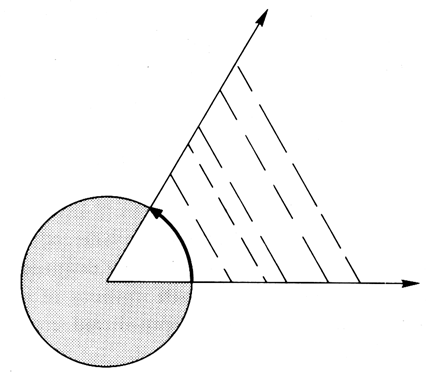
In conventional geometry the linear characteristics and the relative sizes of lines dominate the conceptioning and its nomenclature-as, for instance, using the term “equiangular” triangle because only lengths or sizes of lines vary in time. Lines are unlimited in size and can be infinitely extended, whereas angles are discrete fractions of a discrete whole circle. Angles are angles independently of the lengths of their edges. (See Sec. 515.10.) Lengths are always special time-size cases: angles are eternally generalized… We can say with scientific accuracy: “identical equiangular triangles.” (See Fig. 986.816.)
986.817
In summary, lines are “size” phenomena and are unlimited in length. Size measuring requires “time.” Primitive synergetics deals only in angles, which are inherently whole fractions of whole circular azimuths.
986.818
Angles are angles independent of the length of their edges. Triangles are triangles independent of their size. Time is cyclic. Lacking one cycle there is no time sense. Angle is only a fraction of one cycle.
986.819
Synergetics procedure is always from a given whole to the particular fractional angles of the whole system considered. Synergetics employs multiplication only by division… only by division of finite but non-unitarily-conceptual Scenario Universe, subdivided into initially whole primitive systems that divide whole Universe into all the Universe outside the system, all the Universe inside the system, and the little bit of Universe that provides the relevant set of special case stars of experience that illuminatingly define the vertexes of the considered primitive generalized system of consideration. (See Sec. 509.) Conventional geometry “abstracts” by employment of nonexistent—ergo, nondemonstrable—parts, and it compounds a plurality of those nonexistents to arrive at supposedly real objects.
986.820
Because the proofs in conventional geometry depend on a plurality of divider-stepped-off lengths between scribed, punched, or pricked indefinably sized point- speck holes, and because the lengths of the straightedge-drawn lines are extendible without limit, conventional geometry has to assume that any two entities will never be exactly the same. Primitive synergetics has only one length: that of the prime unit vector of the VE and of the isotropic vector matrix.
986.821
Synergetics identifies all of its primitive hierarchy and their holistic subdivisions only by their timeless-sizeless relative angular fractional subdivisions of six equiangular triangles surrounding a point, which hexagonal array equals 360 degrees, if we assume that the three angles of the equiangular triangle always add up to 180 degrees. Synergetics conducts all of its calculations by spherical trigonometry and deals always with the central and surface angles of the primitive hierarchy of pre-time-size relationships of the symmetrically concentric systems around any nucleus of Universe—and their seven great-circle symmetries of the 25 and 31 great-circle systems (Sec. 1040). The foldability of the four great-circle planes demonstrates the four sets of hexagons omnisurrounding the cosmic nucleus in omni-60-degree angular symmetry. This we call the VE. (See Sec. 840.) Angular identities may be operationally assumed to be identical: There is only one equiangular triangle, all of its angles being 60 degrees. The 60-ness comes from the 60 positive and 60 negative, maximum number of surface triangles or T Quanta Modules per cosmic system into which convergent-divergent nuclear unity may be subdivided. The triangle, as physically demonstrated by the tube necklace polygons (Sec. 608), is the only self-stabilizing structure, and the equiangular triangle is the most stable of all triangular structures. Equiangular triangles may be calculatingly employed on an “identical” basis.
986.830 Unrealizability of Primitive Sphere
986.831
As is shown elsewhere (Sec. 1022.11), synergetics finds that the abstract Greek “sphere” does not exist; nor does the quasisphere—the sense-reported “spheric” experiencings of humans—exist at the primitive stage in company with the initial cosmic hierarchy of timeless-sizeless symmetric polyhedra as defined by the six positive and six negative cosmic degrees of freedom and their potential force vectors for adequately coping with all the conditions essential to maintain the individual integrity of min-max primitive, structural, presubdivision systems of Universe.
986.832
The sphere is only dynamically developed either by profiles of spin or by multiplication of uniformly radiused exterior vertexes of ever-higher frequency of modular subdivisioning of the primitive system’s initial symmetry of exterior topology. Such exclusively time-size events of sufficiently high frequency of modular subdivisioning, or high frequency of revolution, can transform any one of the primitive (eternal, sizeless, timeless) hierarchy of successive = 2½, 1, 2½, 3, 4, 5, 6-tetravolumed concentrically symmetric polyhedra into quasispherical appearances. In respect to each such ever-higher frequency of subdividing or revolving in time, each one of the primitive hierarchy polyhedra’s behavioral appearance becomes more spherical.
986.833
The volume of a static quasisphere of unit vector length (radius = l) is 4.188. Each quasisphere is subexistent because it is not as yet spun and there is as yet no time in which to spin it. Seeking to determine anticipatorily the volumetric value of the as-yet- only-potential sphere’s as-yet-to-be-spun domain (as recounted in Secs. 986.206-214), I converted my synergetics constant 1.0198255 to its ninth power, as already recounted and as intuitively motivated to accommodate the energetic factors involved, which gave me the number 1.192 (see Sec. 982.55), and with this ninth-powered constant multiplied the incipient sphere’s already-third-powered volume of 4.188, which produced the twelfth- powered value 4.99206, which seems to tell us that synergetics’ experimentally evidenceable only-by-high-frequency-spinning polyhedral sphere has an unattainable but ever-more-closely-approached limit tetravolume-5.000 (alpha) with however a physically imperceptible 0.007904 volumetric shortfall of tetravolume-5, the limit 4.99206 being the maximum attainable twelfth-powered dynamism—being a sphericity far more perfect than that of any of the planets or fruits or any other of nature’s myriads of quasispheres, which shortfallers are the rule and not the exceptions. The primitively nonconceptual, only- incipient sphere’s only-potentially-to-be-demonstrated domain, like the square root of minus one, is therefore a useful, approximate-magnitude, estimating tool, but it is not structurally demonstrable. The difference in magnitude is close to that of the T and E Quanta Modules.
986.834
Since structure means an interself-stabilized complex-of-events patterning (Sec. 600.01), the “spheric” phenomenon is conceptually—sensorially—experienceable only as a time-size high-frequency recurrence of events, an only-by-dynamic sweepout domain, whose complex of involved factors is describable only at the twelfth-power stage. Being nonstructural and involving a greater volumetric sweepout domain than that of their unrevolved structural polyhedral domains, all quasispheres are compressible.
986.835
Independently occurring single bubbles are dynamic and only superficially spherical. In closest packing all interior bubbles of the bubble aggregate become individual, 14-faceted, tension-membrane polyhedra, which are structured only by the interaction with their liquid monomer, closed-system membranes of all the trying-to- escape, kinetically accelerated, interior gas molecules—which interaction can also be described as an omniembracing restraint of the trying-to-escape gaseous molecules by the sum-total of interatomic, critical-proximity-interattracted structural cohesion of the tensile strength of the bubble’s double-molecule-layered (double-bonded) membranes, which comprehensive closed-system embracement is similar to the cosmically total, eternally integral, nonperiodic, omnicomprehensive embracement by gravitation of the always-and- only periodically occurring, differentiated, separate, and uniquely frequenced nonsimultaneous attempts to disintegratingly escape Universe enacted by the individually differentiated sum-total entities (photons) of radiation. Gravity is always generalized, comprehensive, and untunable. Radiation is always special case and tunable.
986.836
Bubbles in either their independent spherical shape or their aggregated polyhedral shapes are structural consequences of the omnidirectionally outward pressing (compression) of the kinetic complex of molecules in their gaseous, single-bonded, uncohered state as comprehensively embraced by molecules in their liquid, double-bonded, coherent state. In the gaseous state the molecules operate independently and disassociatively, like radiation quanta—ergo, less effective locally than in their double- bonded, integrated, gravity-like, liquid-state embracement.
986.840 Primitive Hierarchy as Physical and Metaphysical
986.841
A special case is time-size. Generalization is eternal and is independent of time-size “Spheres,” whether as independent bubbles, as highfrequency geodesic polyhedral structures, or as dynamically spun primitive polyhedra, are always and only special case time-size (frequency) physical phenomena. The omnirational primitive- numbered-tetravolume-interrelationships hierarchy of concentric symmetric polyhedra is the only generalized conceptuality that is both physical and metaphysical. This is to say that the prime number and relative abundance characteristics of the topology, angulation, and the relative tetravolume involvements of the primitive hierarchy are generalized, conceptual metaphysics. Physically evidenced phenomena are always special case, but in special cases are manifests of generalized principles, which generalized principles themselves are also always metaphysical.
986.850 Powerings as Systemic-integrity Factors
986.851
Synergetics is everywhere informed by and dependent on experimental evidence which is inherently witnessable—which means conceptual—and synergetics’ primitive structural polyhedra constitute an entire, infra-limit-to-ultra-limit, systemic, conceptual, metaphysical hierarchy whose entire interrelationship values are the generalizations of the integral and the “internal affairs” of all systems in Universe—both nucleated and nonnucleated. Bubbles and subatomic A, B, T, and E Quanta Modules are nonnucleated containment systems. Atoms are nucleated systems.
986.852
The systemically internal interrelationship values of the primitive cosmic hierarchy are all independent of time-size factorings, all of which generalized primitive polyhedra’s structurings are accommodated by and are governed by six positive and six negative degrees of freedom. There are 12 integrity factors that definitively cope with those 12 degrees of freedom to produce integral structural systems—both physical and metaphysical—which integrity factors we will henceforth identify as powerings.
986.853
That is, we are abandoning altogether the further employment of the word dimension, which suggests (a) special case time-size lengths, and (b) that some of the describable characteristics of systems can exist alone and not as part of a minimum system, which is always a part of a priori eternally regenerative Universe. In lieu of the no longer scientifically tenable concept of “dimension” we are adopting words to describe time-size realizations of generalized, timeless, primitive systems as event complexes, as structural selfstabilizations, and structural intertransformings as first, second, third, etc., local powering states and minimum local systemic involvement with conditions of the cosmic totality environment with its planetary, solar, galactic, complex-galactic, and supergalactic systems and their respective macro-micro isotropicities.
986.854
In addition to the 12-powered primitive structurings of the positive and negative primitive tetrahedron, the latter has its primitive hierarchy of six intertransformable, tetravolumed, symmetrical integrities which require six additional powerings to produce the six rational-valued, relative-volumetric domains. In addition to this 18-powered state of the primitive hierarchy we discover the integrally potential six- way intertransformabilities of the primitive hierarchy, any one of which requires an additional powering factor, which brings us thus far to 24 powering states. Realization of the intertransformings requires time-size, special case, physical transformation of the metaphysical, generalized, timeless-sizeless, primitive hierarchy potentials.
986.855
It is demonstrably evidenceable that the physically realized superimposed intertransformability potentials of the primitive hierarchy of systems are realizable only as observed from other systems. The transformability cannot be internally observed. All primitive systems have potential external observability by other systems. “Otherness” systems have their own inherent 24-powered constitutionings which are not additional powerings—just more of the same.
986.856
All systems have external relationships, any one of which constitutes an additional systemic complexity-comprehending-and-defining-and-replicating power factor. The number of additional powering factors involved in systemic self-systems and otherness systems is determined in the same manner as that of the fundamental interrelationships of self- and otherness systems, where the number of system interrelationships is
986.857
Not including the
additional intersystems-relationship powerings, beyond the 24 systemically integral powers, there are six additional, only- otherness-viewable (and in some cases only multi-otherness viewable and realizable), unique behavior potentials of all primitive hierarchy systems, each of which behaviors can be comprehensively accounted for only by additional powerings. They are:
25th-power = axial rotation of the system
26th-power = orbital travel of the system
27th-power = expansion-contraction of the system
28th-power = torque (axial twist) of the system
29th-power = inside-outing (involuting-evoluting) of the system
30th-power = intersystem precession (axial tilting) of the system
31st-power = external interprecessionings amongst a plurality of systems
32nd-power = self-steering of a system within the galaxy of systems (precessionally accomplished)
33rd-power = universal synergistic totality comprehensive of all intersystem effects and ultimate micro- and macroisotropicity of VE-ness
986.860 Rhombic Dodecahedron 6 Minus Polyhedron 5 Equals Unity
986.861
High-frequency, triangulated unit-radius-vertexed, geodesically interchorded, spherical polyhedral apparencies are also structural developments in time-size. There are therefore two kinds of spherics: the highfrequency-event-stabilized, geodesic, structural polyhedron and the dynamically spun, only superficially “apparent” spheres. The static, structural, multifaceted, polyhedral, geodesic sphere’s vertexes are uniformly radiused only by the generalized vector, whereas the only superficially spun and only apparently profiled spheres have a plurality of vertexial distances outward from their systemic center, some of which distances are greater than unit vector radius while some of the vertexes are at less than unit vector radius distance. (See Fig. 986.861.)
986.862
Among the symmetrical polyhedra having a tetravolume of 5 and also having radii a little more or a little less than that of unit vector radius, are the icosahedron and the enenicontahedron whose mean radii of spherical profiling are less than four percent vector-aberrant. There is, however, one symmetrical primitive polyhedron with two sets of its vertexes at greater than unit radius distance outwardly from their system’s nucleic center; that is the rhombic dodecahedron, having, however, a tetravolume of 6. The rhombic dodecahedron’s tetravolume of 6 may account for the minimum intersystemness in pure principle, being the space between omni-closest-packed unit-radius spheres and the spheres themselves. And then there is one symmetric primitive polyhedron having a volume of exactly tetravolume 5 and an interpattern radius of 0.9995 of one unit vector; this is the T Quanta Module phase rhombic triacontahedron. There is also an additional rhombic triacontahedron of exact vector radius and a tetravolume of 5.007758031, which is just too much encroachment upon the rhombic dodecahedron 6 minus the triacontahedron 5 → 6 - 5 = 1, or one volumetric unit of unassigned cosmic “fail-safe space”: BANG—radiation-entropy and eventual turnaround precessional fallin to syntropic photosynthetic transformation into one of matter’s four states: plasmic, gaseous, liquid, crystalline.
986.863
All the hierarchy of primitive polyhedra were developed by progressive great-circle-spun hemispherical halvings of halvings and trisectings of halvings and quintasectings (see Sec. 100.1041) of halvings of the initial primitive tetrahedron itself. That the rhombic triacontahedron of contact-facet radius of unit vector length had a trigonometrically calculated volume of 4.998 proved in due course not to be a residual error but the “critical difference” between matter and radiation. This gives us delight in the truth whatever it may be, recalling that all the discoveries of this chronicle chapter were consequent only to just such faith in the truth, no matter how initially disturbing to misinformed and misconditioned reflexes it may be.
986.870 Nuclear and Nonnuclear Module Orientations
986.871
The rhombic triacontahedron may be fashioned of 120 trivalently bonded T Quanta Module tetrahedra, or of either 60 bivalently interbonded positive T Modules or of 60 bivalently interbonded negative T Modules. In the rhombic triacontahedron we have only radiantly arrayed basic energy modules, arrayed around a single spheric nuclear- inadequate volumetric domain with their acute “corners” pointed inwardly toward the system’s volumetric center, and their centers of mass arrayed outwardly of the system—ergo, prone to escape from the system.
986.872
In the tetrahedron constructed exclusively of 24 A Modules, and in the octahedron constructed of 48 A and 48 B Modules, the asymmetric tetrahedral modules are in radical groups, with their acute points arrayed outwardly of the system and their centers of mass arrayed inwardly of the system—ergo, prone to maintain their critical mass interattractive integrity. The outer sharp points of the A and B Modules are located at the centers of the four or six corner spheres defining the tetrahedron and octahedron, respectively. The fact that the tetrahedron’s and octahedron’s A and B Modules have their massive centers of volume pointing inwardly of the system all jointly interarrayed in the concentric layers of the VE, whereas in the rhombic triacontahedron (and even more so in the half-Couplers of the rhombic dodecahedron) we have the opposite condition—which facts powerfully suggest that the triacontahedron, like its congruent icosahedron’s nonnuclear closest-possible-packed omniarray, presents the exclusively radiational aspect of a “one” or of a “no” nuclear-sphere-centered and isolated most “spheric” polyhedral system to be uniquely identified with the nonnuclear bubble, the one-molecule-deep, kinetically-escape-prone, gas-molecules-containing bubble.
986.8721
In the case of the rhombic dodecahedra we find that the centers of volume of their half-Couplers’ A and B Modules occur almost congruently with their respective closest-packed, unit-radius sphere’s outward ends and thereby concentrate their energies at several spherical-radius levels in respect to a common nuclear-volume-adequate center—all of which suggests some significant relationship of this condition with the various spherical-radius levels of the electron “shells.”
986.873
The tetrahedron and octahedron present the “gravitational” model of self- and-otherness interattractive systems which inherently provide witnessable evidence of the systems’ combined massive considerations or constellations of their interbindings.
986.874
The highly varied alternate A and B Module groupings permitted within the same primitive rhombic dodecahedron, vector equilibrium, and in the Couplers, permit us to consider a wide spectrum of complexedly reorientable potentials and realizations of intermodular behavioral proclivities Lying in proximity to one another between the extreme radiational or gravitational proclivities, and all the reorientabilities operative within the same superficially observed space (Sec. 954). All these large numbers of potential alternatives of behavioral proclivities may be circumferentially, embracingly arrayed entirely within the same superficially observed isotropic field.