[987.00-987.416 Multiplication by Division Scenario]
987.010 Operational Scenario in Proof of Multiplication Only by Progressive Divisioning of Simplest Vectorially Structured Polyhedra
987.011
Six equi-zero-magnitude, mass-times-velocity-produced vectors representing the six equi-energetic, differently angled (i.e., differently directioned) cosmic forces that always cointeract to freshly reinitiate minimum local structuring in Universe, constitute the minimum-maximum cosmic set of coordinates necessary to formulate a definitive system. A system is the first finite unitarily conceptual subdivision of finite but nonunitarily conceptual Scenario Universe. (See Sec. 400.011 and especially Fig. 401.)
987.012
A system is a polyhedral pattern—regular or irregular—that definitively closes back upon itself topologically to subdivide Universe locally into four parts: (1) all the Universe outside the system, the macrocosm; (2) all the Universe within the system, the microcosm; (3) the convex-outside little bit of the Universe of which the system itself is constituted; and (4) the concave-inside little bit of the Universe of which the system is constituted.
987.013
The tetrahedron, with its six equi-lengthed vector edges and four vertexes and with its four triangular windows, is experimentally demonstrable to be the topologically simplest structural system of Universe.
987.020 Topological Uniqueness
987.021
Recognizing that angles are conceptual independent of the lengths of the lines converging to form them, it follows that a triangle or a tetrahedron or any polygons or polyhedra are conceptual—and conceptually different—quite independent of the time- size lengths of the lines defining the polyhedra. All primitive non-space-time differences are exclusively angular and topological.
987.022
The topological variables of systems are identified exclusively as the unique number of vertexes (points), faces (areas), and edges (lines) of the system considered.
987.030 Finite Synergetics
987.031
Starting with mass = zero and velocity = zero (i.e., MV = 0), as the energy- quantum product of the six vectors of the minimum structural system in Universe (that is, each of the tetrahedron’s six equi-lengthed edges individually = 0), the mathematical art and science known as Synergetics provides a cosmically comprehensive mathematical strategy of employing always and only physically demonstrable, omnidimensional, quantum-compatible multiplication only by division of a no-gain-no-loss, no-beginning- no-ending, omnicomplexedly and nonsimultaneously overlapping, ceaselessly and differently intertransforming, eternally self-regenerative, 100-percent-efficient, energetic Universe.
987.032
The omnidirectionally multiplying amplification of information in Universe is arrived at only by discretely progressive subdivision of the structural system that has been already experimentally and operationally demonstrated to be the simplest-the regular tetrahedron.
987.033
Synergetics progressively divides and progressively discovers the omnirational tetrahedral-related volumes (see Table 1033.192 for table of tetravolume values) and the other topological and angular characteristics of the great-circle-spun, hemisystem cleavages and their respective fractionation resultants. This progressive synergetic division and discovery describes the entire primitive hierarchy of timeless- sizeless, omnisymmetrical, omniconcentric, omniintertransformative, intercommensurable,⁷ systemic polyhedral structures. (See cosmic hierarchy at Table 982.62)
(Footnote 7: Intercommensurable means the uniform proportional interequatability of two or more separate, volumetrically interrational, geometrical sets. These sets have different divisors, which are noninterrational but interproportionally constant and successively intertransformative.)
987.040 Macro-medio-micro Mensuration Limits
987.041
Primitive unity is at minimum a union of two uniquely individual quantum vectorizations of each member of the primitive minimum polyhedral system hierarchy, each of whose polyhedra described by the quantum vectorizations are complementarily intravolumed and intra-energetic. The quantum-vectored polyhedra of the primitive hierarchy are always relative volumetrically, topologically, and vectorially—
— micro to the tetrahedron as the minimum structural system of Universe, and
— macro to the icosahedron as the maximum volume for the least energy investment structural system of Universe.
987.042
Micro tetra and macro icosa always and only coact as cosmic unity equaling at least two. This incommensurable pair serves as the two only separately rational-but proportionately constant and interequatable—mensuration reference limits in all geometrical, topological, chemical, and quantum-coordinate scientific interconsiderability.
987.043
The medio octahedron serves as the average, between-limits, most structurally expedient, and most frequently employed of the three prime structural systems of Universe. It is significant that the limit case pair micro tetra and macro icosa are both prime numbers—1 and 5—whereas the medio octa is a second power of 2, the only prime even number in Universe: 2² = 4.
987.044
The self-regeneration of the nonsimultaneously and only-partially- overlappingly-episoded, beginningless and endless Scenario Universe inherently requires in pure principle an eternal incommensurability of—at minimum two—overall symmetrical and concentric system intertransformative behaviors and characteristic phases.
987.050 Intercommensurable Functions of Jitterbug
987.051
The vector equilibrium of tetravolume-20 = prime 5 × prime 2², is rationally coordinate with the tetrahedron representing the prime number 1 and with the octahedron representing the prime number 2. But the 20-tetravolume (5 × 2²) VE is inherently incommensurable with the icosahedron, which represents the prime number 5 compounded with swrt(2), even though the VE and icosa are concentrically and omnisymmetrically intertransformable (see Secs. 461.02-06).
987.052
The mathematical span between the second power of 2, (2² = 4) and the second root of 2, (sqrt(2))— which is the same proportional relationship as that existing between sqrt(2) and 1—is the constant proportional accommodating median between tetra 1 and octa 2 and between the first two prime numbers: between the most primitive odd and even, between the most primitive yes and no of the primitive binary system—ergo, of all computer mathematics.
987.053
The 2 as constant proportional equity median is clearly evidenced as each of the VE’s six square unit-length-vector-edged faces jitterbuggingly transform into the two unit-vector-edged equilateral triangles. We recall that the diagonal of each square was the hypotenuse of a right-angle-apexed, unit-vector-edged isosceles triangle whose hypotenuse jitterbuggingly contracted in length to the length of each of the unit-vector edges. We have the well-known formula for the second power of the hypotenuse equaling the sum of the second powers of the right triangle’s right-angle sides, and since the right- angle-apexed isosceles triangle’s sides were of unit-vector length = 1, the second powers of both equal 1. The sum of their second powers was 2, and the length of the square’s hypotenuse diagonal = sqrt(2). Ergo, the total linear alteration of the VE → icosa was the contraction of sqrt(2) → 1. This introduces one of nature’s most profound incommensurability equations, wherein
987.054
Proportionately expressed this equation reads:
Fractionally expressed the equation reads:
Thus we have a sublime equation of constant proportionality of otherwise inherently incommensurate value sets.
987.055
In the jitterbug, as the 20-tetravolume VE contracts symmetrically through the icosahedral phase with a tetravolume of 18.51229587, and then ever symmetrically contracts to the bivalent octahedral phase of tetravolume-4, the six-membered axis of the concentric system does not rotate while the other 18 nonaxis “equatorial” members rotate around the axis. (Fig. 460.08.)
987.056
As the system contraction continues beyond the octahedron stage of tetravolume-4, the axis also torques and contracts as the octahedron either (1) contracts symmetrically and rotationally into the regular tetrahedron of tetravolume-1 (or counterrotates into the alternate regular tetrahedron of tetravolume-1), or (2) flattens by contraction of its axis to form zerovolume, edge-congruent pair of triangular patterns; thereafter the triangle’s three corners are foldable alternately into the quadrivalent positive or the quadrivalent negative regular tetrahedron of tetravolume-1.
987.057
Since all 24 internal radiation vectors had been removed before the jitterbugging, leaving only the 24 external gravitation vectors, the transformation is systematically comprehensive and embraces all the complex unities of the VE and icosa and their only-proportionally-equatable, separately rational, geometrical membership sets. Though the tetra and icosa are incommensurable with each other, the octahedron is transformatively commensurable with either.
987.058
The inherent volumetric incommensurability of VE and icosa (and their respective four- and three-unique-symmetrical-great-circle-system sets), compounded with the ability of the octahedron to intertransformably interconnect these two otherwise incommensurables, produces the energetic oscillations, resonances, and intertransformings of the eternally regenerative Universe. This eternal disquietude regeneration of Universe is also accommodated by the fact that the tetra and VE are a priori incommensurable with the icosa. Despite this the rhombic triacontahedron of tetravolume-5 (as a product of the icosa’s 15-great-circle cleavaging), while under the oscillatory pressuring, is volumetrically and rationally coordinate with the tetrahedron and the state we speak of as matter—and when it is under the negative tensive pressure of the oscillatory Universe, it transforms from matter to radiation. (See scenario of T and E Modules at Sec. 986.)
987.060 Isotropic Limits
987.061
Cosmic regeneration, metaphysical and physical, involves phases of maximum asymmetry or of random pattern uniqueness. The self-regeneration propagated by the eternal war of incommensurability occurs at the medio phase of Universe; the propagation commences at the middle and proceeds syntropically outward or recedes syntropically inward from the maxi-entropic center in both macro and micro directions with the ultrasyntropic isotropic macrophase being manifest in the interspacing of the galaxies and with the infra syntropic, isotropic microphase being manifest kinetically in time-size as “cosmic background radiation” and statically (timelessly, sizelessly) in the closest packing of unit radius spheres, like the aggregates of atoms of any one element.
987.062
The median turbulence and kaleidoscopically nonrepetitive, random, individually unique, local patterning events occur between the four successive, symmetrically orderly, “click-stop” phases of the hierarchy of primitive polyhedra: VE, icosa, octa, and tetra. Between the four maximum symmetrical phases the (overall symmetrical, internally asymmetrical) evolutionary events of Universe are empirically and operationally manifest by the VE jitterbugging: they are infinitely different as multiplication only by division is infinitely employed. Time-size infinity is embraced by primitive finity.
987.063
In the VE jitterbug the local patterning events of Universe rotate outwardly to the macro isotropicity of VE, which can rotate beyond macro to converge symmetrically again through the central phase of the icosa → octa transformation. The maximum incommensurability occurs between the latter two, whereafter octa transforms to tetra. The tetra occurs at the microphase of radiation isotropicity and itself transforms and rotates via the negative tetra, expanding again through the negative phases of the octa’s duo-twoness → octa → icosa → alternate VE.
987.064
VE is potentially pattern-divisible both positively and negatively and both internally and surfacewise. Icosahedron is potentially pattern-divisible both positively and negatively and both internally and surfacewise. The octahedron has internal comprehensive (duo-tet) twoness of 2², 2, sqrt(2). Tetrahedron is likewise both positively and negatively integrally intertransformable.
987.065
The incommensurability of the icosa derives from its lack of a nucleus. The VE is inherently nucleated. The primitive tetra is nonnuclear but acquires a nucleus with frequency. The icosa cannot acquire a nucleus whatever the frequency. (See Sec. 466 and Fig. 466.01 for jitterbug transformation pumping out of nuclear sphere.)
987.066
Since multiplication is accomplished only by division, we observe that the macroisotropicity of seemingly Expanding Universe is equally explicable as the shrinking relative magnitude of the system viewpoint of the observer. (See Secs. 986.756-57 and 1052.62.)
987.067
Octaphase: The eternally inherent incommensurability of the regenerative turmoil of eternally self-regenerative Universe occurs always at its mediophase of intertransforming between VE and icosa and between icosa and tetra: at these mediophases the never-repeating maxi-asymmetry patterns are generated.
987.070 Topological Minima
987.071
In synergetics all topological characteristics are interconformationally conceptual independent of size; for instance, a vertex is one of the convergence loci of a system’s inherent plurality of conceptual interrelationships.
987.072
Since vertexes are omnidimensional, system topology deals with the loci of interrelationship convergences at any one of the system’s set of defining loci—with a closest-packing-of-spheres-imposed maximum of 12 unit-radius convergences around any one unit-radius locus sphere. In the latter case vertexes may be predominantly identified as spheres of unit radius and may identify a prime nucleated system.
987.073
The minimum conceptual system in Universe is the regular tetrahedron, which consists of a minimum of four vertexes that can be represented as four approximately intertangent, equiradius spheres. Vertex-representing spheres do not occur in Universe or become conceptually considerable in sets of less than four. (This process is described at Secs. 100.331 and 411. A minimum of four successive events and three intervals is required to define a frequency cycle; see Sec. 526.23.) In the same way lines—or edges, as they are spoken of in topology—occur only in sets of six, as the most economical interrelationships of vertexes of polyhedral systems.
987.074
The minimum system in Universe is the tetrahedron; its unit radius spheres at each of the four vertexes have a minimum of six intersystem vertexial relationships. We have learned that topological system vertex interrelationships always occur in sets of six. The formula for the number of system interrelationships is
wherein n is the number of system vertexes (or unit radius spheres). A tetrahedron has four vertexes: 4²=16, minus n4 = 12, divided by 2 = 6—i.e., the number of unique vertex interrelationship lines of the minimum structural system—the tetrahedron—is six.
987.075
Although Alfred North Whitehead and Bertrand Russell did not recognize the full conceptual implications, their “new mathematics” of set theory and empty sets were tour de force attempts by the leading abstract nonconceptual mathematicians of their day to anticipate the inevitable historical convergence of their mathematics with the inherently conceptual topology of Euler, as well as with the phase rule of Gibbs in chemistry, the simplified quantum mechanics of Dirac in physics, and the homogenizing biochemistry and physics of virology’s DNA-RNA design programming—all remotely but inexorably rendezvousing with Boltzmann’s, Einstein’s, and Hubble’s astrophysics and cosmology to constitute unitary science’s unitary self-regenerative, untenably equilibrious, cosmic-coordinate system to be embraced and accommodated by the epistemography of synergetics.
987.076
What are known in the terminology of topology as faces — the polyhedron’s hedra sides or facets—are known in synergetics as windows, being the consequences of system-vertex interrelationship lines framing or viewing “windows of nothingness”— windows opening to a nonconvergence, to nonrelatedness, to the untuned-in. Nothingness is the at-present-untuned-in information of each special case individual’s special local-in- Universe, momentary, tuned-in, preoccupying consideration. Vertexes are tuned-in; hedra are untuned-in, ergo out. Hedra faces are system outs.
987.077
Unit radius spheres are unit-wavelength, tuned-in, event loci; topological faces (Greek hedra) are all the windows looking out upon all the rest of the Universe’s presently-untuned-in information in respect to the considered or tuned-in system.
987.078
Since two system-interrelationship lines (vectorially energetic in pure principle) cannot pass through the same point at the same time, the windows’ “corners” are always superimposed time-crossing aspects—one crossing behind or in front of, but not touching, the other. The topological windows of synergetics are polygonal aspects of the system’s interrelationships and not of physical lines.
987.079
Synergetics’ experimentally produced, minimum-structural-system subdivisions of Universe have four tuned-in vertexial loci, four windows looking toward all the untuned-in complementary balance of Universe. and six vertexial interrelationship vector lines, with all the latter occurring as outermost system features. The minimum nonnucleated structural system does not require internal vertexes.
987.080 Vertexial Spheres Form Rigids
987.081
Fig. 987.081 Trivalent Bonding of Vertexial Spheres Form Rigids
Fig. 987.081 Trivalent Bonding of Vertexial Spheres Form Rigids: At C: Gases are monovalent, single- bonded, omniflexible, inadequate-interattraction, separatist, compressible. At B: Liquids are bivalent, double-bonded, hinged, flexible, viscous integrity. At A: Rigids are trivalent, triple-bonded, rigid, highest tension coherence.
Link to original
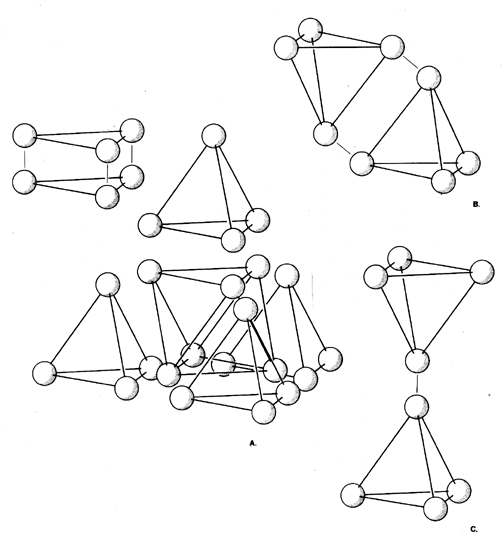
In addition to the four vertexial spheres of the precleavage primitive tetrahedron, we find after the cleavage all six vertexial unit-radius-vertex spheres of the octahedron also occurring in the outermost structure of the nonnucleated system. Neither the primitive tetrahedron nor the primitive octahedron have internal or nuclear unit-radius- vertex spheres. For an illustration of these structural “rigids” see Fig. 987.081.
987.100 Great-circle-spun Symmetries and Cleavagings
987.110 Intercommensurability Functions
987.111
In the great-circle-spun cleavaging of synergetics’ multiplication only by division there are seven primitive symmetries of spinnability. (See Sec. 1040.) Four symmetries belong directly to the separate tetrahedral commensurability, and three symmetries belong to the separate icosahedral commensurability, with the integrity of eternal interrelationship being provided by the symmetrically contractive, concentric intertransformability of the two sets of symmetry at the jitterbug VEricosa stage. This symmetrically embraced intertransformable stage corresponds to the constant interproportionality stage of the VE and icosa manifest as
987.120 Sequence of Symmetries and Cleavagings
987.121
Table
TETRA
| Symmetry Sequence | Cleavage Sequence |
|---|---|
| Symmetry #1: 3 great circles | Cleavage #1 |
| Symmetry #2: 4 great circles | Cleavage #4 |
| Symmetry #3: 6 great circles (VE) | Cleavages #2 & #3 |
| Symmetry #4: 12 great circles |
Thereafter we have the jitterbug transformation of the VE → icosa and the further progressive halvings of:
ICOSA
| Symmetry Sequence | Cleavage Sequence |
|---|---|
| Symmetry #5: 6 great circles (icosa) | Cleavage #6 |
| Symmetry #6: 15 great circles | Cleavage #5 |
| Symmetry #7: 10 great circles (producing the S Modules and T & E Modules) | Cleavage #7 |
(See also Secs. 1025.14, 1040, 1041.10.)
987.122
Starting with the regular tetrahedron the progressive primitive subdividing of synergetics is initially accomplished only by the successive equatorial halvings of the progressively halved-out parts of the first four of the only seven cosmic symmetries of axial spin of the primitive structural systems .
987.130 Primary and Secondary Great-circle Symmetries
987.131
There are seven other secondary symmetries based on the pairing into spin poles of vertexes produced by the complex secondary crossings of one another of the seven original great circle symmetries.
987.132
Fig. 987.132E Composite of Primary and Secondary Icosahedron Greate Circle Sets
Fig. 987.132E Composite of Primary and Secondary Icosahedron Greate Circle Sets: This is a black- and-white version of color plate 30. The Basic Disequilibrium 120 LCD triangle as presented at Fig. 901.03 appears here shaded in the spherical grid. In this composite icosahedron spherical matrix all of the 31 primary great circles appear together with the three sets of secondary great circles. (The three sets of secondary icosahedron great circles are shown successively at color plates 27-29.)
Link to original
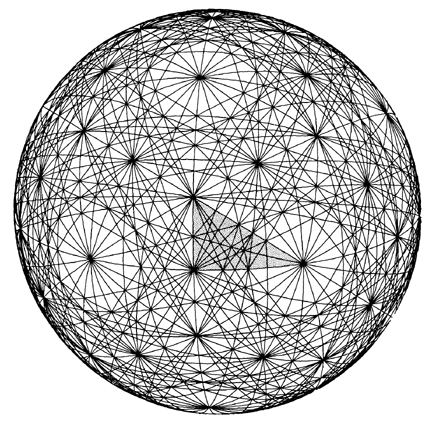
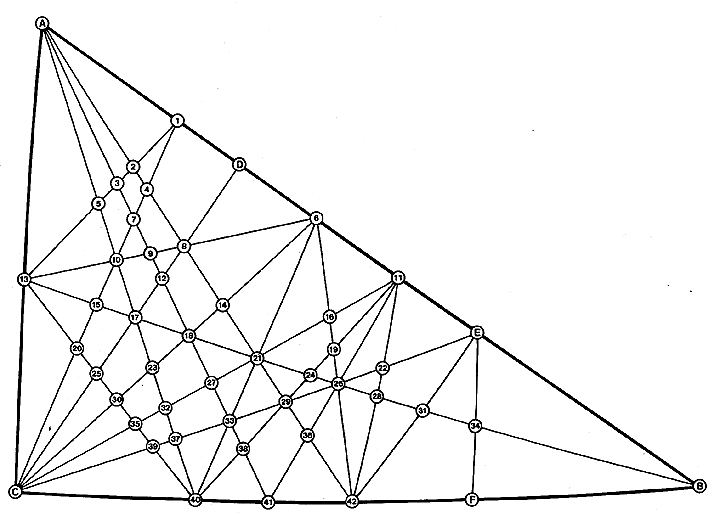
Fig. 987.132F Net Diagram of Angles and Edges for Basic Disequilibrium 120 LCD Triangle
Fig. 987.132F Net Diagram of Angles and Edges for Basic Disequilibrium 120 LCD Triangle: This is a detail of the basic spherical triangle shown shaded in Fig. 987.132E and at Fig. 901.03. It is the key to the trigonometric tables for the spherical central angles, the spherical face angles, the planar edge lengths, and the planar face angles presented at Table 987.132G.
Link to original
The primary and secondary icosa symmetries altogether comprise 121 = 11² great circles. (See Fig. 987.132E.)
987.133
The crossing of the primary 12 great circles of the VE at G (see Fig. 453.01, as revised in third printing) results in 12 new axes to generate 12 new great circles. (See color plate 12.)
987.134
The crossing of the primary 12 great circles of the VE and the four great circles of the VE at C (Fig. 453.01) results in 24 new axes to generate 24 new great circles. (See color plate 13.)
987.135
The crossing of the primary 12 great circles of the VE and the six great circles of the VE at E (Fig. 453.01) results in 12 new axes to generate 12 new great circles. (See color plate 14.)
987.136
The remaining crossing of the primary 12 great circles of the VE at F (Fig. 453.01 results in 24 more axes to generate 24 new great circles. (See color plate 15.)
987.137
Fig. 987.137B Composite of Primary and Secondary Vector Equilibrium Great Circle Sets
Fig 987.137B Composite of Primary and Secondary Vector Equilibrium Great Circle Sets: This is a black-and-white version of color plate 16. The Basic Equilibrium 48 LCD triangle as presented at Fig. 453.01 appears here shaded in the spherical grid. In this composite vector equilibrium spherical matrix all the 25 primary great circles appear together with the four sets of secondary great circles. (The four sets of secondary vector equilibrium great circles are shown successively at color plates 12-15.)
Link to original
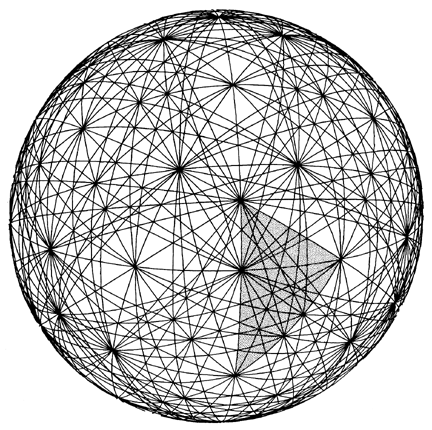
Fig. 987.137C
Fig 987.137C Net diagram of Angles and Edges for Basic Equilibrium 48 LCD Triangle in Vector Equilibrium Grid: This is a coded detail of the basic spherical triangle shown shaded in Fig. 987.137B and at Fig. 453.01. It is the key to the trigonometry tables for the spherical central angles, the spherical face angles, the planar edge lengths, and the planar face angles presented at Table 987.137D. (The drawing shows the spherical phase: angle and edge ratios are given for both spherical and planar phases.)
Link to original
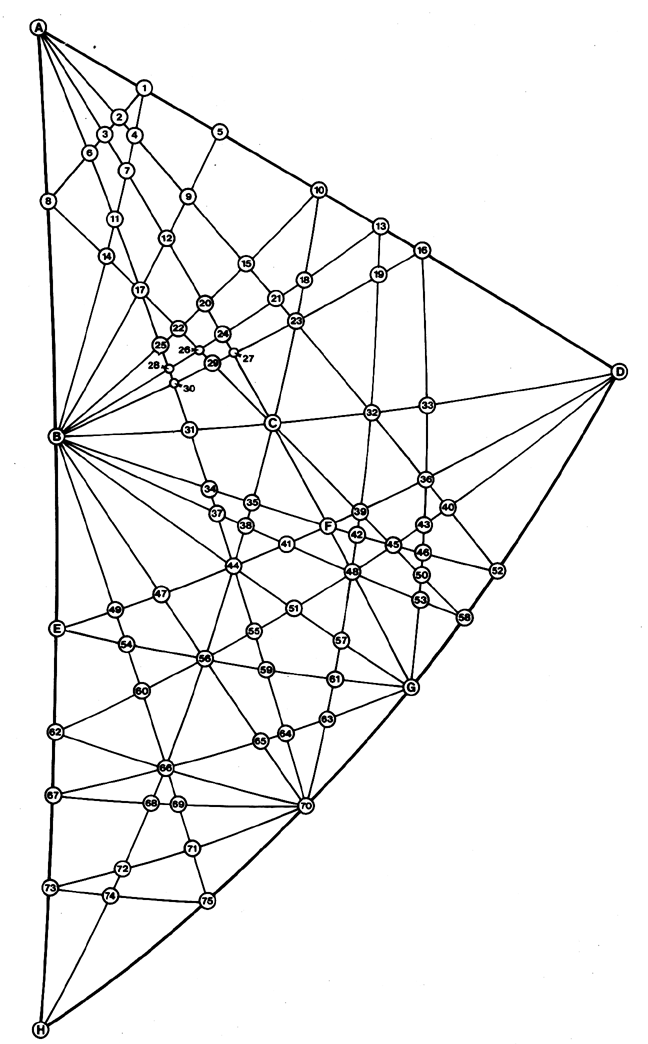
The total of the above-mentioned secondary great circles of the VE is 96 new great circles (See Fig 987.137B.)
987.200 Cleavagings Generate Polyhedral Resultants
987.210 Symmetry #1 and Cleavage #1
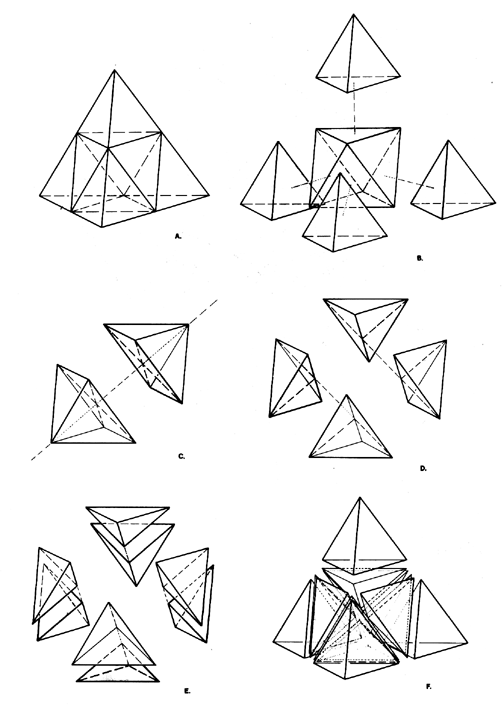
Fig. 987.210 Subdivision of Tetrahedral Unity
Fig. 987.210 Subdivision of Tetrahedral Unity: Symmetry #1:
Link to original
A. Initial tetrahedron at two-frequency stage.
B. Tetrahedron is truncated: four regular corner tetra surround a central octa. The truncations are not produced by great-circle cleavages. C, D, and E show great-circle cleavages of the central octahedron. (For clarity, the four corner tetra are not shown.) Three successive great-circle cleavages of the tetrahedron are spun by the three axes connecting the midpoints of opposite pairs of the tetra’s six edges.
C. First great-circle cleavage produces two Half-Octa.
D. Second great-circle cleavage produces a further subdivision into four irregular tetra called “Icebergs.”
E. Third great-circle cleavage produces the eight Eighth-Octahedra of the original octa.
F. Eight Eighth-Octa and four corner tetras reassembled as initial tetrahedron.
987.211
In Symmetry #1 and Cleavage #1 three great circles-the lines in Figs. 987.210 A through F—are successively and cleavingly spun by using the midpoints of each of the tetrahedron’s six edges as the six poles of three intersymmetrical axes of spinning to fractionate the primitive tetrahedron, first into the 12 equi-vector-edged octa, eight Eighth-octa (each of l/2-tetravolume), and four regular tetra (each of l-tetravolume).
987.212
A simple example of Symmetry #1 appears at Fig. 835.11. Cleavage #1 is illustrated at Fig. 987.210E.
987.213
Figs. 987.210A-E demonstrate Cleavage #1 in the following sequences: (1) The red great circling cleaves the tetrahedron into two asymmetric but identically formed and identically volumed “chef’s hat” halves of the initial primitive tetrahedron (Fig. 987.210). (2) The blue great circling cleavage of each of the two “chef’s hat” halves divides them into four identically formed and identically volumed “iceberg” asymmetrical quarterings of the initial primitive tetrahedron (Fig. 987.210B). (3) The yellow great circling cleavage of the four “icebergs” into two conformal types of equivolumed one- Eighthings of the initial primitive tetrahedron—four of these one-Eighthings being regular tetra of half the vector-edge-length of the original tetra and four of these one-Eighthings being asymmetrical tetrahedra quarter octa with five of their six edges having a length of the unit vector = 1 and the sixth edge having a length of sqrt(2) = 1.414214. (Fig. 987.210C.)
987.220 Symmetry #2 and Cleavage #4:
987.221
Fig. 987.221 Four-great-circle Systems of Octahedron and Vector Equilibrium
Fig. 987.221 Four-great-circle Systems of Octahedron and Vector Equilibrium: Symmetry #2:
Link to original
A. Six-great-circle fractionation of octahedron (as shown in Figs. 987.240 B and C) defines centers of octa faces; interconnecting the pairs of opposite octa faces provides the octahedron’s four axes of symmetry — here shown extended.
B. Four mid-face-connected spin axes of octahedron generate four great circle trajectories.
C. Octahedron removed to reveal inadvertent definition of vector equilibrium by octahedron’s four great circles. The four great circles of the octahedron and the four great circles of the vector equilibrium are in coincidental congruence. (The vector equilibrium is a truncated octahedron; their triangular faces are in parallel planes.)
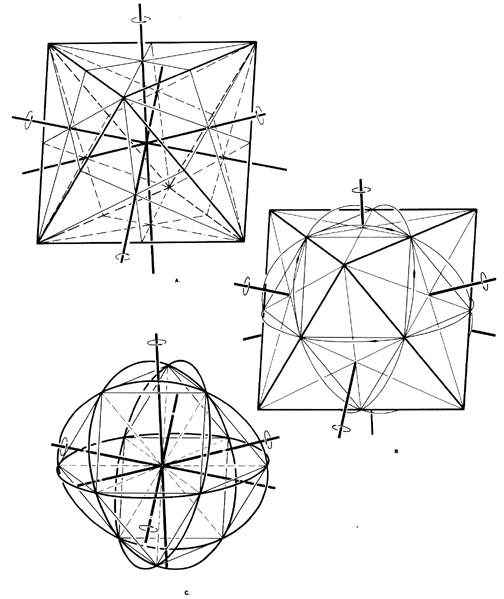
In Symmetry #2 and Cleavage #4 the four-great-circle cleavage of the octahedron is accomplished through spinning the four axes between the octahedron’s eight midface polar points, which were produced by Cleavage #2. This symmetrical four-great- circle spinning introduces the nucleated 12 unit-radius spheres closest packed around one unit-radius sphere with the 24 equi-vector outer-edge-chorded and the 24 equi-vector- lengthed, congruently paired radii—a system called the vector equilibrium. The VE has 12 external vertexes around one center-of-volume vertex, and altogether they locate the centers of volume of the 12 unit-radius spheres closest packed around one central or one nuclear event’s locus-identifying, omnidirectionally tangent, unit-radius nuclear sphere.
987.222
The vectorial and gravitational proclivities of nuclear convergence of all synergetics’ system interrelationships intercoordinatingly and intertransformingly permit and realistically account all radiant entropic growth of systems as well as all gravitational coherence, symmetrical contraction, and shrinkage of systems. Entropic radiation and dissipation growth and syntropic gravitational-integrity convergency uniquely differentiate synergetics’ natural coordinates from the XYZ-centimeter-gram-second abstract coordinates of conventional formalized science with its omniinterperpendicular and omniinterparallel nucleus-void frame of coordinate event referencing.
987.223
Symmetry #2 is illustrated at Fig. 841.15A.
987.230 Symmetries #1 & 3; Cleavages #1 & 2
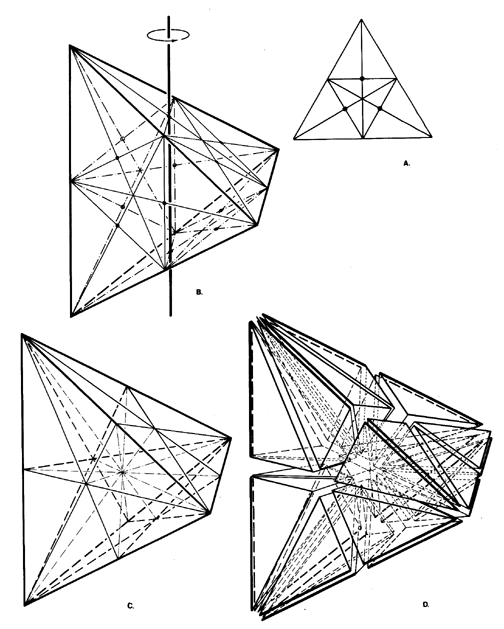
Fig. 987.230 Subdivision of Tetrahedral Unity
Fig 987.230 Subdivision of Tetrahedral Unity: Symmetry #3:
Link to original
A. The large triangle is the tetrahedron face. The smaller inscribed triangle is formed by connecting the mid-points of the tetra edges and represents the octa face congruent with the plane of the tetra face.
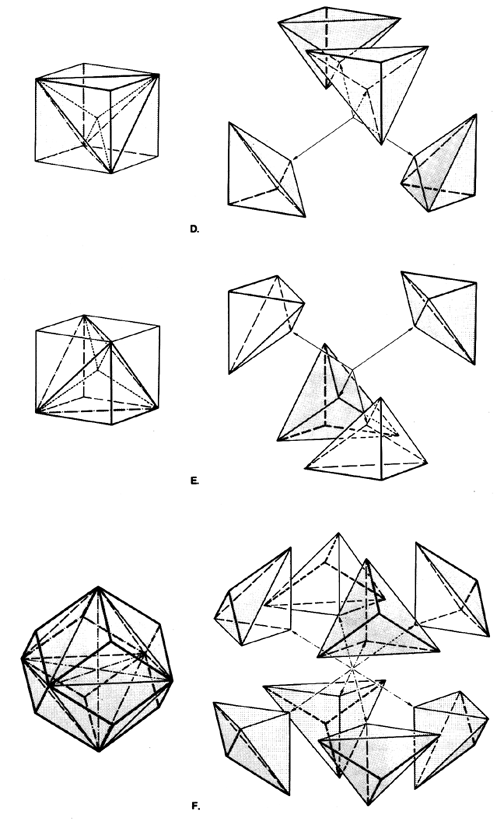
B. Connecting the midpoints of the opposite pairs of the internal octahedron’s 12 edges provides the six axes of spin for the six great circle system of Symmetry #3. The perpendicular bisectors at A and B are projections resulting from the great circle spinning. B also shows an oblique view of the half- Tetra or “Chef’s Caps” separated by the implied square. (For other views of Chef’s Caps compare Figs. 100.103 B and 527.08 A&B.)
C. The six great circle fractionations subdivide the tetrahedron into 24 A Quanta Modules.
D. Exploded view of the tetrahedron’s 24 A Quanta Modules.
E. Further explosion of tetrahedron’s A Quanta Modules.
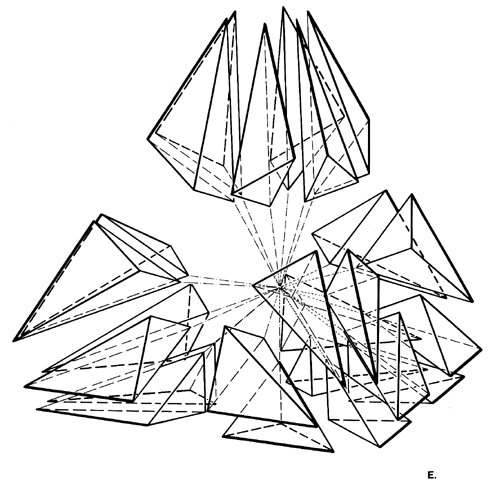
987.231
Of the seven equatorial symmetries first employed in the progression of self- fractionations or cleavages, we use the tetrahedron’s six mid-edge poles to serve as the three axes of spinnability. These three great-circle spinnings delineate the succession of cleavages of the 12 edges of the tetra-contained octahedron whose six vertexes are congruent with the regular tetrahedron’s six midedge polar spin points. The octahedron resulting from the first cleavage has 12 edges; they produce the additional external surface lines necessary to describe the two-frequency, non-time-size subdividing of the primitive one-frequency tetrahedron. (See Sec. 526.23, which describes how four happenings’ loci are required to produce and confirm a system discovery.)
987.232
The midpoints of the 12 edges of the octahedron formed by the first cleavage provide the 12 poles for the further great-circle spinning and Cleavage #2 of both the tetra and its contained octa by the six great circles of Symmetry #3. Cleavage #2 also locates the center-of-volume nucleus of the tetra and separates out the center-of-volume- surrounding 24 A Quanta Modules of the tetra and the 48 B Quanta Modules of the two- frequency, tetra-contained octa. (See Sec. 942 for orientations of the A and B Quanta Modules.)
987.240 Symmetry #3 and Cleavage #3
Fig. 987.240 Subdivision of Tetrahedral Unity
Fig. 987.240 Subdivision of Tetrahedral Unity: Symmetry #3: Subdivision of Internal Octahedron:
Link to original
A. Bisection of tetrahedron face edges describes a congruent octahedron face.
B. The spinning of the internal octahedron on axes through the opposite mid-edges generates the six great circle system of Symmetry #3.
C. The six great circle fractionations subdivide the octahedron into 48 Asymmetric Tetrahedra; each such Asymmetric Tetrahedron is comprised of one A Quanta Module and one B quanta Module.
D. Exploded view of octahedron’s 48 Asymmetric Tetrahedra.
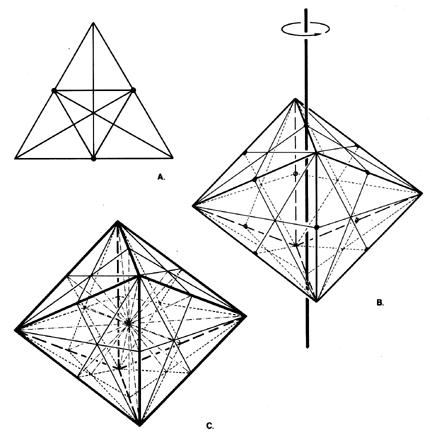
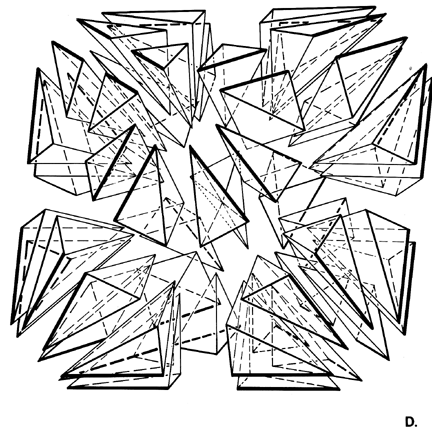
987.241
Fig. 987.241 Subdivision of Tetrahedral Unity
Fig. 987.241 Subdivision of Tetrahedral Unity: Octet: Duo-Tet Cube: Rhombic Dodecahedron:
Link to original
A. Eighth-Octa composed of six asymmetric tetrahedra. Each asymmetric tetrahedron is composed of one A quanta Module and one B Quanta Module. The drawing is labeled to show the relationship of the A Modules and the B Modules. Vertex A is at the center of volume of the octahedron and F is at the surface of any of the octahedron’s eight triangular faces.
B. Proximate assembly of Eighth-Octa and Quarter-Tetra to be face bonded together as Octet.
C. Octet: (Oc-Tet = octahedron + tetrahedron.) An Eighth-Octa is face bonded with a Quarter-Tetra to produce the Octet. (See Sec. 986.430.) The Octet is composed of 12 A Quanta Modules and 6 B Quanta Modules. (Compare color plate 22.)
D, E. Duo-Tet Cube: Alternate assemblies of eight Octets from Duo-Tet Cube. Each Duo-Tet Cube = 3- tetravolumes.
F. Rhombic Dodecahedron: Two Duo-Tet Cubes disassociate their Octet components to be reassembled into the Rhombic Dodecahedron. Rhombic Dodecahedron = 6-tetravolumes.
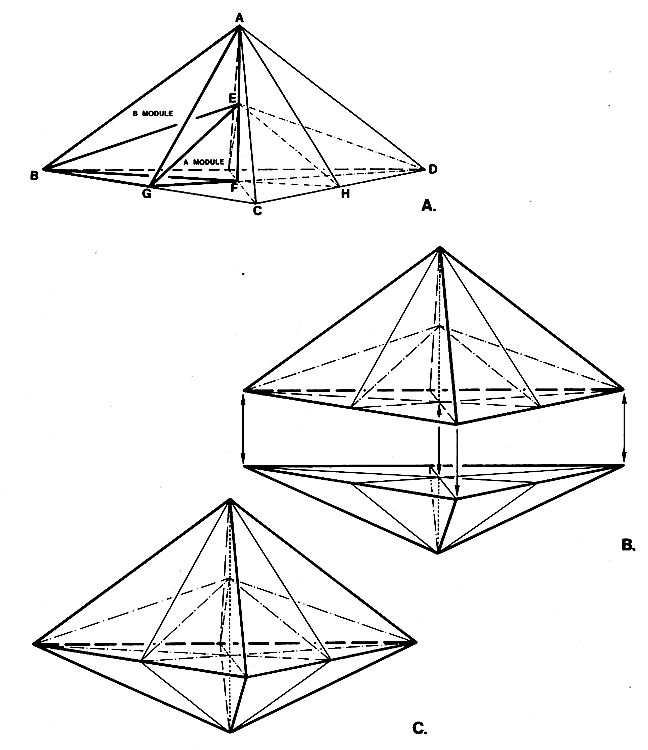
Symmetry #3 and Cleavage #3 mutually employ the six-polar-paired, 12 midedge points of the tetra-contained octa to produce the six sets of great-circle spinnabilities that in turn combine to define the two (one positive, one negative) tetrahedra that are intersymmetrically arrayed with the common-nuclear-vertexed location of their eight equi-interdistanced, outwardly and symmetrically interarrayed vertexes of the “cube”—the otherwise nonexistent, symmetric, square-windowed hexahedron whose overall most economical intervertexial relationship lines are by themselves unstructurally (nontriangularly) stabilized. The positive and negative tetrahedra are internally trussed to form a stable eight-cornered structure superficially delineating a “cube” by the most economical and intersymmetrical interrelationships of the eight vertexes involved. (See Fig. 987.240.)
987.242
Fig. 987.242 Evolution of Duo-Tet Cube and Hourglass Polyhedron
Fig. 987.242 Evolution of Duo-Tet Cube and Hourglass Polyhedron:
Link to original
A. One positive regular tetrahedron and one negative regular tetrahedron are intersymmetrically arrayed within the common nuclear-vertexed location. Their internal trussing permits their equi-inter- distanced vertexes to define a stable eight-cornered structure, a “cube.” The cube is tetravolume-3; as shown here we observe 1 1/2-tetravolumes of “substance” within the eight vertexes and 1 1/2- tetravolumes of complementation domain within the eight vertexes . The overall cubic domain consists of three tetravolumes: one outside-out (1 1/2) and one inside-out (1 1/2). The same star polyhedron appears within a vector equilibrium net at Fig. 1006.32.
B. Octahedron: tetravolume-4
C. Icosahedron; tetravolume- 18.51229586
D. Vector equilibrium: tetravolume-20
E. Eight-faceted asymmetric Hourglass Polyhedron: tetravolume-l l/2. These complex asymmetric doughnut-cored hexahedra appear within the star polyhedron at A.
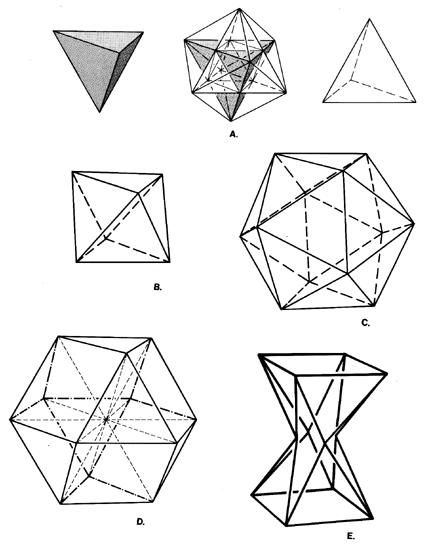
In this positive-negative superficial cube of tetravolume-3 there is combined an eight-faceted, asymmetric hourglass polyhedron of tetravolume-l½, which occurs interiorly of the interacting tetrahedra’s edge lines, and a complex asymmetric doughnut cored hexahedron of tetravolume 1½, which surrounds the interior tetra’s edge lines but occurs entirely inside and completely fills the space between the superficially described “cube” defined by the most economical interconnecting of the eight vertexes and the interior 1½-tetravolume hourglass core. (See Fig. 987.242E.)
987.243
An illustration of Symmetry #3 appears at Fig. 455.11A.
987.250 Other Symmetries
987.251
An example of Symmetry #4 appears at Fig. 450.10. An example of Symmetry #5 appears at Fig. 458.12B. An example of Symmetry #6 appears at Fig. 458.12A. An example of Symmetry #7 appears at Fig. 455.20.
987.300 Interactions of Symmetries: Spheric Domains
987.310 Irrationality of Nucleated and Nonnucleated Systems
987.311
The six great circles of Symmetry #3 interact with the three great circles of Symmetry # 1 to produce the 48 similar-surface triangles ADH and AIH at Fig. 987.21ON. The 48 similar triangles (24 plus, 24 minus) are the surface-system set of the 48 similar asymmetric tetrahedra whose 48 central vertexes are congruent in the one—VE’s—nuclear vertex’s center of volume.
987.312
Fig. 987.312 Rhombic Dodecahedron
Fig. 987.312 Rhombic Dodecahedron:
Link to original
A. The 25 great circle system of the vector equilibrium with the four great circles shown in dotted lines. (Compare Fig. 454.06 D, third printing.)
B. Spherical rhombic dodecahedron great circle system generated from six-great-circle system of vector equilibrium, in which the two systems are partially congruent. The 12 rhombuses of the spherical rhombic dodecahedron are shown in heavy outline. In the interrelationship between the spherical and planar rhombic dodecahedron it is seen that the planar rhombus comes into contact with the sphere at the mid-face point.
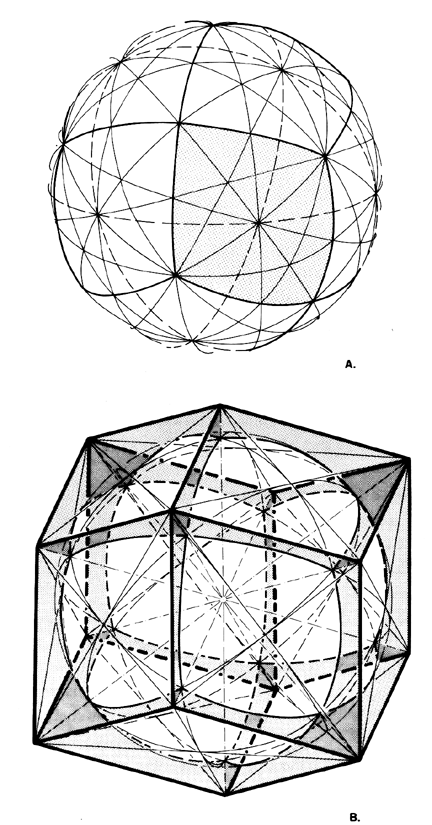
These 48 asymmetric tetrahedra combine themselves into 12 sets of four asymmetric tetra each. These 12 sets of four similar (two positive, two negative) asymmetric tetrahedra combine to define the 12 diamond facets of the rhombic dodecahedron of tetravolume-6. This rhombic dodecahedron’s hierarchical significance is elsewhere identified as the allspace-filling domain of each closest-packed, unit-radius sphere in all isotropic, closest-packed, unit-radius sphere aggregates, as the rhombic dodecahedron’s domain embraces both the unit-radius sphere and that sphere’s rationally and exactly equal share of the intervening intersphere space.
987.313
The four great circles of Symmetry #2 produce a minimum nucleated system of 12 unit-radius spheres closest packed tangentially around each nuclear unit-radius sphere; they also produce a polyhedral system of six square windows and eight triangular windows; they also produce four hexagonal planes of symmetry that all pass through the same nuclear vertex sphere’s exact center.
987.314
These four interhexagonalling planes may also be seen as the tetrahedron of zero-time-size-volume because all of the latter’s equi-edge lengths, its face areas, and system volumes are concurrently at zero.
987.315
This four-great-circle interaction in turn defines the 24 equilengthed vectorial radii and 24 equi-lengthed vector chords of the VE. The 24 radii are grouped, by construction, in two congruent sets, thereby to appear as only 12 radii. Because the 24 radial vectors exactly equal energetically the circumferentially closed system of 24 vectorial chords, we give this system the name vector equilibrium. Its most unstable, only transitional, equilibrious state serves nature’s cosmic, ceaseless, 100-percent-energy- efficient, self-regenerative integrity by providing the most expansive state of intertransformation accommodation of the original hierarchy of primitive, pre-time-size, “click-stop” rational states of energy-involvement accountabilities. Here we have in the VE the eight possible phases of the initial positive-negative tetrahedron occurring as an inter-double-bonded (edge-bonded), vertex-paired, self-inter-coupling nuclear system.
987.316
With the nucleated set of 12 equi-radius vertexial spheres all closest packed around one nuclear unit-radius sphere, we found we had eight tetrahedra and six Half- octahedra defined by this VE assembly, the total volume of which is 20. But all of the six Half-octahedra are completely unstable as the 12 spheres cornering their six square windows try to contract to produce six diamonds or 12 equiangular triangles to ensure their interpatterning stability. (See Fig. 987.240.)
987.317
If we eliminate the nuclear sphere, the mass interattraction of the 12 surrounding spheres immediately transforms their superficial interpatterning into 20 equiangular triangles, and this altogether produces the self-structuring pattern stability of the 12 symmetrically interarrayed, but non-spherically-nucleated icosahedron.
987.318
When this denucleation happens, the long diagonals of the six squares contract to unit-vector-radius length. The squares that were enclosed on all four sides by unit vectors were squares whose edges—being exactly unity—had a diagonal hypotenuse whose length was the second root of two—ergo, when VE is transformed to the icosahedron by the removal of the nuclear sphere, six of its sqrt(2)-lengthed, interattractive-relationship lines transform into a length of 1, while the other 24 lines of circumferential interattraction remain constant at unit-vector-radius length. The difference between the second root of two (which is 1.414214 - 1, i.e., the difference is 0.414214) occurs six times, which amounts to a total system contraction of 2.485284. This in turn means that the original
24 + 8.485284 = 32.485284
overall unit-vector-lengths of containing bonds of the VE are each reduced by a length of 2.485284 to an overall of exactly 30 unit-vector-radius lengths.
987.319
This 2.485284 a excess of gravitational tensional-embracement capability constitutes the excess of intertransformative stretchability between the VE’s two alternatively unstable, omnisystem’s stable states and its first two similarly stable, omnitriangulated states.
987.320
Because the increment of instability tolerance of most comprehensive intertransformative events of the primitive hierarchy is an irrational increment, the nucleus- void icosahedron as a structural system is inherently incommensurable with the nucleated VE and its family of interrational values of the octahedral, tetrahedral, and rhombic dodecahedral states.
987.321
The irrational differences existing between nucleated and nonnucleated systems are probably the difference between proton-nucleated and proton-neutron systems and nonnucleated-nonneutroned electron systems, both having identical numbers of external closest-packed spheres, but having also different overall, system-domain, volumetric, and system-population involvements.
987.322
There is another important systemic difference between VE’s proton-neutron system and the nonnucleated icosahedron’s electron system: the icosahedron is arrived at by removing the nucleus, wherefore its contraction will not permit the multilayering of spheres as is permitted in the multilayerability of the VE—ergo, it cannot have neutron populating as in the VE; ergo, it permits only single-layer, circumferential closest packings; ergo, it permits only single spherical orbiting domains of equal number to the outer layers of VE-nucleated, closest-packed systems; ergo, it permits only the behavioral patterns of the electrons.
987.323
When all the foregoing is comprehended, it is realized that the whole concept of multiplication of information by division also embraces the concept of removing or separating out the nucleus sphere (vertex) from the VE’s structurally unstable state and, as the jitterbug model shows, arriving omnisymmetrically throughout the transition at the structural stability of the icosahedron. The icosahedron experimentally evidences its further self-fractionation by its three different polar great-circle hemispherical cleavages that consistently follow the process of progressive self-fractionations as spin- halved successively around respective #5, #6, and #7 axes of symmetry. These successive halvings develop various fractions corresponding in arithmetical differentiation degrees, as is shown in this exploratory accounting of the hierarchy of unit-vector delineating multiplication of information only by progressive subdividing of parts.
987.324
When the tetrahedron is unity of tetravolume-1 (see Table 223.64), then (in contradistinction to the vector-radiused VE of tetravolume-20)
- the vector-diametered VE = + 2½ or = - 2½
- a rational, relative primitive prime number S tetravolume is also only realizable with half of its behavioral potentials in the presently-tune-in-able macrocosm and the other half of its total 5 behavioral potential existent in the presently-tune-out-able microcosm; thus,
- an overall +5 tetravolume potential -2½—ergo, +5 - 2½ = +2½
or - an overall -5 tetravolume potential +2½ —ergo, - 5+2½ = - 2½
987.325
The positive and negative tetrahedra, when composited as symmetrically concentric and structurally stable, have eight symmetrically interarranged vertexes defining the corners of what in the past has been mistakenly identified as a primitive polyhedron, popularly and academically called the “cube” or hexahedron. Cubes do not exist primitively because they are structurally unstable, having no triangularly-self-stabilizing system pattern. They occur frequently in nature’s crystals but only as the superficial aspect of a conglomerate complex of omnitriangulated polyhedra.
987.326
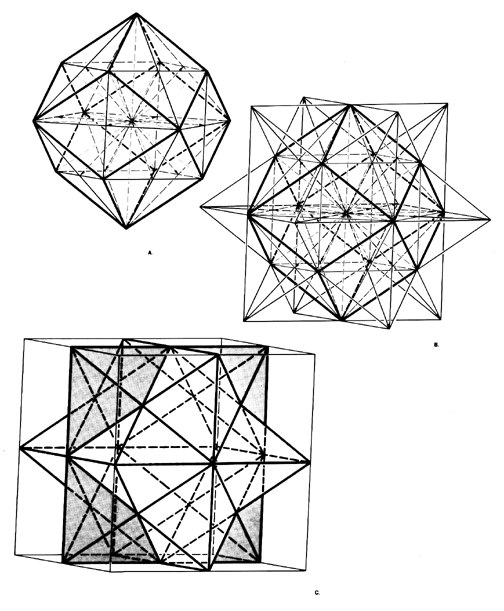
Fig. 987.326 Stellated Rhombic Dodecahedron
Fig. 987.326 Stellated Rhombic Dodecahedron:
Link to original
A. Rhombic dodecahedron with diamond faces subdivided into quadrants to describe mid-face centers. Interior lines with arrows show unit radii from system center to mid-face centers. This is the initial rhombic dodeca of tetravolume-6.
B. The rhombic dodecahedron system is “pumped out” with radii doubled from unit radius to radius = 2, or twice prime vector radius . This produces the stellated rhombic dodecahedron of tetravolume- 12.
C. The stellated rhombic dodecahedron vertexes are congruent with the mid-edge points of the cube of tetravolume-24. A composite of three two-frequency Couplers (each individually of tetravolume-8) altogether comprises a star complex of tetravolume-12, sharing a common central rhombic dodeca domain of tetravolume-6. The stellated rhombic dodeca of tetravolume-12 is half the volume of the 24-tetravolume cube that inscribes it. (Compare the Duo-Tet Cube at Fig. 987.242 A.
This positive-negative tetrahedron complex defines a hexahedron of overall volume-3—1½ inside and 1½ outside its intertrussed system’s inside-and-outside-vertex-defined domain.
- The three-great-circle symmetrical cleavaging (#I) of the primitive tetrahedron produces the vector-edged octahedron of tetravolume-4.
- The vector-radiused rhombic triacontahedron, with its .9994833324 unit-vector- radius perpendicular to its midface center produces a symmetrical polyhedron of tetravolume-5.
- With its 12 diamond-face-centers occurring at unit-vector-radius, the rhombic dodecahedron has a tetravolume-6.
The rhombic dodecahedron exactly occupies the geometric domain of each unit-vector- radius sphere and that sphere’s external share of the symmetrically identical spaces intervening between closest-packed unit-radius spheres of any and all aggregates of unit- radius, closest-interpacked spheres. In this closest-packed condition each sphere within the aggregate always has 12 spheres symmetrically closest packed tangentially around it. The midpoints of the 12 diamond faces of the rhombic dodecahedron’s 12 faces are congruent with the points of tangency of the 12 surrounding spheres. All the foregoing explains why unit-radius rhombic dodecahedra fill allspace when joined together.
987.327
Repeating the foregoing more economically we may say that in this hierarchy of omnisymmetric primitive polyhedra ranging from I through 2, 2 , 3, 4, 5, and 6 tetravolumes, the rhombic dodecahedron’s 12 diamond-face-midpoints occur at the points of intertangency of the 12 surrounding spheres. It is thus disclosed that the rhombic dodecahedron is not only the symmetric domain of both the sphere itself and the sphere’s symmetric share of the space intervening between all closest-packed spheres and therefore also of the nuclear domains of all isotropic vector matrixes (Sec. 420), but the rhombic dodecahedron is also the maximum-limit-volumed primitive polyhedron of frequency-l.
987.400 Interactions of Symmetries: Secondary Great-circle Sets
987.410 Icosa Phase of Rationality
987.411
The 96 secondary great circles of the VE divide the chorded edge of the VE (which is the unit vector radius of synergetics) into rational linear fractions of the edge length—i.e., 1/2, 3/10, 1/4, 1/6, 1/10—and these fractions embrace all the intercombinings of the first four prime numbers 1, 2, 3, and 5.
987.412
Fig. 987.412
Fig. 987.412 Rational Fraction Edge Increments of 60-degree Great-circle Subdividings of Vector Equilibrium: When these secondary VE great-circle sets are projected upon the planar VE they reveal the following rational fraction edge increments:
Link to original
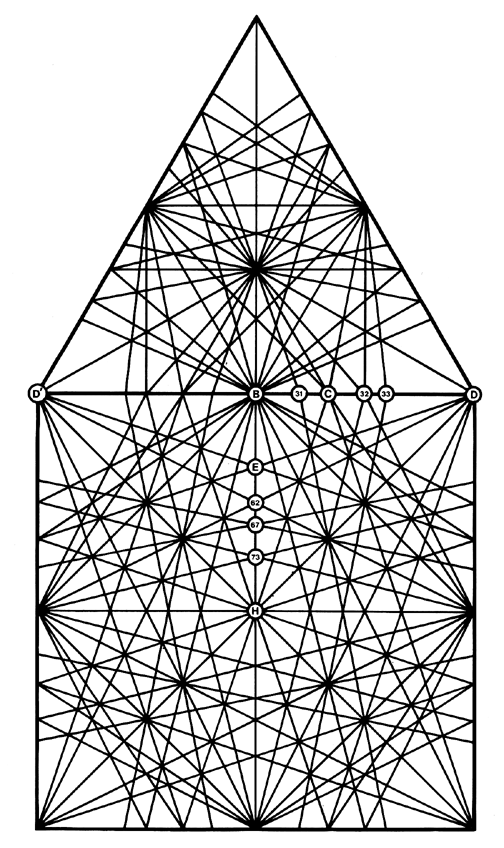
For an illustration of how the four VE great circles of 60-degree central angles subdivide the central-angle chord increments, see Fig. 987.412.
987.413
Next recalling the jitterbug transformation of the VE into the icosa with its inherent incommensurability brought about by the 2:sqrt(2) = sqrt(2):1 transformation ratio, and recognizing that the transformation was experimentally demonstrable by the constantly symmetrical contracting jitterbugging, we proceed to fractionate the icosahedron by the successive 15 great circles, six great circles (icosa type), and 10 great circles whose self-fractionation produces the S Modules⁸ as well as the T and E Modules.
(Footnote 8: See Sec. 988.)
987.414
But it must be recalled that the experimentally demonstrable jitterbug model of transformation from VE to icosa can be accomplished through either a clockwise or counterclockwise twisting, which brings about 30 similar but positive and 30 negative omniintertriangulated vector edge results.
987.415
The midpoints of each of these two sets of 30 vertexes in turn provide the two alternate sets of 30 poles for the spin-halving of the 15 great circles of Symmetry #6, whose spinning in turn generates the 120 right spherical triangles (60 positive, 60 negative) of the icosahedral system.
987.416
The 120 right triangles, evenly grouped into 30 spherical diamonds, are transformed into 30 planar diamonds of central angles identical to those of the 30 spherical diamonds of the 15 great circles of the icosa. When the radius to the center of the face of the rhombic triacontahedron equals 0.9994833324… of the unit vector radius of Synergetics (1.000), the rhombic triacontahedron has a tetravolume of 5 and each of its 120 T Quanta Modules has a volume of one A Module. When the radius equals 1, the volume of the rhombic triacontahedron is slightly larger (5.007758029), and the corresponding E Module has a volume of 1.001551606 of the A Module. (See Sec. 986.540)