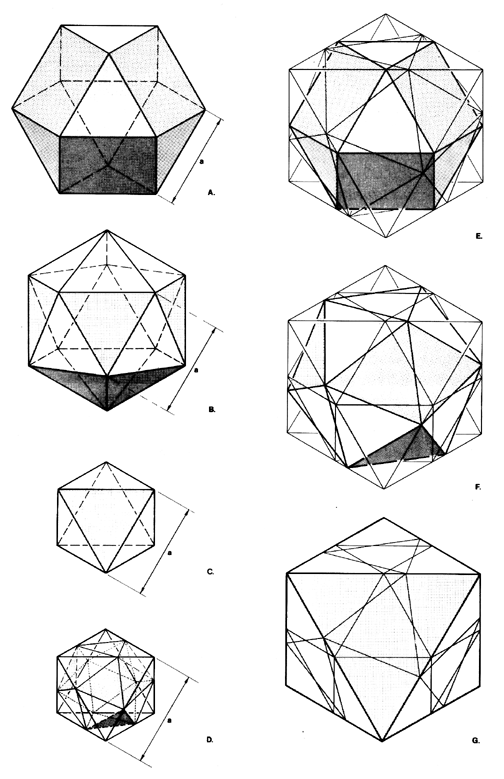
Fig. 988.00 Polyhedral Evolution
Fig. 988.00 Polyhedral Evolution: S Quanta Module: Comparisons of skew polyhedra.
Link to original
988.100 Octa-icosa Matrix
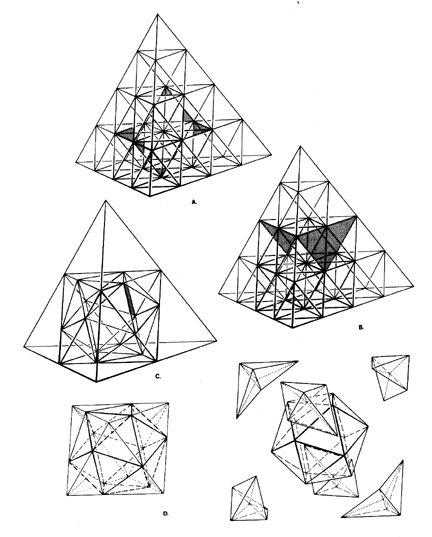
Fig. 988.100 Octa-Icosa Matrix
Fig. 988.100 Octa-Icosa Matrix: Emergence of S Quanta Module:
Link to original
A. Vector equilibrium inscribed in four-frequency tetrahedral grid.
B. Octahedron inscribed in four-frequency tetrahedral grid.
C. Partial removal of grid reveals icosahedron inscribed within octahedron.
D. Further subdivision defines modular spaces between octahedron and icosahedron.
E. Exploded view of six pairs of asymmetric tetrahedra that make up the space intervening between octa and icosa. Each pair is further subdivided into 24 S Quanta Modules. Twenty-four S Quanta Modules are added to the icosahedron to produce the octahedron.
988.110
The icosahedron positioned in the octahedron describes the S Quanta Modules. (See Fig. 988.100.) Other references to the S Quanta Modules may be found at Secs. 100.105, 100.322, Table 987.121, and 987.413.
988.111
As skewed off the octa-icosa matrix, they are the volumetric counterpart of the A and B Quanta Modules as manifest in the nonnucleated icosahedron. They also correspond to the 1/120th tetrahedron of which the triacontahedron is composed. For their foldable angles and edge-length ratios see Figs. 988.111A-B.
988.12
Fig. 988.12 Icosahedron Inscribed Within Octahedron
Fig. 988.12 Icosahedron Inscribed Within Octahedron: The four-frequency tetrahedron inscribes an internal octahedron within which may be inscribed a skew icosahedron. Of the icosahedron’s 20 equiangular triangle faces, four are congruent with the plane of the tetra’s faces (and with four external faces of the inscribed octahedron). Four of the icosahedron’s other faces are congruent with the remaining four internal faces of the icosahedron. Two-fifths of the icosa faces are congruent with the octa faces. It requires 24 S Quanta Modules to fill in the void between the octa and the icosa.
Link to original
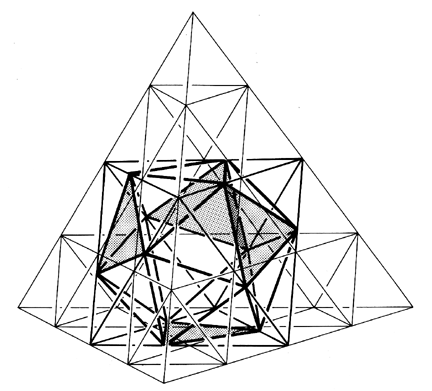
The icosahedron inscribed within the octahedron is shown at Fig. 988.12.
988.13
Fig. 988.13A S Quanta Module Edge Lengths
Fig. 988.13A S Quanta Module Edge Lengths: This plane net for the S Quanta Module shows the edge lengths ratioed to the unit octa edge (octa edge = tetra edge.)
Link to original
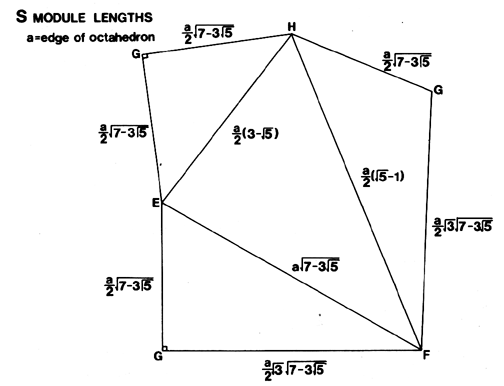
Fig. 988.13B S Quanta Module Angles
Fig. 988.13B S Quanta Module Angles: This plane net shows the angles and foldability of the S Quanta Module.
Link to original
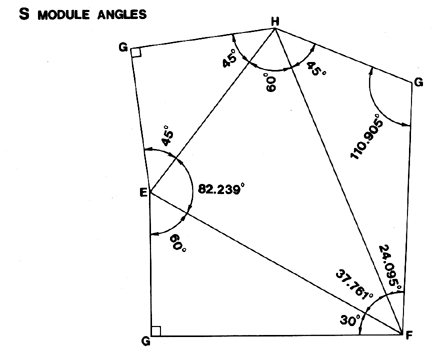
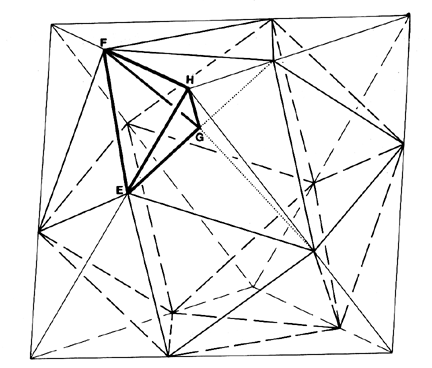
Fig. 988.13C S Quanta Module in Context of Icosahedron and Octahedron
Fig. 988.13C S Quanta Module in Context of Icosahedron and Octahedron
Link to original
The edge lengths of the S Quanta Module are shown at Fig. 988.13A.
988.14
The angles and foldability of the S Quanta Module are shown at Fig. 988.13B.
988.20 Table: Volume-area Ratios of Modules and Polyhedra of the Primitive Hierarchy:
| Volume | Area | Volume/Area | Area/Volume | |
|---|---|---|---|---|
| A Module | 1* | 1* | ||
| T “ | 1 | 1.0032 | 0.9968 | 1.0032 |
| E “ | 1.0016 | 1.0042 | 0.9974 | 1.0026 |
| S “ | 1.0820 | 1.0480 | 1.0325 | 0.9685 |
| B “ | 1 | 1.2122 | 0.8249 | 1.2122 |
| Tetrahedron | 24 | 6.9576 | 3.4495 | 0.2899 |
| Icosahedron ** | 70.0311 | 10.5129 | 6.6615 | 0.1501 |
| Cube | 72 | 12.0508 | 5.9747 | 0.1674 |
| Octahedron | 96 | 13.9151 | 6.8990 | 0.1449 |
| Rhombic dodecahedron | 144 | 17.6501 | 8.1586 | 0.1226 |
| Icosahedron | 444.2951 | 36.0281 | 12.3319 | 0.0811 |
* Volume and area of A Module considered as unity.
** Icosahedron inside octahedron.