990.01
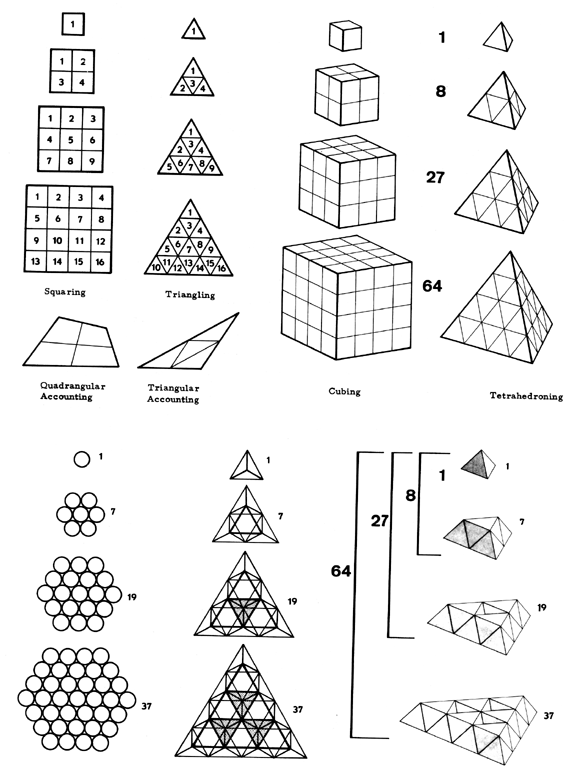
All scientists as yet say “X squared,” when they encounter the expression “X²,” and “X cubed,” when they encounter “X³” But the number of squares enclosed by equimodule-edged subdivisions of large gridded squares is the same as the number of triangles enclosed by equimodule-edged subdivisions of large gridded triangles. This remains true regardless of the grid frequency, except that the triangular grids take up less space. Thus we may say “triangling” instead of “squaring” and arrive at identical arithmetic results, but with more economical geometrical and spatial results. (See Illus. 990.01 and also 415.23.)
990.02
Corresponding large, symmetrical agglomerations of cubes or tetrahedra of equimodular subdivisions of their edges or faces demonstrate the same rate of third-power progression in their symmetrical growth (1, 8, 27, 64, etc.). This is also true when divided into small tetrahedral components for each large tetrahedron or in terms of small cubical components of each large cube. So we may also say “tetrahedroning” instead of “cubing” with the same arithmetical but more economical geometrical and spatial results.
990.03
We may now say “one to the second power equals one,” and identify that arithmetic with the triangle as the geometrical unit. Two to the second power equals four: four triangles. And nine triangles and 16 triangles, and so forth. Nature needs only triangles to identify arithmetical “powering” for the self-multiplication of numbers. Every square consists of two triangles. Therefore, “triangling” is twice as efficient as “squaring.” This is what nature does because the triangle is the only structure. If we wish to learn how nature always operates in the most economical ways, we must give up “squaring” and learn to say “triangling,” or use the more generalized “powering.”
990.04
There is another very trustworthy characteristic of synergetic accounting. If we prospectively look at any quadrilateral figure that does not have equal edges, and if we bisect and interconnect those mid-edges, we always produce four dissimilar quadrangles. But when we bisect and interconnect the mid-edges of any arbitrary triangle—equilateral, isosceles, or scalene—four smaller similar and equisized triangles will always result. There is no way we can either bisect or uniformly subdivide and then interconnect all the edge division points of any symmetrical or asymmetrical triangle and not come out with omni- identical triangular subdivisions. There is no way we can uniformly subdivide and interconnect the edge division points of any asymmetrical quadrangle (or any other different-edge-length polygons) and produce omnisimilar polygonal subdivisions. Triangling is not only more economical; it is always reliable. These characteristics are not available in quadrangular or orthogonal accounting.
990.05
The increasingly vast, comprehensive, and rational order of arithmetical, geometrical, and vectorial coordination that we recognize as synergetics can reduce the dichotomy, the chasm between the sciences and the humanities, which occurred in the mid-nineteenth century when science gave up models because the generalized case of exclusively three-dimensional models did not seem to accommodate the scientists’ energy- experiment discoveries. Now we suddenly find elegant field modelability and conceptuality returning. We have learned that all local systems are conceptual. Because science had a fixation on the “square,” the “cube,” and the 90-degree angle as the exclusive forms of “unity,” most of its constants are irrational. This is only because they entered nature’s structural system by the wrong portal. If we use the cube as volumetric unity, the tetrahedron and octahedron have irrational number volumes.