995.01 Magic Numbers
995.02
The magic numbers are the high abundance points in the atomic-isotope occurrences. They are 2, 8, 20, 50, 82, 126, …, ! For every nonpolar vertex, there are three vector edges in every triangulated structural system. The Magic Numbers are the nonpolar vertexes. (See Illus. 995.31.)
995.03
Fig. 995.03 Vector Models of Atomic Nuclei
Fig. 995.03 Vector Models of Atomic Nuclei: Magic Numbers: In the structure of atomic nuclei there are certain numbers of neutrons and protons which correspond to states of increased stability. These numbers are known as the magic numbers and have the following values: 2, 8, 20, 50, 82, and 126. A vector model is proposed to account for these numbers based on combinations of the three fundamental omnitriangulated structures: the tetrahedron, octahedron, and icosahedron. In this system all vectors have a value of one-third. The magic numbers are accounted for by summing the total number of vectors in each set and multiplying the total by 1/3. Note that although the tetrahedra are shown as opaque, nevertheless all the internal vectors defined by the isotropic vector matrix are counted in addition to the vectors visible on the faces of the tetrahedra.
Link to original
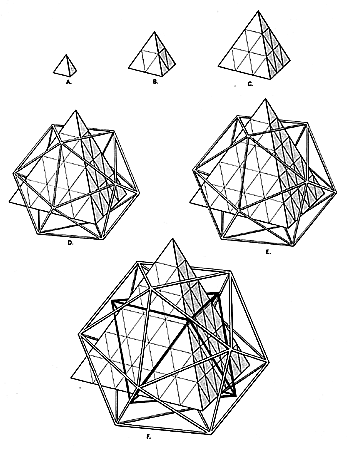
Fig. 995.03A Vector Models of Atomic Nuclei
Fig. 995.03A Vector Models of Atomic Nuclei: Magic Numbers: In the structure of atomic nuclei there are certain numbers of neutrons and protons which correspond to states of increased stability. These numbers are known as the magic numbers and have the following values: 2, 8, 20, 28, 50, 82, and 126. A vector model is proposed to account for these numbers based on combinations of the three fundamental omnitriangulated structures: the tetrahedron, octahedron, and icosahedron. In this system all vectors have a have of one-third. The magic numbers are accounted for by summing the total number of vectors in each set and multiplying the total by 1/3. Note that although the tetrahedra are shown as opaque, nevertheless all the internal vectors defined by the isotropic vector matrix are counted in addition to the vectors visible on all faces of the tetrahedra.
Link to original
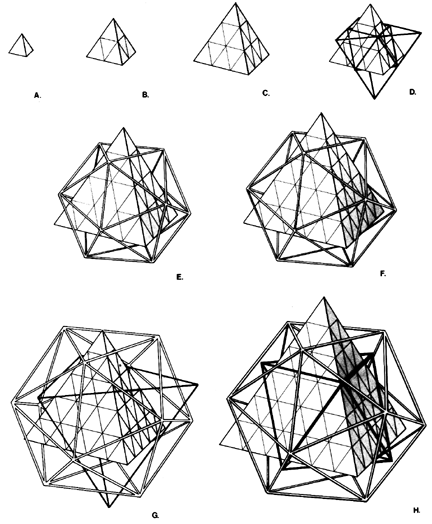
In the structure of atomic nuclei, the Magic Numbers of neutrons and protons correspond to the states of increased stability. Synergetics provides a symmetrical, vector-model system to account for the Magic Numbers based on combinations of the three omnitriangulated structures: tetrahedron, octahedron, and icosahedron. In this model system, all the vectors have the value of one-third. The Magic Numbers of the atomic nuclei are accounted for by summing up the total number of external and internal vectors in each set of successive frequency models, then dividing the total by three, there being three vectors in Universe for every nonpolar vertex.
995.10 Sequence
995.11A
The sequence is as follows:
| (Magic Numbers) | ||
|---|---|---|
| One-frequency tetrahedron | 6 vectors times 1/3 | = 2 |
| Two-frequency tetrahedron | 24 vectors times 1/3 | = 8 |
| Three-frequency tetrahedron | 60 vectors times 1/3 | = 20 |
| Three frequency tetrahedron + two-frequency tetrahedron | 60 vectors + 24 vectors times 1/3 | = 28 |
| Four-frequency tetrahedron + one-frequency icosahedron | 120 vectors + 30 vectors times 1/3 | = 50 |
| Five-frequency tetrahedron + one-frequency tetrahedron + one-frequency icosahedron | 210 + 6 + 30 vectors times 1/3 | = 82 |
| Six-frequency tetrahedron + one-frequency octahedron + one-frequency icosahedron | 336 + 12 + 30 vectors times 1/3 | = 126 |
995.11
The sequence is as follows:
| Configuration | Calculation | Magic Number |
|---|---|---|
| One-frequency tetrahedron | 6 vectors 1/3 | 2 |
| Two-frequency tetrahedron | 24 vectors 1/3 | 8 |
| Three-frequency tetrahedron | 60 vectors 1/3 | 20 |
| Four-frequency tetrahedron + One-frequency icosahedron | (120 + 30) vectors 1/3 | 50 |
| Five-frequency tetrahedron + One-frequency icosahedron | (216 + 30) vectors 1/3 | 82 |
| Six-frequency tetrahedron + One-frequency octahedron + One-frequency icosahedron | (336 + 12 + 30) vectors 1/3 | 126 |
995.12
Magic Number 28: The Magic Number 28, which introduces the cube and the octahedron to the series, was inadvertently omitted from Synergetics 1. The three- frequency tetrahedron is surrounded by an enlarged two-frequency tetrahedron that shows as an outside frame. This is a negative tetrahedron shown in its halo aspect because it is the last case to have no nucleus. The positive and negative tetrahedra combine to provide the eight corner points for the triangulated cube. The outside frame also provides for an octahedron in the middle. (See revised Figs. 995.03A and 995.31A.)
995.20 Counting
995.21
In the illustration, the tetrahedra are shown as opaque. Nevertheless, all the internal vectors defined by the isotropic vector matrix are counted in addition to the vectors visible on the external faces of the tetrahedra.
995.30 Reverse Peaks in Descending Isotope Curve
Fig. 995.31
Fig. 995.31A
995.31
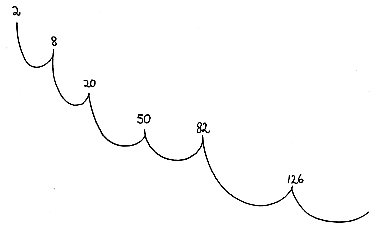
Fig. 995.31A Reverse Peaks in Descending Isotope Curve
Fig. 995.31A Reverse Peaks in Descending Isotope Curve: Magic Numbers
Link to original
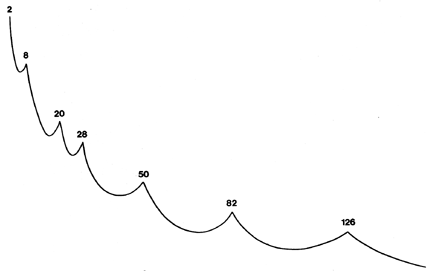
There emerges an impressive pattern of regularly positioned behaviors of the relative abundances of isotopes of all the known atoms of the known Universe. Looking like a picture of a mountainside ski run in which there are a series of ski-jump upturns of the run, there is a series of sharp upward-pointing peaks in the overall descent of this relative abundance of isotopes curve, which originates at its highest abundance in the lowest-atomic-numbered elemental isotopes.
995.32
The Magic Number peaks are approximately congruent with the atoms of highest structural stability. Since the lowest order of number of isotopes are the most abundant, the inventory reveals a reverse peak in the otherwise descending curve of relative abundance.
995.33
The vectorial modeling of synergetics demonstrates nuclear physics with lucid comprehension and insight into what had been heretofore only instrumentally apprehended phenomena. In the post-fission decades of the atomic-nucleus explorations, with the giant atom smashers and the ever more powerful instrumental differentiation and quantation of stellar physics by astrophysicists, the confirming evidence accumulates.
995.34
Dr. Linus Pauling has found and published his spheroid clusters designed to accommodate the Magic Number series in a logical system. We find him—although without powerful synergetic tools—in the vicinity of the answer. But we can now identify these numbers in an absolute synergetic hierarchy, which must transcend any derogatory suggestion of pure coincidence alone, for the coincidence occurs with mathematical regularity, symmetry, and a structural logic that identifies it elegantly as the model for the Magic Numbers.