540.01
The system generates itself whenever there is an event. The system actually regenerates itself: it is an eternal rebirth system.
540.02
The octet truss is not a priori. The octet truss is simply the most economical way of behaving relative to unity and to self. The octet truss is the evolutionary patterning, intervectoring, and intertrajectory-ing of the ever-recurrent 12 alternative options of action, all 12 of which are equally the most economical ways of self-and-otherness interbehaving—all of which interbehavings we speak of as Universe.
540.03
Starting with whole Universe as consisting always of observer plus the observed, we can subdivide the unity of Universe. In synergetics—as in quantum mechanics—we have multiplication only by division.
540.04
I do not like the word frame. What we are talking about is the multi- optioned omni-orderly scheme of behavioral reference; simply the most economic pattern of evolvement. Pattern of evolvement has many, many equieconomical intertransformability options. There are many transformation patterns, but tetrahedron is the absolute minimum limit case of structural system interself-stabilizing. A tetrahedron is an omnitriangulated, four-entity, six-vector interrelationship with system-defining insideness and outsideness independent of size; it is not a rigid frame and can be any size. “Rigid” means “sized”—arbitrarily sized. “Rigid” is always special-case. Synergetics is sizeless generalization.
540.05
Synergetics is not a frame at all, but a pattern of most omnieconomic (ergo, spontaneous) interaccommodation of all observed self-and-otherness interexperiencing (ergo, geodesic—geodesic being the most economical interrelationships of a plurality of events).
540.06
Prime otherness demands identification of the other’s—initially nebulous—entity integrity, which entity and subentities’ integrities first attain cognizable self-interpatterning stabilization, ergo, discrete considerability, only at the tetrahedron stage of generalizable entity interrelationships. Resolvability and constituent enumerability, and systematic interrelationship cognition of entity regeneration presence, can be discovered only operationally. (See Secs. 411.00, 411.10, 411.20, and 411.30.) After the four-ball structural interpatterning stability occurs, and a fifth ball comes along, and, pulled by mass attraction, it rolls into a three-ball nest, and there are now two tetrahedra bonded face-to-face.
540.07
Because of discontinuity, the otherness points and subpoints may be anywhere. We start always with any point—event points being as yet noncomprehended; ergo, initially only as an apprehended otherness entity. Synergetics, as a strategy of converting apprehension to discrete comprehension, always proceeds vectorially.
540.08
The only difference between experience and nonexperience is time. The time factor is always radial, outwardly, inwardly, and chordally around; always accounted only in most economical to self-experience, energy time relationship (i.e., geodesic) units. The vector is time-energy incrementation, embracing both velocity and relative mass, as well as the observer’s angulation of observation—strictly determined in relation to the observer’s head-to-toe axis and time, relative, for instance, to heartbeat and diurnal cyclic experience frequencies.
540.09
A vectorial evolvement in no way conforms to a rigid rectilinear frame of the XYZ coordinate analysis which arbitrarily shuns most economical directness and time realizations—by virtue of which calculus is able only awkwardly to define positions rectilinearly, moving only as the chessman’s knight. Nature uses rectilinear patterns only precessionally; and precession brings about orbits and not straight lines.
540.10 Prime Vector
540.11
All structural accounting of nature is accomplished with rational quantities of tetrahedra. The XYZ coordinates may be employed to describe the arrangements, but only in awkward irrationality, because the edge of the cube is inherently irrational in respect to the cube’s facial diagonal. The hypotenuses actually function only as the edges of the positive and negative tetrahedra, which alone permit the cube to exist as a structure. The hypotenuses connect the sphere centers at the cube corners; they function concurrently and simultaneously as the natural structuring of tetrahedra edges in the omnidirectional isotropic vector matrix; as either hypotenuse or tetra edge they are prime vectors.
540.12
Of the eight corners of the cube only four coincide with the sphere centers of closest-packed, unit-radius spheres; therefore only the cube’s facial diagonals can interconnect closest-packed spheres. One closed set of six cube-face diagonals can interconnect only four sphere-center corners of the prime tetrahedron, which alone provides the structural stability of the cube, whose eight-cornered, structural-stability completeness requires the saturation of the alternate set of six diagonals in each of the cube’s six faces. This alternate set of six diagonals intertriangulates the other four sphere centers of the cube’s eight corners. The cube diagonals and the edges of the tetrahedra structuring the cube are two aspects of the same phenomenon. The tetra-edge, cube-face diagonals connecting the two sets, of four corners each, of the cube’s total of eight corners are the prime vectors of the vector equilibrium and of the isotropic vector matrix.
540.13
The second power of the length of the prime vector that constitutes the diagonal of the cube’s face equals the sum of the second powers of any two edges of the cube. Because these two edges converge at the cube’s corner to form one standing wave that may be multifrequenced to apparently coincide with the cube’s facial diagonal, we discover that this relationship is what we are talking about in the deliberately nonstraight line. It is the same mathematical relationship demonstrated in the ancients’ proof of the Pythagorean theorem, wherein the square of the hypotenuse is proven to be equal to the sum of the squares of the triangle’s two legs. Thus the deliberately nonstraight line displays an evolutionary transformation from coincidence with the two sides of the parallelogram to coincidence with the seemingly straight, wavilinear diagonal of the parallelogram.
540.14
Prime vector may be considered variously as:
— the axis of intertangency (Secs. 521.21 and 537.22);
— the control line of nature (Sec. 982.21);
— the deliberately nonstraight line (Sec. 522);
— the diagonal of the cube (Sec. 463);
— diametric unity (Sec. 986.160 and Fig. 986.161);
— half-vectors (Sec. 537.21);
— the hypotenuse (Sec. 825.26);
— the internuclear vector modulus (Sec. 240.40);
— the line of interrelationship (Secs. 505.74 and 505.82);
— the line between two sphere centers (Sec. 537.21);
— linear mensuration unity (Sec. 982.51);
— the radial line (Sec. 537.21);
— the T Quanta Module edge;
— the tetra edge (Sec. 982.53);
— unit radius (Sec. 1106.23).
540.30 Four-frequency Hyperbolic Paraboloid
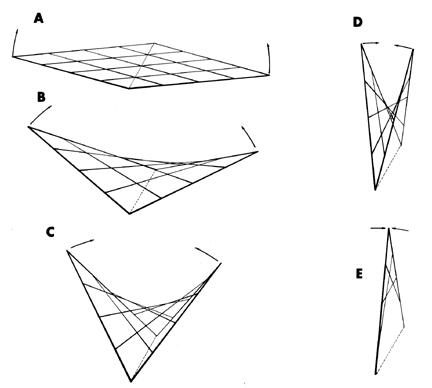
Fig. 540.30 Hyperbolic Paraboloid
Fig. 540.30 Hyperbolic Paraboloid: There are always only two different cross-lengths for a four- frequency hyperbolic paraboloid. As opposite vertexes of the frame are lifted, the grid lines change length at unequal rates. The moment the four-sided frame is no longer planar, the fact of two different axis lengths is revealed.
Link to original
540.31
A flat, four-sided frame (A) can be folded to define a nonplanar hyperbolic paraboloid (B, C, D).
540.32
The edges of the four-sided frame are joined with lines parallel to its edges. This forms the basic grid of the hyperbolic paraboloid. When the frame is in planar position (A), all the grid lines are of equal length. As opposite vertexes of the frame are lifted, the grid lines change lengths at unequal rates. Figure 540.30 is a four-frequency system that in closed position (E) reveals there are two different cross-lengths in addition to the length of the frame edge. Although the lengths shorten as the altitude increases, there are always only two different cross-lengths for a four-frequency hyperbolic paraboloid. The moment the four-sided frame is no longer planar, the fact of two different axis lengths is revealed.
540.40 Multidimensional Accommodation
540.41
Vectors, like all real experiences, are inherently terminal. The relative lengths of the vectors are the products of the mass and velocity of the energy events, as expressed in unified scale in relation to other co-occurring energy events. All co-occurring vectors have unique angles of direction as angularly referenced multidimensionally to a given observer’s system axis, spin orientation, and system-orbit direction at the time of observation. All angularly referenced relationships inherently involve fourth-dimensional accommodation (and fifth-power accommodation, when referenced to the cosmic scenario). These relationships can be conceptually comprehended in synergetics but can be expressed only in complex formula terms in the XYZ-CGt S system.