821.01
The Early Greek geometers and their Egyptian and Babylonian predecessors pursued the science of geometry with three basic tools; the dividers, the straightedge, and the scriber. They established the first rule of the game of geometry, that they could not introduce information into their exploration unless it was acquired empirically as constructed by the use of those tools. With the progressive interactive use of these three tools, they produced modular areas, angles, and linear spaces.
821.02
The basic flaw in their game was that they failed to identify and define as a tool the surface on which they inscribed. In absolute reality, this surface constituted a fourth tool absolutely essential to their demonstration. The absolute error of this oversight was missed at the time due to the minuscule size of man in relation to his planet Earth. While there were a few who conceived of Earth as a sphere, they assumed that a local planar condition existed — which the vast majority of humans assumed to be extended to infinity, with a four-cornered Earth plane surrounded by the plane of water that went to infinity.
821.03
They assumed the complementary tool to be a plane. Because the plane went to infinity in all planar directions, it could not be defined and therefore was spontaneously overlooked as a tool essential to their empirical demonstrating. What they could not define, yet obviously needed, they identified by the ineffable title “axiomatic,” meaning “Everybody knows that.” Had they recognized the essentiality of defining the fourth tool upon which they inscribed, and had they recognized that our Earth was spherical — ergo, finite; ergo, definite — they could and probably would have employed strategies completely different from that of their initiation of geometry with the exclusive use of the plane. But to the eastern Mediterranean world there lay the flat, infinite plane of the Earth at their feet on which to scratch with a scriber.
821.10
Dividers: The ends of two sticks can be bound together to serve as dividers. A straightedge stick could be whittled by a knife and sighted for straightness and improved by more whittling.
821.11 The opening of the dividers could be fixed by binding on a third stick between the other two ends, thus rigidifying by triangulation. Almost anyone at sea or in the desert could start playing this game.
825.00 Greek Scribing of Right-Angle Modularity in a Plane
825.01
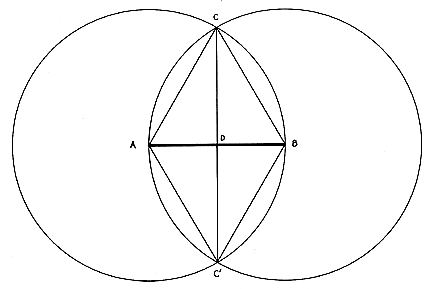
It was easy for the Greeks to use their fixed dividers to identify two points on the plane marked by the divider’s two ends: A and B, respectively. Employing their straightedge, they could inscribe the line between these two points, the line AB. Using one end of the dividers as the pivot point at one end of the line, A, a circle can be described around the original line terminal: circle A. Using point B as a center, a circle can be described around it, which we will call circle B. These two circles intersect one another at two points on either side of the line AB. We will call the intersection points C and C’.
825.02
By construction, they demonstrated that points C and C’ were both equidistant from points A and B. In this process, they have also defined two equilateral triangles ABC and ABC’, with a congruent edge along the line AB and with points C and C’ equidistant on either side from points A and B, respectively.
825.10 Right Triangle
825.11
They then used a straightedge to connect points C and C’ with a line that they said bisected line AB perpendicularly, being generated by equidistance from either point on either side. Thus the Greeks arrived at their right triangle; in fact, their four right triangles. We will designate as point D the intersection of the lines CC’ and AB. This gave the Greeks four angles around a common point. The four right triangles ADC, BDC, ADC’, and BDC’ have hypotenuses and legs that are, as is apparent from even the most casual inspection, of three different lengths. The leg DB, for instance, is by equidistance construction exactly one-half of AB, since AB was the radius of the two original circles whose circumferences ran through one another’s centers. By divider inspections, DB is less than CD and CD is less than CB. The length of the line CD is unknown in respect to the original lines AB, BD, or AC, lines that represented the original opening of the dividers. They have established, however, with satisfaction of the rules of their game, that 360 degrees of circular unity at D could be divided into four equal 90-degree angles entirely and evenly surrounding point D.
825.20 Hexagonal Construction
825.21
Diameter: The Greeks then started another independent investigation with their three tools on the seemingly flat planar surface of the Earth. Using their dividers to strike a circle and using their straightedge congruent to the center of the circle, they were able with their scriber to strike a seemingly straight line through the center of construction of the circle. As the line passed out of the circle in either direction from the center, it seemingly could go on to infinity, and therefore was of no further interest to them. But inside the circle, as the line crossed the circumference at two points on either side of its center, they had the construction information that the line equated the opening of the dividers in two opposite directions. They called this line the diameter: DIA + METER.
825.22
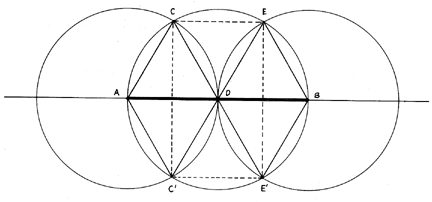
Now we will call the center of the constructed circle D and the two intersections of the line and the circumference A and B. That AD = DB is proven by construction. They know that any point on the circumference is equidistant from D. Using their dividers again and using point A as a pivot, they drew a circle around A; they drew a second circle using B as a pivot. Both of these circles pass through D. The circle around A intersects the circle around D at two points, C and C’. The circle around B intersects the circle around D at two points, E and E’ . The circle around A and the circle around B are tangent to one another at the point D.
825.23
They have now constructed four equilateral triangles in two pairs: ADC and ADC’ as the first pair, and DBE and DBE’ as the second pair. They know that the lines AC, CD, AC’, and DC’ are all identical in length, being the fixed opening of the dividers and so produced and proven by construction. The same is true of the lines DE, EB, DE’, and BE’ — they are all the same. The Greeks found it a tantalizing matter that the two lines CE and C’E’, which lie between the vertexes of the two pairs of equilateral triangles, seemed to be equal, but there was no way for them to prove it by their construction.
825.24
At first it seemed they might be able to prove that the increments CE and C’E’ are not only equal to one another, but are equal to the basic radius of the circle AD; therefore, the hexagon ACEBE’C’ would be an equilateral hexagon; and hexagons would be inherently subdivisible into six 60-degree equilateral triangles around the central point, and all the angles would be of 60 degrees.
825.25
There seemed to be one more chance for them to prove this to be true, which would have provided an equiangular, equiedged, triangularly stable structuring of areal mensuration. This last chance to prove it was by first showing by construction that the line ADB, which runs through the point of tangency of the circles A and B, is a straight line. This was constructed by the straightedge as the diameter of circle D. This diameter is divided by four equal half-radii, which are proven to be half-radii by their perpendicular intersection with lines both of whose two ends are equidistant from two points on either side of the intersecting lines. If it could be assumed that: (1) the lines CE and C’E’ were parallel to the straight line ADB running through the point of tangency as well as perpendicular to both the lines CC’ and EE’; and (2) if it could be proven that when one end between two parallels is perpendicular to one of the parallels, the other end is perpendicular to the other parallel; and (3) if it could be proven also that the perpendicular distances between any two parallels were always the same, they could then have proven CE = CD = DE = D’E’, and their hexagon would be equilateral and equiradial with radii and chords equal.
825.26 Pythagorean Proof
825.261
All of these steps were eventually taken and proven in a complex of other proofs. In the meantime, they were diverted by the Pythagoreans’ construction proof of “the square of the hypotenuse of a right triangle’s equatability with the sum of the squares of the other two sides,” and the construction proof that any non-right triangle’s dimensional values could be obtained by dropping a perpendicular upon one of its sides from one of its vertexes and thus converting it into two right triangles each of which could be solved arithmetically by the Pythagoreans’ “squares” without having to labor further with empirical constructs. This arithmetical facility induced a detouring of strictly constructional explorations, hypotheses, and proofs thereof.
825.27
Due to their misassumed necessity to commence their local scientific exploration of geometry only in a supposed plane that extended forever without definable perimeter, that is, to infinity, the Ionians began using their right-triangle exploration before they were able to prove that six equilateral triangles lie in a circle around point D. They could divide the arithmetical 360 degrees of circular unity agreed upon into six 60-degree increments. And, as we have already noted, if this had been proven by their early constructions with their three tools, they might then have gone on to divide all planar space with equilateral triangles, which models would have been very convenient in connection with the economically satisfactory point-locating capability of triangulation and trigonometry.
825.28
Euclid was not trying to express forces. We, however — inspired by Avogadro’s identical-energy conditions under which different elements disclosed the same number of molecules per given volume — are exploring the possible establishment of an operationally strict vectorial geometry field, which is an isotropic (everywhere the same) vector matrix. We abandon the Greek perpendicularity of construction and find ourselves operationally in an omnidirectional, spherically observed, multidimensional, omni- intertransforming Universe. Our first move in spherical reality scribing is to strike a quasi- sphere as the vectorial radius of construction. Our dividers are welded at a fixed angle. The second move is to establish the center. Third move: a surface circle. The radius is uniform and the lesser circle is uniform. From the triangle to the tetrahedron, the dividers go to direct opposites to make two tetrahedra with a common vertex at the center. Two tetrahedra have six internal faces=hexagon=genesis of bow tie=genesis of modelability=vector equilibrium. Only the dividers and straightedge are used. You start with two events — any distance apart: only one module with no subdivision; ergo, timeless; ergo, eternal; ergo, no frequency. Playing the game in a timeless manner. (You have to have division of the line to have frequency, ergo, to have time.) (See Secs. 420 and 650.)
825.29
Commencing proof upon a sphere as representative of energy convergent or divergent, we may construct an equilateral triangle from any point on the surface. If we describe equilateral (equiangular) triangles whose chords are identical to the radii, the same sphere may be intersected alternately by four great-circle planes whose circles intercept each other, respectively, at 12 equidistant points in such a manner that only two circles intersect at any one point. As this system is described, each great circle becomes symmetrically subdivided into six equal-arc segments whose chords are identical to the radii. From this four-dimensional tribisection, any geometrical form may be described in whole fractions.
825.30 Two-Way Rectilinear Grid
825.31
To the Greeks, a two-way, rectilinearly intersecting grid of parallel lines seemed simpler than would a three-way grid of parallel lines. (See Chapter 11, “Projective Transformation.“) And the two-way grid was highly compatible with their practical coordinate needs for dealing with an assumedly flat-plane Universe. Thus the Greeks came to employ 90-degreeness and unique perpendicularity to the system as a basic additional dimensional requirement for the exclusive, and consequently unchallenged, three- dimensional geometrical data coordination.
825.32
Their arithmetical operations were coordinated with geometry on the assumption that first-power numbers represented linear module tallies, that second-power N² = square increments, and that third-power N³ = cubical increments of space. First dimension was length expressed with one line. Two dimensions introduced width expressed with a cross of two lines in a plane. Three dimensions introduced height expressed by a third line crossing perpendicularly to the first two at their previous crossing, making a three-way, three-dimensional cross, which they referred to as the XYZ coordinate system. The most economical distance measuring between the peripheral points of such XYZ systems involved hypotenuses and legs of different lengths. This three- dimensionality dominated the 2,000-year scientific development of the XYZ — c.gₜs. “Comprehensive Coordinate System of Scientific Mensurations.” As a consequence, identifications of physical reality have been and as yet are only awkwardly characterized because of the inherent irrationality of the peripheral hypotenuse aspects of systems in respect to their radial XYZ interrelationships.
825.33
Commanded by their wealth-controlling patrons, pure scientists have had to translate their theoretical calculations of physical-system behaviors into coordinate relationship with physical reality in order to permit applied science to reduce theoretical inventions to physical practice and use. All of the analytic geometers and calculus mathematicians identify their calculus-derived coordinate behaviors of theoretical systems only in terms of linear measurements taken outwardly from central points of reference; they locate the remote event points relative to those centers only by an awkward set of perpendicularities emanating from, and parallel to, the central XYZ grid of perpendicular coordinates. The irrationality of this peripheral measuring in respect to complexedly orbited atomic nuclei has occasioned the exclusively mathematical processing of energy data without the use of conceptual models.
826.00 Unity of Peripheral and Radial Modularity
826.01
Had the Greeks originally employed a universal model of x-dimensional reality as their first tool upon and within which they could further inscribe and measure with their divider, scriber, and straightedge, they would have been able to arrive at unity of circumferential as well as radial modularity. This would have been very convenient to modern physics because all the accelerations of all the constantly transforming physical events of Universe are distinguished by two fundamentally different forms of acceleration, angular and linear.
826.02
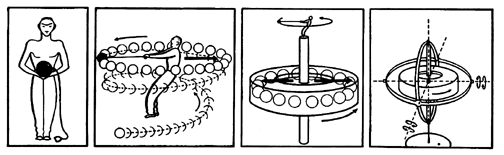
Hammer Throw: When a man accelerates a weight on the end of a cord by swinging it around his head, the weight is restrained by the cord and it accumulates the energy of his exertions in the velocity it maintains in a circular pattern. This is angular acceleration, and its velocity rates and angular momentum are calculated in central-angle increments of the circular movement accomplished within given units of time. When the weight’s cord is released by its human accelerator, it then goes into linear acceleration and its accomplished distance is measured in time increments following its release and its known release velocity, which calculations are modified by any secondary restraints.
note two hammer throws? interesting
826.02A
Fig. 826 02A Hammer Throw
Fig. 826 02A Hammer Throw: The weight on the cord accumulates energy as the man swings it around his head in a circular pattern that illustrates angular acceleration, When the weight is released it goes into linear acceleration as modified by any secondary restraints.
Link to original
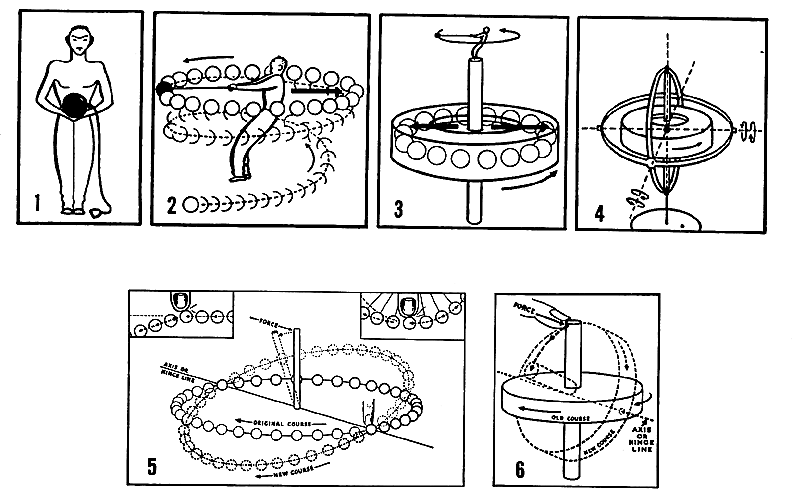
Hammer Throw: The picture of the hammer throw and gyroscope appearing in Synergetics 1 was incomplete, The complete sequence of six line drawings appears here in revised Fig. 826.02A.
826.03
The angular accelerations relate then to the myriad of circular or elliptical orbitings of components of systems around their respective centers or focii, and are intimate to original acceleration-generating factors such as the “hammer thrower” himself and his muscle as the metabolic powering by the beef he ate the day before, which gained its energy from vegetation it had eaten, which gained its energy from the Sun’s radiation by photosynthesis- all of whose attendant relative efficiencies of energy relaying were consequent upon the relative design efficacies and energy divergence to complementary environment conditions of the total synergetically effective system with the eventually total regenerative Universe itself.³
(Footnote 3: This is a typical illustration of total energy accounting, which all society must become conversant with in short order if we are to pass through the crisis and flourish upon our planet. If we do suceed, it will be because, among other planetary events, humans will have come to recognize that the common wealth equating accounting must be one that locks fundamental and central energy incrementations—such as kilowatts hours—to human physical-energy work capability and its augmentation by the mind-comprehending employability of generalized principles of Universe, as these may be realistically appraised in the terms of increasing numbers of days for increasing hours and distances of increasing freedoms for increasing numbers of human beings. All of this fundamental data can be introduced into world computer memories, which can approximately instantly enlighten world humanity on its increasingly more effective options of evolutionary cooperation and fundamentally spontaneous social commitment.)
826.04
Science as a Tool: The linear measurements represent the radial going-away accelerations or resultants of earlier or more remote events as well as of secondary restraints. The rigid rectilinear angularity of the 90-degree-central-angle XYZ mensuration instituted by the Greeks made impossible any unit language of direct circumferential or peripheral coordination between angular and linear phenomena. As a consequence, only the radial and linear measurements have been available to physics. For this reason, physics has been unable to make simultaneous identification of both wave and particle aspects of energy events.
826.05
The Greeks’ planar inception of geometry and its diversion first into theoretical mathematical calculations and ultimate abandonment of models has occasioned the void of ignorance now existing between the sciences and the humanities imposed by the lack of logical and unitarily moduled conceptual systems. This, in turn, has occasioned complete social blindness to either the facts or the potential benefits of science to humanity. Thus science has now come to represent an invisible monster to vast numbers of society, wherefore society threatens to jettison science and its “obnoxious” technology, not realizing that this would lead swiftly to genocide. Central to this crisis of terrestrially situate humans is the necessity for discovering and employing a comprehensively comprehendible universal coordinate system that will make it swiftly lucid to world society that science and technology are only manipulative tools like inanimate and cut-offable hands which may be turned to structuring or destructuring. How they are to be employed is not a function of the tools but of human choice. The crisis is one of the loving and longing impulse to understand and be understood, which results as informed comprehension. It is the will to structure versus ignorant yielding to fear-impulsed reflexive conditioning that results from being born utterly helpless. Intellectual information-accumulating processing and anticipatory faculties are necessary, and are only slowly discovered as exclusively able to overcome the ignorantly feared frustrating experiences of the past. Science must be seen as a tool of fundamental advantage for all, which Universe requires that man understand and use exclusively for the positive advantage of all of humanity, or humanity itself will be discarded by Universe as a viable evolutionary agent.
826.06
It is to this dilemma that we address ourselves; not being interested in palliatives, we backtrack two and a half millennia to the turning of the road where we entered in the hope of regaining the highway of lucid rationality. Using the same Greek tools, but not starting off with a plane or the subsequently substituted blackboard of the pedagogues working indoors and deprived of direct access to the scratchable Earth surface used by the Near Eastern ancients,⁴ we will now institute scientific exploration in the measurement of physical reality.
(Footnote 4: With the blackboard the pedagogues were able to bring infinity indoors.)
826.10 Otherness Restraints and Elliptical Orbits
826.11
Angular acceleration is radically restrained accumulation of circular momentum; angular deceleration is the local depletion of angular momentum.
826.12
Release from angular acceleration appears to be linear acceleration, but the linearity is only theoretical. Linear acceleration is the release from the restraint of the nearest accelerator to the angularly accelerative or decelerative restraint of the integrated vectorial resultant of all the neighboringly dominant, forever-otherness restraints in Universe. Linear acceleration never occurs, because there is no cosmic exemption of otherness.
826.13
The hammer thrower releases his “hammer’s” ball-and-rod assembly from his extended arm’s-end grasp, seemingly allowing the hammer to take a tangentially linear trajectory, but Earth’s gravitational pull immediately takes over and converts the quasistraight trajectory into an elliptical arc of greater orbiting radius than before. But the arc is one of ever-decreasing radius as the Earth’s gravity takes over and the hammer thrower’s steel ball seemingly comes to rest on the Earth’s surface, which is, however, in reality traveling around the Earth’s axis in synchronized consonance with the other huddled together atoms of the Earth’s surface. Near the Earth’s equator this would be at a circular velocity of approximately 1000 miles an hour, but near the Earth’s poles the velocity would be only inches per hour around the Earth’s axis. Both Earth, hammer thrower, and thrown hammer are traveling at 60,000 miles an hour around the Sun at a radial restraint distance of approximately 92 million miles, with the galaxies of Universe’s other nonsimultaneously generated restraints of all the othernesses’ overlappingly effective dominance variations, as produced by degrees of neighboring energy concentrations and dispersions. It is the pulsation of such concentrations and dispersions that brings about the elliptical orbiting.
826.14
This is fundamental complementarity as intuited in Einstein’s curved space prior to the scientific establishment of generalized complementarity, which we may now also speak of as the “generalized otherness” of Universe. This is why there can be only curved space. (See Sec. 1009.52.)
826.15
Isaac Newton’s first law of motion, “A body persists in a state of rest or in a straight line except as affected by other forces,” should now be restated to say, “Any one considered body persists in any one elliptical orbit until that orbit is altered to another elliptical orbit by the ceaselessly varying interpositionings and integrated restraint effects imposed upon the considered body by the ever-transforming generalized cosmic otherness.” A body is always responding orbitally to a varying plurality of otherness forces.