950.01
The regular tetrahedron will not associate with other regular tetrahedra to fill allspace. (See Sec. 780.10 for a conceptual definition of allspace.) If we try to fill allspace with tetrahedra, we are frustrated because the tetrahedron will not fill all the voids above the triangular-based grid pattern. (See Illus. 950.31.) If we take an equilateral triangle and bisect its edges and interconnect the mid-points, we will have a “chessboard” of four equiangular triangles. If we then put three tetrahedra chessmen on the three corner triangles of the original triangle, and put a fourth tetrahedron chessman in the center triangle, we find that there is not enough room for other regular tetrahedra to be inserted in the too-steep valleys Lying between the peaks of the tetrahedra.
950.02
If we remove the one tetrahedral chessman from the center triangle of the four-triangle chessboard and leave the three tetra-chessmen standing on the three corner triangles, we will find that one octahedral chessman (of edges equal to the tetra) exactly fits into the valley Lying between the first three tetrahedra; but this is not allspace-filling exclusively with tetrahedra.
950.10 Self-Packing Allspace-Filling Geometries
950.11
There are a variety of self-packing allspace-filling geometries. Any one of them can be amplified upon in unlimited degree by highfrequency permitted aberrations. For instance, the cube can reoccur in high frequency multiples with fundamental rectilinear aspects_with a cubical node on the positive face and a corresponding cubical void dimple on the negative face_which will fill allspace simply because it is a complex of cubes.
950.12
Fig. 950.12 Three Self-Packing, Allspace-Filling Irregular Tetrahedra
Fig 950.12 Three Self-Packing, Allspace-Filling Irregular Tetrahedra: There are three self-packing irregular tetrahedra that will fill allspace without need of any complementary shape (not even with the need of right- and left-hand versions of themselves). One, the Mite (A), has been proposed by Fuller and described by Coxeter as a tri-rectangular tetrahedron in his book Regular Polytopes, p.71. By joining together two Mites, two varieties of irregular tetrahedra, both called Sytes, can be formed. The tetragonal disphenoid (B), described by Coxeter, is also called the isosceles tetrahedron because it is bounded by four congruent isosceles triangles. The other Syte is formed by joining two Mites by their right-triangle faces (C). It was discovered by Fuller that the Mite has a population of two A quanta modules and one B quanta module (not noted by Coxeter). It is of interest to note that the B quanta module of the Mite may be either right- of left-handed (see the remarks of Arthur L. Loeb). Either of the other two self-packing irregular tetrahedra (Sytes) have a population of four A quanta modules and two B quanta modules, since each Syte consists of two Mites. Since the Mites are the limit case all space-filling system, Mites may have some relationship to quarks. The A quanta module can be folded out of one planar triangle, suggesting that it may be an energy conserver, while the B quanta module can not, suggesting that it may be an energy dissipator. This gives the Mite a population of two energy conservers (A quanta module) and one energy dissipator (B quanta module).
Link to original
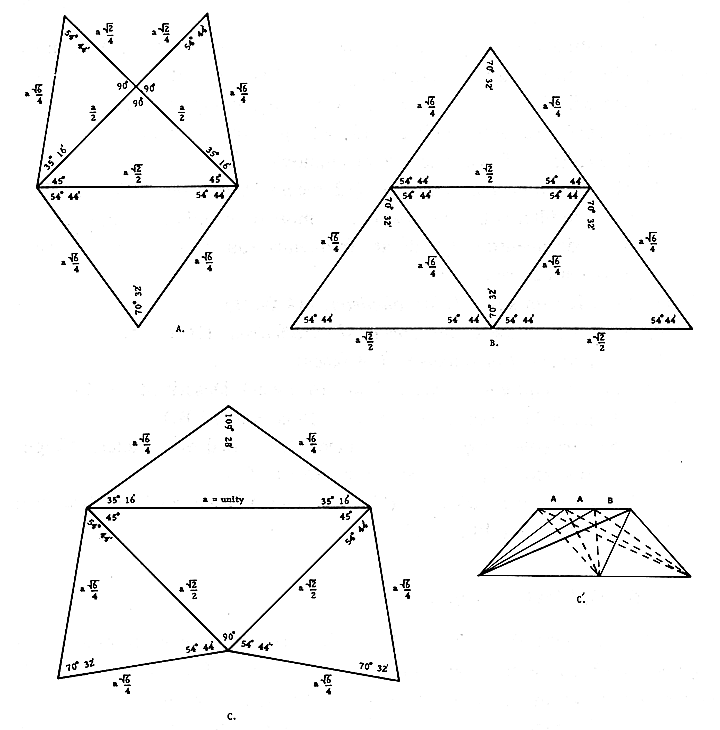
There are eight familiar self-packing allspace-fillers:
1. The cube. (6 faces) Discoverer unknown.
2. The rhombic dodecahedron. (12 faces) Discoverer unknown. This allspace filler is the one that occurs most frequently in nature. Rhombic dodecahedron crystals are frequently found in the floor of mineral-rich deserts.
3. Lord Kelvin’s tetrakaidecahedron. (14 faces)
4. Keith Critchlow’s snub-cornered tetrahedron. (16 faces)
5. The truncated octahedron. ( 14 faces)
6. The trirectangular tetrahedron. (4 faces) Described by Coxeter, “Regular Polytopes,” p. 71. (See Illus. 950.12B.)
7. The tetragonal disphenoid. (4 faces) Described by Coxeter, “Regular Polytopes,” p. 71. (See Illus. 950.12C.)
8. The irregular tetrahedron (Mite). (4 faces) Discovered and described by Fuller. (See Illus. 950.12A.)
950.20 Cubical Coordination
950.21
Because the cube is the basic, prime-number-three-elucidating volume, and because the cube’s prime volume is three, if we assess space volumetrically in terms of the cube as volumetric unity, we will exploit three times as much space as would be required by the tetrahedron employed as volumetric unity. Employing the extreme, minimum, limit case, ergo the prime structural system of Universe, the tetrahedron (see Sec. 610.20), as prime measure of efficiency in allspace filling, the arithmetical-geometrical volume assessment of relative space occupancy of the whole hierarchy of geometrical phenomena evaluated in terms of cubes is threefold inefficient, for we are always dealing with physical experience and structural systems whose edges consist of events whose actions, reactions, and resultants comprise one basic energy vector. The cube, therefore, requires threefold the energy to structure it as compared with the tetrahedron. We thus understand why nature uses the tetrahedron as the prime unit of energy, as its energy quantum, because it is three times as efficient in every energetic aspect as its nearest symmetrical, volumetric competitor, the cube. All the physicists’ experiments show that nature always employs the most energy-economical strategies.
950.30 Tetrahedron and Octahedron as Complementary Allspace Fillers: A and B Quanta Modules
950.31
We may ask: What can we do to negotiate allspace filling with tetrahedra? In an isotropic vector matrix, it will be discovered that there are only two polyhedra described internally by the configuration of the interacting lines: the regular tetrahedron and the regular octahedron. (See Illus. 950.31.)
950.32
All the other regular symmetric polyhedra known are also describable repetitiously by compounding rational fraction elements of the tetrahedron and octahedron: the A and B Quanta Modules, each having the volume of 1/24th of a tetrahedron.
950.33
It will be discovered also that all the polygons formed by the interacting vectors consist entirely of equilateral triangles and squares, the latter occurring as the cross sections of the octahedra, and the triangles occurring as the external facets of both the tetrahedra and octahedra.
950.34
The tetrahedra and octahedra complement one another as space fillers. This is not very satisfactory if you are looking for a monological explanation: the “building block” of the Universe, the “key,” the ego’s wished-for monopolizer. But if you are willing to go along with the physicists, recognizing complementarity, then you will see that tetrahedra plus octahedra_and their common constituents, the unit-volume, A and B Quanta Modules_provide a satisfactory way for both physical and metaphysical, generalized cosmic accounting of all human experience. Everything comes out rationally.
951.00 Allspace-Filling Tetrahedra
951.01
The tetrahedra that fill allspace by themselves are all asymmetrical. They are dynamic reality only-for-each-moment. Reality is always asymmetrical.
951.10
Synergetic Allspace-Filling Tetrahedron: Synergetic geometry has one cosmically minimal, allspace-filling tetrahedron consisting of only four A Quanta Modules and two B Quanta Modules—six modules in all—whereas the regular tetrahedron consists of 24 such modules and the cube consists of 72. (See Illus. 950.12.)
953.00 Mites and Sytes: Minimum Tetrahedra as Three-Module Allspace Fillers
953.10
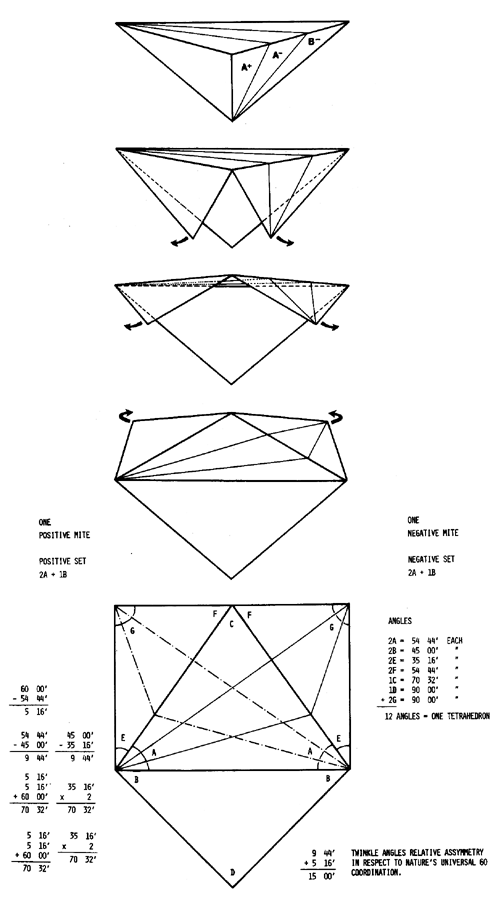
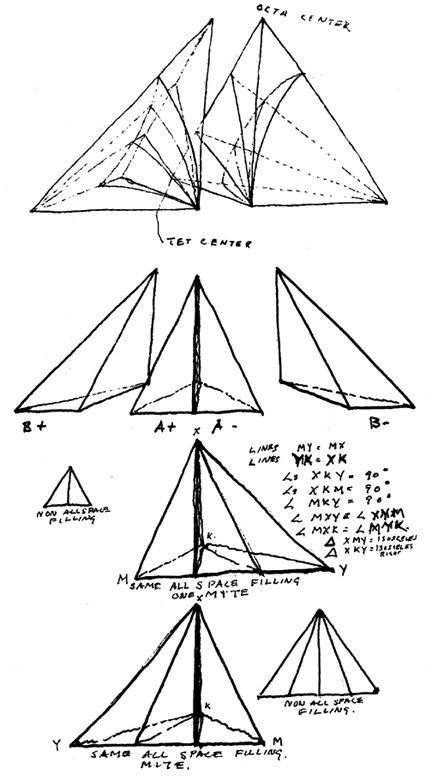
Minimum Tetrahedron: Mite: Two A Quanta Modules and one B Quanta Module may be associated to define the allspace-filling positive and negative sets of three geometrically dissimilar, asymmetric, but unit volume energy quanta modules which join the volumetric center hearts of the octahedron and tetrahedron. For economy of discourse, we will give this minimum allspace-filling AAB complex three-quanta module’s asymmetrical tetrahedron the name of Mite (as a contraction of Minimum Tetrahedron, allspace filler). (See drawings section.)
953.20
Positive or Negative: Mites can fill allspace. They can be either positive (+) or negative (-), affording a beautiful confirmation of negative Universe. Each one can fill allspace, but with quite different energy consequences. Both the positive and negative Mite Tetrahedra are comprised, respectively, of two A Quanta Modules and one B Quanta Module. In each Mite, one of the two A s is positive and one is negative; the B must be positive when the Mite is positive and negative when the Mite is negative. The middle A Quanta Module of the MB wedge-shaped sandwich is positive when the Mite and its B Quanta Module are negative. The Mite and its B Quanta Module have like signs. The Mite and its middle A Quanta Module have unlike signs.
953.21
If there were only positive Universe, there would be only Sytes (see Sec. 953.40. But Mites can be either plus or minus; they accommodate both Universes, the positive and the negative, as well as the half-positive and half-negative, as manifestations of fundamental complementarity. They are true rights and lefts, not mirror images; they are inside out and asymmetrical.
953.22
There is a noncongruent, ergo mutually exclusive, tripartiteness (i.e., two As and one B in a wedge sandwich) respectively unique to either the positive or the negative world. The positive model provides for the interchange between the spheres and the spaces.⁴ But the Mite permits the same kind of exchange in negative Universe.
(Footnote 4: See Sec. 1032.10.)
953.23
The cube as an allspace filler requires only a positive world. The inside-out cube is congruent with the outside-out cube. Whereas the inside-out and outside-out Mites are not congruent and refuse congruency.
953.24
Neither the tetrahedron nor the octahedron can be put together with Mites. But the allspace-filling rhombic dodecahedron and the allspace-filling tetrakaidecahedron can be exactly assembled with Mites. Their entire componentation exclusively by Mites tells us that either or both the rhombic dodecahedron and the tetrakaidecahedron can function in either the positive or the negative Universe.
953.25
The allspace-filling functions of the (+) or (-) AAB three-module Mite combines can operate either positively or negatively. We can take a collection of the positives or a collection of the negatives. If there were only positive outside-out Universe, it would require only one of the three alternate six-module, allspace-filling tetrahedra (see Sec. 953.40) combined of two A (+), two A (-), one B (+), and one B (-) to fill allspace symmetrically and complementarily. But with both inside-out and outside-out worlds, we can fill all the outside-out world’s space positively and all the inside-out world’s space negatively, accommodating the inherent complementarity symmetry requirements of the macro-micro cosmic law of convex world and concave world, while remembering all the time that among all polyhedra only the tetrahedron can turn itself inside out.
953.30
Tetrahedron as Three-Petaled Flower Bud: Positive or negative means that one is the inside-out of the other. To understand the insideouting of tetrahedra, think of the tetrahedron’s four outside faces as being blue and the four inside faces as being red. If we split open any three edges leading to any one of the tetrahedron’s vertexes, the tetrahedron will appear as a three-petaled flower bud, just opening, with the triangular petals hinging open around the common triangular base. The opening of the outside-blue- inside-red tetrahedron and the hinging of all its blue bud’s petals outwardly and downwardly until they meet one another’s edges below the base, will result in the whole tetrahedron’s appearing to be red while its hidden interior is blue. All the other geometrical characteristics remain the same. If it is a regular tetrahedron, all the parts of the outside-red or the outside-blue regular tetrahedron will register in absolute congruence.
953.40
Symmetrical Tetrahedron: Syte: Two of the AAB allspace-filling, three- quanta module, asymmetric tetrahedra, the Mites—one positive and one negative—may be joined together to form the six-quanta-module, semisymmetrical, allspace-filling Sytes. The Mites can be assembled in three different ways to produce three morphologically different, allspace-filling, asymmetrical tetrahedra: the Kites, Lites, and Bites, but all of the same six-module volume. This is done in each by making congruent matching sets of their three, alternately matchable, right-triangle facets, one of which is dissimilar to the other two, while those other two are both positive-negative mirror images of one another. Each of the three pairings produces one six-quanta module consisting of two A (+), two A (-), one B (+), and one B (-).
953.50
Geometrical Combinations: All of the well-known Platonic, Archimedean, Keplerian, and Coxeter types of radially symmetric polyhedra may be directly produced or indirectly transformed from the whole unitary combining of Mites without any fractionation and in whole, rational number increments of the A or B Quanta Module volumes. This prospect may bring us within sight of a plenitudinous complex of conceptually discrete, energy-importing, -retaining, and -exporting capabilities of nuclear assemblage components, which has great significance as a specific closed-system complex with unique energy-behavior-elucidating phenomena. In due course, its unique behaviors may be identified with, and explain discretely, the inventory of high-energy physics’ present prolific production of an equal variety of strange small-energy “particles,” which are being brought into split-second existence and observation by the ultrahigh-voltage accelerator’s bombardments.
953.60
Prime Minimum System: Since the asymmetrical tetrahedron formed by compounding two A Quanta Modules and one B Quanta Module, the Mite, will compound with multiples of itself to fill allspace and may be turned inside out to form its noncongruent negative complement, which may also be compounded with multiples of itself to fill allspace, this minimum asymmetric system—which accommodates both positive or negative space and whose volume is exactly 1/8th that of the tetrahedron, exactly 1/32nd that of the octahedron, exactly 1/160th that of the vector equilibrium of zero frequency, and exactly 1/1280th of the vector equilibrium of initial frequency ( = 2), 1280 = 2⁸ × 5—this Mite constitutes the generalized nuclear geometric limit of rational differentiation and is most suitably to be identified as the prime minimum system; it may also be identified as the prime, minimum, rationally volumed and rationally associable, structural system.
954.00 Mite as the Coupler’s Asymmetrical Octant Zone Filler
Fig. 954.00A A and B Quanta Module Orientations.
Link to original
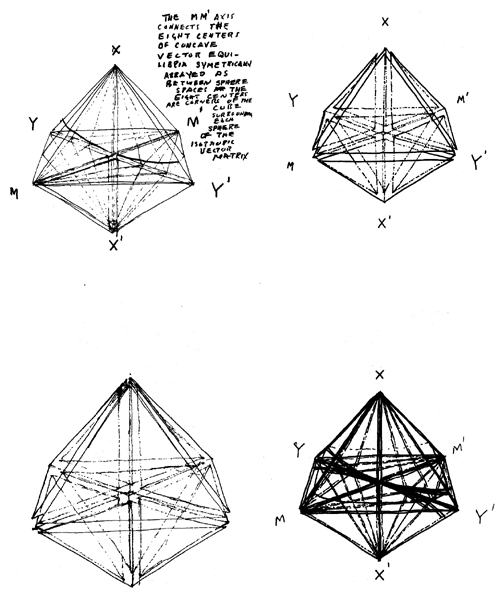
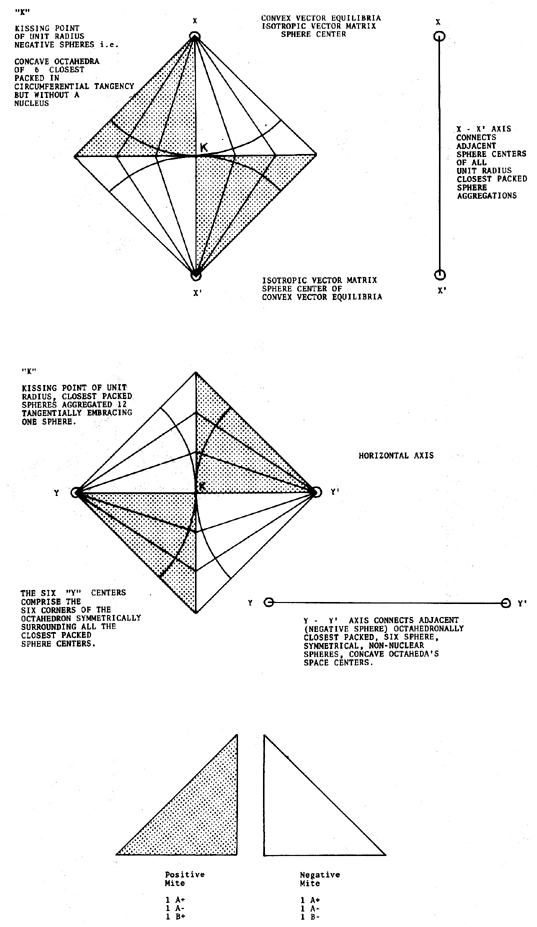
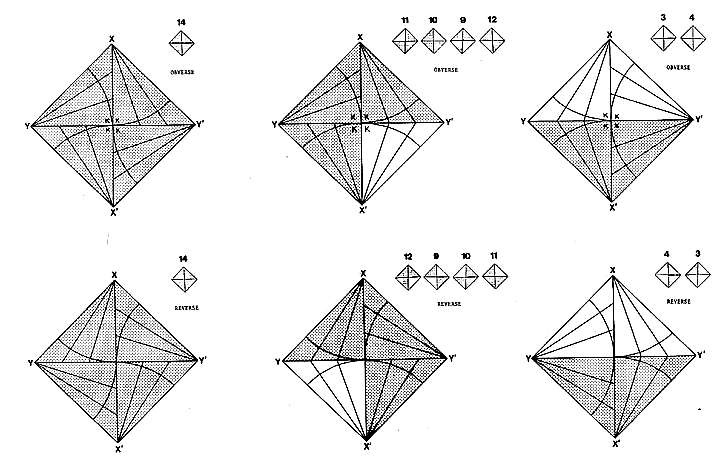
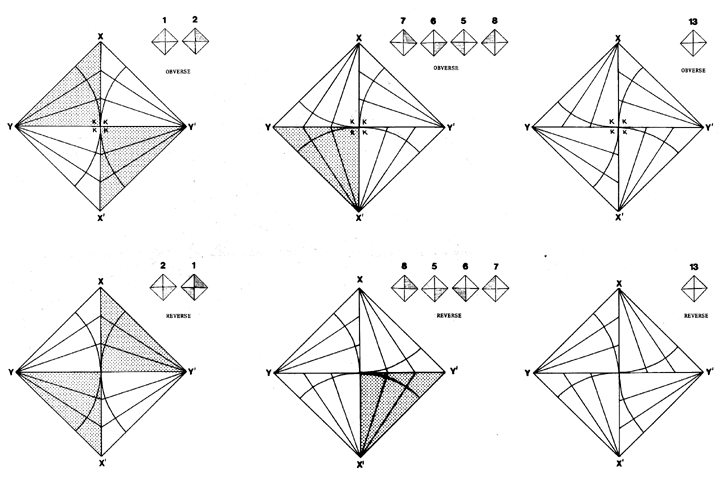
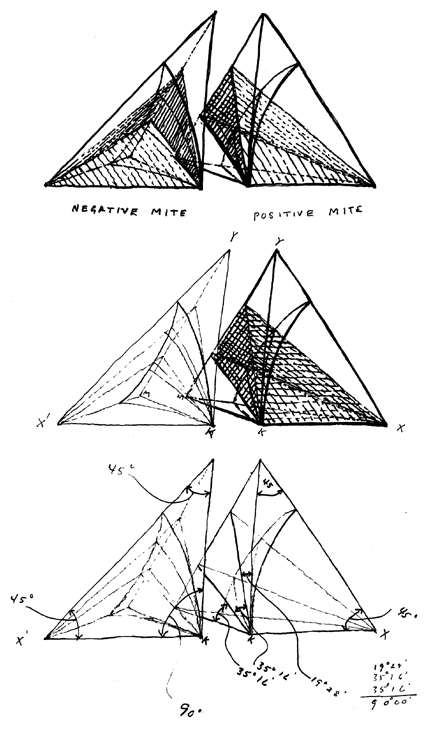
Fig. 954.00B Mites and Couplers
Link to original
954.01
The Coupler is the asymmetric octahedron to be elucidated in Secs. 954.20 through 954.70. The Coupler has one of the most profound integral functionings in metaphysical Universe, and probably so in physical Universe, because its integral complexities consist entirely of integral rearrangeability within the same space of the same plus and/or minus Mites. We will now inspect the characteristics and properties of those Mites as they function in the Coupler. Three disparately conformed, nonequitriangular, polarized half-octahedra, each consisting of the same four equivolumetric octant zones occur around the three half-octants’ common volumetric center. These eight octant zones are all occupied, in three possible different system arrangements, by identical asymmetrical tetrahedra, which are Mites, each consisting of the three AAB Modules.
954.02
Each of these 1/8 octant-zone-filling tetrahedral Mite’s respective surfaces consists of four triangles, CAA, DEE, EFG¹, and EFG², two of which, CAA and DBB, are dissimilar isosceles triangles and two of which, EFG¹ and EFG², are right triangles. (See Illus. 953.10.) Each of the dissimilar isosceles triangles have one mutual edge, AA and BB, which is the base respectively of both the isosceles triangles whose respective symmetrical apexes, C and D, are at different distances from that mutual baseline.
954.03
The smaller of the mutually based isosceles triangle’s apex is a right angle, D. If we consider the right-angle-apexed isosceles triangle DBB to be the horizontal base of a unique octant-zone-filling tetrahedron, we find the sixth edge of the tetrahedron rising perpendicularly from the right-angle apex, D, of the base to C (FF), which perpendicular produces two additional right triangles, FGE¹ and FGE², vertically adjoining and thus surrounding the isosceles base triangle’s right-angled apex, D. This perpendicular D (FF) connects at its top with the apex C of the larger isosceles triangle whose baseline, AA, is symmetrically opposite that C apex and congruent with the baseline, BB, of the right- angle-apexed isosceles base triangle, BBD, of our unique octant-filling tetrahedral Mite, AACD.
954.04
The two vertical right triangles running between the equilateral edges of the large and small isosceles triangles are identical right triangles, EFG¹ and EFG², whose largest (top) angles are each 54° 44’ and whose smaller angles are 35° 16’ each.
954.05
As a tetrahedron, the Mite has four triangular faces: BBD, AAC, EFG¹, and EFG². Two of the faces are dissimilar isosceles triangles, BBD and AAC; ergo, they have only two sets of two different face angles each—B, D, A, and C—one of which, D, is a right angle.
954.06
The other two tetrahedral faces of the Mites are similar right triangles, EFG, which introduce only two more unique angles, E and F, to the Mite’s surface inventory of unique angles.
954.07
The inventory of the Mite’s twelve corner angles reveals only five different angles. There are two As and two Fs, all of which are 54° 44’ each, while there are three right angles consisting of one D and two Gs. There are two Bs of 45° 00’ each, two Es of 35° 16’ each, and one C of 70° 32’. (See drawings section.)
954.08
Any of these eight interior octant, double-isosceles, three-right-angled- tetrahedral domains—Mites—(which are so arrayed around the center of volume of the asymmetrical octahedron) can be either a positively or a negatively composited allspace- filling tetrahedron.
954.09
We find the Mite tetrahedron, AACD, to be the smallest, simplest, geometrically possible (volume, field, or charge), allspace-filling module of the isotropic vector matrix of Universe. Because it is a tetrahedron, it also qualifies as a structural system. Its volume is exactly l/8th that of its regular tetrahedral counterpart in their common magnitude isotropic vector matrix; within this matrix, it is also only 1/24th the volume of its corresponding allspace-filling cube, 1/48th the volume of its corresponding allspace-filling rhombic dodecahedron, and 1/6144th the volume of its one other known unique, omnidirectional, symmetrically aggregatable, nonpolarized-assemblage, unit- magnitude, isotropic-vector-matrix counterpart, the allspace-filling tetrakaidecahedron.
954.10
Allspace-Filling Hierarchy as Rationally Quantifiable in Whole Volume Units of A or B Quanta Modules
| Synergetics’ Name | Quanta Module Volume | Type Polyhedron | Symmetrical or Asymmetrical |
|---|---|---|---|
| Mite | 3 | Tetrahedron | Asymmetrical |
| Syte (3 types) | 6 | Tetrahedron | Asymmetrical |
| Kites | |||
| Lites | |||
| Bites | |||
| Coupler | 24 | Octahedron | Asymmetrical |
| Cube | 72 | Cube | Simple Symmetrical |
| Rhombic Dodecahedron | 144 | Rhombic Dodecahedron | Complex Symmetrical |
| Tetrakaidecahedron | 18,432 | Tetrakaidecahedron | Complex Symmetrical |
954.10A
Allspace-Filling Hierarchy as Rationally Quantifiable in Whole Volume Units of A or B Quanta Modules
| Synergetics’ Name | Quanta Module Volume | Type Polyhedron | Symmetrical or Asymmetrical |
|---|---|---|---|
| Mite | 3 | Tetrahedron | Asymmetrical |
| Syte (3 types) | 6 | Tetrahedron | Asymmetrical |
| Kites | 6 | Tetrahedron | Asymmetrical |
| Lites | 6 | Tetrahedron | Asymmetrical |
| Bites | 6 | Hexahedron | Asymmetrical |
| Coupler | 24 | Octahedron | Asymmetrical |
| Cube | 72 | Hexahedron | Simple Symmetrical |
| Rhombic dodecahedron | 144 | Dodecahedron | Simple Symmetrical |
| Tetrakaidecahedron | 18,432 | Tetrakaidecahedron | Complex Symmetrical |
954.20
Coupler: The basic complementarity of our octahedron and tetrahedron, which always share the disparate numbers 1 and 4 in our topological analysis (despite its being double or 4 in relation to tetra = 1), is explained by the uniquely asymmetrical octahedron, the Coupler, that is always constituted by the many different admixtures of AAB Quanta Modules; the Mites, the Sytes, the cube (72 As and Bs), and the rhombic dodecahedron (144 As and Bs).
954.21
There are always 24 As or Bs in our uniquely asymmetrical octahedron (the same as one tetra), which we will name the Coupler because it occurs between the respective volumetric centers of any two of the adjacently matching diamond faces of all the symmetrical, allspace-filling rhombic dodecahedra (or 144 As and Bs). The rhombic dodecahedron is the most-faceted, identical-faceted (diamond) polyhedron and accounts, congruently and symmetrically, for all the unique domains of all the isotropic-vector- matrix vertexes. (Each of the isotropic-vector-matrix vertexes is surrounded symmetrically either by the spheres or the intervening spaces-between-spheres of the closest-packed sphere aggregates.) Each rhombic dodecahedron’s diamond face is at the long-axis center of each Coupler (vol. = 1) asymmetric octahedron. Each of the 12 rhombic dodecahedra is completely and symmetrically omnisurrounded by—and diamond-face-bonded with—12 other such rhombic dodecahedra, each representing one closest-packed sphere and that sphere’s unique, cosmic, intersphere-space domain Lying exactly between the center of the nuclear rhombic dodecahedron and the centers of their 12 surrounding rhombic dodecahedra—the Couplers of those closest-packed-sphere domains having obviously unique cosmic functioning.
954.22
A variety of energy effects of the A and B Quanta Module associabilities are contained uniquely and are properties of the Couplers, one of whose unique characteristics is that the Coupler’s topological volume is the exact prime number one of our synergetics’ tetrahedron (24 As) accounting system. It is the asymmetry of the Bs (of identical volume to the As) that provides the variety of other than plusness and minusness of the all-A- constellated tetrahedra. Now we see the octahedra that are allspace filling and of the same volume as the As in complementation. We see proton and neutron complementation and non-mirror-imaging interchangeability and intertransformability with 24 subparticle differentiabilities and 2, 3, 4, 6, combinations—enough to account for all the isotopal variations and all the nuclear substructurings in omnirational quantation.
954.30
Nuclear Asymmetric Octahedra: There are eight additional asymmetric octahedra Couplers surrounding each face of each Coupler. It is probable that these eight asymmetric nuclear octahedra and the large variety of each of their respective constituent plus and minus Mite mix may account for all the varieties of intercomplex complexity required for the permutations of the 92 regenerative chemical elements. These eight variables alone provide for a fantastic number of rearrangements and reorientations of the A and B Quanta Modules within exactly the same geometric domain volume.
954.31
It is possible that there are no other fundamental complex varieties than those accounted for by the eight nuclear Coupler-surrounding asymmetrical octahedra. There is a mathematical limit of variation—with our friend octave coming in as before. The Coupler may well be what we have been looking for when we have been talking about “number one.” It is quite possibly one nucleon, which can be either neutron or proton, depending on how you rearrange the modules in the same space.
954.32
There are enough coincidences of data to suggest that the bombardment- produced energy entities may be identified with the three energy quanta modules-two A Quanta Modules and one B Quanta Module—allspace-filler complexities of associability, all occurring entirely within one uniquely proportioned, polarized, asymmetrical, nonequilateral, eight-triangle-faceted polyhedron—the Coupler—within whose interior only they may be allspace-fillingly rearranged in a large variety of ways without altering the external conformation of the asymmetrical, octahedral container.
954.40
Functions of the Coupler: In their cosmic roles as the basic allspace-filling complementarity pair, our regular tetrahedron and regular octahedron are also always identified respectively by the disparate numbers 1 and 4 in the column of relative volumes on our comprehensive chart of the topological hierarchies. (See Chart 223.64.) The volume value 4—being 2² also identifies the prime number 2 as always being topologically unique to the symmetrical octahedron while, on the same topological hierarchy chart, the uniquely asymmetrical allspace-filling octahedron, the Coupler, has a volume of 1, which volume-1-identity is otherwise, topologically, uniquely identified only with the non-allspace-filling regular symmetrical tetrahedron.
954.41
The uniquely asymmetrical octahedron has three XYZ axes and a center of volume, K. Its X and Y axes are equal in length, while the Z axis is shorter than the other two. The uniquely asymmetrical octahedron is always polarly symmetrical around its short Z axis, whose spin equatorial plane is a square whose diagonals are the equilengthed X and Y axes. The equatorially spun planes of both the X and Y axes are similar diamonds, the short diagonal of each of these diamonds being the Z axis of the uniquely asymmetrical octahedron, while the long diagonal of the two similar diamonds are the X and Y axes, respectively, of the uniquely asymmetrical octahedron.
954.42
The uniquely asymmetrical octahedron could also be named the polarly symmetrical octahedron. There is much that is unique about it. To begin with the “heart,” or center of volume of the asymmetrical octahedron (knowable also as the polarly symmetrical octahedron, of geometrical volume 1), is identified by the capital letter K because K is always the kissing or tangency point between each and every sphere in all closest-packed unit radius sphere aggregates; and it is only through those 12 kissing (tangency) points symmetrically embracing every closest-packed sphere that each and all of the 25 unique great circles of fundamental crystallographic symmetry must pass—those 25 great circles being generated as the 3, 4, 6, 12 = 25 great circle equators of spin of the only-four-possible axes of symmetry of the vector equilibrium. Therefore it is only through those volumetric heart K points of the uniquely asymmetrical octahedra that energy can travel electromagnetically, wavelinearly, from here to there throughout Universe over the shortest convex paths which they always follow.
954.43
The uniquely asymmetrical octahedron is always uniformly composed of exactly eight asymmetrical, allspace-filling, double-isosceles tetrahedra, the Mites, which in turn consist of AAB three-quanta modules each. Though outwardly conformed identically with one another, the Mites are always either positively or negatively biased internally in respect to their energy valving (amplifying, choking, cutting off, and holding) proclivities, which are only “potential” when separately considered, but operationally effective as interassociated within the allspace-filling, uniquely asymmetrical octahedron, and even then muted (i.e., with action suspended as in a holding pattern) until complexes of such allspace-filling and regeneratively circuited energy transactions are initiated.
954.44
The cosmically minimal, allspace-filling Mites’ inherent bias results from their having always one A + and one A - triple-bonded (i.e., face-bonded) to constitute a symmetrical isosceles (two-module) but non-allspace-filling tetrahedron to either one of the two external faces, of which either one B + or one B -can be added to provide the allspace-filling, semisymmetrical double-isosceles, triple right-angled, three-moduled Mite, with its positive and negative bias sublimatingly obscured by the fact that either the positive or the negative quantum biasing add together to produce the same overall geometrical space-filling tetrahedral form, despite its quanta-biased composition. This obscurity accounts for its heretofore unbeknownstness to science and with that unbeknownstness its significance as the conceptual link between the heretofore remote humanists and the scientists’ cerebrating, while with its discovery comes lucidly conceptual comprehension of the arithmetical and geometrical formings of the whole inventory of the isotopes of all the atoms as explained by the allspace-filling variety of internal and external associabilities and reorientings permitted within and without the respective local octant-filling of the, also in-turn, omni-space-filling, uniquely asymmetrical octahedron, the Coupler.
954.45
As learned in Sections 953 and 954, one plus-biased Mite and one minus- biased Mite can be face-bonded with one another in three different allspace-filling ways, yet always producing one energy-proclivity-balanced, six-quanta-moduled, double- isosceles, allspace-filling, asymmetrical tetrahedron: the Syte. The asymmetric octahedron can also be composed of four such balanced-bias Sytes (4 As—2 + , 2- —and 2 Bs—1 + , 1 -). Since there are eight always one-way-or-the-other-biased Mites in each uniquely asymmetrical octahedron, the latter could consist of eight positively biased or eight negatively biased Mites, or any omnigeometrically permitted mixed combination of those 16 (2⁴) cases.
954.46
There are always 24 modules (16 As and 8 Bs—of which eight As are always positive and the eight other As are always negative, while the eight Bs consist of any of the eight possible combinations of positives and negatives)⁵ in our uniquely asymmetrical octahedron. It is important to note that this 24 is the same 24-module count as that of the 24-A-moduled regular tetrahedron. We have named the uniquely asymmetrical octahedron the Coupler.
| Footnote 5: | |
| 8 all plus | 0 minus |
| 7 plus | 1 minus |
| 6 plus | 2 minus |
| 5 plus | 3 minus |
| 4 plus | 4 minus |
| 3 plus | 5 minus |
| 2 plus | 6 minus |
| 1 plus | 7 minus |
| 0 plus | 8 minus |
These combinations accommodate the same bow-tie wave patterns of the Indigs (see Sec. 1223). This eight-digited manifold is congruent with the Indig bow-tie wave —another instance of the congruence of number and geometry in synergetics. Because of the prime quanta functioning of the allspace-filling Mites, we observe an elegant confirmation of the omniembracing and omnipermeative pattern integrities of synergetics.)
954.47
We give it the name the Coupler because it always occurs between the adjacently matching diamond faces of all the symmetrical allspace-filling rhombic dodecahedra, the “spherics” (of 96 As and 48 Bs). The rhombic dodecahedron has the maximum number (12) of identical (diamond) faces of all the allspace-filling, unit edge length, symmetrical polyhedra. That is, it most nearly approaches sphericity, i.e., the shortest-radiused, symmetrical, structural, polyhedral system. And each rhombic dodecahedron exactly embraces within its own sphere each of all the closest-packed unit radius spheres of Universe, and each rhombic dodecahedron’s volumetric center is congruent with the volumetric center of its enclosed sphere, while the rhombic dodecahedron also embracingly accounts, both congruently and symmetrically, for all the isotropic-vector-matrix vertexes in closest-packed and all their “between spaces.” The rhombic dodecahedra are the unique cosmic domains of their respectively embraced unit radius closest-packed spheres. The center of area, K, of each of the 12 external diamond faces of each rhombic dodecahedron is always congruent with the internal center of volume (tangent sphere’s kissing points), K, of all the allspace-filling uniquely asymmetrical octahedra.
954.48
Thus the uniquely asymmetrical octahedra serve most economically to join, or couple, the centers of volume of each of the 12 unit radius spheres tangentially closest packed around every closest packed sphere in Universe, with the center of volume of that omnisurrounded, ergo nuclear, sphere. However the asymmetrical, octahedral coupler has three axes (X, Y, M), and only its X axis is involved in the most economical intercoupling of the energy potentials centered within all the closest-packed unit radius spheres. The Y and M axes also couple two alternative sets of isotropic-vector-matrix centers. The M axis coupling the centers of volume of the concave vector equilibria shaped between closest- packed sphere spaces, and the Y axis interconnecting all the concave octahedral between spaces of unit-radius closest-packed sphere aggregates, both of which concave between- sphere spaces become spheres as all the spheres—as convex vector equilibria or convex octahedra-transform uniformly, sumtotally, and coincidentally into concave-between-unit- radius-sphere spaces. The alternate energy transmitting orientations of the locally contained A and B Quanta Modules contained within the 12 couplers of each nuclear set accommodate all the atomic isotope formulations and all their concomitant side effects.
954.49
We also call it the Coupler because its volume = 1 regular tetrahedron = 24 modules. The Couplers uniquely bind together each rhombic dodecahedron’s center of volume with the centers of volume of all its 12 omniadjacent, omniembracing, rhombic dodecahedral “spherics.”
954.50
But it must be remembered that the centers of volume of the rhombic dodecahedral spherics are also the centers of each of all the closest-packed spheres of unit radius, and their volumetric centers are also omnicongruent with all the vertexes of all isotropic vector matrixes. The Couplers literally couple “everything,” while alternatively permitting all the varieties of realizable events experienced by humans as the sensation of “free will.”
954.51
We see that the full variety of energy effects made by the variety of uniquely permitted A-and-B-Module rearrangeabilities and reassociabilities within the unique volumetric domain of the Coupler manifest a startling uniqueness in the properties of the Coupler. One of the Coupler’s other unique characteristics is that its volume is also the exact prime number 1, which volumetric oneness characterizes only one other polyhedron in the isotropic-vector-matrix hierarchy, and that one other prime-number-one-volumed polyhedron of our quantum system is the symmetric, initial-and-minimal-structural system of Universe: the 24-module regular tetrahedron. Here we may be identifying the cosmic bridge between the equilibrious prime number one of metaphysics and the disequilibrious prime number one of realizable physical reality.
954.52
It is also evidenced that the half-population ratio asymmetry of the B Modules (of identical volume to the A Modules) in respect to the population of the A Modules, provides the intramural variety of rearrangements—other than the 1/1 plus-and- minusness—of the all-A-Module-constellated regular tetrahedron.
954.53
The Coupler octahedron is allspace-filling and of the same 24-module volume as the regular tetrahedron, which is not allspace-filling. We go on to identify them with the proton’s and neutron’s non-mirror-imaged complementation and intertransformability, because one consists of 24 blue A Modules while the other consists of sixteen blue As and eight red Bs, which renders them not only dissimilar in fundamental geometric conformation, but behaviorally different in that the As are energy-inhibiting and the Bs are either energy-inhibiting or energy-dissipating in respect to their intramural rearrangeabilities, which latter can accommodate the many isotopal differentiations while staying strictly within the same quanta magnitude units.
954.54
When we consider that each of the eight couplers which surround each nuclear coupler may consist of any of 36 different AAB intramural orientations, we comprehend that the number of potentially unique nucleus and nuclear-shell interpatternings is adequate to account for all chemical element isotopal variations, as well as accommodation in situ for all the nuclear substructurings, while doing so by omnirational quantation and without any external manifestation of the internal energy kinetics. All that can be observed is a superficially static, omniequivectorial and omnidirectional geometric matrix.
954.55
Again reviewing for recall momentum, we note that the unique asymmetrical Coupler octahedron nests elegantly into the diamond-faceted valley on each of the 12 sides of the rhombic dodecahedron (called spheric because each rhombic dodecahedron constitutes the unique allspace-filling domain of each and every unit radius sphere of all closest-packed, unit-radius sphere aggregates of Universe, the sphere centers of which, as well as the congruent rhombic dodecahedra centers of which, are also congruent with all the vertexes of all isotropic vector matrixes of Universe).
954.56
Neatly seated in the diamond-rimmed valley of the rhombic dodecahedron, the unique asymmetrical octahedron’s Z axis is congruent with the short diagonal, and its Y axis is congruent with the long diagonal of the diamond-rimmed valley in the rhombic dodecahedron’s face into which it is seated. This leaves the X axis of the uniquely asymmetrical octahedron running perpendicular to the diamond face of the diamond- rimmed valley in which it so neatly sits; and its X axis runs perpendicularly through the K point, to join together most economically and directly the adjacent hearts (volumetric centers) of all adjacently closest-packed, unit radius spheres of Universe. That is, the X axes connect each nuclear sphere heart with the hearts of the 12 spheres closest-packed around it, while the Y axis, running perpendicularly to the X axis, most economically joins the hearts (volumetric centers) of the only circumferentially adjacent spheres surrounding the nuclear sphere at the heart of the rhombic dodecahedron, but not interconnecting with those nuclear spheres’ hearts. Thus the Y axes interlink an omnisymmetrical network of tangential, unit-radius spheres in such a manner that each sphere’s heart is interconnected with the hearts of only six symmetrically interarrayed tangentially adjacent spheres. This alternate interlinkage package of each-with-six, instead of(six-with-twelve, other adjacent spheres, leaves every other space in a closest-packed, isotropic-vector-matrixed Universe centrally unconnected from its heart with adjacent hearts, a condition which, discussed elsewhere, operates in Universe in such a way as to permit two of the very important phenomena of Universe to occur: (1) electromagnetic wave propagations, and (2) the ability of objects to move through or penetrate inherently noncompressible fluid mediums. This phenomenon also operates in such a manner that, in respect to the vertexes of isotropic vector matrixes, only every other one becomes the center of a sphere, and every other vertex becomes the center of a nonsphere of the space interspersing the spheres in closest packing, whereby those spaces resolve themselves into two types—concave vector equilibria and concave octahedra. And, whenever a force is applied to such a matrix every sphere becomes a space and every space becomes a sphere, which swift intertransforming repeats itself as the force encounters another sphere, whereby the sphere vanishes and the resulting space is penetrated.
954.57
We now understand why the K points are the kinetic switch-off-end-on points of Universe.
954.58
When we discover the many rearrangements within the uniquely asymmetric Coupler octahedra of volume one permitted by the unique self-interorientability of the A and B Modules without any manifest of external conformation alteration, we find that under some arrangements they are abetting the X axis interconnectings between nuclear spheres and their 12 closest-packed, adjacently-surrounding spheres, or the Y axis interconnectings between only every other sphere of closest-packed systems.
954.59
We also find that the A and B Module rearrangeabilities can vary the intensity of interconnecting in four magnitudes of intensity or of zero intensity, and can also interconnect the three X and Y and M systems simultaneously in either balanced or unbalanced manners. The unique asymmetric octahedra are in fact so unique as to constitute the actual visual spin variable mechanisms of Dirac’s quantum mechanics, which have heretofore been considered utterly abstract and nonvisualizable.
954.70
The Coupler: Illustrations: The following paragraphs illustrate, inventory, sort out, and enumerate the systematic complex parameters of interior and exterior relationships of the 12 Couplers that surround every unit-radius sphere and every vertexial point fix in omni-closest-packed Universe, i.e., every vertexial point in isotropic vector matrixes.
954.71
Since the Coupler is an asymmetric octahedron, its eight positive or negative Mite (AAB module), filled-octant domains introduce both a positive and a negative set of fundamental relationships in unique system sets of eight as always predicted by the number-of-system-relationships formula:
which with the system number eight has 28 relationships.
954.72
There being three axes—the X, Y, and M sets of obverse-reverse, polar- viewed systems of eight—each eight has 28 relationships, which makes a total of three times 28 = 84 integral axially regenerated, and 8 face-to-face regenerated K-to-K couplings, for a total of 92 relationships per Coupler. However, as the inspection and enumeration shows, each of the three sets of 28, and one set of 8 unique, hold-or-transmit potentials subgroup themselves into geometrical conditions in which some provide energy intertransmitting facilities at four different capacity (quantum) magnitudes: 0, 1, 2, 4 (note: 4 = 2²), and in three axial directions. The X-X’ axis transmits between—or interconnects—every spheric center with one of its 12 tangentially adjacent closest-packed spheres.
954.73
The Y-Y’ axis transmits between—or interconnects—any two adjacent of the six octahedrally and symmetrically interarrayed, concave vector equilibria conformed, `tween-space, volumetric centers symmetrically surrounding every unit-radius, closest- packed sphere.
954.74
The M-M’ axis interlinks, but does not transmit between, any two of the cubically and symmetrically interarrayed eight concave octahedra conformed sets of `tween-space, concave, empty, volumetric centers symmetrically surrounding every unit- radius, closest-packed sphere in every isotropic vector matrix of Universe.
954.75
The eight K-to-K, face-to-face, couplings are energizingly interconnected by one Mite each, for a total of eight additional interconnections of the Coupler.
954.76
These interconnections are significant because of the fact that the six concave vector equilibria, Y-Y’ axis-connected `tween-spaces, together with the eight concave octahedral `tween-spaces interconnected by the M-M’ axis, are precisely the set of spaces that transform into spheres (or convex vector equilibria) as every sphere in closest-packed, unit-radius, sphere aggregates transforms concurrently into either concave vector equilibria `tween-spaces or concave octahedra `tween-sphere spaces.
954.77
This omni-intertransformation of spheres into spaces and spaces into spheres occurs when any single force impinges upon any closest-packed liquid, gaseous, or plasmically closest-packed sphere aggregations.
954.78
The further subdivision of the A Modules into two subtetrahedra and the subdividing of the B Modules into three subtetrahedra provide every positive Mite and every negative Mite with seven plus-or-minus subtetrahedra of five different varieties. Ergo 92 × 7 = 644 possible combinations, suggesting their identification with the chemical element isotopes.
955.00 Modular Nuclear Development of Allspace-Filling Spherical Domains
955.01
The 144 A and B Quanta Modules of the rhombic dodecahedron exactly embrace one whole sphere, and only one whole sphere of closest-packed spheres as well as all the unique closest-packed spatial domains of that one sphere. The universal versatility of the A and B Quanta Modules permits the omni-invertibility of those same 144 Modules within the exact same polyhedral shell space of the same size rhombic dodecahedron, with the omni-inversion resulting in six l/6th spheres symmetrically and intertangentially deployed around one concave, octahedral space center.
955.02
On the other hand, the vector equilibrium is the one and only unique symmetric polyhedron inherently recurring as a uniformly angled, centrially triangulated, complex collection of tetrahedra and half-octahedra, while also constituting the simplest and first order of nuclear, isotropically defined, uniformly modulated, inward-outward- and-around, vector-tensor structuring, whereby the vector equilibrium of initial frequency, i.e., “plus and minus one” equilibrium, is sometimes identified only as “potential,” whose uniform-length 24 external chords and 12 internal radii, together with its 12 external vertexes and one central vertex, accommodates a galaxy of 12 equiradiused spheres closest packed around one nuclear sphere, with the 13 spheres’ respective centers omnicongruent with the vector equilibrium’s 12 external and one internal vertex.
955.03
Twelve rhombic dodecahedra close-pack symmetrically around one rhombic dodecahedron, with each embracing exactly one whole sphere and the respective total domains uniquely surrounding each of those 13 spheres. Such a 12-around-one, closest symmetrical packing of rhombic dodecahedra produces a 12-knobbed, 14-valleyed complex polyhedral aggregate and not a single simplex polyhedron.
955.04
Since each rhombic dodecahedron consists of 144 modules, 13 × 144 = 1,872 modules.
955.05
Each of the 12 knobs consists of 116 extra modules added to the initial frequency vector equilibrium’s 12 corners. Only 28 of each of the 12 spheres’ respective 144 modules are contained inside the initial frequency vector equilibrium, and 12 sets of 28 modules each are 7/36ths embracements of the full 12 spheres closest packed around the nuclear sphere.
955.06
In this arrangement, all of the 12 external surrounding spheres have a major portion, i.e., 29/36ths, of their geometrical domain volumes protruding outside the surface of the vector equilibrium, while the one complete nuclear sphere is entirely contained inside the initial frequency vector equilibrium, and each of its 12 tangent spheres have 7/36ths of one spherical domain inside the initial frequency vector equilibrium. For example, 12 × 7 = 84/36 = 2 1/3 + 1 = 3 1/3 spheric domains inside the vector equilibrium of 480 quanta modules, compared with 144 ’ 3.333 rhombic dodecahedron spherics = 479.5 + modules, which approaches 480 modules.
955.07
The vector equilibrium, unlike the rhombic dodecahedron or the cube or the tetrakaidecahedron, does not fill allspace. In order to use the vector equilibrium in filling allspace, it must be complemented by eight Eighth-Octahedra, with the latter’s single, equiangular, triangular faces situated congruently with the eight external triangular facets of the vector equilibrium.
955.08
Each eighth-octahedron consists of six A and six B Quanta Modules. Applying the eight 12-moduled, 90-degree-apexed, or “cornered,” eighth-octahedra to the vector equilibrium’s eight triangular facets produces an allspace-filling cube consisting of 576 modules: one octahedron = 8 × 12 modules = 96 modules. 96 + 480 modules = 576 modules. With the 576 module cube completed, the 12 (potential) vertexial spheres of the vector equilibrium are, as yet, only partially enclosed.
955.09
If, instead of applying the eight eighth-octahedra with 90-degree corners to the vector equilibrium’s eight triangular facets, we had added six half-octahedra “pyramids” to the vector equilibrium’s six square faces, it would have produced a two- frequency octahedron with a volume of 768 modules: 6 × 48 = 288 + 480 = an octahedron of 768 modules.
955.10
Mexican Star: If we add both of the set of six half-octahedra made up out of 48 modules each to the vector equilibrium’s six square faces, and then add the set of eight Eighth-Octahedra consisting of 12 modules each to the vector equilibrium’s eight triangular facets, we have not yet completely enclosed the 12 spheres occurring at the vector equilibrium’s 12 vertexes. The form we have developed, known as the “Mexican 14-Pointed Star,” has six square-based points and eight triangular-based points. The volume of the Mexican 14-Pointed Star is 96 + 288 + 480 = 864 modules.
955.11
Not until we complete the two-frequency vector equilibrium have we finally enclosed all the original 12 spheres surrounding the single-sphere nucleus in one single polyhedral system. However, this second vector-equilibrium shell also encloses the inward portions of 42 more embryo spheres tangentially surrounding and constituting a second closest-packed concentric sphere shell embracing the first 12, which in turn embrace the nuclear sphere; and because all but the corner 12 of this second closest-packed sphere shell nest mildly into the outer interstices of the inner sphere shell’s 12 spheres, we cannot intrude external planes parallel to the vector equilibrium’s 14 faces without cutting away the internesting portions of the sphere shells.
955.12
On the other hand, when we complete the second vector equilibrium shell, we add 3,360 modules to the vector equilibrium’s initial integral inventory of 480 modules, which makes a total of 3,840 modules present. This means that whereas only 1,872 modules are necessary to entirely enclose 12 spheres closest packed around one sphere, by using 12 rhombic dodecahedra closest packed around one rhombic dodecahedron, these 13 rhombic dodecahedra altogether produce a knobby, 14-valleyed, polyhedral star complex.
955.13
The 3,840 modules of the two-frequency vector equilibrium entirely enclosing 13 whole nuclear spheres, plus fractions of the 42 embryo spheres of the next concentric sphere shell, minus the rhombic dodecahedron’s 1,872 modules, equals 1,968 extra modules distributable to the 42 embryo spheres of the two-frequency vector equilibrium’s outer shell’s 42 fractional sphere aggregates omnioutwardly tangent to the first 12 spheres tangentially surrounding the nuclear sphere. Thus we learn that 1,968 - 1,872 = 96 = 1 octahedron.
955.14
Each symmetrical increase of the vector-equilibrium system “frequency” produces a shell that contains further fractional spheres of the next enclosing shell. Fortunately, our A and B Quanta Modules make possible an exact domain accounting, in whole rational numbers—as, for instance, with the addition of the first extra shell of the two-frequency vector equilibrium we have the 3,360 additional modules, of which only 1,872 are necessary to complete the first 12 spheres, symmetrically and embryonically arrayed around the originally exclusively enclosed nucleus. Of the vector equilibrium’s 480 modules, 144 modules went into the nuclear sphere set and 336 modules are left over.
955.20
Modular Development of Omnisymmetric, Spherical Growth Rate Around One Nuclear Sphere of Closest-Packed, Uniradius Spheres: The subtraction of the 144 modules of the nuclear sphere set from the 480-module inventory of the vector equilibrium at initial frequency, leaves 336 additional modules, which can only compound as sphere fractions. Since there are 12 equal fractional spheres around each corner, with 336 modules we have 336/12ths. 336/12ths = 28 modules at each corner out of the 144 modules needed at each corner to complete the first shell of nuclear self-embracement by additional closest-packed spheres and their space-sharing domains.
955.21
The above produces 28/144ths = 7/36ths present, and 1l6/144ths = 29/36ths per each needed.
955.30
Possible Relevance to Periodic Table of the Elements: These are interesting numbers because the 28/l44ths and the 116/144ths, reduced to their least common denominator, disclose two prime numbers, i.e., seven and twenty-nine, which, together with the prime numbers 1, 2, 3, 5, and 13, are already manifest in the rational structural evolvement with the modules’ discovered relationships of unique nuclear events. This rational emergence of the prime numbers 1, 3, 5, 7, 13, and 29 by whole structural increments of whole unit volume modules has interesting synergetic relevance to the rational interaccommodation of all the interrelationship permutation possibilities involved in the periodic table of the 92 regenerative chemical elements, as well as in all the number evolvements of all the spherical trigonometric function intercalculations necessary to define rationally all the unique nuclear vector-equilibrium intertransformabilities and their intersymmetric-phase maximum aberration and asymmetric pulsations. (See Sec. 1238 for the Scheherazade Number accommodating these permutations.)
955.40
Table: Hierarchy of A and B Quanta Module Development of Omni- Closest-Packed, Symmetric, Spherical, and Polyhedral, Common Concentric Growth Rates Around One Nuclear Sphere, and Those Spheres’ Respective Polyhedral, Allspace-Filling, Unique Geometrical Domains (Short Title: Concentric Domain Growth Rates)
| A and B Quanta Module Inventory | Spherical Domains | |||
| Rhombic Dodecahedron | = | 144 modules | = | 1 |
| Initial-Frequency Vector Equilibrium | = | 480 modules | = | 3 1/3 |
| Octahedron | = | 96 modules | = | 2/3 |
| Cube | = | 72 modules | = | 1/2 |
| Tetrahedron | = | 24 modules | = | 1/6 |
955.41
Table: Spherical Growth Rate Sequence
Modular Development of Omnisymmetric Spherical Growth Rate Around One Nuclear Sphere.
Title
The below table was a list in rwgrayprojects.com
| Nuclear Set of Rhombic Dodecahedron: | 144 modules | 1 sphere |
| Vector Equilibrium, Initial Frequency: | 480 modules-Itself and | 2 1/3 additional spheres |
| Cube-Initial Frequency: | 576 modules | 4 spheres |
| Octahedron, Two-Frequency: | 768 modules | 5 1/3 spheres |
| Mexican 14-Point Star: | 864 modules | 6 spheres |
| Rhombic Dodecahedron, 12-Knobbed Star: | 1,872 modules | 13 spheres |
| Vector Equilibrium, Two-Frequency: | 3,840 modules | 26 1/9 spheres |
955.50
Rhombic Dodecahedron at Heart of Vector Equilibrium: Nature always starts every ever freshly with the equilibrious isotropic-vector-matrix field. Energy is not lost; it is just not yet realized. It can be realized only disequilibriously.
955.51
At the heart of the vector equilibrium is the ball in the center of the rhombic dodecahedron.
955.52
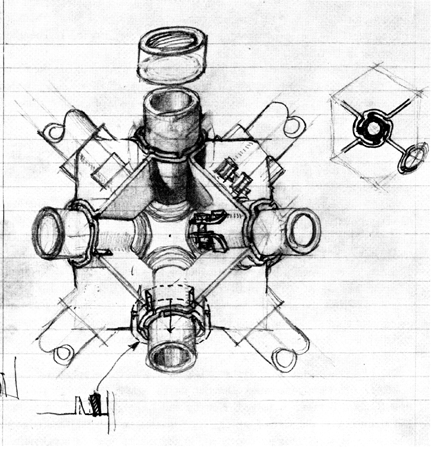
Look at the picture which shows one-half of the rhombic dodecahedron. (See Illus. 955.52.) Of all the polyhedra, nothing falls so readily into a closest-packed group of its own kind as does the rhombic dodecahedron, the most common polyhedron found in nature.