517.01
Two different energy events articulated as invisibly modulated, spiraled, vectorial lines each represent their respective masses multiplied by their velocities, and each has a unique angular direction in respect to the observer’s axis. They cannot pass through the same point at the same time. When one energy event is passing through a given point and another impinges upon it, there is an interference.
517.02
Speaking operationally, lines are products of the energy interactions of two or more separate systems. The local environment is a system. A line is always formed by an alteration of the local environment by another system. “Lines” are the patterns of consequences of one system altering another system either by adding to it or taking away from it. The event leaves some kind of tracery—either additively, as with a vapor trail or a chalk mark, or reductively, as with a chiseled groove or a pin scratch, as a crack opened between two parts of a formerly unit body, or as a coring through an apple.
517.03
We find experimentally that two lines cannot go through the same point at the same time. One can cross over or be superimposed upon another. Both Euclidian and non-Euclidian geometries misassume that a plurality of lines can go through the same point at the same time. But we find experimentally that two or more lines cannot physically go through the same point at the same time.
517.04
When a physicist bombards a group of atoms in a cloud chamber with a neutron, he gets an interference. When the neutron runs into a nuclear component: (1) it separates the latter into smaller components; (2) they bounce acutely apart (reflection); (3) they bounce obliquely (refraction); (4) they combine, mass attractively. The unique angles in which they separate or bounce off identify both known or unknown atomic-nucleus components.
517.05
There is a unique and limited set of angle and magnitude consequences of interfering events. These resultants may always be depicted as vectors in the inward-and- outward, omnidirectional, multifrequency-ranging, circumferential-or-radial relativistic system patternings, which altogether constitute the comprehensively combined metaphysical and physical “reality” that is reported into and is processed by our brain and is reconsidered by our thoughts as referenced conceptually to various optimally selected observational axes and time-module durations.
517.06
When there is an interference of two energy events of similar magnitude, there is a coequal pattern of interference resultants, as when two knitting needles slide tangentially by one another. But when one converging body of an interfering pair is much larger than the other, the little one “seems” to do all the resultant moving as viewed by an observer small enough to see the small converger’s motion—as, for instance, human beings see a tennis ball hit the big ball Earth and see only the tennis ball bounce away, the Earth ball being too big to be seen as a ball by the viewer and the relative bounce-off deflection of Earth’s orbit from the tennis ball point of impact being too small for detection. As the magnitudes of energy vectors are products of the mass multiplied by the velocity, the velocity may be high and the mass small, or vice versa, and the vectors remain the same length or magnitude. A little body moving at sufficient velocity could have the same effect upon another body with which it interferes as could a big body moving at a slower rate. With these vectorial variables in mind, we see that there are three fundamental preconditions of the interference vectors: where one is larger than the other; one is the same; or one is smaller in energy magnitude than the other.
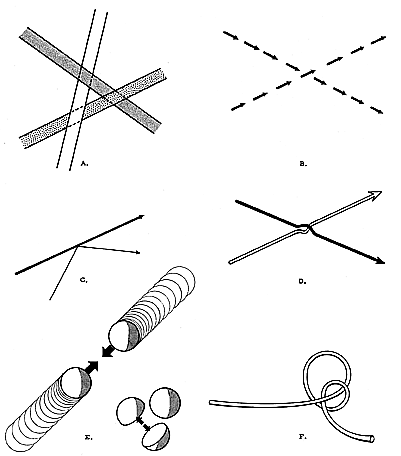
517.10 Six Interference Resultants
Fig. 517.10 Interference Phenomena
Fig. 517.10 Interference Phenomena: Lines Cannot Go Through the same Point at the Same Time: Interference phenomena: No two actions can go through the same point at the same time. The consequences of this can be pictured as follows:
Link to original
- Tangential avoidance (like knitting needles).
- Modulated noninterference.
- Reflection.
- Refraction.
- Smash-up.
- The minimum knot or critical proximity.
517.101
There are six fundamentally unique patterns of the resultants of interferences. The first is a tangential avoidance, like knitting needles slipping by one another. The second is modulated noninterference, as in frequency modulation. The third is reflection, which results from a relatively direct impact and a rebound at an acute angle. The fourth, which is refraction, results from a glancing impact and an obtuse angle of deflection. The fifth is a smash-up, which results in several parts of one or the other interfering bodies going away from one another in a plurality of angular directions (as in an explosion). The sixth is a going-the-same-way, “critical-proximity,” attraction link-up such as that established between the coordinated orbiting of Earth and Moon around the Sun.
517.11 Summary of Interference Phenomena
517.12
a. Tangential avoidance
b. Modulated noninterference (Frequency Modulation)
c. Reflection
d. Refraction
e. Smash-up (Explosion)
f. Critical Proximity (The Minimum Knot)
517.13
All three of these vectorial conditions and all six of these resultants are manifest in cloud chambers, in which the physicist can view with his naked eye the photographed resultants of angular directions and energy-magnitude lengths of the interference patternings that occur when, for instance, they bombard a group of atoms with an accelerated neutron that moves at such velocity as probably to interfere with one or another of billions times billions of atoms present in the elemental “gas” aggregation. From these cloud-chamber interference patterns, physicists are able to calculate much information regarding the interfering components. The cloud chamber makes it obvious that two lines, which are always experimentally proven to be energy vectors, cannot pass through the same point at the same time.
517.20 Tetrahedron of Interferences
517.201
A machine gun is shooting through a swiftly revolving airplane propeller. It is automatedly timed to shoot between every blade, or every second blade, or every third blade—with a sonic “wow” every time it goes between the propeller blades. We are synchronizing purposefully. Unautomated by human mind and brain’s anticipatory designing, bullets would produce a random sequence of patterns as they hit the propeller blades; some would at first bounce off precessionally, while others would knock off sections of the propeller blades.
517.21
Let us assume two machine guns firing from two different positions, one of them due north of a point in space and the other due west of the same point. One is aimed south and the other is aimed east, which means they are both firing through a common point in space. They are synchronized so that their bullets will not interfere with one another. The bullets all weigh the same. If they were nonsynchronized, they would frequently meet and be precessionally deflected.
517.22
Now place three machine guns at the three corners of an equilateral triangle. From the center of area (sometimes miscalled the center of gravity) of the equilateral triangle, one of the three corners lies in a bearing of 0° (i.e., 360°) in a northerly direction; the second bears at 120° ; the third at 240° from the triangle’s center. We then aim all three machine guns toward the center of the triangle and elevate their aim to 35° 16’. We synchronize their firing periods to coincide. We thus introduce an interference at the center of gravity of a regular tetrahedron whose triangular base corners are occupied by the three guns. Precession will take place, with the result that all three bullets precess into a vertical trajectory as a triangular formation team through the apex of the regular tetrahedron whose base corners are identified by the three guns.
517.23
Every action has an equal and opposing reaction. So now let us assume that instead of machine guns firing in one direction only, we have three bazookas in which both action and reaction are employed in two directions. The double-ended openness of the bazooka sees the rocket missile projected in one direction while a blast of air is articulated in an opposing conical zone of directions. The cone’s inertia provides the shove-off for the projectile by the explosion. Inertia is dynamic—as sensed in the orbital course integrity of the enormous mass of Earth going around the Sun at 60,000 m.p.h. so that the little man on board it, who is also going around the Sun at 60,000 m.p.h., and is also walking around Earth at four m.p.h. and as he steps around Earth’s surface he pushes Earth in the opposite direction to his walking, but so negligibly that the little man does not conceive of his Earth as movable and so has invented the concept of completely inert, or “at rest.” Our deceptive fixity of celestial position as a standing still in Universe is fortified by the absolute silence of travel in vacuo around the Sun.
517.24
Now we take two bazookas (not three!) firing in different parallel planes and not at the same level. One is aimed north-south in respect to the North Star and the Southern Cross. The other bazooka is in a parallel plane but remote; it is aiming east-west. They are fired, and at each of their two terminals, we get four precessional effects of the reactions and resultants occurring at 55 degrees in respect to their respective parallel planes. The result will be six vectors interacting to form the tetrahedron, a tetrahedron of interferences.